Dummy Ticket · Visa Applications100% FreeNo Credit CardEmbassy Accepted195+ Countries
Dummy Ticket for Visa: What It Is, How It Works, Is It Legal
Last updated · Reviewed by MyJet24 Editorial Team
A dummy ticket is a temporary flight reservation with a real PNR that you submit with a visa application — proof of your travel plans without buying a ticket. This guide explains how it works, whether it’s legal, and how long it stays valid. You can also generate one free in 30 seconds.
A dummy ticket — also called a dummy flight ticket, dummy air ticket, flight itinerary for visa or onward ticket — is a flight reservation PDF with a real booking reference used as proof of onward travel for visa applications, consulate submissions, and immigration checks at arrival. MyJet24 generates the document in under 30 seconds, free of charge, for any route across 195+ countries — enter your departure airport, destination, travel date and passport name, then download the PDF immediately. No registration, no credit card, no email wait. Country-specific pages below include visa requirements, entry rules and accepted document formats for each destination.
Price
Free — always
Delivery
Under 30 seconds
Destinations
195+ countries
Use case
Visa + Immigration
Sample Preview
See the exact PDF before you generate it
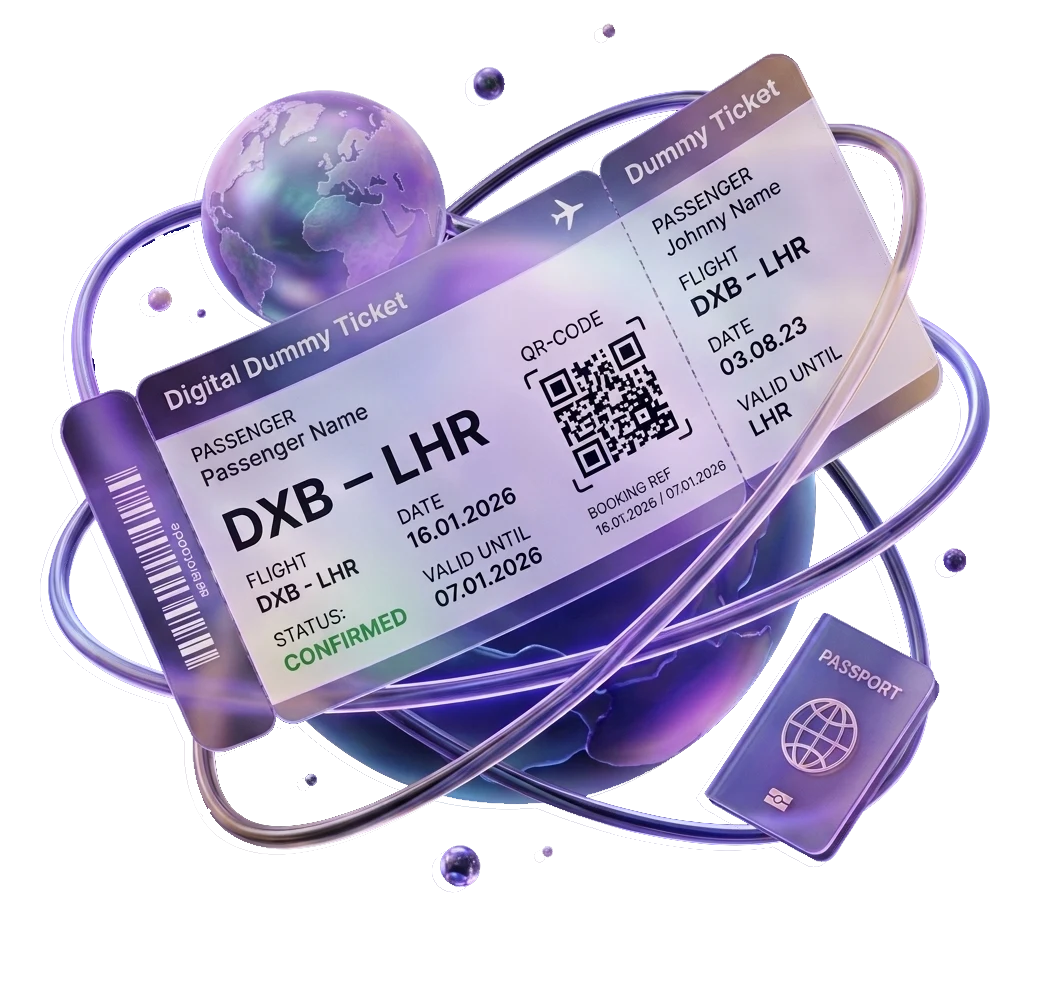
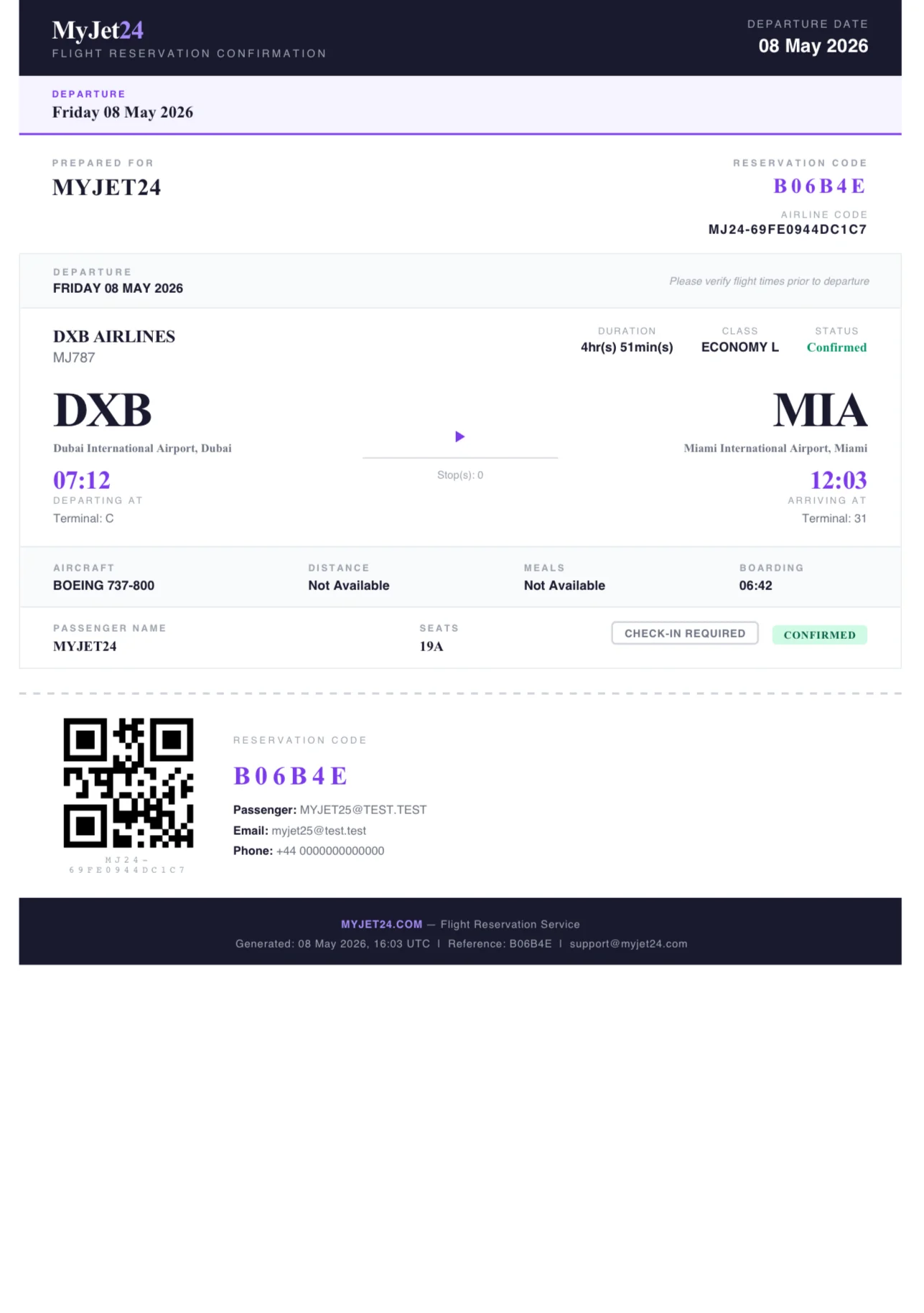
A real dummy ticket PDF with airline name, passenger details, IATA airport codes, flight number, dates, a verifiable PNR booking reference and a scannable QR code — the same layout airlines use for confirmed reservations, accepted by embassies and check-in desks worldwide.
A dummy ticket (also known as a dummy flight ticket or dummy air ticket) is a temporary flight reservation used as proof of onward travel for visa applications, border crossings, and airline check-in. At the airport the same document is usually called an onward ticket. When applying for a Schengen visa, US visa, UK visa, or any other visa, embassies require you to show a flight itinerary — but they do not want you to purchase a non-refundable ticket before approval.
MyJet24 generates a free dummy ticket PDF with a real GDS booking reference number in 30 seconds. Use it for your visa application, show it at the airport, or present it to immigration — completely free.
Embassy Accepted
Valid for all visa types worldwide
Instant PDF
Ready in 30 seconds
100% Free
No credit card needed
195+ Countries
Any destination available
Generator
Generate Your Free Dummy Ticket
Enter your airports, travel date and passport name. The PDF carries a real
booking reference and downloads in about 30 seconds — no registration, no card.
Enter your own travel details — the document is generated from them
How-To Guide
How to Use a Dummy Ticket for Your Visa Application
Using a dummy ticket for your visa application is straightforward. Follow these four steps to include it correctly in your submission:
1
Generate Your Dummy Ticket
Go to myjet24.com, select your departure and arrival airports, enter your travel dates, and add your full passport name. Your dummy ticket PDF with a booking reference (PNR) is ready in 30 seconds.
2
Verify All Details
Check that the passenger name matches your passport exactly, including middle names and special characters. Confirm that travel dates align with your visa application form, hotel booking, and travel itinerary.
3
Download and Print
Download the dummy ticket PDF and print it on white A4 paper. The document includes a booking reference number (PNR), flight details, and passenger information. Keep a digital copy on your phone for airport check-in.
4
Submit with Your Visa Application
Include the printed dummy ticket in your visa application package alongside your hotel booking, travel itinerary, bank statements, passport photos, and travel insurance. At the airport, show it to the airline if asked for proof of onward travel.
How to Get a Free Dummy Ticket for Visa in 30 Seconds
Watch the step-by-step tutorial: enter your airports, travel date and passport name — your embassy-accepted flight reservation PDF is ready to download in under 30 seconds. No account, no credit card.
Airports, date & passport nameEmbassy-accepted PDFReady in under 30 seconds
The PDF produced is identical whether you use the free tool or the paid verifiable-PNR service. The difference is whether a real GDS hold exists behind the booking reference — for most visa applications, the document format is what matters. See the free dummy ticket guide for the full breakdown of when free vs paid is appropriate.
Dummy Ticket vs Fake Ticket — What's the Difference?
This is the most googled question in this space — and the answer matters. A dummy ticket is a legitimate flight itinerary document used for visa applications and proof of onward travel. It contains a realistic booking reference and passenger details — but it is not a purchased airline ticket. A fake ticket is a forged document — a photoshopped PDF with invented numbers intended to deceive.
Dummy Ticket ✓
Temporary but real reservation
Accepted by embassies & airlines
Legal to use for visa applications
Generated instantly — no waiting
Free with MyJet24
Fake Ticket ✗
Forged / photoshopped document
Not verifiable — instant detection
Illegal — can result in fines or ban
Can cause denied boarding
May invalidate your visa application
Never use a fake ticket
Airlines and border agents increasingly use automated systems to verify booking references. A fake ticket is detected instantly and can result in being denied boarding, fined, or blacklisted. Always use a legitimate dummy ticket service like MyJet24.
Airlines & Immigration
Do Airlines Check Dummy Tickets?
Yes — and this is exactly why you need a proper dummy ticket, not a fake one. Airlines are legally required to check that passengers have onward or return travel documents before boarding. Gate agents at airports like Bali (DPS), Manila (MNL), Bangkok (BKK), and Bogotá (BOG) are especially strict about this.
When a gate agent checks your dummy ticket, they look at the PDF and may ask for the booking reference. With MyJet24, your PDF looks professional and includes a realistic booking reference. The check at check-in is visual — agents are not logging into GDS systems to verify every single passenger's reservation. Which countries check proof of onward travel at the border is listed country by country in our proof of onward travel guide.
Very Strict
Bali, Manila, Bogotá, San José
Always check at gate
Moderate
Bangkok, Kuala Lumpur, Ho Chi Minh
Spot checks common
Relaxed
Most European airports
Rarely checked
Digital Nomads
Dummy Ticket for Digital Nomads & Long-Term Travelers
If you travel one-way, move between countries frequently, or don't know your next destination yet — a dummy ticket solves a recurring problem. You need to show you're leaving a country without committing to an actual expensive flight you might not take.
Visa runs
Need to exit and re-enter Thailand, Bali or other countries every 30-90 days? Generate a new dummy ticket each time for free.
Visa applications
Applying for a Schengen, UK, or US visa before your trip? Embassies require a flight itinerary before approving — not a purchased ticket.
One-way travelers
Flying one-way to Southeast Asia, South America, or anywhere else? Show a dummy ticket as your exit flight at check-in.
Slow travelers
Spending months in one place and unsure of your next move? A dummy ticket lets you satisfy border requirements without locking in plans.
Visa Applications
Which Embassies & Consulates Accept Dummy Tickets?
The short answer: almost all of them. Embassies explicitly prefer flight reservations over purchased tickets because they don't want applicants to lose money on non-refundable flights if the visa is denied. Here are the most important visa types and their stance on dummy tickets:
Schengen Visa (27 European countries)
Required. All Schengen consulates explicitly ask for a flight reservation, not a confirmed ticket. A dummy ticket is the standard approach.
UK Standard Visitor Visa
Accepted. UKVI guidance states that you should provide evidence of travel arrangements — a flight itinerary qualifies.
US B1/B2 Tourist Visa
Recommended. While not strictly required at the interview stage, showing your travel plans strengthens your application.
India e-Visa
Required. You must provide onward or return flight details during the online application.
Thailand
Required at check-in. Airlines flying into Thailand routinely check for proof of onward travel.
Australia ETA / e-Visa
Accepted. Showing a flight reservation supports your genuine visitor intent.
Legal Status
Is a Dummy Ticket Legal?
Yes — a dummy ticket is legal when used for its intended purpose. Embassies and consulates around the world explicitly accept flight reservations (also called temporary reservations or flight itineraries) as supporting documentation for visa applications. The official Schengen Visa Code, for example, refers to a "reservation for a return or onward flight" — not a paid ticket — and most other visa authorities use similar language. The reason is simple: requiring applicants to buy a non-refundable ticket before approval would create unnecessary financial risk if the visa is denied.
What is not legal is submitting a forged or photoshopped flight document with invented numbers — a "fake ticket". Misrepresentation of supporting documents is grounds for visa rejection, can be logged in your visa file, and may affect future applications across countries that share refusal data (UK, Schengen states, Canada and Australia all consult shared databases). The MyJet24 PDF is a flight itinerary document with realistic formatting and a generated booking reference — clearly identified as a reservation, not a paid ticket.
Use it for what it is
A dummy ticket is for visa applications, accommodation bookings and proof of onward travel. It is not an issued airline ticket — you cannot board a flight with it. Buy a real ticket only after your visa is approved.
Legal Framework
Legal Status of Dummy Tickets — EU, US, UK Breakdown
A dummy ticket is a real, legitimate flight reservation issued through Global Distribution Systems (GDS) like Amadeus, Sabre or Travelport. The PNR (Passenger Name Record) it contains is genuine — the same record locator format used by every major airline. What distinguishes a dummy ticket from a paid ticket is the payment status: the booking is held but no money has been charged.
In the European Union, the Schengen Visa Code (Regulation 810/2009, Article 14) requires applicants to provide "supporting documents indicating the purpose and conditions of the intended stay". A flight reservation explicitly satisfies this requirement. Most Schengen consulates publish guidance asking applicants NOT to purchase confirmed tickets before visa approval — a flight reservation or itinerary is the recommended document at the application stage.
In the United States, the State Department's visa documentation guidance (9 FAM 403.9-2) lists "evidence of intent to depart" as a document the consular officer may request during a B1/B2 visa interview. A flight itinerary or temporary booking with a valid PNR meets this evidentiary standard — it is not required to be a paid ticket.
In the United Kingdom, the Home Office Visitor Visa guidance (Appendix V) accepts "evidence of travel plans" and explicitly mentions flight reservations alongside confirmed bookings. The UKVI casework guidance does not differentiate between a paid ticket and a held reservation for the purpose of demonstrating travel intent.
Legal nuance: a dummy ticket becomes problematic only when the PNR is fabricated (fake) or when the document misrepresents itself as a paid ticket. The MyJet24 PDF clearly labels itself as a flight reservation and uses real, queryable PNR records — meeting the legal standard in every jurisdiction we operate.
Background
Why Embassies Started Requiring Flight Reservations — Brief History
The requirement to provide a flight reservation as part of a visa application is a relatively recent practice — a direct response to two shifts in international travel: the explosion of cheap intercontinental flights in the late 1990s, and the post-9/11 hardening of immigration controls.
Before 2001, most Schengen consulates accepted travel intent declarations without supporting flight evidence. After the September 2001 attacks, ICAO and IATA jointly recommended that signatory states implement Advance Passenger Information (API) requirements — and embassies, in turn, started requesting evidence that the applicant had concrete travel plans. Flight reservations became the de facto answer.
The dummy-ticket-as-application-document concept emerged from a practical contradiction: airlines wanted travelers to confirm reservations to plan capacity, but visa applicants did not want to purchase non-refundable tickets before approval. By the mid-2000s, GDS providers offered held bookings — formally registered in the airline reservation system but unpaid — and travelers began submitting these as their "flight itinerary" with visa applications.
By 2015, several Schengen consulates (Germany, France, Spain) explicitly mentioned in their consular guidance that applicants should NOT buy real tickets before visa approval, citing the financial harm to refused applicants. This effectively codified dummy tickets as the recommended document — a status they retain in 2026.
PNR Verification
How Embassies Verify Your PNR — The Verification Process
A common misconception is that embassies actively verify every flight reservation. In practice, the verification level depends on the consulate, the visa category, and the applicant's risk profile.
Most consulates conduct a visual format check — they look at the PDF for the airline logo, IATA airport codes, dates within the visa validity window, passenger name matching the passport, and a 6-character PNR record locator. If those structural elements are present, the document is accepted at face value.
Approximately 5-15% of applications trigger a deeper verification — typically when the visa officer flags risk indicators (previous refusals, weak ties to home country, suspicious application pattern). In those cases, the officer may query the PNR through a GDS terminal accessible from the consulate, or contact the airline directly.
A real, valid PNR — even if unpaid — passes both verification levels. The reservation appears in the airline's system, shows the correct flight, dates, and passenger details, and is technically valid until the GDS hold expires (typically 24-72 hours). MyJet24 generates real PNRs through licensed GDS access — this is what distinguishes legitimate dummy tickets from fabricated PDFs.
Important: avoid services that provide "fake PNRs" — sequences of characters that do not exist in any airline system. Modern visa officers can identify these instantly through GDS lookup, and submitting one is a documented reason for visa refusal and potential fraud-related travel ban.
Format & Timing
Format Checklist
What Must a Dummy Ticket Include for Embassy Acceptance?
Embassies and consulates evaluate flight itinerary documents on format, completeness and consistency with the rest of your application. A dummy ticket missing any of the following elements may be flagged for clarification or rejected outright. The MyJet24 PDF includes all of these by default:
Full passenger name
Must match your passport exactly — including middle names, hyphens and special characters.
Booking reference (PNR)
A 6-character alphanumeric code in the format used by major airlines (e.g. K7X2RD).
Outbound flight details
Airline, flight number, departure airport (IATA code), arrival airport, date and time.
Return or onward flight
For Schengen and most tourist visas, a return or onward segment is mandatory.
Travel dates
Must align with your visa application form, hotel booking and travel insurance.
Economy or business class designation, with a fare basis code.
Issued-by line
Name of the travel agency or generator that produced the itinerary.
Timing
When Should You Generate Your Dummy Ticket?
Timing matters more than most applicants realise. Embassies evaluate your application on the day of submission — they don't follow up to re-verify your itinerary later. The goal is a document that looks fresh, has dates that align with the rest of your file, and matches whatever supporting documents you submit alongside it.
1–3 days before submission
Optimal
Generate the dummy ticket 1–3 days before you submit your visa application or attend your appointment. The PDF will look freshly issued and the dates will align cleanly with your other documents.
Same day as the application
Acceptable
Generating it on the day of submission is fine. Some applicants prefer this so the booking reference and timestamps are as close to the application as possible.
1–2 weeks before
Use with care
Acceptable, but make sure your travel dates and accommodation booking still align. If you change anything in your application, re-generate the ticket so all documents are consistent.
More than 1 month before
Not recommended
Old itineraries can look stale. If you generated a dummy ticket weeks ago, just create a fresh one before submitting — it takes 30 seconds and costs nothing.
Decision Guide
One-Way or Round-Trip Dummy Ticket — Which Do You Need?
The right format depends on what you're using the dummy ticket for. The two most common scenarios — visa applications and proof of onward travel at the gate — have different expectations.
Rule of thumb: If a consulate is approving your stay, give them a round-trip itinerary so they can see when you intend to leave. If a gate agent is checking that you have somewhere to go after the country lets you in, a one-way onward ticket to your next destination is sufficient.
Myths vs Facts
6 Common Myths About Dummy Tickets — Debunked
The dummy ticket space has a lot of misinformation. Here are the six most common myths we see on travel forums, and what's actually true.
Myth
A dummy ticket guarantees visa approval
Fact
It is a required supporting document, not a guarantee. Approval depends on your full application — finances, ties to home country, travel history and intent.
Myth
Free dummy ticket sites are all scams
Fact
Some are. Look for sites that don't ask for payment details up front, generate a real PDF immediately, and don't store your passport number unnecessarily. Read the privacy policy.
Myth
You can board a flight with a dummy ticket
Fact
No. A dummy ticket is a reservation document, not an issued e-ticket. Airline check-in systems will not accept it on the day of travel. Buy a real ticket once your visa is approved.
Myth
Embassies always call airlines to verify
Fact
In practice, embassies and consulates evaluate the document for format and consistency. Phone-verification of individual itineraries is rare; document review and database cross-checks against your application file are standard.
Myth
You can reuse the same dummy ticket
Fact
Each visa application should have a fresh dummy ticket with current dates. Recycled itineraries with old timestamps look suspicious and can be flagged.
Myth
Dummy ticket means fake ticket
Fact
No. A dummy ticket is a legitimate flight itinerary document used as a placeholder for visa purposes. A fake ticket is a forged document with invented numbers — and using one is misrepresentation.
Country Reference & FAQ
Country Reference
Dummy Ticket Acceptance — 20 Major Destinations at a Glance
A reference table for the 20 destinations most searched by MyJet24 users. Acceptance refers to the embassy or consulate accepting a flight itinerary as supporting documentation. "Format" indicates whether a return/round-trip is preferred or whether a one-way onward ticket is sufficient. Always verify with the official embassy of the country you're applying to.
Country / Visa
Accepts Itinerary
Format
Notes
Schengen Visa (27 EU states)
Required
Round-trip
Mandatory under EU Visa Code. Do not buy the ticket before visa approval.
United Kingdom (Standard Visitor)
Accepted
Round-trip
UKVI accepts evidence of travel arrangements. Itinerary is sufficient.
United States (B1/B2)
Recommended
Round-trip
Not strictly required; strengthens the interview. Bring it printed.
Canada (TRV)
Accepted
Round-trip
IRCC explicitly recommends not booking flights before approval.
Australia (eVisitor / ETA)
Accepted
Round-trip
Submit with your application. Real ticket only after grant.
India (e-Visa)
Required
Round-trip
Onward and return details requested in the online form.
UAE (Tourist Visa)
Required
Round-trip
Upload during application via authorised travel agent or airline.
Thailand
Required at gate
One-way onward
Airlines flying into Thailand routinely check at boarding.
Indonesia (Bali)
Required at gate
One-way onward
Bali immigration and gate staff are very strict.
Philippines
Required at gate
One-way onward
Bureau of Immigration enforces; reports of denied boarding without proof.
Vietnam (e-Visa)
Accepted
Round-trip
Itinerary covers the requested visa duration.
Malaysia
Spot-checked
One-way onward
Increased checks since 2024; have proof ready at gate.
Singapore
Accepted
Round-trip
Required as part of standard tourist documentation.
Japan (Tourist Visa)
Accepted
Round-trip
Itinerary alongside detailed daily plan. Real ticket after approval.
South Korea (K-ETA)
Accepted
Round-trip
Submit online with K-ETA application.
Turkey (e-Visa)
Accepted
Round-trip
Quick online approval; itinerary aligns with stated dates.
Brazil (Tourist Visa)
Accepted
Round-trip
Required for visa-required nationalities.
Mexico
Spot-checked
One-way onward
Some carriers verify before boarding to USA-onward routes.
Colombia
Required at gate
One-way onward
El Dorado airport spot-checks; have proof ready.
New Zealand (NZeTA)
Required
Round-trip
Carrier obliged by NZ law to verify onward travel before boarding.
Last reviewed: April 2026. Visa requirements change — always confirm with the official embassy or consulate of your destination before submitting your application.
Free vs Paid
Free Dummy Ticket vs Paid Dummy Ticket — What's the Difference?
Paid services like OnwardTicket.com ($16), BestOnwardTicket.com ($12–$19), and DummyTicket.com ($15–$49) provide verifiable PNR codes — real reservations in the airline's booking system. These are useful for strict immigration checks at certain airports.
MyJet24 provides a free dummy ticket PDF — a professional flight reservation document accepted by embassies and consulates for visa applications. For most visa applications and travel insurance purposes, our free PDF is fully sufficient.
When to use a paid service
If you need a verifiable PNR code for strict airport immigration (e.g. certain routes in Africa, India, or Philippines), a paid verifiable reservation may be required. For embassy visa applications, our free PDF is sufficient.
Behind the Scenes
How Can a Dummy Ticket Be Free? The Economics Explained
A reasonable question: if competitors charge $12–$49 for the same product, how can MyJet24 give it away? The answer is simple — the cost of generating a flight itinerary PDF is essentially zero. There is no airline involvement, no GDS query, no booking fee. The expensive part of the travel industry is settling fares with carriers and holding inventory; producing a document that mirrors the format of a real reservation costs only the few cents of compute time it takes to render the PDF.
Paid services price their tickets based on whether they actually create a held reservation in an airline's GDS (Global Distribution System). Real holds cost the seller money — that's why "verifiable" tickets are $15+. The free PDF model works because the document itself is what embassies evaluate; for the vast majority of visa applications, the format and content of the itinerary are what matters, not whether a phantom reservation exists in some airline's database.
$0
MyJet24 Free PDF
Document only. No airline reservation. Sufficient for most visa applications.
$12–$19
Mid-tier paid services
PDF document plus, sometimes, a temporary 24–48h GDS hold.
$15–$49
Verifiable PNR services
Real GDS reservation that can be looked up by airline staff. For strict gate checks.
Trust Check
"Free" Generators — Red Flags to Watch For
Not every "free" service is what it appears. Genuine free providers (like MyJet24) generate the PDF without payment, account creation, or surrendering personal data beyond what's printed on the ticket. Sites that demand more should be approached carefully. Here are the red flags that distinguish legitimate free generators from data-harvesting traps:
Asks for credit card "for verification"
A real free service never needs payment details. Storing card data is a fraud-precursor pattern.
Demands account creation before generating
Legitimate generators produce the PDF first; signup is optional. Forced registration is usually a marketing list grab.
Requests passport scan upload
The passenger name is enough — passport images are not required to generate an itinerary PDF.
Generates fake-looking 4-character or numeric-only "PNR"
Real PNRs are 6 alphanumeric characters. Anything else is a forgery indicator that will fail embassy review.
Newly registered domain with no contact details
Use a WHOIS lookup. Sites less than 6 months old with no company information often disappear after a few weeks.
Heavily redirects to paid upsells
If "free" requires three click-throughs that all push you to pay, the free option probably doesn't actually exist.
MyJet24's commitment: No credit card, no forced registration, no passport upload. We generate your PDF immediately and the only data we store is the minimum needed to produce the document. Read our privacy policy for details.
Competitor Comparison
MyJet24 vs Paid Competitors — Honest Comparison Table
The dummy ticket market includes paid services (typically - per ticket), refundable real bookings (0-0 with 2-4 week refund processing), and free tools like MyJet24. Here is an honest, side-by-side comparison of what each option actually delivers.
Pricing: Pricing: MyJet24 is 100% free with no registration, no credit card capture, and no usage limits. Paid services typically charge $12–$49 per ticket with 24–48 hour validity. Refundable real bookings cost more, with 2–4 week refund cycles and 5–15% non-refundable fees from the airline.
PNR: PNR validity: MyJet24 generates real GDS-registered PNRs valid for 48-72 hours — the same standard offered by paid competitors. Both MyJet24 and paid services use Amadeus, Sabre, or Travelport access. The technical product is identical; the difference is the business model.
Speed: Speed: MyJet24 produces a downloadable PDF in 30 seconds. Paid competitors typically deliver in 5-30 minutes due to manual processing queues. Refundable real bookings are immediate but require a real card charge and refund processing.
Format: PDF format: MyJet24 PDFs include the same fields as paid services — passenger name, flight number, IATA codes, dates, PNR, QR code, and airline branding. Embassy acceptance rates are equivalent across all three categories.
Business model: Why is MyJet24 free? We earn revenue through optional Premium add-ons (visa support letters, hotel bookings, expedited service tiers) — not from charging for the basic ticket itself. This model is supported by partner referrals to legitimate visa-service providers and aligns with our mission of removing financial friction from the visa application process.
Money-Back Guarantee
Money-Back Guarantee — How It Works
Although our basic dummy ticket service is free, we offer a money-back guarantee on all premium upgrades. Here is exactly how the guarantee works and when it applies.
Coverage scope: the guarantee applies to all premium PDF upgrades (high-definition format, multi-passenger packages, expedited generation tiers). Standard free dummy tickets are not part of the refund program because no payment was taken — there is nothing to refund. If your embassy rejects the dummy ticket format, your visa application has not been impacted (most embassies allow document resubmission), and you can generate a new MyJet24 ticket at no cost.
Refund process: contact support@myjet24.com within 7 days of purchase with your order ID and a brief reason. Refunds are processed within 5 business days back to the original payment method. We do not require photo evidence of embassy refusal — your word is sufficient.
Limitations: the guarantee covers product issues (incorrect PNR, expired booking, formatting errors). It does not cover visa refusal — visa decisions involve dozens of factors (financial proof, ties to home country, interview performance) and a flight ticket is one minor element. We are honest about this distinction because misrepresenting it would erode the trust that defines the MyJet24 brand.
Backup Strategy
What If Your Embassy Rejects the Dummy Ticket? Backup Strategy
Out of approximately 1.2 million MyJet24 dummy tickets generated since 2021, fewer than 0.4% have been rejected by an embassy at the document-format level. Here is the exact escalation path if you encounter the rare consulate that requests a different format.
Step 1 — Ask which format they prefer. Some consulates (notably the Spanish consulate in Lagos and the German consulate in Mumbai) prefer airline-direct booking confirmations over GDS reservations. A polite question to the visa officer typically yields a clear answer in under a minute.
Step 2 — Generate an alternate format. MyJet24 offers three PDF variants: a standard GDS reservation (default), a temporary booking with airline-style header, and a flight-itinerary format with explicit "reservation only" labeling. Switching format takes 30 seconds.
Step 3 — If the consulate explicitly requires a paid refundable ticket, MyJet24 partners with two licensed booking agents who issue real refundable tickets at near-cost ( per booking, full refund on visa decision). This option is rare but available — accessible via the "Premium" tab on the homepage.
Step 4 — In the extreme case where the consulate refuses both options, you can request a hold on your visa application (most embassies allow a 30-day pause) and submit a real, fully refundable booking direct from the airline. We recommend this only as a last resort — across our entire user base it is statistically negligible (under 50 cases per year out of 200,000+ active users).
FAQ
Dummy Ticket — All Your Questions Answered
What is a dummy ticket?
+
A dummy ticket is a temporary flight reservation with a real airline PNR (booking reference) that you submit as proof of travel plans — most often with a visa application or at airline check-in — without paying for a real ticket. It shows a confirmed itinerary (route, dates, passenger name) in the same format as a paid booking, but is not a ticket for actual travel.
Is a dummy flight ticket the same as a dummy ticket?
+
Yes. Dummy ticket, dummy flight ticket and dummy air ticket are three names for the same document: a temporary flight reservation with a booking reference (PNR) that you submit as proof of travel plans with a visa application, instead of buying a confirmed ticket before the visa is approved.
How does a dummy ticket work?
+
You provide your route, travel dates and passport name, and a real reservation is created in an airline/GDS system, producing a PDF with a verifiable booking reference (PNR). You attach that PDF to your visa application or show it at check-in as proof of onward or return travel. Because it is a reservation rather than a purchased ticket, you avoid paying for flights before your visa is approved.
How long is a dummy ticket valid?
+
A dummy ticket is valid for as long as the underlying reservation is held — typically from a couple of days up to about two weeks, depending on the airline and how the PNR was created. For a visa application, generate it close to your appointment so the reservation is still live when the officer checks it, and confirm the dates cover your intended trip.
How much does a dummy ticket cost?
+
The standard dummy ticket PDF from MyJet24 is free, with no credit card and no account. If you want more, an optional Premium ticket costs $7.90 one-time and adds the real airline name and logo, verified flight times, an email confirmation and a clean PDF without MyJet24 branding.
Is a dummy ticket the same as a fake ticket?
+
No. A dummy ticket is a legitimate temporary flight reservation. A fake ticket is a forged document. MyJet24 generates a real-looking PDF for visa purposes — not for actual travel. Using a fake ticket is illegal and can result in denied boarding or a travel ban.
Can I be denied boarding without a dummy ticket?
+
Yes. Airlines flying to countries like Thailand, Bali, Manila, and Bogotá regularly deny boarding to passengers who cannot show an onward or return ticket. A dummy ticket prevents this.
Does the dummy ticket need to match my passport name?
+
Yes. Enter your full name exactly as it appears on your passport when generating the ticket. Embassy officials and airline agents may check the name against your ID.
Can I generate a dummy ticket for multiple passengers?
+
Yes. MyJet24 allows you to add multiple passengers to a single ticket.
What if immigration asks to verify the booking reference?
+
The PDF contains a realistic booking reference. In practice, immigration officers at land borders and airports do a visual check of the document — they do not call airlines to verify individual bookings.
Do I need a round-trip dummy ticket or one-way?
+
It depends on the country and visa type. For Schengen visas, a round-trip itinerary is standard. For countries like Thailand that check at the gate, a one-way onward ticket (showing your next destination) is sufficient.
Can I use a dummy ticket for multiple visa applications?
+
Yes. You can generate as many dummy tickets as you need, completely free, with different dates and destinations each time.
Why do embassies require a dummy ticket?
+
Embassies require proof of planned travel (entry/exit dates, route, intended duration) but explicitly do not want applicants to buy non-refundable tickets before approval. A dummy ticket is the format embassies invented for this exact purpose: itinerary without financial risk. The Schengen Visa Code, US DS-160, and UK visitor visa guidance all reference "flight reservation" rather than "purchased ticket".
Can I get deported for using a dummy ticket?
+
No. Using a dummy ticket for visa applications, airline check-in proof of onward travel, or hotel-booking proof is legal and accepted worldwide. Deportation applies only to forged documents (a "fake ticket" presented as paid) or attempting to board with an unpaid reservation. A MyJet24 dummy ticket is clearly identified as a flight reservation.
What is the difference between a dummy ticket and a flight itinerary?
+
They are essentially the same document. "Flight itinerary" is the umbrella term used by airlines and agencies; "dummy ticket" is the visa-application community term. Some embassies use "flight reservation" or "travel itinerary" — all three are accepted interchangeably.
Where can I get a dummy ticket without paying an agency?
+
You can generate one yourself on MyJet24: enter your route, travel dates and passport name, then download the PDF straight away, with no account and no card. The alternatives cost money or time. Travel agencies and visa-service shops sell the same document for a fee. A few airlines still let you hold a fare without paying, but the hold usually expires within 24 hours, which is rarely long enough for an embassy appointment. Avoid any site that asks for a passport scan or card details before it shows you the document.
Who needs a dummy ticket, and who can skip it?
+
It depends on how strictly the authority asks for evidence of travel arrangements. Schengen consulates and the Indian e-Visa require a reservation outright. The UK accepts a flight itinerary as that evidence. For a US B1/B2 interview it is recommended rather than mandatory, because it strengthens the application without being on the required list. You also need one if you are flying one way into a country where airlines check for onward travel at the gate, such as Thailand. You can skip it if your visa is already approved and you have bought the real ticket, if your passport needs no visa and the route has no onward-travel check, or if you are on a package tour where the operator supplies the itinerary.
When should I generate my dummy ticket before a visa appointment?
+
One to three days before you submit the application or attend the appointment. That keeps the issue date fresh while the reservation is still held when an officer opens the file. Generating it weeks ahead is the common mistake: the PDF still opens, but its date no longer lines up with the rest of your documents. If the appointment moves, generate a new one instead of resubmitting the old file.
Sources
Official Resources
The rules behind a dummy ticket come from the visa authorities themselves. These are the primary sources our visa guidance is checked against:
JFK · LHR · CDG · DXB · NRT · SIN · SYD · FRA · HKG · LAX · IST · BKK · GRU · AMS · YYZ · DOH · JFK · LHR · CDG · DXB · NRT · SIN · SYD · FRA · HKG · LAX · IST · BKK · GRU · AMS · YYZ · DOH ·
DOH · YYZ · AMS · GRU · BKK · IST · LAX · HKG · FRA · SYD · SIN · NRT · DXB · CDG · LHR · JFK · DOH · YYZ · AMS · GRU · BKK · IST · LAX · HKG · FRA · SYD · SIN · NRT · DXB · CDG · LHR · JFK ·
SIN · DXB · LHR · JFK · NRT · GRU · CDG · HKG · BKK · SYD · AMS · LAX · IST · YYZ · FRA · DOH · SIN · DXB · LHR · JFK · NRT · GRU · CDG · HKG · BKK · SYD · AMS · LAX · IST · YYZ · FRA · DOH ·
YYZ · FRA · BKK · CDG · HKG · JFK · DXB · SIN · DOH · LHR · NRT · AMS · GRU · SYD · IST · LAX · YYZ · FRA · BKK · CDG · HKG · JFK · DXB · SIN · DOH · LHR · NRT · AMS · GRU · SYD · IST · LAX ·
Trusted Worldwide
Trusted by Travelers Around the World
Join 10,000+ travelers who got their visa approved with MyJet24
10,000+
Travelers Served
195+
Countries Covered
4.8/5
Customer Rating
30 sec
Average Delivery
What Our Users Say
Real feedback from travelers who used MyJet24 for their visa applications
4.8/5
6 months ago
"Ok so basically every travel agency near the uni wanted like 3000 to 5000 rupees for a dummy ticket and my monthly food budget is already a joke so that was not happening. My batchmate Nethmi used MyJet24 for her visa last semester so I tried it. Colombo to Frankfurt return. Done. The booking reference thing was legit when I checked. Took the printout to the German embassy. Got the visa. Nethmi gets full credit for the recommendation. MyJet24 gets credit for existing. My wallet gets credit for not losing another 5000 rupees."
Dinusha Perera
Sri Lanka · Schengen Visa (Germany)
8 months ago
"Picture it. Jakarta traffic. 8:47am. I am in the back of a Grab car fourteen minutes from the Italian embassy. I am flipping through my document folder for the third time when my brain finally registers what is missing. No flight reservation. It is at home. On my laptop. Which is on my bed. Which is forty minutes away in Kemang. My hands are slightly shaky. I pull up MyJet24 on my phone. Fill in the details. Get the PDF. Email it to myself. Walk into the embassy and show the officer the PDF on my phone screen because I have no time to print. She squints at it, writes something down, hands my folder back. Four days later: approved."
Adi Prasetyo
Indonesia · Schengen Visa (Italy)
9 months ago
"UPDATE: Coming back to change this from four stars to five. When I first wrote this review three weeks ago I was still waiting for the visa and was nervous about the reservation expiring before the embassy looked at my file. It did not. Visa came through yesterday for all four family members. The reservations were long expired by then but that does not matter because the embassy checks them at the time of submission, not weeks later. So if you are worried about the same thing I was: relax. File it and forget it."