Free Dummy Ticket for United States of America — Visa Application 2026
Last updated · Reviewed by Marc Hoffmann, MyJet24
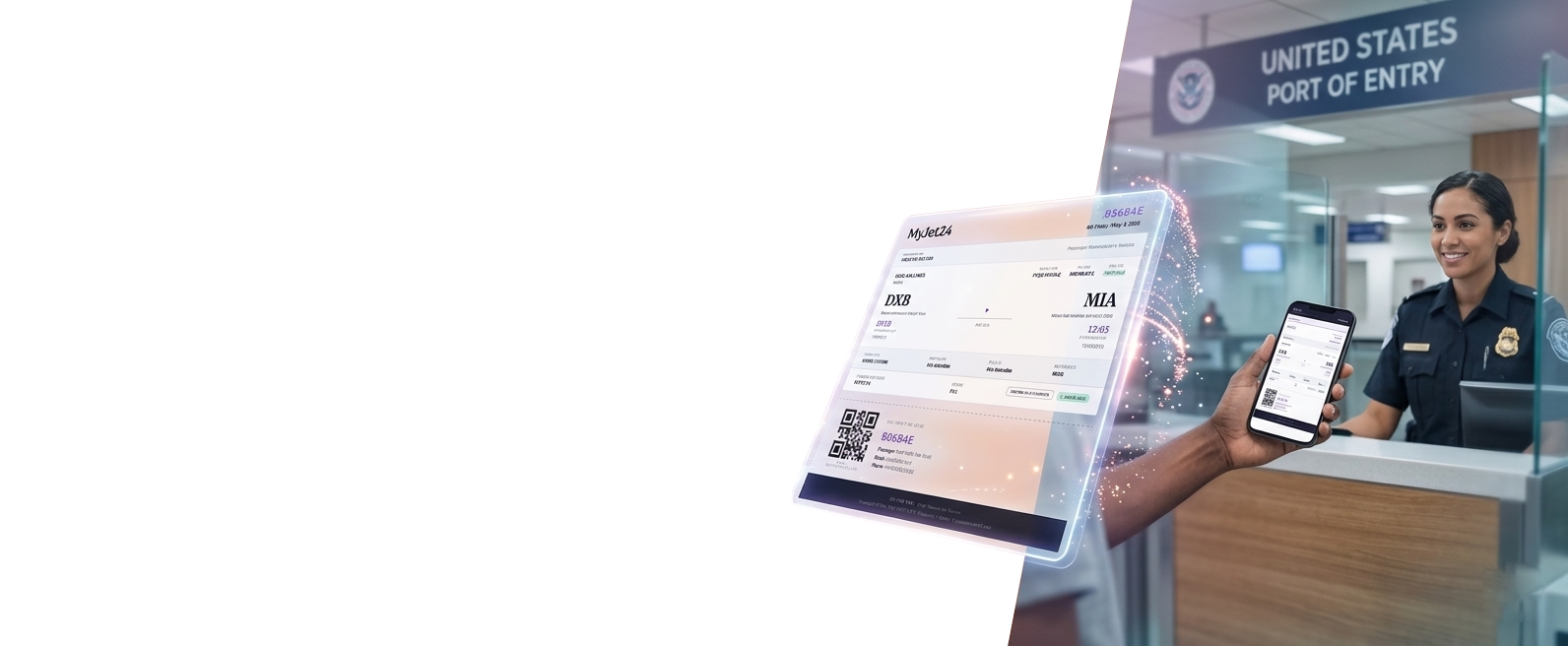
A dummy ticket for United States of America is a flight reservation PDF used to prove you have return travel planned when applying for your United States of America visa or entering at the border. United States of America embassies and consulates require this document — but won't accept a non-refundable ticket purchase before visa approval. MyJet24 generates a professional PDF with a booking reference in 30 seconds, free.
A dummy ticket for the United States is a flight reservation for your visa application, made before you pay for a real ticket. Every US visa application starts with the DS-160 at ceac.state.gov, whose barcoded confirmation page is mandatory at the embassy interview; name mismatches and wrong intended dates are among the most common technical refusals. MyJet24 generates that reservation as a PDF in about 30 seconds.
Validity
48 hours
Price
Free
Delivery
under 5 minutes
Visa type
Esta
Visa-Embassy Focus
A dummy ticket for United States of America is the document you submit to the embassy or VFS centre with your visa application. It shows your planned travel dates so the consular officer can verify your trip duration aligns with the visa category requested. This page focuses on the embassy-submission requirements, processing-time considerations, and visa-fee context for United States of America.
What United States of America Embassy Officers Look For on Your Dummy Ticket
The United States of America embassy reviewer wants: (1) full passenger name matching your passport application, (2) flight dates that fall WITHIN the visa-validity window you requested, (3) a round-trip itinerary if your visa category is short-stay, (4) a real-format PNR / booking reference, and (5) IATA-code airports rather than city names alone. Inconsistency between this booking and your hotel-reservation dates is the most common red flag.
United States of America Visa Processing Time and Documentation Checklist
For United States of America visa applications, the dummy ticket is one document among several (visa form, photos, financial proof, hotel booking, travel insurance). Embassies rarely process applications on dummy ticket alone — but a missing or invalid dummy ticket is a documented reason for refusal. Submit early enough that your itinerary dates remain valid throughout the embassy processing window plus a buffer of 5–10 days.
Guide
What is a Dummy Ticket for United States of America?
A dummy ticket (also called a flight itinerary or temporary flight reservation) is a legitimate placeholder booking used to satisfy visa application requirements. When applying for your United States of America visa, embassies ask for proof that you have onward or return travel planned — but they don't want you to buy a non-refundable ticket before approval.
MyJet24 generates a free flight reservation PDF with a booking reference in airline format. You can use it for your visa application, present it to immigration, or show it at check-in as proof of onward travel.
Embassy Accepted
For United States of America visa applications
Instant PDF
Ready in 30 seconds
100% Free
No credit card needed
Valid Worldwide
All airlines & borders
Visa Requirements
United States of America Visa & Entry Info
Visa Type
ESTA
Stay Limit
90 days (ESTA)
Currency
US Dollar (USD)
Capital
Washington D.C.
Language
English
Region
Americas
Entry Note for United States of America
ESTA required for Visa Waiver Program countries. US visa applications (B1/B2) require flight itinerary. US embassies review your travel plans during the visa interview. A flight itinerary showing your intended entry and departure dates strengthens your application.
Step by Step
How to attach a flight reservation to your United States of America visa application
1
Generate your dummy ticket
Click the button above and fill in your travel details. Your free flight itinerary PDF is ready in 30 seconds.
2
Include it in your visa application
Add the PDF to your United States of America visa documents. Embassies accept flight reservations — not purchased tickets.
3
Show at check-in if needed
Some airlines ask for proof of onward travel. Show your dummy ticket PDF at the gate.
4
Book your real flight after approval
Once your visa is approved, book your actual flight with any airline.
Ticket Options
Free or Premium — Which Version for Your United States of America Application?
Both are accepted by United States of America embassies. Premium looks more professional to the embassy reviewers and avoids follow-up questions.
Free
$0
✓
Instant PDF
✓
PNR / booking ref
✓
QR code
✓
6,000+ airports
✗
MyJet24 branding
✗
Generic airline name
✗
No email confirm
Most Realistic
Premium
$7.90 one-time
Instant PDF
PNR / booking ref
QR code
6,000+ airports
Real airline name & logo
Verified flight times
Email confirmation
About half the price of paid competitors — most charge $14–$16. You pay $7.90.
DS-160 Complete Walkthrough — Every Section, Every Field
The DS-160 (Online Nonimmigrant Visa Application) is the foundation of every US visa application. Filed at ceac.state.gov/genniv, it captures 18 sections of biographical, travel, and security data. The barcoded confirmation page is mandatory at every US embassy interview worldwide. Errors on the DS-160 cause the most common technical refusals — name mismatches, wrong intended dates, missing prior visa history. The walkthrough below covers every section in order.
The 18 DS-160 Sections
Section
Content
Common Pitfall
1. Personal 1
Full name, passport name, date/place of birth
Surname/given name swap (especially India/China)
2. Personal 2
Nationality, other nationalities, national identification
Forgetting dual nationality declaration
3. Address & Phone
Home address, mailing, phone, email
PO Box address instead of physical
4. Passport
Passport number, issuance, expiry, place of issue
Old passport book number vs current
5. Travel
Purpose of trip, intended date of arrival, length of stay, US address
Vague address (“hotel in NYC”) — use full hotel name + street
6. Travel Companions
Companions traveling with you
Listing companions who aren’t actually traveling
7. Previous US Travel
Previous trips, prior visas, refusals
Failing to disclose prior 214(b) refusal — automatic disqualifier
8. US Contact
Person or organization sponsoring/hosting in US
Listing “myself” — use real contact name
9-10. Family
Parents, spouse, immediate family in US
Hiding US-resident family members
11-13. Work / Education
Current employment, salary, prior education, previous employers
Inconsistent dates between sections
14-16. Security
Health, criminal, security-related questions
Lying — fingerprints will reveal
17. SEVIS (F/M/J only)
SEVIS ID for students, exchange visitors
Wrong SEVIS ID = automatic refusal
18. Photo Upload
2x2-inch (51x51mm), white background, taken within 6 months
Eyeglasses (banned since 2016), smile, dim lighting
Save Your Application ID
DS-160 does NOT auto-save. Save your Application ID (10-character code starting with AA) at the first screen. You can return to your application within 30 days. Print the final confirmation page with barcode — without it, the embassy will turn you away at the security gate before reaching the interview window.
Watch: US Visa Application Walkthrough — DS-160 + Embassy Interview Reality
Step-by-step walkthrough — how to complete the DS-160 form section by section, what consular officers actually ask in the 2-5 minute interview at US embassies in Mumbai, Delhi, Manila, Mexico City and Lagos, the 14-document checklist by visa purpose (tourism / business / medical / family), INA Section 214(b) refusal recovery strategy, and how to demonstrate strong ties to your home country.
Visa Class Decoder
B1, B2, F-1, J-1, M-1, H1-B, L-1 — Which US Visa Class Do You Need?
The US issues over 20 non-immigrant visa classes. Picking the wrong class causes refusal under INA 214(b) before the interview even starts. The matrix below maps the seven most-applied-for classes to typical traveler profiles. Pick the class that matches your primary purpose — mismatched purpose vs class is the #1 technical refusal reason.
Visa Class
For
Max Stay
Fee (MRV)
B-1 (Business)
Business meetings, conferences, contract negotiations
Up to 6 months
USD 185
B-2 (Tourism)
Tourism, family visits, medical treatment
Up to 6 months
USD 185
B1/B2 (Combined)
Business + tourism — most common visitor visa
Up to 6 months per visit, 10-year MEV typical
USD 185
F-1 (Student)
Full-time university or college study
Duration of study + 60 days
USD 185 + USD 350 SEVIS
J-1 (Exchange Visitor)
Research, internships, au pair, summer work travel
Variable (3 months — 7 years)
USD 185 + USD 220 SEVIS
M-1 (Vocational Student)
Non-academic vocational training
Up to 1 year + extensions
USD 185 + USD 350 SEVIS
H-1B (Specialty Worker)
Skilled work at US-sponsoring employer
3 years, extendable to 6
USD 205 + USCIS fees (USD 460+)
L-1 (Intra-Company Transfer)
Manager/specialist transfer from foreign affiliate
3-5 years, extendable to 7
USD 205 + USCIS fees
C-1/D (Transit/Crew)
Airline crew, ship crew, transit passengers
29 days max
USD 185
Most common path: Citizens of India, China, Mexico, Brazil, the Philippines, Nigeria, and most non-VWP nationalities apply for B1/B2 (combined) for any short-term US visit. Visa Waiver Program nationals use ESTA instead. For longer stays or work, F-1 (study), H-1B (specialty work), or L-1 (intra-company transfer) are the typical paths.
Interview Preparation
US Embassy Interview Preparation — The 2-Minute Test
The US visa interview is the most consequential 2-5 minutes of your trip planning. Consular officers process 300+ applicants per day per window — they decide in under 90 seconds whether you’re a genuine non-immigrant visitor or a potential overstayer. Preparation focuses on three things: clear answers, strong ties to home country, and confident body language.
The 10 Questions You Will Be Asked
What is the purpose of your trip? — Answer in 1 sentence: "Tourism" or "Business meetings with [company]"
How long will you stay? — Specific dates: "10 days, October 5 to October 15"
Have you been to the US before? — Complete travel history disclosure
Who is paying for your trip? — Self, employer, sponsor — be specific
What do you do for a living? — Job title, company name, years at job, salary range
Are you married? Do you have children? — Family ties indicate intent to return
Where will you stay in the US? — Hotel name + city, OR host’s name + relationship
Do you have family in the US? — Disclose everyone — they will know
What will you do in the US? — Specific itinerary: Day 1 NYC, Day 5 LA, etc.
Will you return to your home country? — Yes, because [employment / family / education obligations]
Interview Day Logistics
Arrive 30 minutes early — security screening eats 15 min
Dress code: Business formal (shirt + trousers, business dress); no T-shirts, shorts, slippers
Carry minimum belongings: Phones, electronics, and large bags are NOT permitted inside — most embassies have no storage
Document folder: Passport on top, DS-160 confirmation, MRV receipt, then supporting docs in logical order
Speak English (or local language as offered) — interpreters are not provided
Make eye contact — looking down signals deception
Be concise — answer the question, don’t over-explain
Decision Communicated Verbally On the Spot
99% of decisions are issued at the end of the interview. Approved: Officer says "Your visa is approved, you will receive it within X working days." Your passport is retained for visa printing. Refused: Officer hands you a refusal letter under INA 214(b) (or another statute). Passport is returned immediately. Administrative Processing (221g): Additional security checks needed — passport retained but no decision yet. 2-3% of cases.
Document Checklist Matrix
Required Documents by Visa Purpose — The Complete Checklist
Different visa purposes require different document packages. The matrix below maps documents to the four most common B1/B2 application scenarios: tourism, business, medical treatment, and family visit. Bring originals + 2 photocopies of each — embassies retain copies, return originals.
Document
Tourism
Business
Medical
Family
Valid passport (6+ months beyond stay)
Required
Required
Required
Required
DS-160 confirmation with barcode
Required
Required
Required
Required
MRV fee receipt (USD 185)
Required
Required
Required
Required
2x2-inch photo (white background)
Required
Required
Required
Required
Bank statements (3-6 months)
Strongly
Strongly
Strongly
If self-funded
Employer letter (job, salary, leave approved)
Required
Required
If employed
If employed
Income tax return (latest 1-3 years)
Recommended
Required
Recommended
Recommended
Travel itinerary + onward ticket
Required
Required
Required
Required
Hotel booking OR host invitation
Required
Required
Required
Required
Business invitation letter (B1)
N/A
Required
N/A
N/A
Medical estimates + diagnosis letter
N/A
N/A
Required
N/A
Host I-134 affidavit + US tax returns
N/A
N/A
If sponsored
If hosted
Property documents (home, land)
Strong tie
Strong tie
Strong tie
Strong tie
Family proof (marriage cert, birth certs of dependents)
INA Section 214(b) is the catch-all refusal: the consular officer was not convinced you would leave the US at the end of your visit. Globally, around 26% of B1/B2 applications are refused — and 214(b) accounts for the vast majority. A 214(b) refusal is not a permanent ban. Many applicants succeed on their second or third attempt with better preparation and stronger documentation. The recovery playbook below maps the systematic approach.
"Every alien shall be presumed to be an immigrant until he establishes to the satisfaction of the consular officer, at the time of application for a visa, and the immigration officers, at the time of application for admission, that he is entitled to a nonimmigrant status."
— Immigration and Nationality Act, Section 214(b)
The 5-Step Recovery Playbook
Wait 3-6 months minimum before re-applying. Immediate re-applications without material change get auto-refused. Officer notes from the first refusal appear in the second interview.
Strengthen ties to home country. New employment, promotion, marriage, property purchase, child birth — anything that increases your stake at home is material change.
Improve financial documentation. Larger bank balance, stable salary progression, additional income sources. The threshold isn’t absolute — it’s relative to your trip cost.
Refine your interview answers. Replay your first interview mentally. What confused or alarmed the officer? Address those specific points clearly in your next answers.
Update your DS-160 with current information. Do not copy your old form — outdated employment, address, or travel history creates inconsistency.
214(b) Refusal Rate by Country (2024)
Country
Refusal Rate
Re-Apply Strategy
Nigeria
~50%+
Wait 12 months; build prior Schengen / UK travel history first
US Visa Interview Wait Times — By Consulate (Real Data)
Visa interview wait times vary dramatically by consulate. The US State Department publishes real wait-time data at travel.state.gov/wait-times updated weekly. The matrix below reflects average B1/B2 first-time interview wait times across major US embassies in 2026.
US Embassy/Consulate
B1/B2 Wait Time
Speed Tier
Mumbai
2–8 months
Slow
Delhi
2–6 months
Slow
Mexico City / Tijuana
2–6 months
Slow
São Paulo / Rio
3–8 weeks
Medium
Manila
2–4 months
Medium-Slow
Beijing / Shanghai
1–3 months
Medium
Bogotá
3–6 months
Slow
Lagos / Abuja
4–10 months
Very Slow
Cairo
3–6 weeks
Medium
Istanbul
2–6 weeks
Fast
European Embassies (most)
2–4 weeks
Fast
Pro tip: If your home consulate has a long wait, consider applying at a less-busy consulate — but you must have a legitimate reason (e.g., temporary residence, work assignment). "Visa shopping" is detected through prior application history and refused under 214(b).
True Cost Calculator
Total US Visa Cost Breakdown — Beyond the USD 185 MRV Fee
The advertised USD 185 application fee is just the start. Hidden costs — biometric capture, courier delivery, visa agent fees, document translations, and incidentals — add 30–80% to the total spend. The matrix below maps real-world costs for first-time B1/B2 applicants from the four busiest US consulate markets in 2026.
Cost Item
India
Mexico
China
Brazil
MRV Fee (DS-160)
USD 185
USD 185
USD 185
USD 185
Biometric / VAC fee
Included in MRV
Included
Included
Included
Courier / passport return
USD 8-12 (VFS)
USD 15-25 (DHL)
CNY 100 (~USD 14)
BRL 30-50 (~USD 10)
Passport-style photos (2 sets)
USD 5
USD 10
USD 5
USD 8
Travel to consulate (intercity)
USD 30-100
USD 50-150
USD 30-100
USD 80-200
Document translations / notarisation
USD 0 (English)
USD 30-80
USD 50-100
USD 30-60
Onward ticket / itinerary
FREE (MyJet24)
FREE (MyJet24)
FREE (MyJet24)
FREE (MyJet24)
Hotel booking proof
FREE (MyJet24)
FREE (MyJet24)
FREE (MyJet24)
FREE (MyJet24)
Visa Agent (optional, NOT required)
USD 80-300
USD 100-400
USD 100-300
USD 150-400
TOTAL Realistic (without agent)
USD 228-302
USD 290-450
USD 284-404
USD 313-463
Visa Agents — Optional, Not Required
Visa agents do NOT have privileged access at US embassies. They cannot influence the consular officer’s decision. They charge for DS-160 form filling, photo specs, and document organisation — services you can complete yourself for free. Use an agent only if English is not your strong language or if you need application support due to complex circumstances.
Multi-Entry Eligibility
10-Year Multi-Entry B1/B2 Visa — Who Qualifies in 2026
Most non-VWP nationalities receive a 10-year multi-entry B1/B2 visa by default — Indian, Chinese, Mexican, Brazilian, Filipino, Egyptian, and many others. The 10-year validity is determined by reciprocity — whether your country issues similar visas to US citizens. The matrix below maps reciprocity-based B1/B2 validity by passport in 2026.
Passport
B1/B2 Validity
Entries
EVUS Required?
India
10 years
Multiple
No
China
10 years
Multiple
Yes (EVUS at evus.gov)
Mexico
10 years
Multiple
No
Brazil
10 years
Multiple
No
Philippines
10 years
Multiple
No
Turkey
10 years
Multiple
No
Egypt
5 years
Multiple
No
Nigeria
5 years
Multiple
No
Pakistan
5 years
Multiple
No
Iran
3 months
Single
No
Russia
3 years
Multiple (limited)
No
North Korea / Iraq
Case-by-case
Restricted
Special review
Important — Validity vs Stay Are Different
A 10-year visa allows you to enter the US repeatedly over 10 years — but each stay is decided by the CBP officer at the port of entry. The standard stay is 6 months (180 days), but the officer can grant less. Frequent visits attract scrutiny — successive 6-month stays signal "living in the US through frequent visits," which violates the non-immigrant intent rule.
Common Mistakes
10 Common US Visa Application Mistakes That Cause Refusal
Based on consular feedback and traveler-reported refusal patterns across 2024-2025, these are the 10 mistakes that cause most preventable refusals. Avoid all 10 and your application moves to the "intent test" merits — where preparation and ties documentation matter most.
Photo failures. Eyeglasses (banned since 2016), uniform, smile, head tilted, hair covering face, off-white background, taken >6 months ago — automatic rejection.
Wrong visa class. Applying for B-2 tourist when purpose is actually business meetings = INA 214(b) refusal.
Vague answers at interview. "Just to visit" or "We’ll see" signals weak intent. Be specific: "10 days, NYC + Niagara Falls + Boston, visiting [specific cousin]".
Inconsistent dates across documents. DS-160 says 12-day trip, hotel booking shows 5 nights — refusal trigger.
Missing financial documentation. Bank statement showing sudden large deposit one week before application = red flag (officer assumes financial fraud).
Weak ties to home country. Single applicant, no property, no permanent job, no children = high overstay risk perception.
Hiding family in US. If you have a brother in the US and don’t disclose, biometric history will reveal — automatic 214(b) refusal.
Wrong consulate. Applying outside your country of legal residence without genuine reason — flagged as "visa shopping".
Fake employer letter. Letter on plain paper, no letterhead, no contact info — officers verify with random callback.
Outdated DS-160. Filed 6+ months ago — embassy requires fresh form. Update before each new interview.
Application + Entry Resource Hub
After Your Visa Is Approved — Prepare for CBP at the Airport
Approval at the consulate is the first step. The CBP officer at JFK / LAX / ORD / MIA / IAD makes the final entry decision at the port of entry — and applies similar but distinct rules than the consular officer. Read our companion guide on CBP primary inspection, the 12-airport strictness matrix, and FIFA World Cup 2026 entry considerations.
Your United States of America application is nearly ready.
Make sure your ticket matches the effort.
Premium shows American/United/Delta branding, verified departure times from
New York JFK (JFK), and a clean PDF — no watermark.
Exactly what the embassy reviewers are used to seeing.
Real airline logo
Verified flight times
Email confirmation
Clean PDF — no watermark
New York JFK (JFK)
Los Angeles (LAX)
Miami (MIA)
Chicago (ORD)
San Francisco (SFO)
Travel Guide
Why your United States of America visa file asks for proof of a flight
When applying for your United States of America visa, the embassy or consulate requires a flight itinerary as part of your application. Buying a non-refundable ticket before visa approval is risky — if your United States of America visa is denied, you lose the full ticket price. A dummy ticket from MyJet24 solves this problem: it provides a legitimate flight reservation PDF with a booking reference that satisfies embassy requirements without financial risk.
A MyJet24 dummy ticket for United States of America includes your full passenger name matching your passport, departure and arrival airports (including New York JFK (JFK), Los Angeles (LAX)), travel dates aligned with your visa application, and a booking reference number. The PDF is generated in under 30 seconds and is accepted by United States of America embassies, consulates, and immigration checkpoints worldwide.
With Dummy Ticket
Apply for your United States of America visa with a $0 flight reservation. Buy your real ticket only after approval.
Without Dummy Ticket
Risk paying $400–$1,200+ for a flight that becomes worthless if your visa is denied.
Travelers applying this week
Most United States of America applicants submit the Premium version to their embassy.
Real American/United/Delta branding · Verified departure from New York JFK (JFK) · No watermark — clean embassy-ready PDF.
United States of America — frequently asked questions
How quickly is it ready, and is speed the point here?
Half a minute, but speed is not what decides your American trip. What decides it is whether you are on the visa route or the Visa Waiver route, because the two ask for different things — an itinerary in a consular file versus a purchased round-trip ticket at the gate. Getting that distinction right is worth more than any amount of speed.
How long does the reservation stay valid?
It covers the moment it is presented — a consular appointment, a question about your plans. It is not the year-long return ticket that the Visa Waiver regulation describes, and no reservation is. We would rather you knew which of the two you need before you book anything.
Does every traveller need their own?
Yes, spelled as the passport spells it, and that applies to the ESTA too: everyone aged 17 and under needs their own authorisation, infants included. American systems match on the individual travel document and nothing else.
Is a hotel booking part of what they look at?
An officer will ask where you are staying, and an address you can give without hesitating helps. It carries less weight than in most countries, though — the American conversation at the booth turns on whether you intend to leave, not on where you sleep.
Will the reference be checked?
At a consular window, rarely. At an American gate, the airline is checking something else entirely: whether your return ticket meets the regulation's conditions on carrier and destination. That is a check about the ticket's nature, not about whether a reference resolves.
Does Premium change anything for the United States?
Less than elsewhere, and we will not pretend otherwise. A resolvable reference is worth having for a consular file, but it does not convert a reservation into the round-trip ticket the Visa Waiver Programme requires. If you are flying in on an ESTA, buy the return ticket.
Does the port of entry make a difference?
One that matters: arriving by land removes the round-trip ticket requirement altogether and replaces it with proof of funds and a home to return to. Arriving by air or sea does not. Same country, same programme, two different documentary tests.
Is presenting a reservation honest here?
As a reservation for a visa application, yes, and it is the normal thing to file. What would not be honest is offering one at an American gate as though it were the return ticket the regulation demands. A false statement to a Customs and Border Protection officer is a serious matter in its own right, quite apart from the trip you would lose.
Does the United States accept a flight reservation as proof of departure?
For the Visa Waiver Programme, be careful: the regulation asks for a round-trip ticket on a participating carrier, valid for at least a year. That is a purchased ticket, not a held seat. Where a reservation genuinely belongs is the visa route — a B-1/B-2 application, the interview, the consular file — and for questions about your intended plans rather than as the boarding condition itself.
What exactly does the round-trip rule say?
Under 8 CFR 217.2 a traveller arriving by air or sea on the Visa Waiver Programme needs return transportation on a participating carrier, and it must take them out of the country to somewhere that is not contiguous territory or an adjacent island — unless they live in that destination. An electronic ticket record counts. A Miami-to-Cancún hop does not, for anyone who does not live in Mexico.
Do the rules change if I arrive by land?
Completely. No round-trip ticket is required at a land border. Instead you show the officer evidence of financial solvency and a domicile abroad that you intend to return to. The ESTA still has to be approved before you arrive — that is one requirement the land route does not relax.
How long is an ESTA good for?
Two years, or until the passport expires, whichever comes first. It covers multiple trips within that window. The fee changed sharply on 30 September 2025 and is now reviewed each fiscal year, so read the amount on the official site rather than trusting a figure you saw in an article.
How long may I stay under the Visa Waiver Programme?
Ninety days or less. Not ninety days plus a little, and not extendable from inside the country — the programme trades the visa interview for the loss of the flexibility a visa would give you. If ninety days is not enough, the answer is a visa, decided before you travel.
What disqualifies someone from the programme?
An arrest, even one that led to no conviction. A criminal record. A previous refusal of admission or a deportation. An earlier overstay on an ESTA. And travel to Iran, Iraq, Libya, North Korea, Somalia, Sudan, Syria or Yemen since March 2011, or to Cuba since 12 January 2021. Any of these moves you to the visa route.
Is a selfie really part of the ESTA now?
Yes — Customs and Border Protection requires a photograph on the application, and an older ESTA that predates the requirement may need to be replaced with a new one. It is worth checking an authorisation you have been carrying for a year before you rely on it at the gate.
Do children need their own authorisation?
Every traveller aged 17 and under needs a valid visa or ESTA on arrival, with no exception for infants. A child travelling alone, with one parent, or with someone who is not a guardian should carry a consent letter, in English and ideally notarised.
So when is a reservation the right document for the United States?
For the visa application and the consular interview, where an itinerary is what the file wants rather than a purchased ticket. For the officer's general questions about how long you intend to stay. Not as a substitute for the round-trip ticket the Visa Waiver Programme requires by regulation — and we would rather say so than sell you something for the wrong purpose.
Visa Tools
Complete Your United States of America Visa Application
A dummy ticket is just one part of your United States of America visa application. Use MyJet24's free tools to prepare all required documents — from flight reservations to embassy cover letters — in one place.
JFK · LHR · CDG · DXB · NRT · SIN · SYD · FRA · HKG · LAX · IST · BKK · GRU · AMS · YYZ · DOH · JFK · LHR · CDG · DXB · NRT · SIN · SYD · FRA · HKG · LAX · IST · BKK · GRU · AMS · YYZ · DOH ·
DOH · YYZ · AMS · GRU · BKK · IST · LAX · HKG · FRA · SYD · SIN · NRT · DXB · CDG · LHR · JFK · DOH · YYZ · AMS · GRU · BKK · IST · LAX · HKG · FRA · SYD · SIN · NRT · DXB · CDG · LHR · JFK ·
SIN · DXB · LHR · JFK · NRT · GRU · CDG · HKG · BKK · SYD · AMS · LAX · IST · YYZ · FRA · DOH · SIN · DXB · LHR · JFK · NRT · GRU · CDG · HKG · BKK · SYD · AMS · LAX · IST · YYZ · FRA · DOH ·
YYZ · FRA · BKK · CDG · HKG · JFK · DXB · SIN · DOH · LHR · NRT · AMS · GRU · SYD · IST · LAX · YYZ · FRA · BKK · CDG · HKG · JFK · DXB · SIN · DOH · LHR · NRT · AMS · GRU · SYD · IST · LAX ·
Trusted Worldwide
Trusted by Travelers Around the World
Join 10,000+ travelers who got their visa approved with MyJet24
10,000+
Travelers Served
195+
Countries Covered
4.8/5
Customer Rating
30 sec
Average Delivery
What Our Users Say
Real feedback from travelers who used MyJet24 for their visa applications
4.8/5
5 months ago
"B1/B2 interview at the Amman embassy. The officer asked one question about my travel dates. I pointed to the MyJet24 printout. He moved on. Entire interaction around the flight: five seconds. Visa approved. There is nothing complicated about this. You need a document, this gives you one, it is real, it works."
Lina Awad
Jordan · US B1/B2 Visa
5 months ago
"The whole concept of requiring a flight reservation before approving a visa is backwards. You are asking me to plan a trip I might not be allowed to take. The airline will not refund me if the visa is refused. The embassy knows this. Everybody knows this. But the requirement exists, so you play the game. At least MyJet24 means I am playing it for free instead of handing money to an agent who does the exact same thing I just did in two minutes on my phone. Lagos consulate interview went fine. Officer could not have cared less about the flight document."
Emeka Nnamdi
Nigeria · US B1/B2 Visa
6 months ago
"For context: I travel frequently for work and have been through the US visa process multiple times. The flight reservation has always been the lowest-value, highest-annoyance part of the paperwork. MyJet24 eliminates that friction point entirely. The output is clean, the booking reference validates against the airline system, and the turnaround is measured in minutes, not hours. I have recommended it to several colleagues. Each of them had the same reaction I did: why did nobody tell me about this sooner."