
Last updated: 14 July 2026 · Reading time: 14 min · Author: Joshua White, Travel Documentation Writer at MyJet24
TL;DR — Key Facts
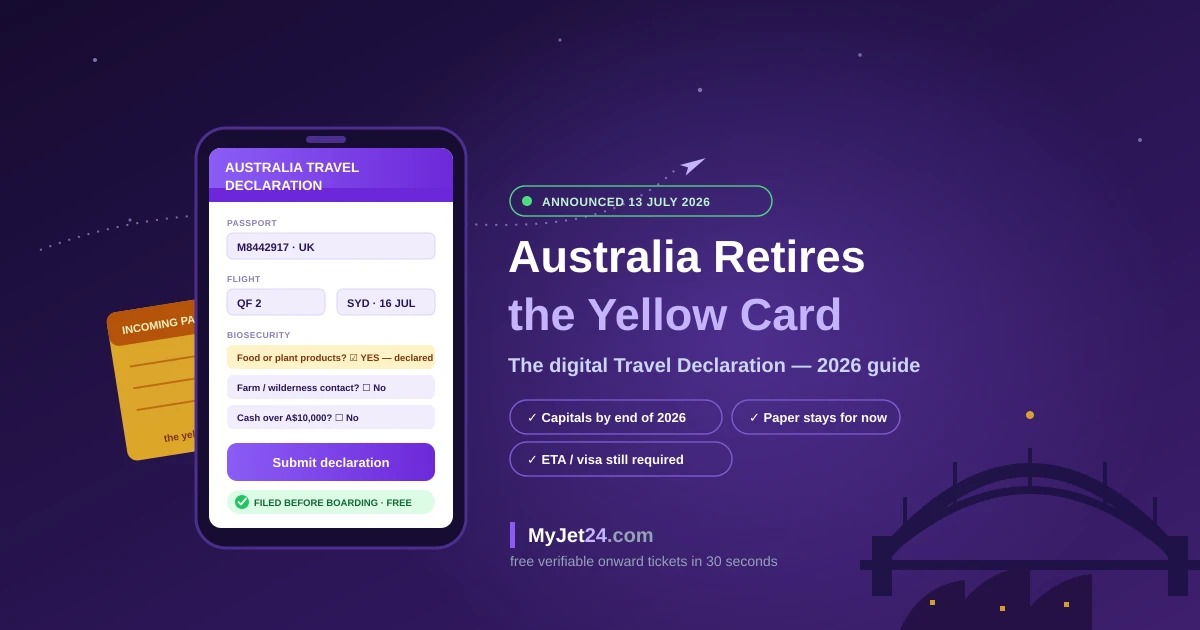
- Australia's famous yellow paper card is finally going digital. On 13 July 2026 the government announced a nationwide rollout of the Australia Travel Declaration (ATD) — backed by A$56.1 million over four years — to replace the Incoming Passenger Card that every arriving traveler has filled in for decades.
- The rollout is gradual, not overnight: the ATD has been piloted on Qantas flights since October 2024 (450,000+ passengers), all capital-city airports offer it before the end of 2026 (Adelaide and Perth next), and every international airport and seaport follows across 2027 into mid-2028.
- Paper isn't dead yet. During the transition the yellow card remains available — if your airline or airport isn't in the program yet, you fill in the IPC exactly as before. Nothing about your trip breaks either way.
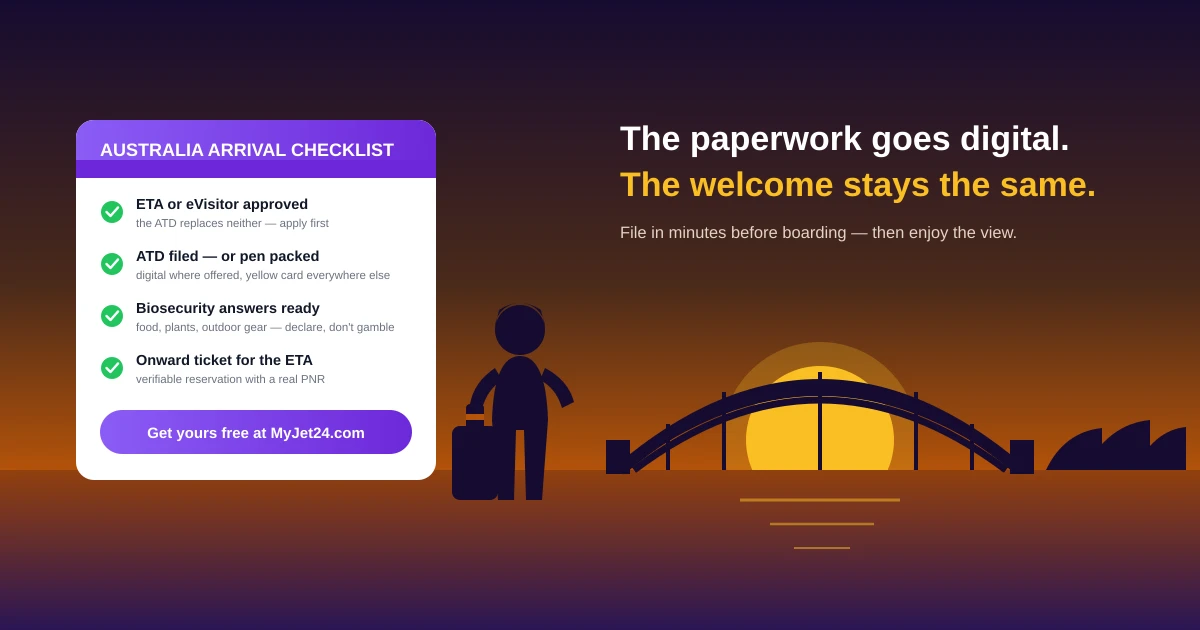
- The ATD is a declaration, not a visa. Every visitor still needs their entry authorization — ETA (subclass 601), eVisitor (651) or another visa — arranged before flying, exactly as today. The declaration replaces the form, not the permission.
- Same questions, new format: biosecurity (food, plants, animal products), customs, health and contact details — the answers that decide whether you meet Australia's famously strict quarantine checks. Digital filing means fewer pen-and-turbulence errors and faster processing, with the 2032 Brisbane Olympics as the deadline in the background.
The Australia Travel Declaration (ATD) is the digital arrival card that will replace Australia's paper Incoming Passenger Card, under a nationwide rollout announced on 13 July 2026 with A$56.1 million in funding. Piloted on Qantas flights since October 2024 with over 450,000 completed declarations, the web-based form covers the same biosecurity, customs and health questions as the yellow card. All Australian capital-city airports will offer it before the end of 2026, with every international airport and seaport following over 12–18 months into mid-2028. During the transition the paper card remains available, and the ATD does not replace visas or ETAs — travelers still need their entry authorization before flying.
Every traveler who has landed in Sydney, Melbourne or Brisbane knows the ritual: somewhere over the Pacific or the Timor Sea, the cabin lights come up and the crew hands out the yellow Incoming Passenger Card — the little form where you declare your food, your medications, your soil-covered hiking boots and whether you've visited a farm lately, signed with whatever pen you could borrow, at whatever angle turbulence allowed. It has survived decades of digitization everywhere else in travel. On 13 July 2026, the Australian Government announced its retirement plan.
The replacement is the Australia Travel Declaration — a digital arrival card quietly piloted on Qantas flights since late 2024 and now funded for a full national rollout. The announcement matters well beyond convenience: Australia runs the strictest biosecurity regime of any major destination, the declaration is legally consequential in a way most countries' arrival cards aren't, and this is the government's second attempt at digitizing it — the first one died quietly in 2022. This guide covers what changes, when it reaches your airport, how the new filing works, what stays exactly the same (your visa or ETA, and the quarantine seriousness), and how Australia's move fits the arrival-card wave we've tracked across Asia, India and Vietnam this year.
What Was Announced on 13 July — and Why It Matters
The federal government committed A$56.1 million over four years to take the Australia Travel Declaration from airline pilot to national standard. The headline facts:
- Proven in the wild first: more than 450,000 passengers have already filed the ATD on eligible Qantas flights since the trial began in October 2024 — this is a scale-up, not a launch-and-pray.
- Capital cities first: every capital-city international airport offers the ATD before the end of 2026, with Adelaide and Perth named as the next additions.
- Then everywhere: a phased rollout to all international airports and seaports across 2027 and into mid-2028 — cruise arrivals included.
- Web form now, apps later: the declaration starts as a web form, with airline in-app integrations planned as the program matures.
- The stated whys: faster arrivals ahead of the 2032 Brisbane Olympic Games, better data quality, and quicker collection in disease-outbreak or biosecurity-emergency scenarios — the exact use case that strained the paper system during the pandemic.
Goodbye, Yellow Card: What the IPC Did and What Replaces It
| Incoming Passenger Card (paper) | Australia Travel Declaration (digital) | |
|---|---|---|
| When you fill it | On the plane, pen and tray table | Online before you fly — no pen, no turbulence handwriting |
| What you declare | Biosecurity items, customs goods, health, contact details | The same questions — the law behind them doesn't change |
| What officers get | A handwritten card to decipher and key in | Structured data before you land — faster lanes, better targeting |
| Errors | Crossed-out boxes, missed questions, lost cards | Validation before submission; your declaration can't be left in the seat pocket |
| During transition | Both coexist — no ATD at your airport/airline yet means the yellow card works exactly as always | |
One deliberate continuity: the legal weight of your answers is identical. The IPC is a legal declaration under Australian law — false answers about biosecurity items bring on-the-spot fines and can cancel visas. The ATD carries the same force in digital form. The format modernizes; the seriousness doesn't soften.
The Rollout Timeline: Who Gets the ATD When
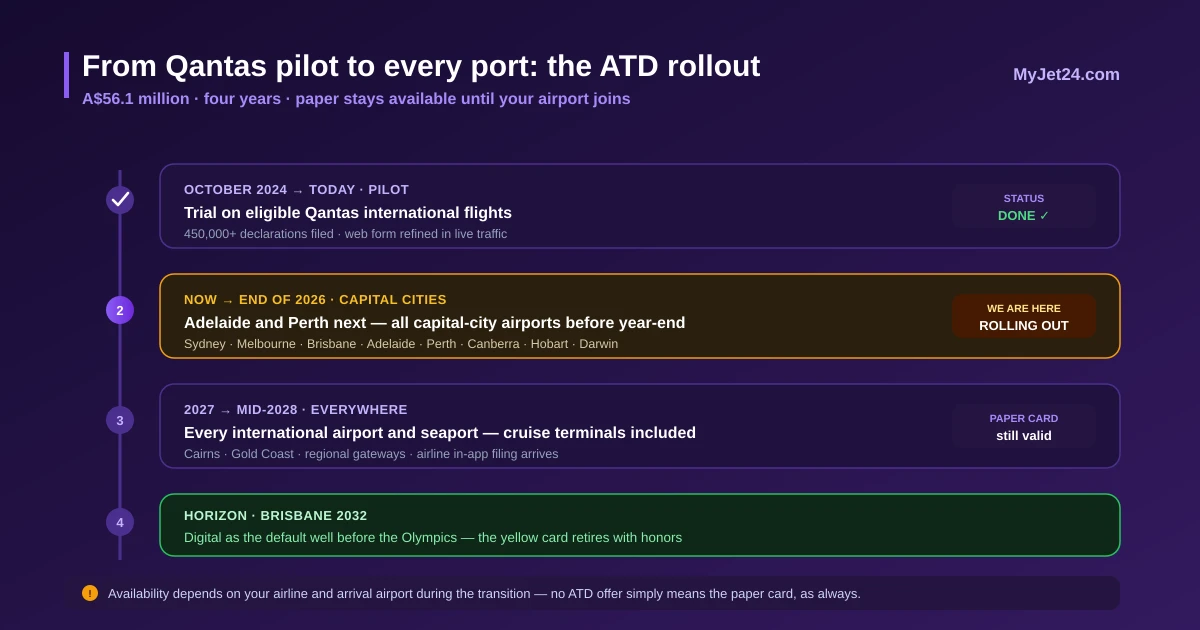
| Phase | What happens |
|---|---|
| October 2024 → now | Pilot on eligible Qantas international flights — 450,000+ declarations filed, product refined. |
| 13 July 2026 | National rollout announced, A$56.1m funded over four years. |
| Rest of 2026 | Adelaide and Perth join; all capital-city airports (Sydney, Melbourne, Brisbane, Adelaide, Perth, Canberra, Hobart, Darwin) offer the ATD before year-end. |
| 2027 → mid-2028 | Phased expansion to every international airport and seaport — Cairns, Gold Coast, cruise terminals and the rest. |
| Beyond | Airline app integrations; paper card retired once coverage is universal — with the 2032 Brisbane Games as the horizon. |
Practical reading of the map: through 2026–2027, whether you can use the ATD depends on your airline and arrival airport, not your nationality. Qantas passengers into major capitals are first in line; arrive on another carrier or into a regional gateway and it's the yellow card a while longer. Either path lands you at the same immigration desk with the same legal declaration made.
How the ATD Works: Filing, Timing, What You'll Declare
- Check eligibility for your flight. During the transition, your airline tells you (check-in email or app) whether the ATD is available for your route. No message means paper — no action needed.
- Fill the web form before departure. Passport details, flight, contact information in Australia, then the declaration questions: food, plant and animal products, medications, currency over A$10,000, recent farm/wilderness contact, and health items. Answer as literally and honestly as you would with a pen — the questions are the law, not smalltalk.
- Save the confirmation. Like every digital arrival card this year (India's QR lesson applies), screenshot or store the completion confirmation with your boarding pass.
- On arrival, proceed as directed. Your declaration data is already with the Australian Border Force; SmartGates and officers handle the rest. Declared items still go through the biosecurity channel — the ATD changes the paperwork, not the beagles.
The Second Attempt: Why the 2022 DPD Failed and Why This Is Different
Australia has been here before. The Digital Passenger Declaration (DPD) — the pandemic-era attempt to digitize arrival paperwork — was scrapped in mid-2022 after months of traveler complaints: a clunky app, mandatory use while airports melted down post-reopening, and a form that took longer than the flight's descent. Its retirement was celebrated at the time as a win for common sense.
The ATD's designers clearly read that post-mortem. The differences that matter: voluntary during transition rather than a hard requirement on day one; web-first instead of app-only; piloted for 21 months on real flights before national rollout rather than launched into chaos; and phased by airport so no single peak-season meltdown can sink it. It's the textbook sequencing lesson — the same one Europe is learning the hard way with EES and the delayed ETIAS this summer: digitize gradually, or queue spectacularly.
Still Not a Visa: ETA, eVisitor and What You Arrange Before Flying
The pattern we flag in every arrival-card guide applies verbatim: the declaration is not the permission. Every visitor to Australia still needs an entry authorization arranged before boarding:
- ETA (subclass 601): for passport holders from the US, Canada, Japan, South Korea, Singapore, Hong Kong and others — applied via the AustralianETA app, usually approved in minutes to hours, multiple visits of up to 3 months across 12 months.
- eVisitor (subclass 651): the free equivalent for EU/EEA and UK passports — same 3-month visits, applied online.
- Visitor visa (subclass 600) and others: for nationalities outside both programs and for longer stays — a full application where documentation matters, covered in our Australia visa documentation guide.
Two adjacent facts worth restating. Airlines verify your ETA/eVisitor electronically at check-in — no authorization, no boarding, ATD or not. And while Australia doesn't run the hard onward-ticket checks some Asian neighbors do, visitor-visa applications ask for evidence of travel plans and funds, and check-in agents on one-way bookings can still ask how you're leaving — a verifiable onward reservation answers that question in 30 seconds without buying a flight your itinerary hasn't settled on, the same instrument our proof of onward travel guide covers country by country.
Biosecurity Is the Real Test — Digital or Paper
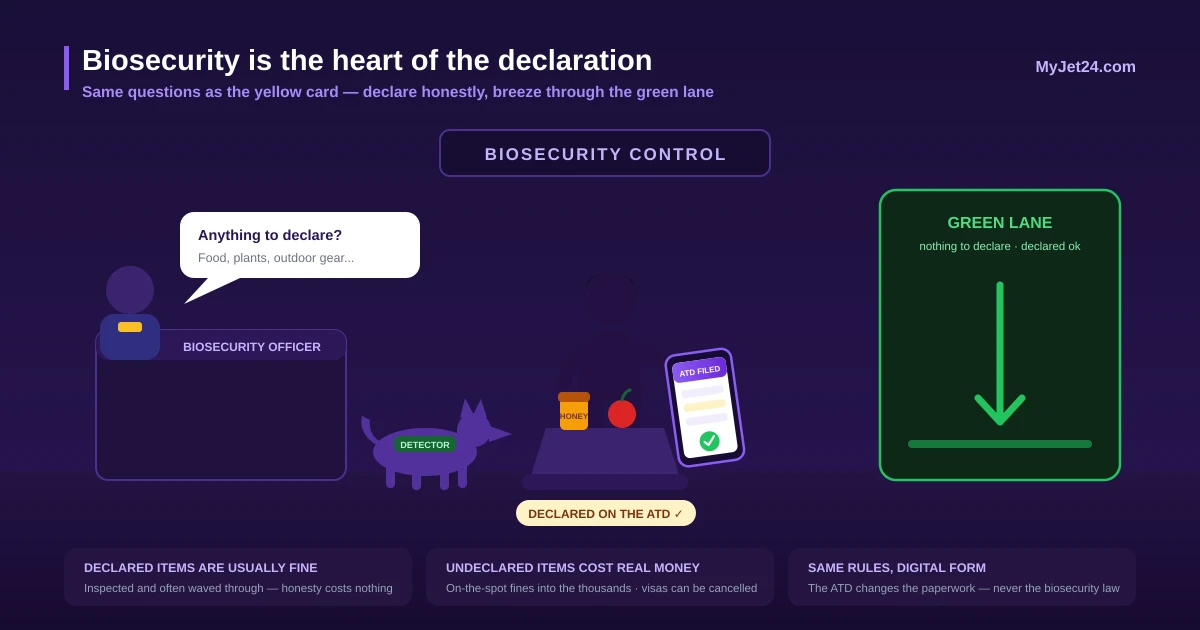
Whatever the format, the declaration's teeth are Australian biosecurity law — the strictest of any major destination, enforced with detector dogs, x-rays and fines that convert honest mistakes into expensive ones. The rules that catch the most travelers:
- Declare everything edible or organic — packaged snacks, honey, nuts, tea, wooden souvenirs, that airline apple in your bag. Declaring is free; failing to declare starts at hundreds of dollars on the spot and can reach visa cancellation for serious breaches.
- "When in doubt, tick yes" survives digitization. A declared item that turns out fine costs you two minutes at the biosecurity bench; an undeclared one that turns up costs money and, for visa holders, potentially the visa.
- Shoes, camping gear and farm contact are questions, not suggestions — soil is a quarantine matter in Australia.
- Cash over A$10,000 must be declared regardless of format — a customs rule the digital form makes harder to "miss."
Australia Joins the Region: the Arrival-Card Map in 2026
With this announcement, the last big holdout of the paper era in the Asia-Pacific joins the queue. The regional scoreboard as of mid-2026: Thailand (TDAC, May 2025), Malaysia (MDAC), Singapore (SGAC), South Korea (e-Arrival, January 2026), Taiwan (TWAC, October 2025), China (CDAC, November 2025), India (e-Arrival Card, mandatory April 2026), Vietnam (Pre-Arrival Form, airport-by-airport since April 2026) — and now Australia on a 2026–2028 glide path. Our regional arrival-card guide tracks the whole family.
The traveler takeaway from the pattern: every one of these is a declaration layered on top of — never instead of — the visa/authorization system, almost all use a 72-hour-style pre-arrival window, each spawns copycat fee-charging websites within weeks of launch, and confirmation screenshots beat email searches at every border on earth. Learn the pattern once and every new country's version becomes a five-minute task.
Six Mistakes to Avoid During the Transition
- Assuming the ATD is mandatory already. It isn't — it's rolling out. No ATD offer from your airline means the yellow card, business as usual.
- Assuming the ATD replaces your ETA or visa. Never. Authorization first, declaration second — the airline checks the first at check-in.
- Paying a third-party site to "file your Australian arrival card." The ATD is free and official; the copycat economy that hit Vietnam's and India's launches will find Australia too.
- Softening your biosecurity answers because the form is digital. Same law, same fines, same dogs. Declare generously.
- Losing the confirmation. Screenshot it next to your boarding pass — the India QR-code lesson applies to every digital card.
- Flying one-way with no answer to "how are you leaving?" Rare in Australia, routine elsewhere on the same trip — a verifiable onward reservation covers the whole itinerary's checkpoints at once.
Frequently Asked Questions
What is the Australia Travel Declaration (ATD)?
The digital arrival card replacing Australia's paper Incoming Passenger Card. Announced for national rollout on 13 July 2026 with A$56.1 million in funding, it's a web form covering the same biosecurity, customs, health and contact questions as the yellow card, filed before you fly instead of on the plane. It was piloted on Qantas flights from October 2024 with more than 450,000 declarations completed.
Is the paper Incoming Passenger Card gone now?
No — the transition is gradual. The yellow card remains available while the ATD rolls out: capital-city airports before the end of 2026, then every international airport and seaport across 2027 into mid-2028. If your airline or arrival airport doesn't offer the ATD yet, you fill in the paper card exactly as before.
Is the Australia Travel Declaration mandatory?
Not during the transition — it's an optional digital alternative where offered, with paper as the fallback. A declaration itself (in one format or the other) has always been mandatory for arriving passengers, and that doesn't change. Expect digital to become the default as coverage reaches all ports toward 2028.
Does the ATD replace the Australian ETA or visa?
No. The ATD is an arrival declaration; entry permission is separate and comes first. Visitors still need an ETA (subclass 601), eVisitor (651) or another visa before boarding, and airlines verify it electronically at check-in. The same declaration-is-not-a-visa rule applies to every digital arrival card launched this year, from India to Vietnam.
Which airports offer the ATD in 2026?
The rollout targets all capital-city international airports before the end of 2026 — Adelaide and Perth were named as next after the announcement, joining the Qantas-pilot gateways like Sydney, Melbourne and Brisbane. Regional international airports (Cairns, Gold Coast and others) and seaports follow across 2027 to mid-2028. Availability also depends on your airline during the early phases.
When and how do I fill in the ATD?
Before departure, as a web form — your airline signals availability for your flight during check-in. You enter passport, flight and contact details, then answer the biosecurity, customs and health questions. Save the confirmation with your boarding pass. In-app airline integrations are planned as the program matures.
What happened to Australia's Digital Passenger Declaration (DPD)?
The pandemic-era DPD was scrapped in mid-2022 after widespread complaints about its clunky app and mandatory use during the post-reopening airport chaos. The ATD is the deliberately different second attempt: web-first, voluntary during transition, piloted for 21 months on real flights, and phased by airport rather than switched on nationwide overnight.
Do the biosecurity rules change with the digital card?
No — the questions and the law behind them are identical. Declare all food, plant and animal products, medications and farm/wilderness contact; undeclared items bring on-the-spot fines and can escalate to visa cancellation for serious breaches. "When in doubt, declare" remains the golden rule, digital or paper.
Is there a fee for the Australia Travel Declaration?
No — the ATD is free through official channels. Treat any website charging a "service fee" to file your Australian arrival card as a scam or an unnecessary middleman, the same pattern documented around Vietnam's Pre-Arrival Form and India's e-Arrival Card launches.
Why is Australia doing this now?
Three stated drivers: faster, smoother arrivals ahead of the 2032 Brisbane Olympics; better-quality, machine-readable traveler data; and quicker information collection during disease outbreaks or biosecurity emergencies — the scenario that overwhelmed paper processing during the pandemic. It also brings Australia in line with the digital arrival cards now standard across the Asia-Pacific.
Do children need their own ATD?
Arrival declarations in Australia cover travelers individually, with parents completing them for children — as with the paper card today, where a parent signs for minors. Follow the form's own household/family flow where offered, and keep each confirmation together with the respective boarding pass.
Does Australia require proof of onward travel?
Australia doesn't enforce onward-ticket checks as hard as some Asian neighbors, but visitor-visa applications ask for travel plans and funds, and airlines can query one-way passengers at check-in. A verifiable onward reservation with a live PNR settles the question in seconds — and covers the stricter checkpoints elsewhere on a multi-country itinerary.
I'm arriving by cruise ship — does the ATD apply?
Seaports are in the rollout's later phases (2027 to mid-2028), so cruise arrivals continue with the paper card until their port joins the program. The declaration obligations are identical at sea and air borders.
Where do I get official information on the ATD?
From the Australian Border Force and Department of Home Affairs channels, and from your airline during check-in for flight-specific availability. As with every new arrival system, type official addresses directly rather than following ads — the copycat-site pattern follows every launch of this kind.
Sources & further reading
- Australian Border Force — official traveler information
- CAPA Centre for Aviation — rollout announcement coverage (13 July 2026)
- VisasNews — Australia: digital arrival card to gradually replace paper form
- Department of Home Affairs — ETA, eVisitor and visitor visa information
Rollout phases and airline availability are evolving; confirm current status with your carrier and official Australian government channels before travel. This guide reflects conditions documented as of 14 July 2026.
