
Last updated: 7 July 2026 · Reading time: 15 min · Author: Joshua White, Travel Documentation Writer at MyJet24
Update (14 July 2026): India relaunched its separate travel health declaration — Air Suvidha 2.0 — on 25 June 2026 amid the WHO’s Ebola public-health emergency. International arrivals now also file a health self-declaration (21-day travel history) up to 24 hours before landing, in addition to the e-Arrival Card described below. Check the official Air Suvidha portal for your arrival airport’s status.
TL;DR — Key Facts
- India's e-Arrival Card has been mandatory for every foreign traveler since 1 April 2026. It replaced the paper disembarkation card that had barely changed since the 1960s. The rule covers tourists, business visitors and — since October 2025 — OCI (Overseas Citizen of India) cardholders too.
- It is not a visa. The e-Arrival Card is a digital declaration checked on arrival; it does not grant permission to enter India and does not replace your e-Visa or paper visa. Most travelers going to India still need both.
- File within 72 hours of landing, not before. The form is submitted on the Indian Visa Online portal or the Su-Swagatam app, takes about 5 minutes, costs nothing, and produces a QR code you must save before you close the browser tab.
- The QR code is the part people get wrong. If you close the confirmation page without downloading it, official guidance says you cannot retrieve it again — and re-issuing it at immigration means a long wait at a staffed kiosk instead of the fast lane.
- Your e-Visa still has its own onward-ticket requirement. Separately from the e-Arrival Card, India's e-Visa rules ask for a return or onward journey ticket with proof of funds. A free MyJet24 onward ticket covers that requirement in about 30 seconds if you don't have a return flight booked yet.
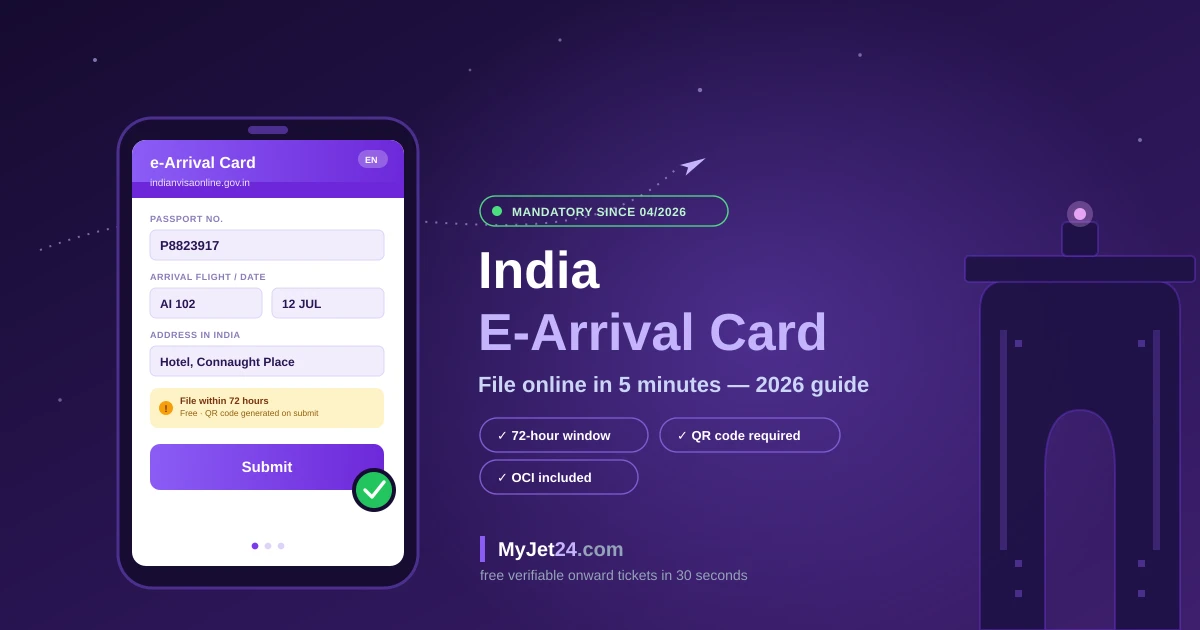
India's e-Arrival Card is a mandatory online form that every foreign national — including OCI cardholders — must submit within 72 hours before landing in India, since it became compulsory on 1 April 2026. You fill it in on the Indian Visa Online portal or the Su-Swagatam app with your passport, flight and address details, and it generates a QR code that immigration scans on arrival. It replaces the old paper disembarkation card but does not replace your visa — the e-Arrival Card and your e-Visa are two separate requirements, and most e-Visas separately require proof of onward or return travel.
Every year, tens of millions of foreign nationals fly into Delhi, Mumbai, Bengaluru and a dozen other Indian gateway airports, and until recently every one of them filled out the same paper disembarkation card — a form so old it had barely changed since the 1960s, hand-written in a queue with an airline pen that half the time didn't work. That era ended on 1 April 2026. India now runs entry declarations the way Singapore, Thailand and a growing list of countries do: online, in advance, with a QR code instead of a signature.
The catch is that almost nothing about the process is intuitive on a first read. The e-Arrival Card sounds like it might be a visa — it is not. It sounds like something you file before you book your flight — you cannot, because the window only opens 72 hours out. And travelers who assume it covers every document check are often the ones caught out at the visa counter, because India's e-Visa carries its own, completely separate onward-ticket requirement that the e-Arrival Card does nothing to satisfy. This guide untangles all of it: the official process, the exemptions nobody advertises clearly, where the rule does and doesn't apply, and the onward-ticket rule most guides to the e-Arrival Card never mention at all. It is the companion piece to our guide on proof of onward travel, which covers that requirement country by country.
The Short Answer: What It Is, Who Needs It, Since When
The e-Arrival Card is India's digital replacement for the paper disembarkation card that immigration used to hand out on incoming flights. It is run by India's Bureau of Immigration (BoI) through the Indian Visa Online portal, the same authority and platform that issues e-Visas, though the two are separate products inside that system.
The rollout happened in two stages, which is why you'll see two dates quoted across different sources:
- 1 October 2025 — the e-Arrival Card portal went live, running in parallel with the paper card during a six-month transition. Filing was optional but encouraged; OCI cardholders became subject to the requirement from this date.
- 1 April 2026 — the transition period ended. The paper disembarkation card was permanently discontinued, and the e-Arrival Card became mandatory for essentially every foreign national arriving in India.
"Every foreign national" is deliberately broad here: tourists, business travelers, and OCI cardholders are all named explicitly in the official guidance and the legal commentary that followed it. Indian citizens travelling on an Indian passport are not affected — this is an entry requirement for foreign nationals, not a domestic travel form.
| Old system | New system (since 1 April 2026) |
|---|---|
| Paper disembarkation card, handed out on the plane or at the airport | Digital e-Arrival Card, filed online up to 72 hours before landing |
| Filled in by hand, often illegibly, checked manually | Filled in on a phone or laptop, checked by scanning a QR code |
| OCI cardholders exempt | OCI cardholders included, since October 2025 |
| No advance data — immigration saw you for the first time at the desk | Passport, flight and address data available to immigration before you land |
e-Arrival Card vs e-Visa: Why You May Need Both
This is the single most common point of confusion, and it is worth stating as plainly as the official guidance does: the e-Arrival Card does not replace a visa and does not grant permission to enter India. It is a declaration, not an authorization. If your nationality requires a visa to enter India, you still need that visa — an e-Visa, a paper visa from an Indian consulate, or a visa-on-arrival where applicable — completely independently of the e-Arrival Card.
Think of the two systems as answering different questions for two different audiences:
| e-Visa | e-Arrival Card | |
|---|---|---|
| Question it answers | Are you allowed to enter India at all? | Who exactly is arriving, on what flight, staying where? |
| When you apply | Days to months before travel | Within 72 hours of arrival |
| Cost | Visa fee applies (varies by nationality and type) | Free |
| Includes onward-ticket check | Yes — return or onward ticket plus sufficient funds | No — not part of this form |
| Who needs it | Nationalities without visa-free access | Every foreign national, including OCI cardholders |
In practice this means most travelers to India now complete two separate online steps for one trip: the e-Visa application (if their passport requires one) well in advance, and the e-Arrival Card in the 72 hours before landing. Skipping the second because you already did the first is the most avoidable mistake in this entire process.
The 72-Hour Window and What Information You'll Need
The e-Arrival Card can only be submitted within 72 hours before your scheduled arrival in India — not earlier. There is no advantage to trying to file a week ahead; the portal is built around that rolling three-day window, mirroring how Taiwan's TWAC and several other new-generation arrival systems handle timing (see our Taiwan TWAC guide for a similar system with a different window). If your itinerary changes after you file — a new flight number, a different first hotel — official guidance is to simply file again; the most recent submission is the one that counts.
Have these ready before you start, so the five-minute form doesn't turn into fifteen minutes of hunting for information mid-flight-Wi-Fi:
- Passport details — number, nationality, issue and expiry dates, exactly as printed.
- Arrival flight details — airline, flight number, and arrival date, so immigration can match your record to your actual landing.
- Contact details — a phone number and email address reachable during your stay.
- Purpose of visit — tourism, business, medical, conference, and so on, matching what you declared on your visa if you have one.
- Address in India — your first night's accommodation is enough; you do not need a full itinerary of every city and hotel for the whole trip.
- A short health declaration — a standard post-2020 addition to most countries' arrival forms.
No documents are uploaded and there is no fee. The form itself takes most travelers under five minutes once the information above is at hand.
Step-by-Step: How to File in About 5 Minutes
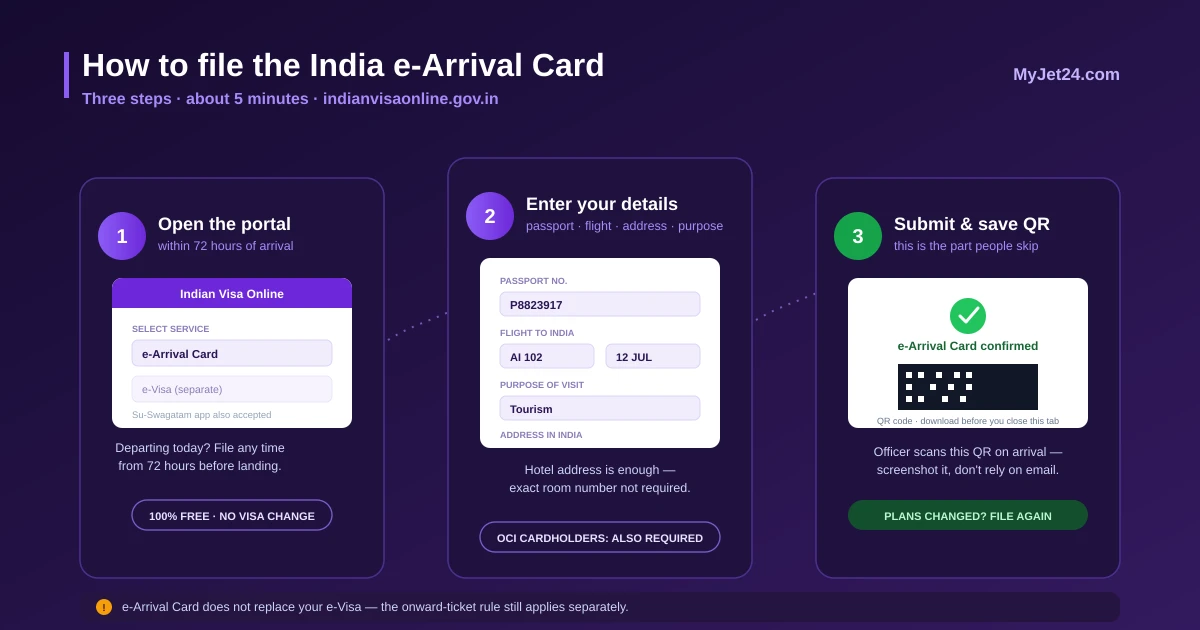
- Open the official portal. Go to the e-Arrival section of Indian Visa Online, or open the Su-Swagatam mobile app — both are run by the Bureau of Immigration and lead to the same system. Do this no earlier than 72 hours before your flight lands.
- Select "e-Arrival Card," not "e-Visa." The portal hosts both services from the same homepage, which is exactly where confused travelers pick the wrong one. If you also need a visa and haven't applied yet, that is a separate, earlier step — not something to rush through now.
- Enter your passport, flight and address details. Double-check the passport number and flight number in particular; these are the two fields immigration cross-references against your physical documents at the desk.
- Add your purpose of visit and a local contact number. A hotel's front-desk number is generally accepted if you don't have a personal Indian number; what matters is that it is reachable, not that it is yours personally.
- Submit, then immediately download or screenshot the confirmation. The system generates a QR code on a confirmation screen. Save it to your phone's photos or download the PDF before you navigate away — see the next section for exactly why this step is non-negotiable.
At Immigration: the QR Code and What Can Go Wrong
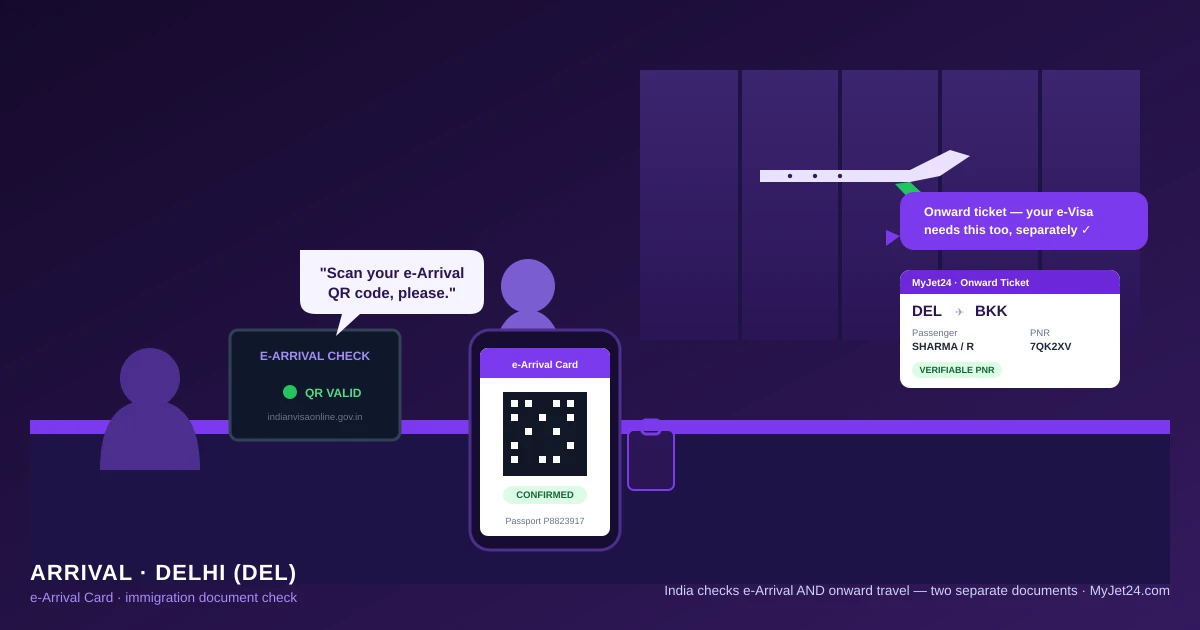
On arrival, an immigration officer scans your QR code — either from your phone screen or a printed copy — instead of collecting a paper form. A valid, matching submission moves you through in seconds. The friction almost always comes from one specific failure: closing the browser tab or the app without saving the confirmation first. Official guidance is explicit that once you do this, you cannot simply reopen the page and retrieve your QR code — you may need to resolve it at a staffed kiosk on arrival, which means the slow line instead of the fast one, precisely when you're already tired from a long-haul flight.
A few practical habits avoid this entirely:
- Download the PDF, don't just view it. A saved file survives a phone restart or a dead Wi-Fi connection at the gate; a browser tab does not.
- Take a screenshot as backup. Photos apps are the one place nearly every traveler reliably finds things again.
- Print a paper copy if you can. A physical QR code never runs out of battery at 6 a.m. after a redeye.
- Carry it separately from your e-Visa printout. They are different documents for different checks — immigration staff and airline check-in staff may ask for either one, and fumbling for the wrong file at the wrong desk costs time.
Who Is Exempt — Including the OCI Surprise
The exemption list is short, and it has narrowed since the system launched:
| Traveler type | Must file the e-Arrival Card? |
|---|---|
| Indian citizens (Indian passport) | No — not a foreign national |
| Foreign tourists and business travelers | Yes |
| OCI (Overseas Citizen of India) cardholders | Yes, since October 2025 — this catches long-time OCI holders off guard, since OCI travel was historically treated closer to a citizen's than a foreign national's |
| Infants and children | Yes, on their own passport — a parent or guardian completes the form on the child's behalf |
| Diplomatic and official passport holders | Generally still expected to file; check with your mission if you hold a diplomatic passport, as protocol arrangements vary by posting |
The OCI change is the one worth flagging loudest, because it's a genuine change in what long-term OCI holders — often people of Indian origin who visit family every year and have never filled in an arrival form in their life — now need to do differently. If you're an OCI cardholder who hasn't filed one of these before, budget the five minutes; don't assume your OCI status covers it automatically.
Air, Sea and Land Borders: Where It Actually Applies
The rule is written to cover all designated Indian entry points — airports, seaports and international land borders — but the practical rollout has not been uniform across all three, and this is a genuine gap in most coverage of the topic:
- Air arrivals — fully live, no exceptions. If you're flying into any major Indian international airport, the e-Arrival Card is enforced exactly as described in this guide. This covers the overwhelming majority of foreign arrivals.
- Sea arrivals — covered by the rule. Cruise passengers and other sea arrivals fall under the same requirement; if you're arriving by ship, file it the same way, within 72 hours of your scheduled port arrival.
- Land borders — technically covered, inconsistently enforced. India shares land crossings with Nepal, Bhutan, Bangladesh, Myanmar and Pakistan. Some Immigration Check Posts have adopted the digital system; others, especially smaller or more remote crossings, still rely on the paper process by necessity. If you're entering overland, check the specific check post's current practice before you travel, and carry printed backup documents in case the digital option isn't available there yet.
This matters in particular for travelers combining India with Nepal — a popular route now that Raxaul, on the India–Nepal border, has been added as an approved first-entry point for e-Visa holders. If your itinerary includes a land crossing, don't assume the same digital-only experience you'd get at Delhi or Mumbai airport; ask ahead, or default to having a printed disembarkation-style backup.
Connecting Flights and Transit Passengers
Whether you need to file depends entirely on whether you clear Indian immigration or not:
- Airside transit, same terminal, no immigration clearance — if you land in Delhi or Mumbai and connect to an onward international flight without ever leaving the transit area or presenting your passport at an immigration desk, you are not "arriving" in India in the sense this form covers, and you do not need to file it.
- Landside transit — leaving the airport, re-entering later — if your connection requires collecting your bags, clearing immigration, and re-checking in (common on long layovers or when changing airports within the same city), you are entering India in the full legal sense and must file the e-Arrival Card exactly as any other arriving traveler would.
- Domestic-to-international or international-to-domestic connections — any leg that requires you to clear Indian immigration counts as arrival, regardless of whether your final destination is inside India or a third country.
The safest rule of thumb: if a human immigration officer will look at your passport before your next flight, file the e-Arrival Card. If you never leave a sterile transit zone, you don't need to.
Eight Mistakes That Cause Delays at Immigration
- Filing more than 72 hours before arrival. The portal won't accept it, and travelers sometimes give up and forget to come back within the actual window.
- Closing the confirmation page before saving the QR code. Covered above, and still the single most common self-inflicted delay.
- Assuming the e-Visa covers it, or vice versa. They are separate systems with separate submissions; completing one does not touch the other.
- Mismatched passport numbers or names between the e-Arrival Card, the e-Visa and the physical passport. Any inconsistency invites extra questioning; triple-check digits and spelling against the passport's machine-readable line, not memory.
- Not re-filing after a flight change. If your flight number or arrival date changes after submission, file again — don't assume immigration will reconcile an outdated record with your new boarding pass.
- Assuming OCI status is still exempt. It has not been since October 2025; long-time OCI travelers are the group most likely to skip this by habit.
- Treating the "address in India" field as needing a full itinerary. Your first night's hotel or host address is enough — you are not required to list every stop of a multi-city trip.
- Forgetting that this form has nothing to do with your onward-ticket requirement. Covered fully in the next section — and the one gap in this whole process that most other guides skip entirely.
The Onward Ticket Rule Hiding Inside Your e-Visa
Here is the detail almost no e-Arrival Card guide mentions, because it technically belongs to a different form: India's e-Visa conditions separately require that travelers hold a return ticket or an onward journey ticket, together with sufficient funds to cover their stay. That requirement exists independently of the e-Arrival Card, has existed for years, and is not going away just because entry declarations went digital.
In practice, enforcement is inconsistent — plenty of travelers land in India without ever being asked to show a return ticket. But "usually not checked" is a different thing from "not required," and the moments it does get checked are exactly the moments you can least afford to be unprepared: an airline check-in agent verifying documents before boarding a one-way flight to India, or an immigration or visa officer asking for it directly. The requirement is phrased as return or onward ticket, so a flight leaving India to any next destination satisfies it — it does not need to be a ticket home.
The mistake to avoid: treating the e-Arrival Card's QR confirmation as proof that "the paperwork is done." It answers a completely different question than the onward-ticket requirement, and an agent who asks "where's your ticket out of India?" will not accept an e-Arrival Card screenshot as the answer.
If you already have a booked return flight or a ticket onward to your next country, you have nothing further to do. If you don't — a common situation for open-ended trips, one-way movers, or travelers deciding their next stop after India — the standard, low-cost fix is a verifiable flight reservation with a real, checkable booking reference:
- Open the MyJet24 onward ticket generator.
- Enter a departure from India to any reasonable next destination, dated after your planned stay.
- Enter your name exactly as it appears on your passport, and generate.
- Download the PDF — a reservation with a verifiable PNR, ready in about 30 seconds, free.
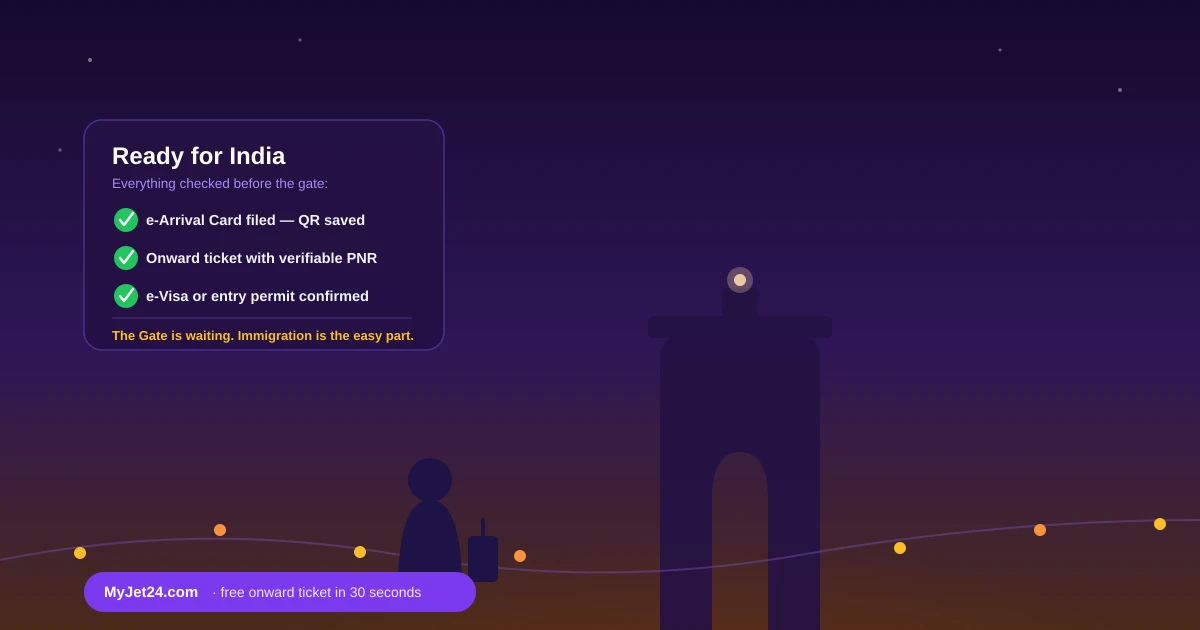
Keep this alongside your e-Visa and your e-Arrival Card confirmation, not instead of either. All three answer different questions, and immigration or airline staff may ask for any of them independently. For the difference between a verifiable reservation and a fabricated document — one survives an agent checking the PNR, the other does not — see our dummy ticket guide.
Frequently Asked Questions
What is India's e-Arrival Card?
It is a mandatory online declaration that replaced India's paper disembarkation card on 1 April 2026. Every foreign national arriving in India, including OCI cardholders, must submit it within 72 hours before landing, via the Indian Visa Online portal or the Su-Swagatam app. It captures passport, flight, contact and accommodation details and produces a QR code that immigration scans on arrival.
Is the e-Arrival Card the same as an Indian e-Visa?
No. The e-Arrival Card is a free arrival declaration; the e-Visa is a paid travel authorization that grants permission to enter India. They are separate systems on the same portal, and completing one does not satisfy the other. Most travelers whose nationality requires a visa need to complete both for the same trip.
Do OCI cardholders need to file the e-Arrival Card?
Yes. OCI (Overseas Citizen of India) cardholders became subject to the requirement in October 2025 and remain so under the mandatory rules from April 2026. This is a change from how OCI travel worked historically, and it catches long-time OCI holders off guard more than any other traveler group.
When exactly should I file my e-Arrival Card?
Within 72 hours before your scheduled arrival in India — not earlier, since the portal will not accept submissions outside that window. Most travelers file the day before departure or right after checking in for their flight.
What happens if I don't file the e-Arrival Card?
Official guidance does not spell out a fixed penalty, but arriving without a completed e-Arrival Card means resolving it at a staffed immigration kiosk instead of the fast QR-scan lane, which can mean a significantly longer wait. Since the paper alternative was discontinued on 1 April 2026, filing online is now the only normal path through arrivals.
I lost my QR code — can I get it back?
Not reliably through the website once you've closed the confirmation page, according to official guidance. If this happens, plan for extra time at a staffed immigration counter on arrival to have it resolved manually. The fix is prevention: download the PDF and take a screenshot the moment you submit the form.
Does the e-Arrival Card cost money?
No. Filing the e-Arrival Card is free, with no document uploads required. This is different from the e-Visa, which carries a fee that varies by nationality and visa type.
Do I need the e-Arrival Card for a connecting flight through India?
Only if you clear Indian immigration during your connection. Airside transit within the same secure zone, without collecting bags or presenting your passport at an immigration desk, does not require it. If your connection requires clearing immigration and re-checking in, you must file it like any arriving traveler.
Do children and infants need their own e-Arrival Card?
Yes, each child travels on their own passport and needs their own submission, completed by a parent or guardian on their behalf. There is no family or group filing that covers multiple passports in one form.
Does the e-Arrival Card apply at land borders with Nepal or Bangladesh?
The rule technically covers all designated entry points, including land borders, but enforcement has rolled out unevenly — major airports are fully digital, while some land crossings still rely on paper processes. Check the specific Immigration Check Post's current practice before an overland entry, and carry backup documentation.
Do I still need proof of onward travel for my Indian e-Visa?
Yes, separately from the e-Arrival Card. India's e-Visa conditions ask for a return or onward journey ticket along with sufficient funds for your stay. Enforcement is inconsistent, but it can be checked at airline check-in or by immigration, and the e-Arrival Card's QR confirmation does not satisfy this — it is a different requirement entirely.
Can I file the e-Arrival Card if my flight time changes afterward?
Yes — simply file a new e-Arrival Card with the updated flight information. There is no penalty for submitting more than once, and the most recent submission is the one immigration will reference.
Is it legal to use a dummy or onward ticket to meet India's e-Visa requirement?
A verifiable flight reservation with a real, checkable PNR — what MyJet24 generates — is a legitimate document used to satisfy onward-travel requirements, the same kind of instrument travel agencies issue during visa processing worldwide. A fabricated document with an invented reference is different: it fails the moment anyone checks it and risks serious consequences for fraud. The difference is verifiability, not the label "dummy" or "onward."
What's the difference between the e-Arrival Card and the Su-Swagatam app?
Su-Swagatam is the Bureau of Immigration's official mobile app, and the e-Arrival Card is one of the services available through it — the other channel being the Indian Visa Online website. Both submit to the same system and produce the same QR code; use whichever is more convenient.
Sources & further reading
- Indian Visa Online — official e-Arrival Card portal
- Fragomen — India Electronic Arrival Card legal alert
- Bureau of Immigration, India — official site
Entry rules and enforcement practice change; verify critical details with official sources before travel. This guide reflects conditions documented as of July 2026.
