
Last updated: June 30, 2026 · 13 min read
TL;DR
- Children under 5 cannot fly alone at all. From 5 to 14 most airlines require their unaccompanied minor (UM) service; from 15 to 17 it's usually optional.
- The UM service typically costs about $150 each way, on top of the ticket, and includes crew supervision from gate to gate.
- Young children (often 5–7) are usually limited to nonstop flights. Rules and ages differ by airline — e.g. British Airways has no UM service and sets a minimum solo age of 14.
- You must name the adults who drop off and collect the child; the person collecting has to show matching photo ID.
- For international trips, bring the child's passport and any visa, plus a signed consent letter where required.
Putting a child on a plane without you is one of the most nerve-wracking things a parent can plan — but airlines do it safely thousands of times a day. The key is understanding the “unaccompanied minor” system: who must use it, what it costs, what the airline actually does for your child, and the paperwork that keeps the whole handover secure. This guide lays out the 2026 rules across the major US and European airlines, with the ages, fees and documents in plain language, so you can book with confidence.
Quick answer
An unaccompanied minor is a child flying without a parent or guardian. Most airlines will not carry a child under 5 alone; for ages 5–14 they require a paid UM service (around $150 each way) with staff supervision gate to gate; for 15–17 the service is optional. You book it with the airline, name the adults handing over and collecting the child, and bring photo ID plus — for international flights — the child's passport, any visa, and a consent letter where needed.
On this page
- What is an unaccompanied minor?
- What age can a child fly alone?
- What the UM service includes
- Airline-by-airline rules & fees
- Low-cost & no-service airlines
- How much does it cost?
- Nonstop vs connecting flights
- Flying alone internationally
- How to book & prepare
- Preparing a first-time solo flyer
- Tips for a smooth trip
- Is it safe — and what if?
- FAQ
What is an unaccompanied minor?
An unaccompanied minor is a child travelling on a flight without a parent, legal guardian or another qualifying adult in the same cabin. To carry them safely, airlines run a dedicated unaccompanied minor (UM) service: a paid programme in which staff check the child in, escort them through the airport and onto the aircraft, keep an eye on them during the flight, and hand them personally to a pre-named adult at the destination. It is essentially a supervised chain of custody from one trusted grown-up to another.
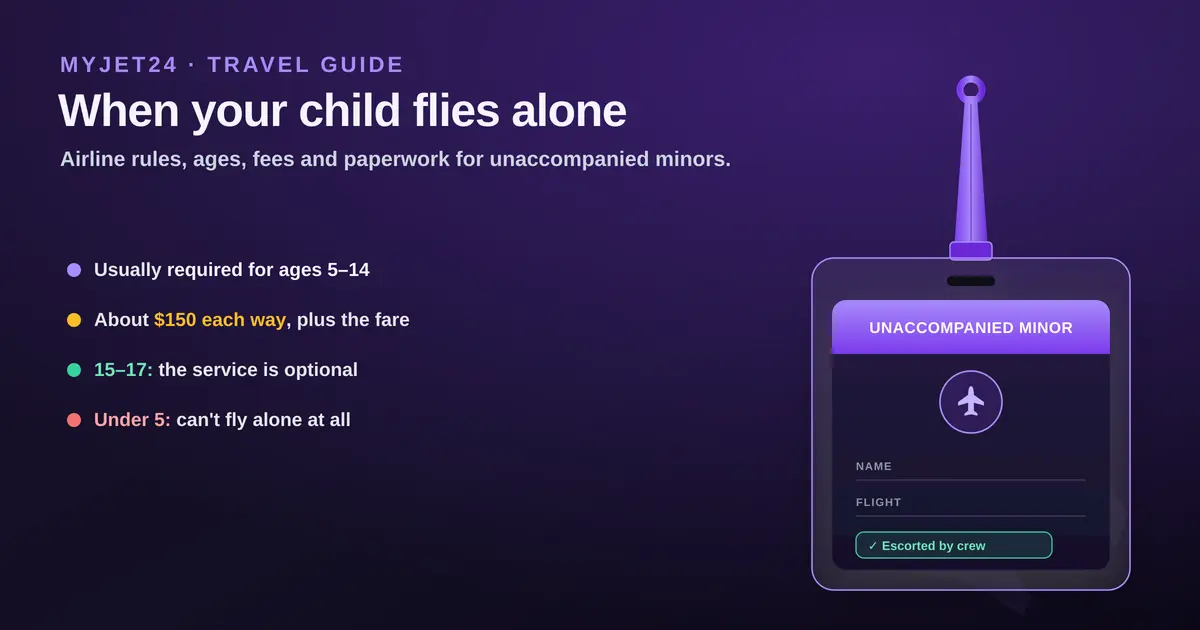
Whether the service is mandatory, optional or simply unavailable depends entirely on the child's age and the airline's policy. Get that combination right first, because it decides everything else — the fee, the flights you're allowed to book, and the documents you'll need.
What age can a child fly alone?
Across almost every airline the rules fall into three age bands. The exact cut-offs vary, but the shape is remarkably consistent worldwide.
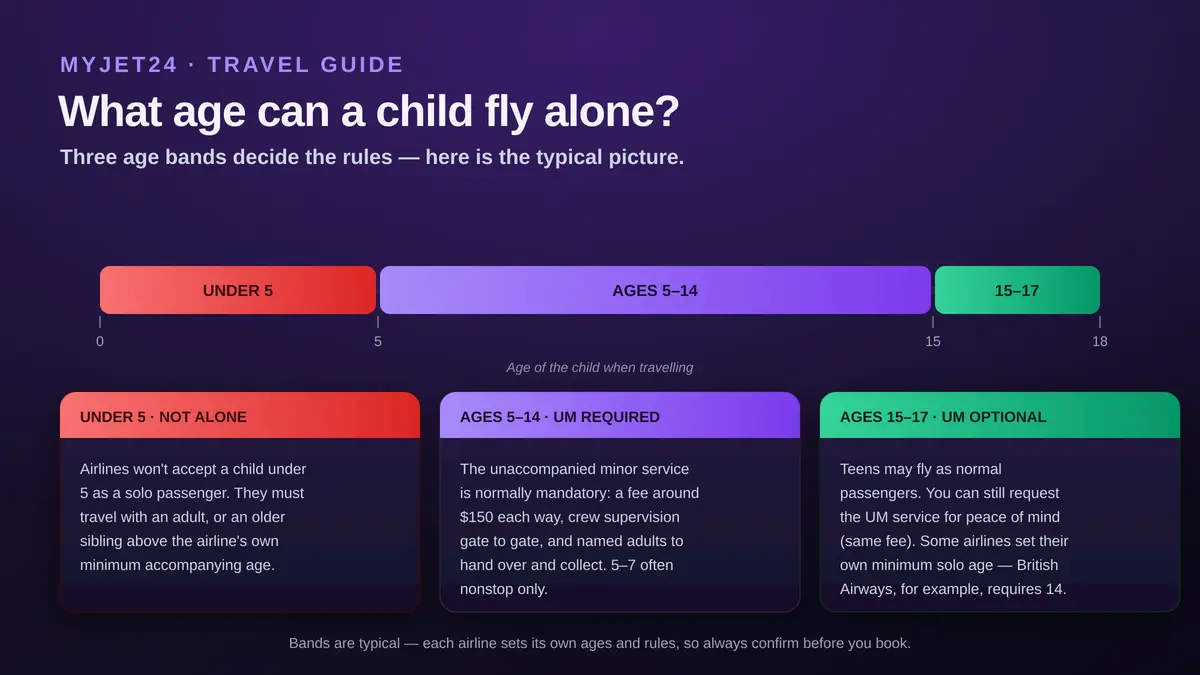
- Under 5: cannot fly alone. A child this young must travel with an adult, or in some cases an older sibling above the airline's minimum accompanying age.
- Ages 5–14: the UM service is usually mandatory. You pay the fee, the airline supervises the child, and you name the adults at both ends.
- Ages 15–17: teenagers may generally fly as normal passengers, and the UM service becomes optional — useful for a nervous first solo trip or a tricky connection.
"The rule of thumb is simple: under 5, never alone; 5 to 14, the airline takes charge for a fee; 15 to 17, it's your call."
What the unaccompanied minor service includes
The fee doesn't buy a special seat — it buys supervision and accountability. A typical UM service covers priority or assisted check-in, an escort through security and to the gate, boarding ahead of other passengers, a crew member keeping a discreet eye on the child in flight, help making any permitted connection with a staff chaperone, and a documented handover to the named adult at arrival, who must show ID. Some airlines give the child a lanyard or wallet holding their documents, and let them wait in a supervised lounge between flights. From the child's point of view it feels reassuringly structured: a friendly staff member is assigned to them, they are usually boarded first and seated where crew can see them, and the same kind of escort meets them on arrival before walking them out to the waiting adult. What the fee really guarantees is that responsibility for the child is formally held by an adult at every single moment — there is no gap in which they are simply on their own in a busy airport.
"The unaccompanied minor fee doesn't buy a seat — it buys a chain of custody: a named adult, a supervised child, and a signature at every handover."
Airline-by-airline rules & fees (2026)
Here is how the major carriers compare in 2026. Note that policies change — and one recent change matters: Spirit Airlines ceased operations on 2 May 2026, so its former UM programme no longer applies.
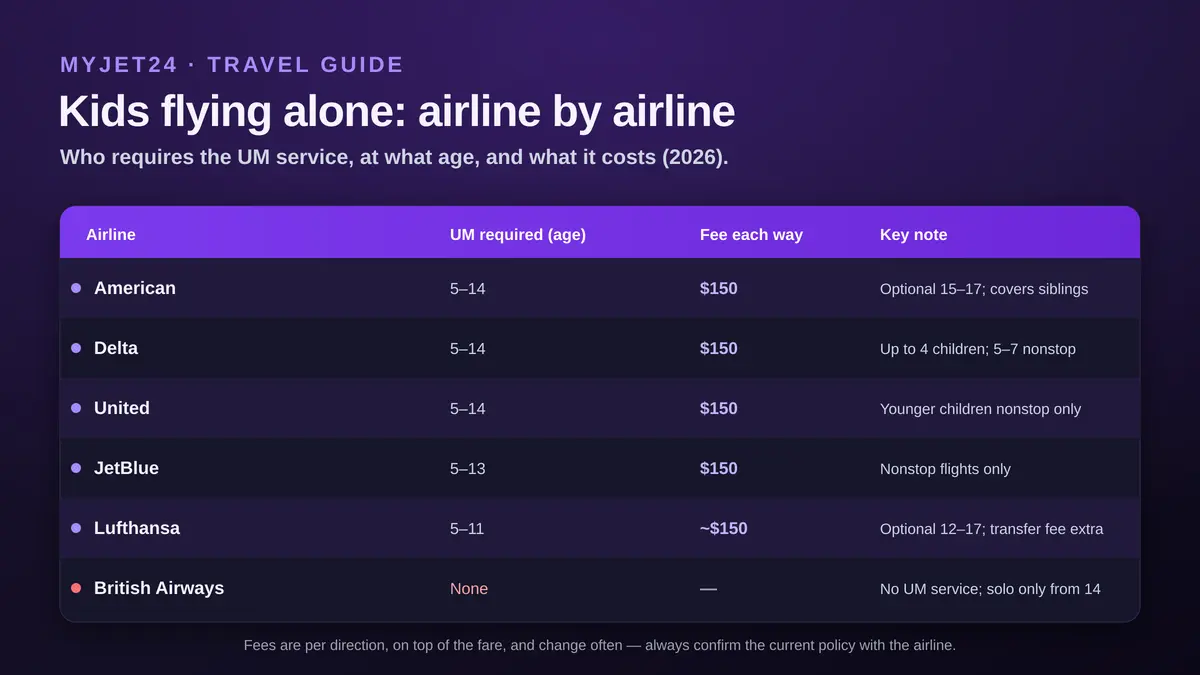
| Airline | UM required (age) | Fee each way | Key note |
|---|---|---|---|
| American | 5–14 | $150 | Optional 15–17; one fee covers siblings |
| Delta | 5–14 | $150 | Covers up to 4 children; 5–7 nonstop |
| United | 5–14 | $150 | Younger children nonstop only |
| JetBlue | 5–13 | $150 | Nonstop flights only |
| Lufthansa | 5–11 | ~$150 | Optional 12–17; transfer fee extra |
| British Airways | None | — | No UM service; solo travel from 14 |
The big US carriers — American, Delta and United — cluster around $150 each way and require the service to age 15. Some low-cost and European carriers differ sharply: Southwest offers no supervised service and lets a “young traveler” fly alone only from 12, nonstop; British Airways withdrew its escort service years ago and simply won't take a child under 14 without an accompanying adult. Always confirm the current policy on the airline's own site before booking — for example the American Airlines UM page.
Low-cost and no-service airlines: a common trap
Not every airline will carry your child alone at any price, and this catches families out constantly. Many budget carriers offer no unaccompanied minor service at all — and some refuse to carry solo minors entirely. In Europe, Ryanair and easyJet do not accept unaccompanied minors: passengers under 16 must travel with someone aged 16 or over, full stop. In the US, Southwest runs no supervised programme and only lets a “young traveler” fly alone from age 12, on nonstop routes. British Airways, as noted, withdrew its escort service and sets a minimum solo age of 14. The trap is obvious once you see it: booking the cheapest fare and only then discovering the airline won't take your 10-year-old alone under any circumstances. Before you pay, confirm two things — that the airline offers the service, and that it accepts it for your child's age and route. If not, you'll need a different carrier or an accompanying adult.
How much does it cost?
Budget around $150 each way for the UM service on the major US airlines — roughly $300 round-trip — on top of the child's ordinary ticket. A few points soften the blow: several airlines let one fee cover multiple siblings travelling together (Delta covers up to four children; American covers additional siblings), so two kids don't always mean double the fee. International services can add a surcharge for connections through a hub. The fee is charged per direction, so a return trip is billed twice. Because these amounts are reviewed regularly, treat $150 as a planning figure and confirm the exact charge when you book. The fee is not negotiable and applies even on award or reward tickets, since it pays for the supervision rather than the seat — so factor it into the true cost when you compare a “cheap” child fare on one airline against a slightly dearer one whose UM policy suits your route better.
Nonstop vs connecting flights for young children
Age doesn't just set the fee — it often limits which flights you can book. The youngest UM travellers (commonly 5–7) are usually restricted to nonstop flights, because a missed or mishandled connection is exactly the scenario airlines want to avoid with a small child. Older children may be allowed on itineraries with a connection, sometimes only on the airline's own network so a staff chaperone can move them between gates. If a connection is unavoidable, understand how tight timings work first — our guide to connecting flights and minimum connection times explains why a comfortable buffer matters even more for a child.
Flying alone internationally: passports, visas & documents
International UM trips add a layer of paperwork on top of the airline's own form. Make sure you have:
- The child's passport — valid well beyond the trip, with any visa the destination requires.
- A consent (authorization) letter from the non-travelling parent(s). Border officers frequently ask for this when a minor arrives without their parents — see our child travel consent letter guide and template.
- Photo ID for the adults dropping off and collecting the child, matching the names on the UM form exactly.
- Proof of onward or return travel, which some countries demand at the border — see which countries require proof of onward travel.
Two details trip families up most. First, the name on the ticket must match the child's passport exactly — a nickname or a missing middle name can cause problems, as we explain in getting the name on a flight ticket right. Second, if a visa application requires a confirmed itinerary before you want to commit to expensive fares, a verifiable flight itinerary for the visa lets you show the booking without locking in a non-refundable ticket.
Sending a child abroad and need travel proof?
If a visa or border check needs a confirmed flight reservation or proof of onward travel, generate a verifiable reservation with a real PNR in under a minute — from just $7.90, with no non-refundable fare to commit to.
Create a flight reservation →How to book & prepare
Booking a child to fly alone is a slightly different process from a normal ticket — follow these five steps.
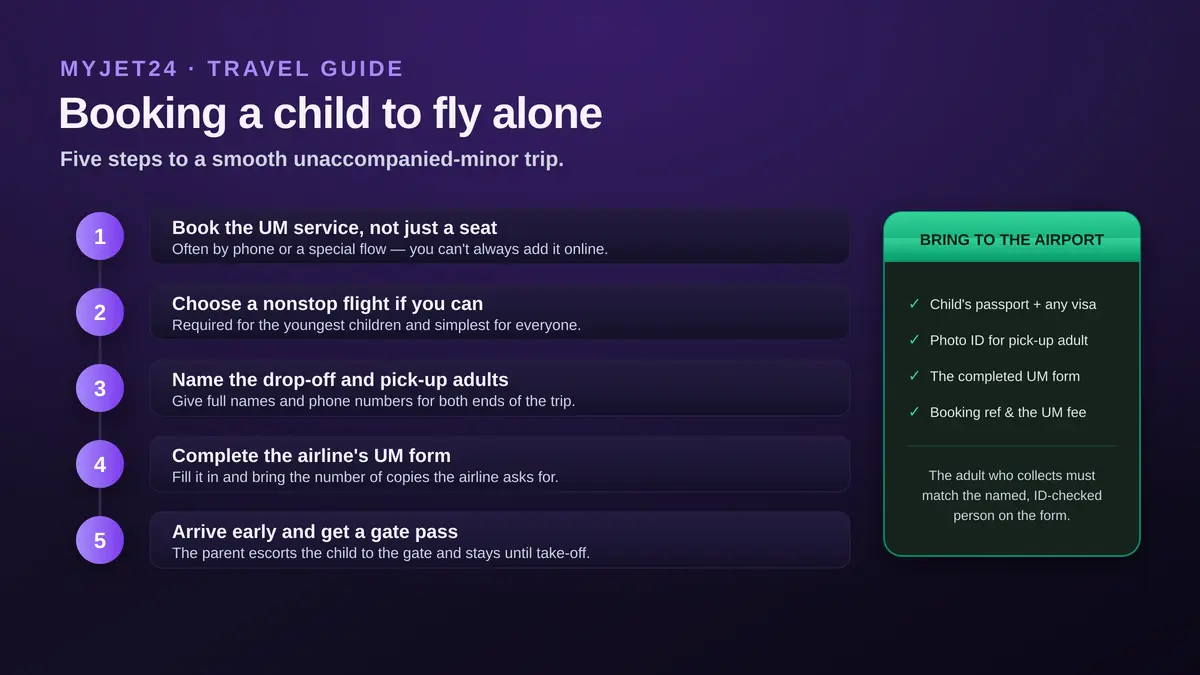
- Book the UM service, not just a seat. Many airlines require you to add the service by phone or through a special flow — you often can't do it in a standard online booking.
- Choose a nonstop flight if you can. It's required for the youngest children and the simplest option for everyone else.
- Name the drop-off and pick-up adults. Provide full legal names and phone numbers for the person handing over the child and the person collecting them.
- Complete the airline's UM form. Fill it in and bring the number of copies the airline specifies (some want three per flight).
- Arrive early and get a gate pass. The parent or guardian is issued a gate pass to escort the child through security to the gate and must stay until the flight has departed.
Preparing a first-time solo flyer
The paperwork keeps a child safe; a little rehearsal keeps them calm. Before the day, walk them through the whole journey in order — check-in, saying goodbye, security, the gate, boarding, the flight, and who will be waiting at the other end — so nothing comes as a surprise. Explain that a crew member is their helper and that they should stay with airline staff and never leave with a stranger, no matter what they're told. Practical touches make a big difference: pack a comfort item, a snack and a fully charged phone (or a written card of contact numbers) in the carry-on; write your number inside their bag; and agree a simple rule such as “text me when you land, before you get off.” For younger children a small printed itinerary with a friendly photo of the person collecting them turns an intimidating trip into an adventure they feel in control of.
Tips for a smooth trip on the day
A little preparation makes the journey calmer for everyone. Pack the child's documents, a charged phone or a written list of contact numbers, snacks and any medication in their carry-on, not checked luggage. Dress them so airline staff can spot them easily, and brief them on who will collect them and to stay with crew until that happens. Make sure the collecting adult arrives early with the right photo ID, because the airline will not release the child to anyone whose ID doesn't match the form. Finally, keep your own phone on and near you for the whole trip — the airline will call you, not the child, if anything changes.
Is it safe — and what if something goes wrong?
The unaccompanied minor system is built around one principle: the child is never left unsupervised and is never released to anyone but the named, ID-checked adult. If a flight is delayed, diverted or cancelled, staff keep the child in their care and contact you directly — they phone the parent or guardian, not the child, to agree what happens next. That is why the drop-off adult must remain at the airport until the flight has departed, and why the collecting adult should arrive early with matching identification. Missed connections are handled by staff who move the child between gates or arrange supervised waiting, and in the rare event of an overnight disruption airlines have defined procedures for care. In other words, the exact scenarios parents lie awake worrying about are the ones the service is specifically designed to manage — there is a staffed plan, not a child left to cope alone. Knowing that procedure exists is the best antidote to first-flight nerves.
Conclusion & next steps
Letting a child fly alone feels daunting, but the unaccompanied minor system exists precisely to make it safe and routine. Remember the three age bands, budget roughly $150 each way for the service where it applies, favour nonstop flights, and get the paperwork — the UM form, photo ID for both adults, and passports or consent letters for international trips — ready in advance. Confirm the exact policy with your chosen airline, because ages and fees differ and change. Do that, and handing your child to the crew becomes just another well-managed step in a journey that ends with a hug at the other end.
Frequently asked questions
What age can a child fly alone?
Children under 5 generally cannot fly alone. From ages 5 to 14 most airlines require their paid unaccompanied minor service with staff supervision, and from 15 to 17 the service is usually optional so teens can fly as normal passengers. Exact ages vary — British Airways, for example, has no UM service and sets a minimum solo age of 14.
How much does the unaccompanied minor service cost?
On the major US airlines it is about $150 each way, roughly $300 round-trip, on top of the child's ticket. Some airlines let one fee cover several siblings travelling together, and international connections can add a surcharge. Fees change, so confirm the current amount when you book.
Last updated: June 30, 2026. General travel information, not airline policy advice — ages, fees and rules vary by airline and change often, so always confirm directly with the carrier. Authoritative background: US DOT aviation consumer protection and The Points Guy's US UM policy roundup.
Marc Hoffmann
Travel-documents specialist at MyJet24. Covers family travel, flying with children, entry requirements and the paperwork that keeps trips moving.
