
Last updated: June 20, 2026 · 11 min read
TL;DR
- A layover is a connection under 24 hours; a stopover is over 24 hours (and often a free city visit).
- Minimum Connection Time (MCT) is the shortest legal gap to connect at an airport — roughly 30–90 min domestic and up to ~3 hours international. It only protects you on a single ticket.
- On a self-transfer (separate tickets), MCT does not apply — you collect bags, re-check in and re-clear security, so allow 3–4 hours+.
- Miss a connection on a single ticket because of an airline delay and the airline rebooks you free (EU261 cash may apply); miss it on separate tickets and it's your cost.
- On a single ticket your bags are usually through-checked to the final destination; on separate tickets you must collect and re-check them.
The cheapest-looking itinerary often hides the riskiest connection — and whether a missed flight is the airline's problem or yours comes down to one thing most travellers never check: are you on one ticket or two? This guide explains layovers versus stopovers, how minimum connection time really works, how much time you actually need, and the single-ticket-versus-self-transfer rule that decides who pays when a connection goes wrong.
Quick answer
A connecting flight is a journey with a change of planes at an intermediate airport. A layover is a connection under 24 hours; a stopover is over 24 hours. The safe connection time depends on the airport and your booking: about 60–90 minutes for a domestic connection and 2–3 hours internationally on a single ticket, but 3–4 hours or more if you booked separate tickets (a self-transfer), because minimum connection time does not protect you and you must recheck bags and re-clear security.
On this page
What is a connecting flight?
A connecting flight is a trip where you change aircraft at an intermediate airport instead of flying non-stop. The stop is called a connection, and the time you spend waiting is your layover. Connections exist because airlines route traffic through hubs — it is cheaper and opens more city pairs — and they are often the lowest fares. The catch is that a connection adds a point of failure: a late inbound flight, a long walk between gates, or a second security check can all put your onward seat at risk. Understanding the rules below turns that risk into something you can plan around.

Layover vs stopover: the 24-hour line
The difference is simply duration. A layover (transit) is a connection of less than 24 hours — anything from a tight 45 minutes to most of a day, usually spent airside in the airport. A stopover is a deliberate stop of more than 24 hours, often used to break up a long trip or visit the hub city, and many airlines offer one free on long-haul routes.
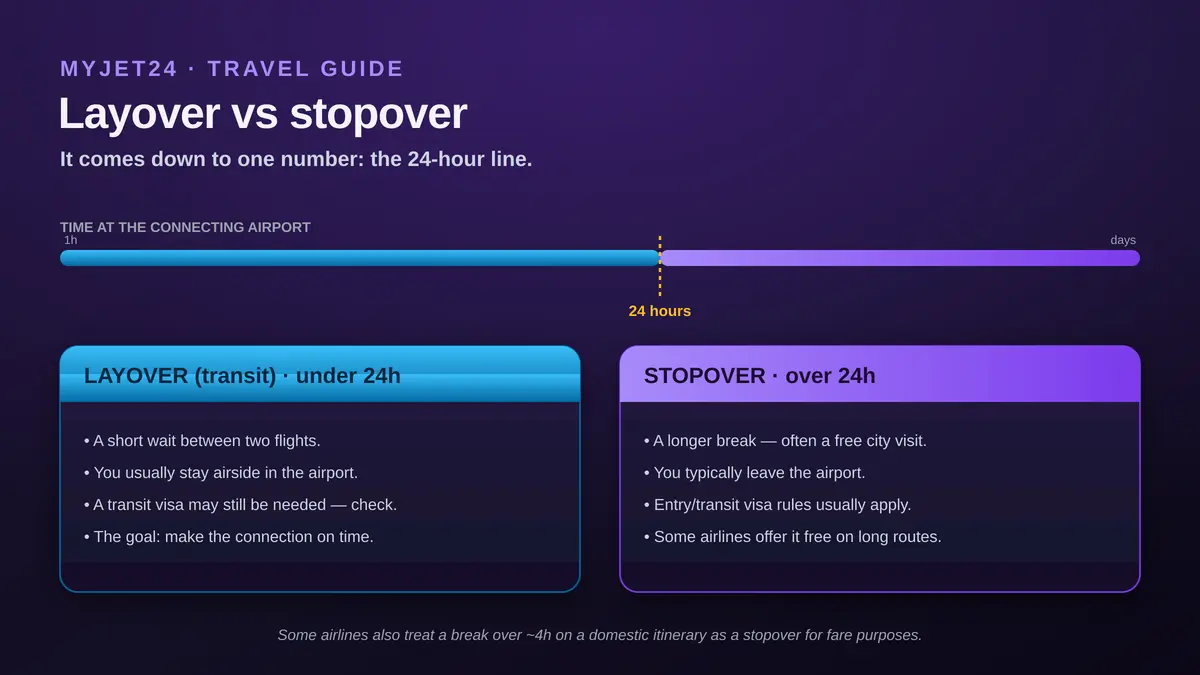
One nuance for fares: some airlines also treat a break of more than about four hours on a domestic itinerary as a stopover for pricing. But for planning purposes, the 24-hour line is the one that matters — and it's also roughly where leaving the airport (and needing a visa) becomes likely.
"Under 24 hours, you're transiting. Over 24 hours, you're visiting — and the rules (and visa requirements) change with it."
Minimum connection time (MCT), explained
Minimum Connection Time is the shortest interval an airport officially considers enough to get from an arriving flight to a departing one. Every airport sets its own MCT, and it varies by terminal and whether the connection is domestic or international. As a rule of thumb it runs about 30–90 minutes for domestic connections and up to three hours for international transfers that involve customs or immigration. When you book a single itinerary, the airline's system will not sell you a connection shorter than the MCT — which is exactly why the single ticket distinction below matters so much.
Single ticket vs self-transfer: the rule that decides everything
This is the most important — and most overlooked — distinction in air travel. It is set by whether your whole journey sits on one booking reference (PNR) or two.
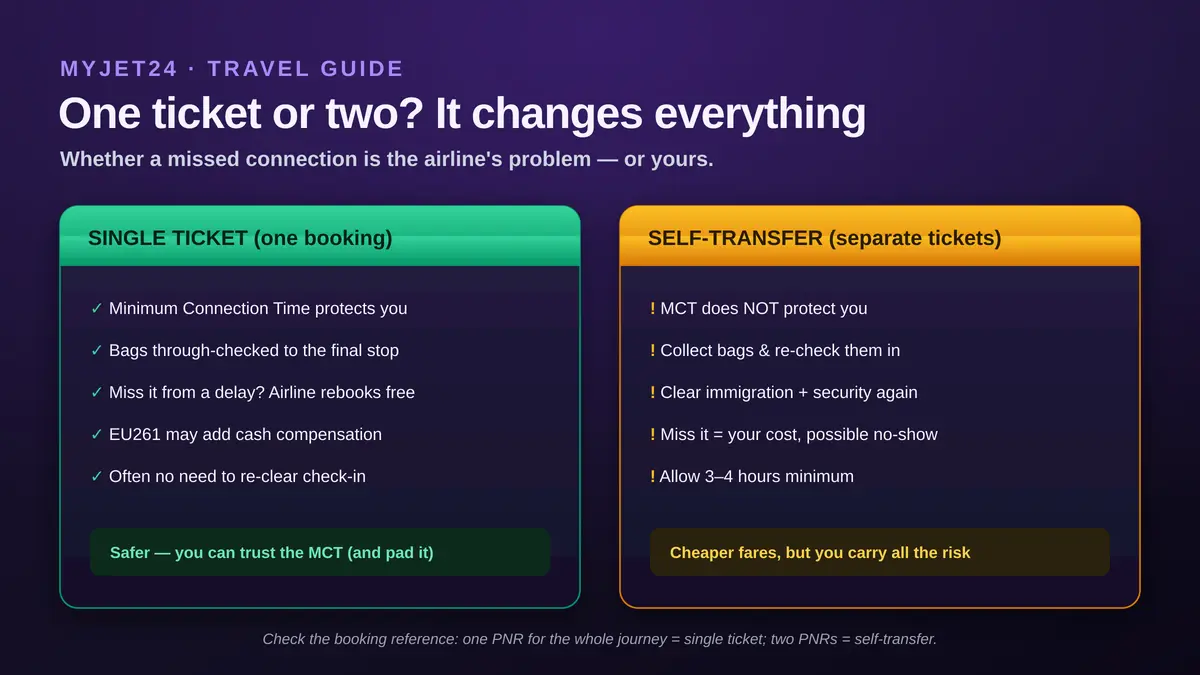
| Aspect | Single ticket | Self-transfer (separate tickets) |
|---|---|---|
| MCT protection | Yes | No |
| Baggage | Through-checked | Collect & re-check |
| Miss it (airline delay) | Airline rebooks free | Your cost / no-show |
| Time to allow | Trust MCT (pad it) | 3–4 hours+ |
How to tell which you have: look at your confirmation. One PNR covering every leg = a single ticket; two separate confirmations = a self-transfer, even if a booking site presented them together. Self-connecting can save real money, but you are the one absorbing the risk.
How much connection time do you really need?
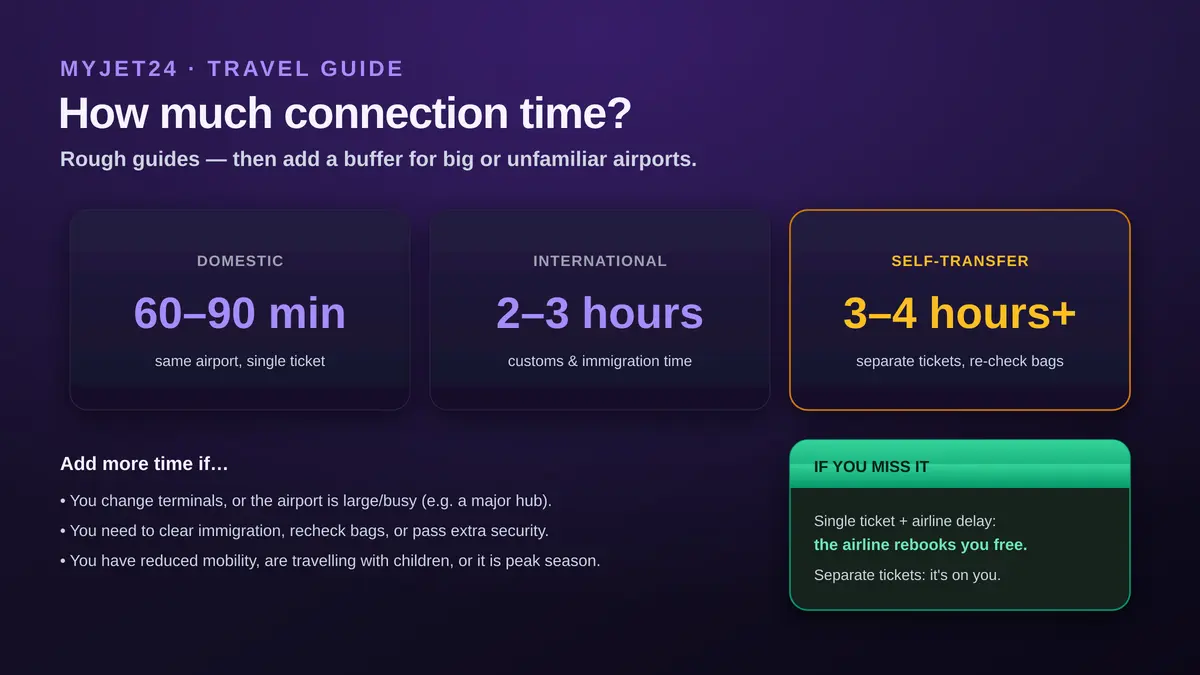
Use these as starting points, then add a buffer:
- Domestic, single ticket: 60–90 minutes.
- International, single ticket: 2–3 hours (customs/immigration eat time).
- Self-transfer (separate tickets): 3–4 hours or more.
Add more if you change terminals, the airport is large or notoriously busy, you must re-clear immigration or recheck bags, you travel with reduced mobility or young children, or it's peak season. A connection that's legal on paper can still be stressful in practice — padding the gap is the cheapest insurance you can buy.
What happens to your baggage at a connection?
On a single ticket, your checked bags are normally tagged through to your final destination — you drop them once at the start and collect them at the end, with the airline moving them between flights. On a self-transfer, you must collect your bags at the connecting airport, exit, and re-check them for the next flight, which is a big part of why self-transfers need so much more time. If a bag goes missing in a connection, the carrier on a single ticket is responsible — and the Montreal Convention sets what you can claim, covered in our baggage compensation guide.
If you miss your connection
What happens next depends entirely on the ticket type. On a single ticket, if an airline delay causes you to miss the connection, the airline must rebook you on the next available flight at no charge, and on covered routes you may also be owed cash under EU261 passenger rights. On separate tickets, the second airline owes you nothing — your missed flight can be marked a no-show, potentially voiding the rest of that ticket, and you may have to buy a new fare. If the miss was your own fault (you cut it too fine), you bear the cost either way. The lesson repeats: the booking structure decides who pays.
"On one ticket, a missed connection is the airline's problem. On two tickets, it's yours. Same airports, completely different outcome."
Do you need a visa for your connection?
Sometimes — even if you never leave the airport. Some countries require a transit visa just to connect, while others let you transit visa-free if you stay airside. A stopover (over 24 hours) where you leave the airport almost always brings entry or transit-visa rules into play. Always check before you book a connection through an unfamiliar country; our transit visa and airport layover guide breaks it down by country. And if you're self-connecting on separate tickets, you may also be asked to show proof of onward travel at check-in for the next leg.
Common connection mistakes
- Booking a self-transfer without realising it — two PNRs, no protection.
- Trusting a tight MCT at a huge hub — legal isn't the same as comfortable.
- Forgetting to recheck bags on separate tickets — they don't move themselves.
- Ignoring a transit-visa requirement — you can be stopped before boarding.
- No buffer for immigration on an international connection.
- Assuming a no-show on leg one keeps leg two valid — it often doesn't.
Conclusion & next steps
Connections are how you get the best fares, and they're perfectly safe when you plan them properly. Know whether you're on one ticket or two, respect the minimum connection time and pad it, allow 3–4 hours for a self-transfer, check whether your bags are through-checked, and confirm any transit-visa need before you book. Do that and a layover becomes a coffee break, not a gamble.
Frequently asked questions
What is the difference between a layover and a stopover?
A layover (or transit) is a connection of less than 24 hours, usually spent in the airport. A stopover is a stop of more than 24 hours, often used to visit the hub city, and many airlines offer one free on long-haul routes. The 24-hour mark is the dividing line.
How long should a layover be?
On a single ticket, about 60–90 minutes for a domestic connection and 2–3 hours for an international one. On a self-transfer with separate tickets, allow 3–4 hours or more, and add a buffer for terminal changes, large airports or immigration.
Self-connecting or need proof for the next leg?
Generate a verifiable flight reservation with a real PNR for a transit visa or proof of onward travel — in under a minute, from just $7.90, no non-refundable fare.
Create your reservation →Last updated: June 20, 2026. Connection times and rules vary by airport and airline and change over time — always confirm with your carrier and official sources before you book.
Marc Hoffmann
Travel-documents specialist at MyJet24. Covers flight connections, air passenger rights, proof of onward travel and entry requirements worldwide.
