
Last updated: June 20, 2026 · 11 min read
TL;DR
- On international flights, the Montreal Convention makes the airline liable for lost, delayed or damaged baggage up to 1,519 SDR per passenger (≈ US$2,000 / €1,800).
- That cap rose from 1,288 SDR on 28 December 2024 — many websites still quote the old figure.
- Deadlines are strict: report damaged baggage within 7 days and delayed baggage within 21 days in writing; miss them and you usually lose the claim.
- It is liability-based: you claim the actual proven value up to the cap, not a fixed payout — so keep receipts.
- You can claim directly with the airline for free; agencies keep 25–50% of baggage payouts.
If an airline loses your suitcase, delivers it days late, or hands it back smashed, an international treaty already says it owes you money — up to about US$2,000. The Montreal Convention sets that liability worldwide, but the payout is not automatic: it runs on tight written-report deadlines that most travellers blow past, and on proving what you actually lost. This guide gives you the current 2026 limit, the exact deadlines for lost, delayed and damaged bags, and how to claim every penny yourself without handing half of it to an agency.
Quick answer
Under the Montreal Convention, an airline is liable for lost, delayed or damaged checked baggage on international flights up to 1,519 SDR per passenger (about US$2,000 / €1,800 in 2026). You must report damaged baggage in writing within 7 days and delayed baggage within 21 days of receiving it; baggage not delivered after 21 days is treated as lost, and you then have up to 2 years to claim. Compensation reimburses your proven actual loss up to the cap, so keep receipts — and you can claim directly with the airline for free.
On this page
What is the Montreal Convention — and what does it cover?
The Montreal Convention (formally MC99) is an international treaty that sets airline liability for passengers and baggage on international flights between the 130+ countries that have signed it. For baggage it does something powerful: it makes the airline strictly liable for your checked bags — meaning it must pay for loss, delay or damage even if nothing was its fault, up to a set limit, unless the damage came from an inherent defect in the items themselves. Carry-on baggage is different: the airline is only liable if it was actually at fault. The treaty is administered through bodies like IATA, and national regulators such as the US Department of Transportation publish passenger-facing guidance.
"For checked bags the airline doesn't get to argue it wasn't careless. Lost, late or broken — it pays, up to the cap. Your job is to claim it correctly and on time."
How much can you claim for lost luggage in 2026?
The maximum liability is 1,519 SDR per passenger — roughly US$2,000, €1,800 or £1,560. SDR stands for Special Drawing Rights, an IMF currency basket, so the exact local value moves daily. Crucially, this single ceiling covers lost, delayed and damaged combined, per passenger — not per item and not per incident.
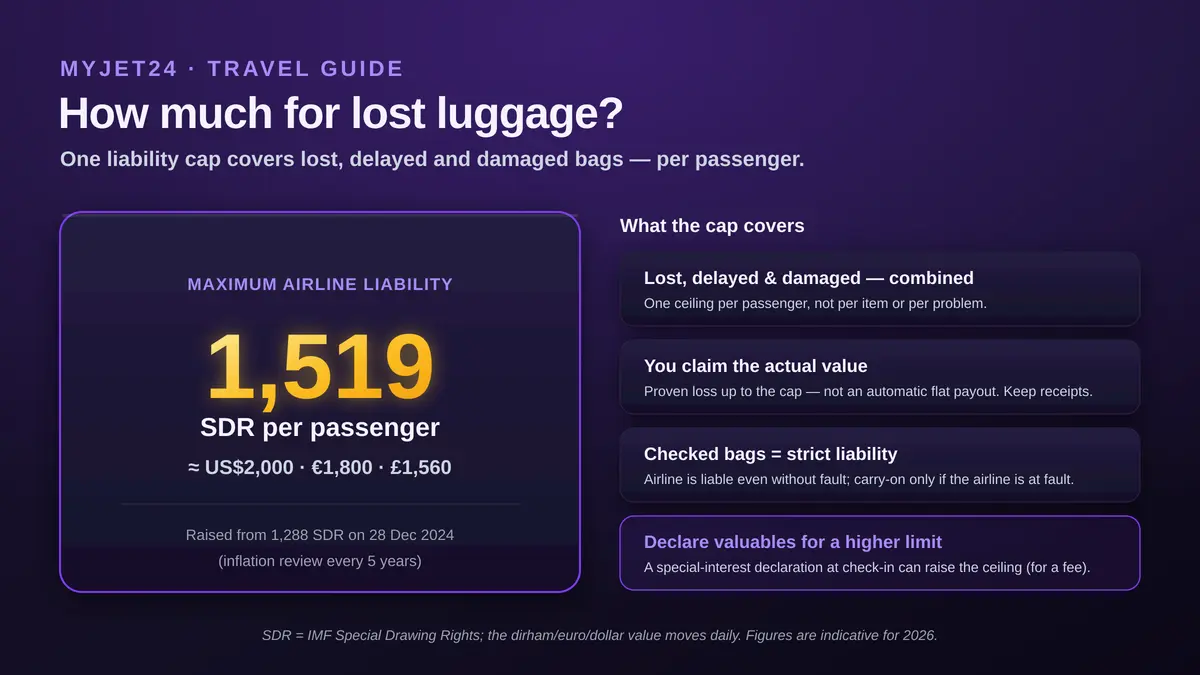
An accuracy note: this cap increased from 1,288 SDR to 1,519 SDR on 28 December 2024, as part of the treaty's built-in five-yearly inflation review. A lot of guides and even some airline pages still show the old 1,288 figure — use the current one. The other key point is that this is a liability limit, not a guaranteed payout: you receive the actual value of what you lost, proven with receipts and an itemised list, up to that ceiling.
The deadlines: lost vs delayed vs damaged
This is where most claims die. The Convention gives you different written-report windows for each scenario, and missing them generally ends your right to compensation.
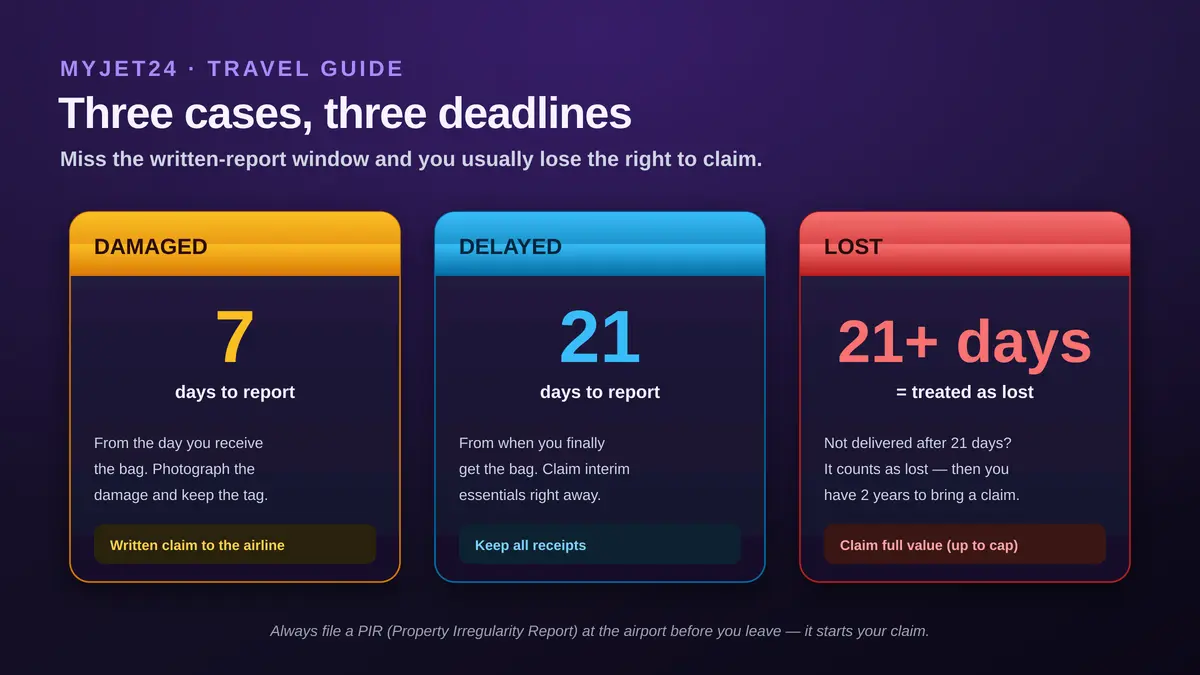
| Situation | Written-report deadline | Then what |
|---|---|---|
| Damaged | 7 days from receipt | Claim repair or value, with photos |
| Delayed | 21 days from receipt | Claim interim expenses + any loss |
| Lost | After 21 days undelivered | Treated as lost; up to 2 years to claim |
Before you leave the airport, always file a Property Irregularity Report (PIR) at the baggage desk. It is not the same as your formal compensation claim, but it timestamps the problem and gives you a reference number the airline will ask for.
Delayed baggage: claim your interim expenses now
When a bag is merely delayed, you do not have to wait to start spending. The airline must reimburse reasonable, necessary expenses while you are without your things — clothing, toiletries and essentials appropriate to your trip. Buy what you genuinely need, keep every receipt, and claim them back. Be sensible: “reasonable” means replacing a few days' basics, not a designer shopping spree, and airlines will push back on anything that looks like an upgrade. If the bag never turns up and crosses into “lost,” those interim costs fold into your overall claim, still subject to the single per-passenger cap.
How this differs from EU261 flight compensation
Travellers mix these up constantly, so keep them separate. EU261 is about the flight being delayed, cancelled or overbooked, and it pays a fixed amount (€250–€600) regardless of your actual costs. The Montreal Convention is about your baggage (and certain other damages), and it reimburses your actual proven loss up to a cap. They can both apply to the same trip — a cancelled flight and a lost bag are two different claims you can make at once. If your flight itself was disrupted, read our companion guide on flight delay compensation under EU261.
"EU261 pays a fixed sum for a broken flight. Montreal reimburses real losses for a broken bag. Different rules, different forms — and you can claim both."
How to claim baggage compensation yourself (for free)
You do not need a baggage-claim agency. Like flight-compensation firms, they take a cut — often 25–50% of a baggage payout — for submitting a form you can complete yourself.

- File a PIR at the airport — report it at the baggage desk before you leave and note the reference number.
- Keep every document — boarding pass, bag tag, the PIR, and receipts for anything you buy.
- Send the written claim in time — within 7 days (damaged) or 21 days (delayed); cite the Montreal Convention.
- Itemise your loss — list contents with values up to the cap, attaching receipts and photos.
- Escalate if refused — take it to the national aviation authority or small-claims court; still free.
What you can — and can't — claim
You can claim the value of lost or damaged contents, the bag itself, and reasonable interim expenses for a delay, all up to the per-passenger cap. Airlines typically depreciate used items rather than paying brand-new replacement cost, so expect a fair-value assessment rather than a full refund of the purchase price. Some categories are commonly excluded or limited: cash, jewellery, electronics, important documents and other valuables are often capped or refused if packed in checked baggage — which is exactly why airlines tell you to carry them in your cabin bag. If you must check something high-value, ask about a special declaration of interest at check-in, which can raise the liability ceiling for an extra fee.
Mistakes that kill a baggage claim
- Leaving the airport without a PIR — report it before you exit the baggage hall.
- Missing the 7- or 21-day window — the single most common reason claims fail.
- No receipts or itemised list — you must prove the value you are claiming.
- Throwing away the damaged bag or tag — keep them as evidence until paid.
- Packing valuables in checked luggage — often excluded; carry them on.
- Paying an agency by default — try the free direct claim first.
A note on connections and codeshares
Bags most often go missing on tight connections. On a single through-ticket, the airline that issued the ticket (or the operating carrier) handles your baggage claim even if another airline lost it — you do not have to chase each carrier separately. This is one more reason to understand connection times and through-checking, which we cover in our airport layover and transit guide. If a misconnection or cancellation forces you to rebook and your onward journey needs proof of travel, see our proof of onward travel guide.
Conclusion & next steps
Baggage compensation is one of the most winnable claims in travel — the airline's liability is automatic for checked bags — but it is deadline-driven and evidence-driven. File the PIR at the airport, act within 7 or 21 days, keep receipts and an itemised list, claim your actual loss up to 1,519 SDR, and submit it directly rather than surrendering a chunk to an agency. Treat it as separate from any flight-delay claim — you may be owed both.
Frequently asked questions
How much compensation do I get for lost luggage?
Up to 1,519 SDR per passenger — about US$2,000 / €1,800 in 2026 — under the Montreal Convention. It reimburses the proven value of what you lost, not an automatic flat sum, so keep receipts and itemise your claim.
How long do I have to report delayed baggage?
You must send a written report within 21 days of receiving delayed baggage (7 days for damaged). File a PIR at the airport first, then submit the formal claim within the deadline, or you usually lose the right to compensation.
Rebooking after a baggage or flight mess?
If your new route needs proof of onward travel for a visa or border check, generate a verifiable flight reservation with a real PNR in under a minute — from just $7.90, no non-refundable fare.
Create a flight reservation →Last updated: June 20, 2026. This is general information, not legal advice — limits and rules change, so confirm with the airline and official sources (IATA MC99, your national aviation authority) before you claim.
Marc Hoffmann
Travel-documents specialist at MyJet24. Covers air passenger rights, baggage claims, proof of onward travel and entry requirements worldwide.
