
Last updated: 11 July 2026 · Reading time: 14 min · Author: Joshua White, Travel Documentation Writer at MyJet24
TL;DR — Key Facts
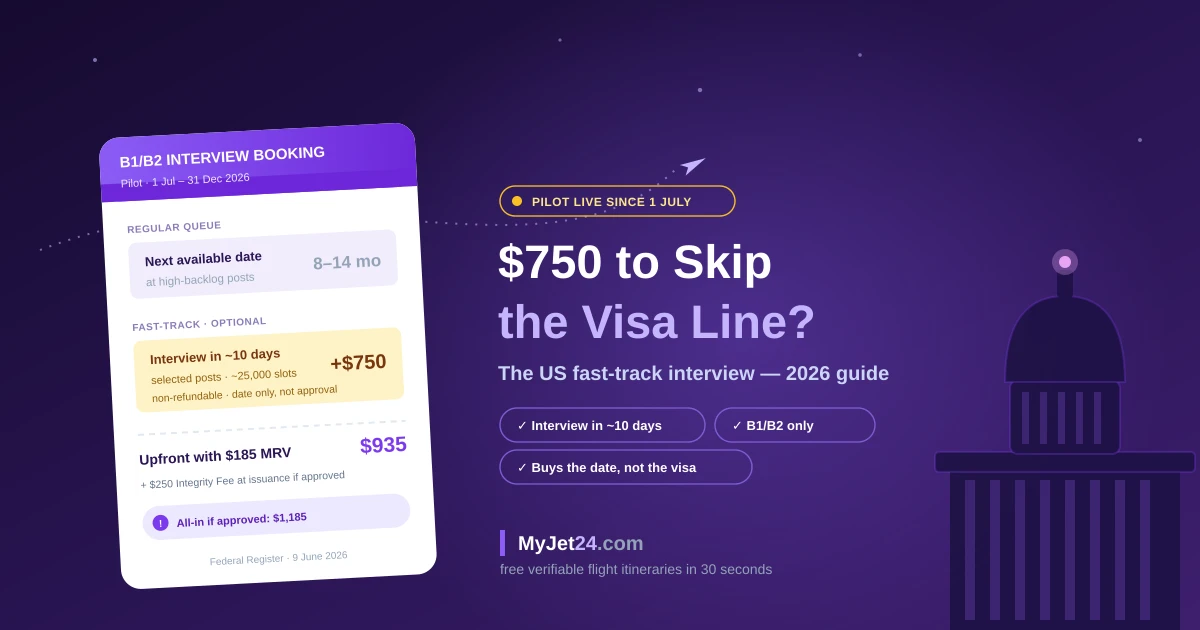
- Since 1 July 2026, B1/B2 applicants can pay an optional $750 to get a US visa interview within about 10 days — a temporary pilot running through 31 December 2026, published in the Federal Register on 9 June 2026.
- It buys a date, not a visa. The fee only accelerates the appointment. The interview itself, Section 214(b), and your documents decide the outcome exactly as before — and the $750 is non-refundable even if you're refused or miss the slot.
- The real total is steep: $185 application fee + $750 fast-track + the $250 Visa Integrity Fee at issuance = up to $1,185 for one approved, expedited B1/B2 visa in 2026.
- Capacity is tiny: roughly 25,000 slots worldwide for the whole six-month pilot, and only at selected embassies and consulates. In high-backlog countries it will sell out fast — in low-wait countries it's money wasted.
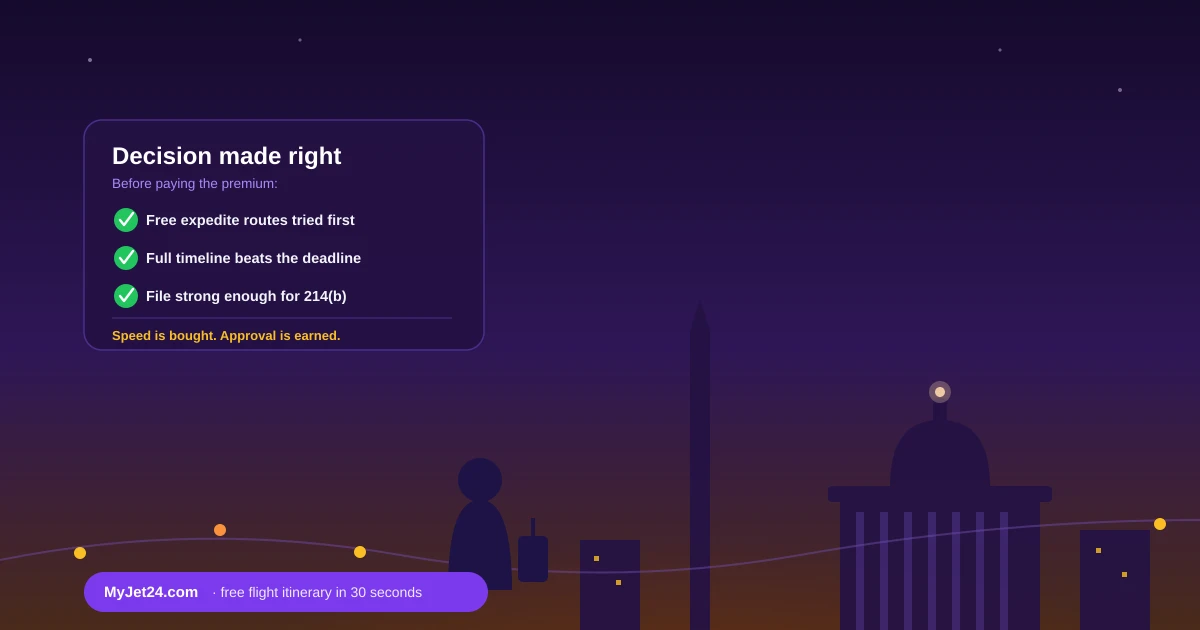
- Do the math before paying: if your consulate's regular wait is a few weeks, skip it. If it's 8–14 months (India, Colombia and similar backlogs) and your trip can't move, $750 may be the only realistic path — but only with an interview file strong enough to survive a 3-minute 214(b) decision, including a verifiable flight itinerary instead of a purchased ticket.
The US $750 fast-track visa interview is a temporary pilot program running from 1 July to 31 December 2026: B1/B2 visitor visa applicants at selected US embassies and consulates can pay an optional $750 premium fee — on top of the standard $185 application fee — to receive a consular interview appointment within about 10 days instead of waiting months. The program is capped at roughly 25,000 expedited slots worldwide, the fee is non-refundable even if the visa is refused, and it does not improve approval chances — it only moves the interview date forward. With the separate $250 Visa Integrity Fee collected at issuance, a fast-tracked, approved B1/B2 visa can cost up to $1,185 in government fees in 2026.
For years, the most painful number in US travel wasn't a fee — it was a wait time. Applicants in Bogotá, New Delhi or Lagos routinely stared at interview calendars showing the next available B1/B2 appointment eight, twelve, even fourteen months away, watching weddings, conferences and family emergencies slide past a date they couldn't move. On 1 July 2026, the State Department put a price on that wait: $750, paid on top of the normal application fee, for an interview within about ten days.
The pilot has been reported with the usual mix of outrage headlines ("pay to skip the line!") and thin summaries, but the practical questions travelers actually have — is it worth it at my consulate, what happens to the money if I'm refused, does it change my odds, what does the full 2026 fee stack now look like — have mostly gone unanswered. This guide answers them with the program's official parameters, the price-ladder math including the separate $250 Visa Integrity Fee, a decision framework for who should and shouldn't pay, and the preparation that protects a $935 upfront bet at a three-minute interview window.
What the $750 Fast-Track Actually Is
The official shape of the program, from the State Department's June 2026 fee schedule notice and the guidance that followed:
- A temporary pilot: it runs from 1 July 2026 through 31 December 2026. It is not (yet) a permanent feature of the visa system; the State Department will evaluate it before deciding what comes next.
- B1/B2 only: the premium option covers visitor visas for business and tourism. Students, workers and other categories are outside the pilot.
- An optional premium on top of the normal fee: you still pay the standard $185 MRV application fee; the $750 comes on top, bringing the upfront total to $935.
- A ~10-day appointment promise: paying the fee books you a consular interview within about ten days of the request, subject to availability at your post.
- Hard capacity limits: roughly 25,000 expedited slots worldwide for the entire six-month pilot, offered only at selected embassies and consulates — not every post participates.
- Non-refundable: the $750 is not returned if your visa is refused, if you miss the appointment, or if you change your plans.
One framing detail worth keeping: this is the second new US visa charge to arrive within a year, after the $250 Integrity Fee created by the One Big Beautiful Bill Act. The two are unrelated mechanisms — one is a mandatory surcharge at issuance, the other an optional speed upgrade at booking — but they stack, which is why the next section's math matters.
The 2026 US Visa Price Ladder: $185 → $435 → $1,185
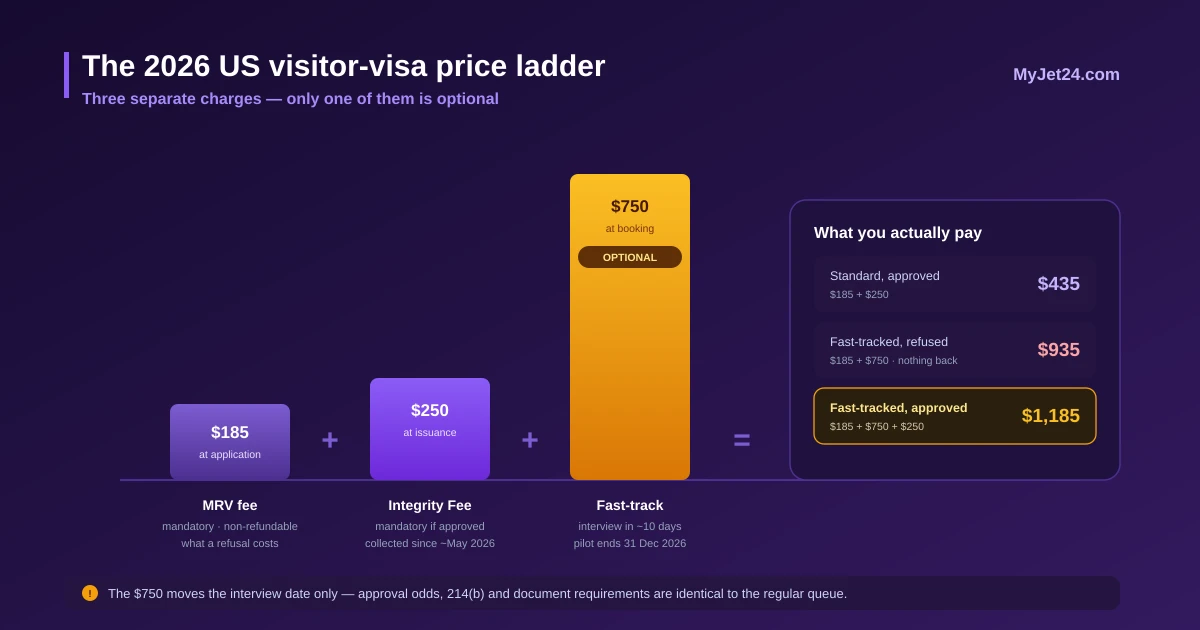
Here is what a B1/B2 visitor visa actually costs in 2026, depending on which rungs apply to you:
| Scenario | Fees | Total |
|---|---|---|
| Standard application, refused | $185 MRV | $185 |
| Standard application, approved | $185 MRV + $250 Integrity Fee at issuance | $435 |
| Fast-tracked, refused | $185 MRV + $750 premium (non-refundable) | $935 |
| Fast-tracked, approved | $185 + $750 + $250 at issuance | $1,185 |
Read the third row twice before booking: a fast-tracked refusal costs $935 and buys nothing but a faster no. That single line should shape both the decision (next sections) and the preparation (further down). For the full mechanics of the $250 rung — who's exempt, when it's collected, the refund that exists only on paper — see our dedicated Visa Integrity Fee guide.
How It Works: Eligibility, Slots and the 10-Day Clock
- Complete the normal application first. DS-160, $185 MRV fee, account on the scheduling system — the fast-track is an upgrade inside the process, not a separate channel.
- Check whether your post participates. The pilot runs only at selected embassies and consulates; availability is announced post by post. If your consulate isn't in the pilot, the option simply won't be offered.
- Pay the $750 premium when booking. The system then offers an appointment within roughly ten days, subject to slot availability at that post.
- Attend a completely normal interview. Same window, same officer, same questions, same 214(b) standard — nothing about the assessment is premium.
- If approved, the $250 Integrity Fee is collected at issuance like for every other applicant, where collection is active.
The scarcity math is worth internalizing: 25,000 slots across six months and dozens of posts is a small number against a backlog measured in millions of pending applicants. In the highest-demand countries the practical experience will be less "pay and pick a date" and more "pay if a slot exists this week" — which is also why waiting for the program to be your plan A is risky. Treat it as a tool for genuine emergencies, not a standing shortcut.
What $750 Does Not Buy You
- Not a higher approval chance. The officer doesn't know or care what you paid to be there. Section 214(b) — the presumption that every visitor is an intending immigrant until proven otherwise — applies with full force.
- Not faster processing after the interview. Administrative processing (221(g)), background checks and passport return times run on their own clocks.
- Not a refund if things go wrong. Refused, missed the slot, trip cancelled — the $750 stays paid.
- Not available everywhere or for everyone. B1/B2 only, selected posts only, while pilot slots last.
- Not a document waiver. Every requirement — ties to home, funds, travel plan, consistency across your file — stands unchanged.
Who Should Pay — and Who Absolutely Shouldn't
| Your situation | Verdict on the $750 |
|---|---|
| Family emergency, funeral, urgent medical visit — and the regular wait is months | Try the free expedited request first (see next section). If it's denied and time is critical, the $750 is justified. |
| Business deal, conference or contract with a hard date; wait time 6+ months (India, Colombia and similar) | Strong candidate. $750 against a lost deal is cheap — if your file is interview-ready. |
| World Cup match, wedding or event this summer that you only now started planning | Maybe — but check total time: even a 10-day interview plus passport return may not beat your event date. Don't pay for a timeline that still doesn't close. |
| Ordinary vacation, flexible dates, wait time under ~2 months | No. You're paying $750 to save weeks you don't need. |
| Weak file: thin ties to home, no clear funds trail, vague plans | Absolutely not. You'd be spending $935 for a faster 214(b) refusal. Fix the file first — the date is not your problem. |
| VWP-eligible nationality (ESTA) | Irrelevant. ESTA travelers don't need an interview at all — the whole ladder doesn't apply. See our US entry guide. |
Free Alternatives to Try First
Before spending $750, three routes cost nothing and regularly work:
- The classic expedited-appointment request. Every post still runs the free emergency mechanism: book any regular date, then submit an expedite request citing a genuine urgent reason (medical, funeral, urgent business with proof). It's discretionary and evidence-driven — but free, and posts approve documented emergencies daily.
- Interview waiver ("Dropbox"), if you qualify. Renewals of a visa in the same category, within the eligibility window, often skip the interview entirely — no interview means no interview wait to buy your way around.
- Cancellation-slot monitoring. Appointment calendars move constantly as people cancel and posts release blocks. Checking the scheduling portal at off-peak hours (early morning, Sunday nights) still catches dates months earlier than the headline wait time — the manual habit that has rescued more trips than any paid service.
If none of these fit — no emergency evidence, first-time applicant, calendar checked for weeks while the trip date approaches — that's exactly the gap the pilot was built for, and the $750 becomes a rational purchase rather than a panic buy.
You Bought the Date — Now Win the Interview
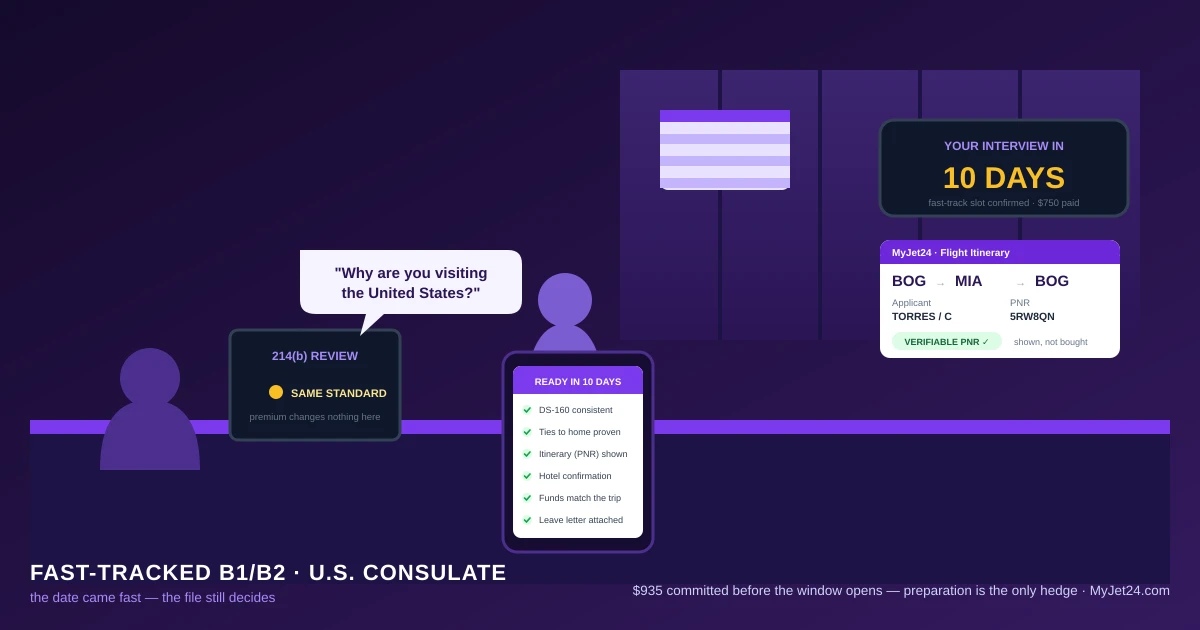
The fast-track compresses your preparation window from months to days — with $935 already committed. The checklist doesn't change; the deadline does:
- One consistent story across DS-160, documents and answers. Dates, employer, purpose, funding — the officer cross-checks in seconds; contradictions are the fastest 214(b) there is.
- Ties to home, on paper. Employment letter with approved leave, property, family obligations, studies — whatever pulls you back.
- A concrete plan you haven't paid for. Consulates explicitly advise against buying tickets before approval — with $935 already at risk, adding non-refundable airfare is indefensible. A verifiable flight itinerary with a live PNR plus a hotel confirmation shows the plan without the exposure — ready in about 30 seconds each.
- Funds that match the itinerary. Bank statements that plausibly cover the trip you're presenting — see our guide to financial proof embassies trust.
- Bring the full paper file from our B1/B2 interview checklist — most interviews never open it, but the one question you can't answer verbally is answered by the folder.
Why This Exists: Backlogs, the World Cup Summer and Pilot Economics
Three forces converged on 1 July. First, the structural backlog: B1/B2 demand rebounded faster than consular staffing after the pandemic years, leaving multi-month waits entrenched at dozens of posts. Second, the calendar: the 2026 FIFA World Cup across the US, Mexico and Canada produced a surge of visitor-visa demand exactly when calendars were fullest — the pilot's June announcement and July start are not a coincidence. Third, fiscal logic: 25,000 slots × $750 is up to $18.75 million in revenue for capacity the posts can staff flexibly, and a six-month pilot generates exactly the data — uptake, no-show rates, displacement effects — that decides whether pay-for-speed becomes permanent.
What it means for you is simpler: the pilot ends 31 December 2026 unless extended. If your travel is next year and your consulate's wait is long, don't bank on the option existing in January — either use the free levers now, or plan around the regular calendar.
Six Expensive Misunderstandings
- "$750 improves my chances." No — it moves the date. The refusal rate at your post applies to premium applicants identically.
- "I'll get the $750 back if I'm refused." No — it is explicitly non-refundable, refusal included.
- "It's $750 total." No — $750 plus the $185 application fee upfront ($935), plus $250 at issuance if approved ($1,185 all-in).
- "Any US consulate offers it." No — selected posts only, ~25,000 slots worldwide, first come first served until the pilot ends.
- "It also speeds up my passport return / administrative processing." No — only the interview date moves. Everything after the window runs at normal speed.
- "Sites can book the premium slot for me for an extra charge." Treat any third-party site "reselling" fast-track access as a scam. The fee is paid inside the official scheduling system only — the same rule as for every other US visa payment.
Frequently Asked Questions
What is the $750 US visa fast-track fee?
An optional premium introduced as a pilot on 1 July 2026: B1/B2 visitor visa applicants at selected US embassies and consulates can pay $750 on top of the standard $185 application fee to receive an interview appointment within about 10 days instead of the regular wait. The pilot runs through 31 December 2026 with roughly 25,000 expedited slots worldwide.
How much does a fast-tracked US visa cost in total in 2026?
$935 upfront ($185 application fee + $750 premium), and if approved, the $250 Visa Integrity Fee is collected at issuance — bringing the complete total to $1,185. A fast-tracked application that gets refused still costs the full $935.
Does paying $750 increase my chance of visa approval?
No. The fee only accelerates the appointment date. The interview, Section 214(b) assessment, document requirements and refusal rates are identical for premium and regular applicants. A weak application fails just as fast — only sooner and $750 poorer.
Is the $750 refundable if my visa is refused?
No. The premium is non-refundable in all scenarios — refusal, missed appointment or cancelled plans. Combined with the $185 application fee, a refused fast-track attempt costs $935 with nothing to show for it, which is why the decision framework and interview preparation matter more than the payment.
Which visa types can use the fast-track option?
Only B-1/B-2 visitor visas (business and tourism) during the 2026 pilot. Student (F/M), work (H/L/O), exchange (J) and other categories are not included — they continue to use the regular calendar and the free expedited-request mechanism where justified.
Is the fast-track available at every US embassy?
No — only at selected embassies and consulates participating in the pilot, and only while the worldwide pool of roughly 25,000 slots lasts. If your post doesn't participate or slots are exhausted, the option won't appear in the scheduling system.
How fast is the interview after paying?
Within about 10 days of the request, subject to slot availability at your post. Note that only the interview moves faster — passport return and any administrative processing after the interview run at normal speed, so build the complete timeline before paying for an event with a hard date.
How do I get a faster US visa interview without paying $750?
Three free routes: (1) the official expedited-appointment request for documented emergencies (medical, funeral, urgent business), (2) the interview waiver / Dropbox for eligible renewals, which skips the interview entirely, and (3) monitoring the scheduling portal for cancellation slots, which regularly surface months ahead of the headline wait time.
Is the $750 fee the same as the $250 Visa Integrity Fee?
No — they are separate charges. The $250 Integrity Fee is mandatory for most approved nonimmigrant visas and collected at issuance; the $750 is an optional interview accelerator paid at booking during the pilot. An expedited, approved applicant pays both, on top of the $185 application fee.
Does the fast-track exist for ESTA / Visa Waiver travelers?
It's irrelevant to them: VWP nationals traveling under ESTA don't attend consular interviews at all, so there is nothing to expedite. ESTA has its own small fee and its own conditions — including the onward or return ticket requirement checked at boarding.
Should I buy my flight before the fast-tracked interview?
No — the compressed timeline doesn't change the rule. Consulates advise against purchasing non-refundable tickets before a visa is issued, and with $935 already committed, adding airfare to the risk is the worst version of the bet. A verifiable flight itinerary with a live PNR presents your concrete plan without the financial exposure.
Will the $750 fast-track become permanent after 2026?
Undecided. The pilot ends 31 December 2026, and the State Department will evaluate uptake and operational effects before any extension or expansion. If your travel falls in 2027, plan around the regular calendar and the free expedite mechanism rather than assuming the paid option survives.
Can a third-party service book the $750 fast-track for me?
The fee is paid within the official visa scheduling system only. Any website or agent claiming to "resell", "reserve" or "guarantee" premium slots for an extra charge should be treated as a scam — the same caution that applies to every US visa payment and to copycat fee sites generally.
Where is the $750 fee officially documented?
In the State Department's consular fee schedule update published in the Federal Register on 9 June 2026, with program details announced by the Department ahead of the 1 July start. Check travel.state.gov and your embassy's visa pages for participating-post announcements and current availability.
Sources & further reading
- Federal Register (9 June 2026) — Schedule of Fees for Consular Services
- U.S. Department of State — visa fee schedule
- Ogletree Deakins — $750 expedited interview option analysis
- Envoy Global — premium fee program alert
Participating posts, slot availability and program terms are evolving during the pilot; confirm current details with your embassy and travel.state.gov before paying. This guide reflects conditions documented as of July 2026.
