
Last updated: 17 May 2026 · Reading time: 12 minutes · Author: Marc Hoffmann, Senior Visa Consultant
TL;DR — Dubai 96-Hour Free Transit Visa 2026
- Dubai's 96-Hour Free Transit Visa is a no-cost entry permit allowing eligible travelers to stay in Dubai for up to 96 hours (4 days) between connecting flights — with zero application fee.
- It is available exclusively on Emirates (EK) and flydubai (FZ) flights. Flying into DXB on any other airline — Air Arabia, Etihad, Qatar Airways, etc. — does not qualify.
- Your inbound and outbound flights must share the same PNR (booking reference). Two separate one-way tickets, even both on Emirates, will get you denied at check-in — this single rule causes ~40% of boarding refusals.
- You must present a booking at a DTCM-licensed hotel. Airbnb stays, unlicensed guesthouses, and "staying with friends" do not satisfy this requirement.
- If the 96-hour transit does not fit your itinerary, the UAE Visa on Arrival (AED 100, 14 days) is the fallback — no same-PNR rule, no DTCM hotel requirement.
The Dubai 96-Hour Free Transit Visa is a UAE government scheme that allows eligible foreign nationals to enter Dubai for up to 96 hours without paying any visa fee, provided they hold a confirmed round-trip or onward itinerary on Emirates or flydubai under a single booking reference, and a reservation at a licensed Dubai hotel. It is the cheapest legal way to spend time in Dubai between international flights.
Table of Contents
- What is the Dubai 96-Hour Free Transit Visa?
- Who qualifies — nationalities and passport requirements
- Emirates and flydubai exclusivity explained
- The same-PNR rule — why it kills 40% of applications
- DTCM hotel requirement — what agents actually check
- How to get the 96-hour transit visa: step-by-step
- 96-Hour Transit vs UAE Visa on Arrival: comparison
- Charter flights and codeshare exclusions
- 7 most common refusal reasons at check-in
- If your application is denied: the INADAD process
- Frequently asked questions
What is the Dubai 96-Hour Free Transit Visa?
The Dubai 96-Hour Free Transit Visa is a UAE Federal Authority for Identity, Citizenship, Customs and Ports Security (ICP) entry permit that grants eligible travelers up to 96 hours of stay in Dubai between connecting flights, at no cost. It is not a pre-approval process — the visa is granted at Dubai International Airport (DXB) immigration counter on arrival, after the airline verifies eligibility during check-in at the departure airport.
Emirates branding for this scheme is "Dubai Connect." flydubai refers to the same benefit under its transit visa services. Despite different names, both airlines operate under the same ICP policy framework, processed through the DTCM and ICP's integrated clearance system.
"The 96-hour transit is not a standard tourist visa. It is a conditional entry permit tied to your airline booking. Change the booking, lose the visa."
— Marc Hoffmann, Senior Visa Consultant, MyJet24
The 96-hour clock starts from the moment you clear immigration at DXB — not from your flight arrival time. If you land at 23:45 and clear passport control at 00:30, your 96 hours begins at 00:30. You must depart Dubai before that window closes. Overstaying triggers an AED 200/day overstay fine under UAE Federal Decree-Law No. 29 of 2021.
Unlike the China 240-hour visa-free transit or Singapore's VFTF, Dubai's 96-hour scheme is not a blanket nationality-based entitlement. It is an airline-product tied to specific carriers operating at DXB. That distinction is the root cause of most refusals. For a comparison with other regional free-transit schemes, see our 2026 transit visa country guide.
Who qualifies — nationalities and passport requirements
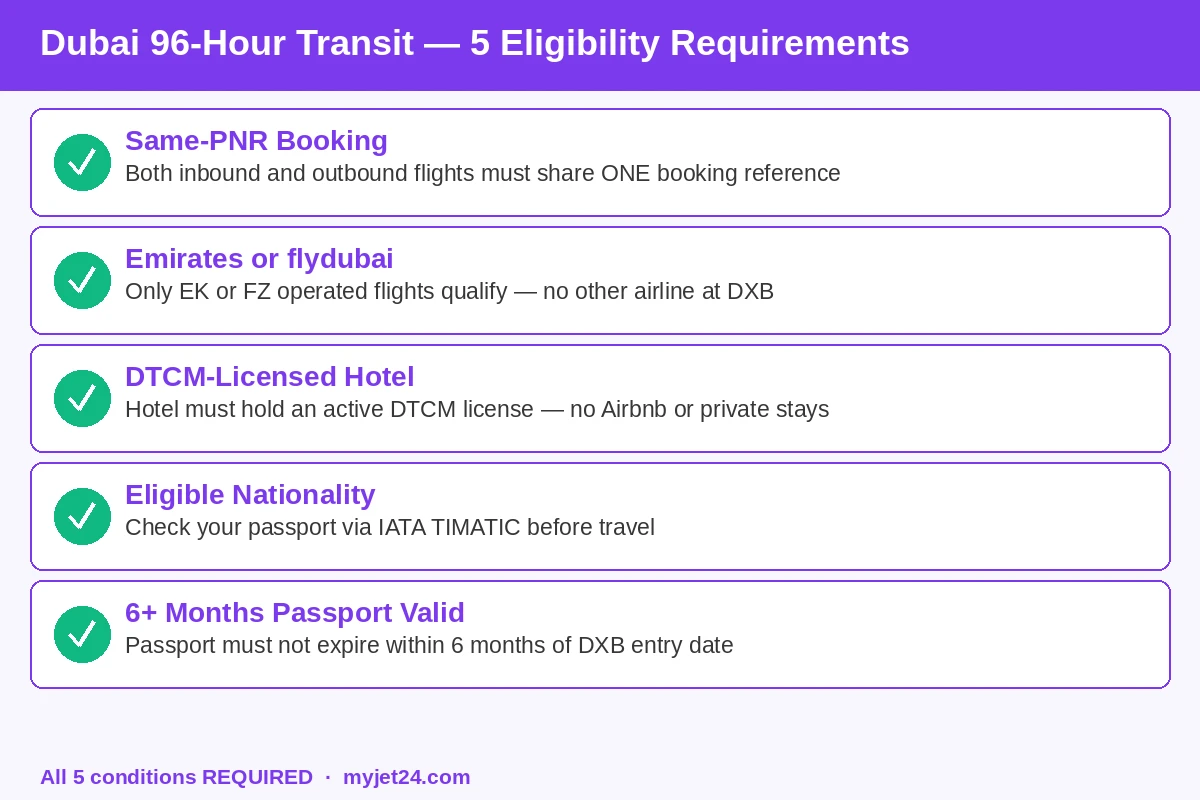
Eligibility for the 96-Hour Free Transit Visa is determined by the UAE ICP under a nationality clearance system called INADAD (Immigration Nationality and Aliens Department Automated Decision). The eligible nationality list is not published in a simple PDF — it is embedded in the airline's boarding system (Altéa for Emirates, DCS for flydubai) and checked in real time at departure check-in.
As a general rule, travelers holding passports from the following groups are eligible:
| Group | Examples | Typically Eligible? |
|---|---|---|
| Western Europe | UK, Germany, France, Netherlands, Spain, Italy, Sweden, Switzerland | ✅ Yes |
| North America / Oceania | USA, Canada, Australia, New Zealand | ✅ Yes |
| East Asia | Japan, South Korea, Singapore, Hong Kong SAR | ✅ Yes |
| GCC nationals | Saudi Arabia, Kuwait, Bahrain, Qatar, Oman | ✅ Yes (visa-free UAE entry anyway) |
| South Asia | India, Pakistan, Bangladesh, Sri Lanka, Nepal | ❌ Not eligible — must apply for UAE visa |
| Most of Africa | Nigeria, Ghana, Ethiopia, Kenya (varies) | ⚠️ Case-by-case — check with Emirates/flydubai directly |
| Select Middle East | Syria, Iraq, Yemen, Afghanistan, Iran | ❌ Not eligible |
Passport validity required: Your passport must be valid for at least 6 months from your date of entry into Dubai. A passport expiring in less than 6 months will be flagged at check-in regardless of nationality eligibility. The definitive eligibility check is IATA Travel Centre (Timatic) — the same database airline agents use. Enter your nationality and destination DXB; it will show transit permission status in real time.
Indian, Pakistani, and Bangladeshi passport holders cannot use the 96-hour free transit. They must apply for a UAE tourist or transit visa separately. Our Dubai and UAE visa guide covers the standard UAE visa process with flight reservation requirements in detail.
Emirates and flydubai exclusivity — why other airlines can't offer this
The Emirates/flydubai exclusivity is the most misunderstood aspect of the 96-hour transit scheme. The policy is not a general Dubai airport benefit — it is contractually tied to the two Dubai-flag carriers that co-own and operate at DXB Terminals 3 and 2 respectively.
Why the exclusion? The UAE ICP imposes carrier liability — if an ineligible passenger is admitted under a transit visa, the sponsoring airline bears the financial penalty and deportation cost. Emirates and flydubai have signed MOUs with ICP agreeing to absorb this risk, which is why they are authorized to apply for the permit on your behalf at check-in. No other airline operating into Dubai has signed the same MOU. This is a structural, policy-level exclusion — not something that can change based on the route or airport.
| Airline | Hub | 96-Hour Transit Available? | Alternative |
|---|---|---|---|
| Emirates (EK) | DXB T3 | ✅ Yes | — |
| flydubai (FZ) | DXB T2 | ✅ Yes | — |
| Air Arabia (G9) | SHJ (Sharjah) | ❌ No | UAE VoA or standard visa |
| Etihad (EY) | AUH (Abu Dhabi) | ❌ No | UAE VoA or standard visa |
| Qatar Airways (QR) via DXB | DXB (rare routing) | ❌ No | UAE VoA or standard visa |
| Other international carriers at DXB | DXB T1 | ❌ No | UAE VoA or standard visa |
Note on Emirates + flydubai codeshare: Emirates and flydubai do operate codeshare routes where a flight carries both an EK and FZ number. On codeshare segments, the operating carrier is what matters for the 96-hour transit — if the operating carrier is Emirates or flydubai, the transit applies. If a third airline operates the flight under an EK marketing code, it does not.
The same-PNR rule — the trap that causes 40% of boarding denials
The same-PNR rule is the single most common — and most preventable — cause of 96-hour transit refusals. The rule states: your inbound flight to Dubai (DXB) and your outbound flight from Dubai must be booked on the same PNR (Passenger Name Record, also called booking reference). A PNR is a 6-character alphanumeric code like "X7K3PQ" that ties all legs of an itinerary together.
"Two separate one-way tickets — even both on Emirates, even flying the same routes on the same days — do not qualify for the 96-hour free transit. The check-in system looks for a single PNR linking inbound and outbound. If it finds two PNRs, it returns a NOCL (No Clearance) decision and the agent must deny boarding."
— Emirates check-in operations, DXB T3 boarding SOP
Why this rule exists: When you book a round-trip or multi-city itinerary on emirates.com or flydubai.com, the system creates one PNR covering all legs. Emirates assumes legal responsibility for ensuring your onward flight departs — because it's in their system. If you buy two separate one-way tickets, each ticket sits in a different PNR, and the airline's boarding system cannot verify continuity. The carrier liability MOU with ICP requires a verifiable onward itinerary, and only a shared PNR satisfies that requirement.
Does a verified dummy ticket on a different PNR work? No. A dummy ticket generates its own PNR on a different airline or booking system. The Emirates/flydubai boarding agent can see that PNR exists, but since it is not linked to your inbound Emirates/flydubai booking, it fails the same-PNR check. A dummy ticket is useful for proving onward travel for visa applications — but the 96-hour transit does not use a visa application process. It uses the airline's check-in system, which requires the matching PNR. For how dummy tickets function in other visa contexts, see our PNR verification guide.
How to book correctly: Always book your full itinerary — inbound to DXB and outbound from DXB — in a single booking session on emirates.com, flydubai.com, or through a travel agent who creates one combined PNR. Do not book inbound and outbound on separate occasions, even if the flights are on the same carrier.
DTCM hotel requirement — what boarding agents actually check
The DTCM hotel requirement is the second-most misunderstood rule. DTCM stands for the Dubai Department of Economy and Tourism (formerly the Dubai Tourism Commerce Marketing Board). Every hotel legally operating in Dubai must hold a valid DTCM license — a unique license number tied to the property.
When you present your hotel booking at check-in, the Emirates or flydubai agent does not simply check that you have a booking — they check that the hotel's DTCM license is valid and active in the system. Properties that fail this check include:
- Airbnb apartments and short-term rental listings (Airbnb is not DTCM-licensed as a hotel category)
- Informal guesthouses and unlicensed bed-and-breakfast properties
- Private residences (staying with family or friends)
- Properties whose DTCM license has lapsed or is under renewal
- Some budget hostels that have switched to apartment licensing instead of hotel licensing
What works: Any established hotel chain operating in Dubai — Marriott, Hilton, Hyatt, Rotana, Jumeirah, IHG, Accor, Premier Inn, ibis, and similar — carries an active DTCM license. Budget-to-luxury hotels listed on Booking.com or Hotels.com will generally carry DTCM licensing; Booking.com explicitly displays DTCM license numbers for Dubai properties in the property details page.
"The DTCM license number appears on every hotel invoice in Dubai. If your hotel booking confirmation doesn't show a DTCM number, call the property and request a confirmation document that includes it before your travel date."
Staying airside only? If you do not plan to leave the airport transit zone (DXB has a well-equipped airside transit hotel called the Dubai International Hotel), you still need a DTCM-licensed accommodation booking. The Dubai International Hotel holds a DTCM license. A booking there fully satisfies the hotel requirement even though it is physically inside the terminal.
How to get the 96-hour transit visa: step-by-step
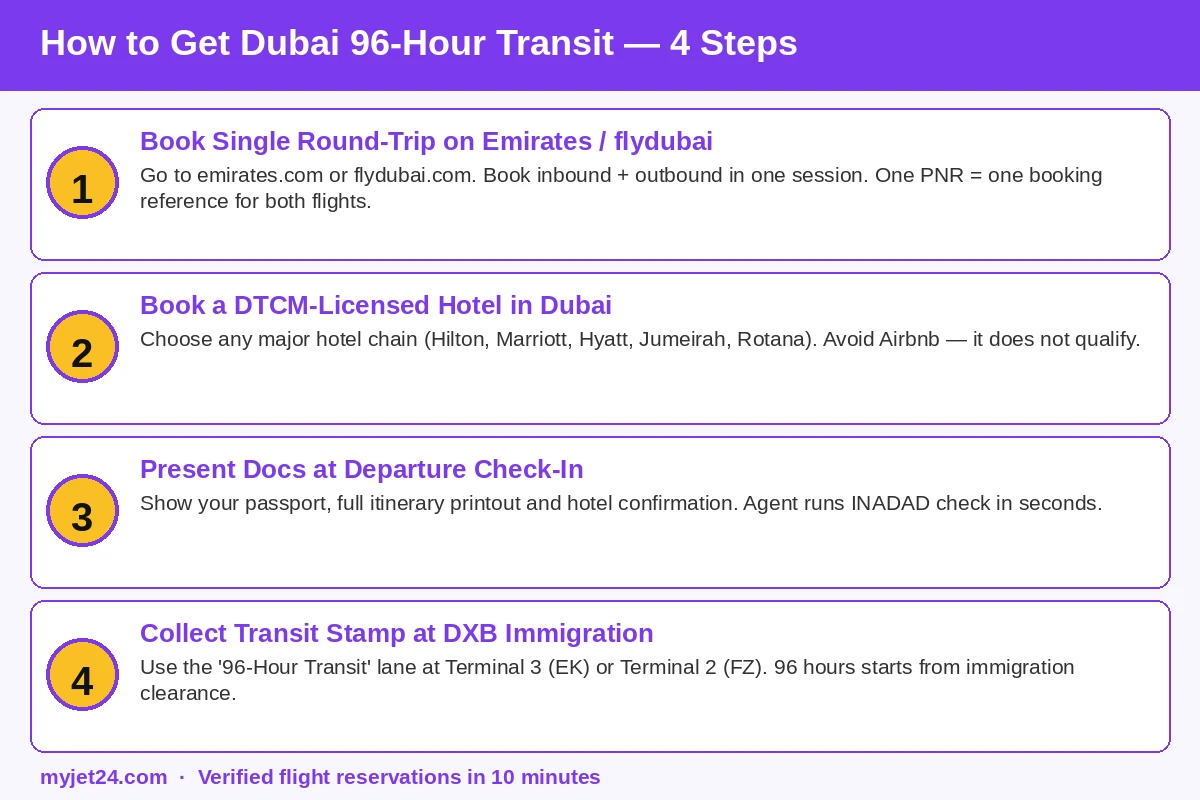
There is no pre-travel application, no online form, and no fee payment. The entire process happens at departure check-in. Here is the exact sequence:
- Book your itinerary as a single round-trip or multi-city booking on emirates.com or flydubai.com — both inbound to DXB and outbound from DXB must be in the same PNR. Do not book them separately.
- Book a DTCM-licensed hotel in Dubai for your stay. Obtain the hotel confirmation email which should include the property's DTCM license number.
- At check-in (your departure airport), present: your passport (6+ months validity), your airline booking confirmation showing the full itinerary, and your hotel booking confirmation.
- The check-in agent runs your details through the airline's boarding system, which queries ICP/INADAD in real time. Within seconds, it returns either CLEA (clearance granted) or NOCL (no clearance).
- If CLEA: The agent notes your transit permission and issues your boarding pass. No sticker or stamp is given at departure — the entry stamp is applied at DXB immigration upon arrival in Dubai.
- On arrival at DXB, proceed to the "Transit Visa" or "96-Hour Transit" lane at immigration (signposted at T3 and T2). Present your passport and boarding pass. The ICP officer stamps a 96-hour entry permit — this is your visa.
- During your Dubai stay, keep your hotel booking confirmation accessible. You may be asked to show it at any point. Stay only at the DTCM-licensed hotel you declared — changing accommodation mid-stay is technically a violation.
- Depart Dubai before your 96 hours expire. You can check the exact expiry time on the stamp in your passport. The departure ICP officer will verify this at passport control.
96-Hour Transit vs UAE Visa on Arrival: which should you use?
The UAE Visa on Arrival (VoA) is an alternative entry option for eligible nationalities arriving at DXB. It is valid for 14 days, costs AED 100 (~USD 27) plus an AED 20 service fee, and has no same-PNR requirement and no DTCM hotel requirement. Here is when to choose each:
| Factor | 96-Hour Free Transit | UAE Visa on Arrival (14 days) |
|---|---|---|
| Cost | Free (AED 0) | AED 120 (~USD 33) |
| Duration | 96 hours (4 days) | 14 days |
| Carrier requirement | Emirates or flydubai only | Any airline into DXB |
| Same-PNR required? | Yes — mandatory | No |
| DTCM hotel required? | Yes — mandatory | No |
| Application location | Airline check-in desk at departure | DXB immigration on arrival |
| Extendable? | No | Yes — one extension available |
| Best for | Short 2-4 day Dubai stopover on Emirates/flydubai round-trip | Flexible itinerary, non-EK/FZ routing, stays over 4 days |
Decision rule: If you are flying Emirates or flydubai on a single round-trip booking and your Dubai stay is 4 days or fewer, the 96-hour free transit saves you AED 120. If your stay exceeds 4 days, if your itinerary involves multiple bookings, or if you are flying a different carrier, use the VoA instead. For broader context on which countries require proof of onward travel for entry, see our proof of onward travel country guide.
Charter flights and codeshare exclusions
Charter operators are not eligible for the 96-hour transit, regardless of the destination. If you are flying to Dubai on a TUI, Condor, Corendon, or any other charter airline — even if the charter lands at DXB — you cannot access the 96-hour free transit scheme. Charter flights sit outside the ICP carrier liability framework entirely.
This exclusion catches European package-holiday travelers off guard. A common scenario: a traveler books a charter package from Germany to Dubai (DXB) with onward plans — they assume they qualify for 96-hour transit since they are landing at DXB, only to discover at check-in that the charter carrier is not in the ICP MOU system. The UAE VoA is the correct option in this case.
7 most common refusal reasons at check-in
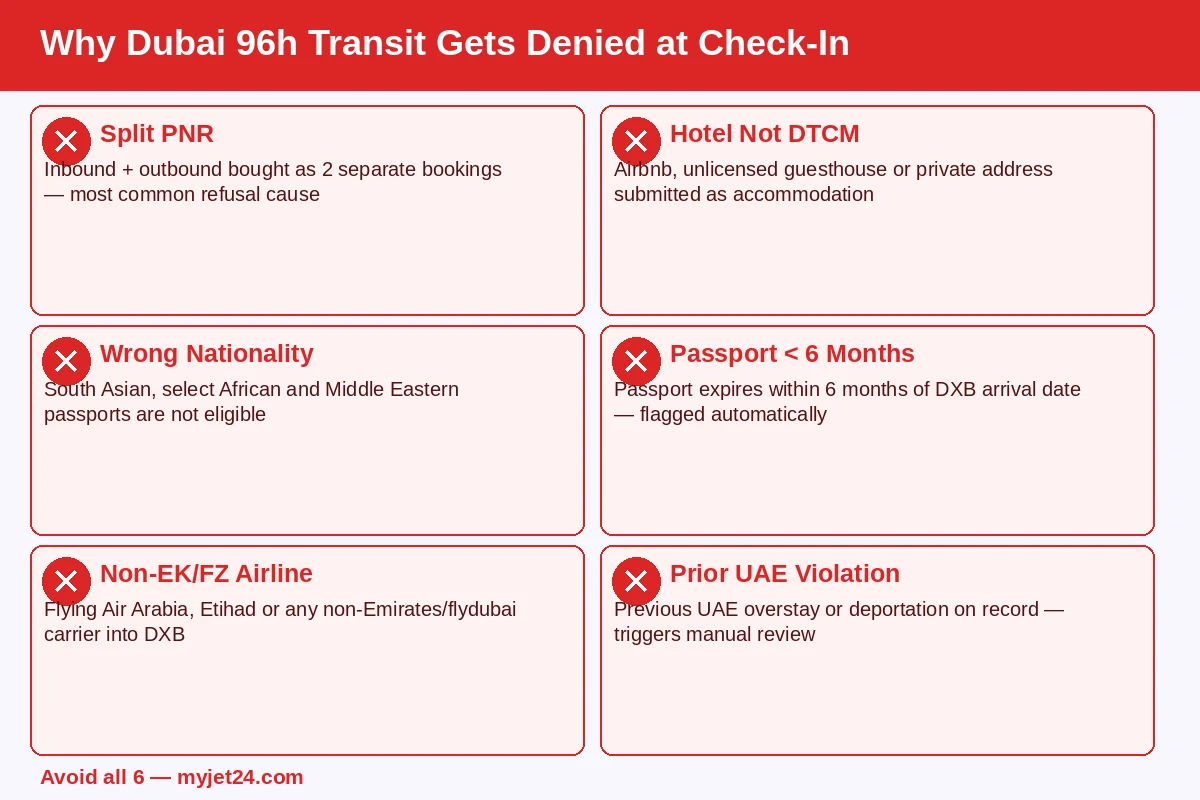
- Split PNR (separate one-way bookings) — The #1 cause. Two separate booking references, even on the same airline, trigger NOCL. Solution: always book inbound + outbound in one session.
- Ineligible nationality — South Asian, most African, and select Middle Eastern passports do not qualify. Solution: apply for a UAE visa before travel via UAE ICP's online portal.
- Non-DTCM hotel booking — Airbnb, unlicensed guesthouses, or private stays. Solution: rebook at a DTCM-licensed property before check-in.
- Passport validity under 6 months — The check-in system automatically flags passports expiring within 6 months. Solution: renew your passport before travel.
- Flying a non-qualifying airline — Any carrier other than Emirates or flydubai. Solution: rebook on EK or FZ, or apply for the VoA.
- Itinerary departure city same as arrival city — The system checks that you are truly transiting, not using the scheme for a simple roundtrip ending back at origin. Unusual routing anomalies can trigger a manual review flag.
- Prior UAE visa violations or overstays — If your passport shows a prior UAE overstay or deportation stamp, the INADAD system may flag your name and return NOCL regardless of other qualifying factors. Solution: apply for a standard UAE visa in advance, which gives the ICP time to review your history manually.
For a broader look at how airlines enforce proof of onward travel policies and what boarding agents actually check, see our airline boarding denial guide.
If your application is denied: the INADAD escalation process
If the airline check-in system returns NOCL and you believe the denial is incorrect — for example, you are confident your nationality qualifies but the system is showing a flag — there is a limited escalation path via the INADAD system.
Step 1: Request the check-in supervisor (not the regular agent) to manually submit a "TIMATIC override request" to the airline's travel document compliance team. Emirates has a 24/7 travel document desk reachable from check-in terminals.
Step 2: If the supervisor cannot resolve it at the airport, contact UAE ICP directly through the UAE ICP inquiry portal (icp.gov.ae). Provide your passport details and the NOCL reference number (the check-in agent can give you this). ICP can issue a manual clearance — but this process takes 24-72 hours and is not practical on the day of travel.
Practical advice: Do not count on day-of escalation. If your travel date is firm, carry the UAE VoA as a backup plan whenever you are uncertain about your 96-hour transit eligibility. The VoA costs AED 120 and is issued in minutes at DXB immigration — far less stressful than being offloaded from a departing flight.
Frequently Asked Questions
Can I use the 96-hour transit if I book Emirates through a third-party site like Expedia?
Yes — as long as the booking creates a single PNR that includes your full round-trip or onward itinerary through DXB, the booking channel does not matter. The PNR is what the airline system checks, not where the ticket was purchased. Always verify that your Expedia or third-party booking shows one unified booking reference, not separate references for each leg.
Does the 96-hour transit work if I fly Emirates inbound and flydubai outbound?
Yes — since Emirates and flydubai are partner airlines under the Emirates Group, a combined itinerary with Emirates inbound and flydubai outbound (or vice versa) can be issued on a single PNR. This is common on Emirates.com, which sells flydubai-operated routes. Confirm that the booking confirmation shows one PNR and lists both flight segments on the same document.
Can I visit Abu Dhabi or other Emirates during my 96-hour transit?
Technically, the 96-hour transit stamp is a UAE entry permit, which gives you access to all seven Emirates — not just Dubai. Travelers do visit Abu Dhabi and Sharjah during a 96-hour transit stopover. However, the permit is administratively linked to your Dubai hotel booking, so any activity outside Dubai is at your own discretion. There is no legal restriction, but your transit remains tied to your DXB departure, so ensure you can return to Dubai International Airport in time.
What happens if my outbound flight is cancelled and I overstay 96 hours due to the airline's fault?
If the overstay is caused by an airline cancellation or a force-majeure event (documented by the airline), the ICP has historically waived the AED 200/day overstay fine on production of an official airline cancellation notice. You must obtain written documentation from the airline at DXB on the day of the disruption. Without documentation, the fine applies automatically at passport control on departure.
Is the Dubai 96-hour transit the same as the Emirates Dubai Stopover program?
No — they are separate programs that serve different purposes. The 96-Hour Free Transit Visa is a UAE government immigration permit with no cost. The Emirates Dubai Stopover program is a commercial hotel-and-activities package sold by Emirates Holidays, which can be added to a booking for a fee. You can use the 96-hour transit without purchasing the Dubai Stopover package — just book your own DTCM-licensed hotel separately.
Can Indian, Pakistani, or Bangladeshi passport holders use the 96-hour transit?
No. South Asian passports are not eligible for the 96-Hour Free Transit Visa. Holders of Indian, Pakistani, or Bangladeshi passports who wish to visit Dubai must apply for a UAE tourist visa (30-day or 60-day) or a UAE transit visa in advance through an authorized UAE visa service. Our Dubai UAE visa guide covers the complete application process for these nationalities.
How does the 96-hour transit compare to free transit schemes in China or Singapore?
China's 240-hour visa-free transit allows 10 days at no cost but requires a "third country" onward destination — you cannot return to your home country. Singapore's VFTF allows 96 hours airside or landside for most nationalities, no hotel requirement, and any airline. Dubai's 96-hour transit is more restrictive (airline-specific, same-PNR, DTCM hotel) but does not impose a third-country rule — you can fly Emirates roundtrip home. See our China 240-hour transit guide for a full comparison.
Do children need a separate 96-hour transit application?
Children traveling on their own passport follow the same process as adults — the check-in system checks each passport individually. Children listed on a parent's passport (in countries that still issue family passports) are covered by the parent's clearance. Infants on lap (no separate seat) are processed together with the parent at check-in. Confirm your children's nationality eligibility through IATA TIMATIC before travel.
Next steps: how to set up a compliant Dubai stopover booking
The Dubai 96-hour free transit is genuinely one of the world's best free stopover programs — four days in one of the most tourist-ready cities on earth, at zero permit cost. But it is also one of the most technically precise: get the PNR wrong, pick the wrong hotel, or fly the wrong airline, and you will not board.
Your compliance checklist before travel:
- Confirm your nationality is eligible via IATA TIMATIC (iatatravelcentre.com)
- Book inbound + outbound on Emirates or flydubai in a single booking session — one PNR
- Book a DTCM-licensed hotel in Dubai — confirm the DTCM license number on your hotel confirmation
- Check passport validity: must be 6+ months valid at DXB entry date
- Carry printed copies of your hotel confirmation and full flight itinerary (single PNR) to check-in
If your onward ticket is not yet booked and you need a verified flight reservation to confirm your plans before purchasing a full ticket, MyJet24 provides real PNR-backed flight reservations in under 10 minutes — each with a verifiable 6-character PNR that shows as confirmed in airline systems. Get your verified flight reservation →
Last updated: 17 May 2026 · Author: Marc Hoffmann, Senior Visa Consultant
Marc Hoffmann
Senior Visa Consultant · MyJet24
Marc has 11 years of experience in travel documentation, transit visa compliance, and airline boarding procedures. He has personally assisted travelers through DXB transit processes and specializes in the intersection of airline systems and immigration law. He writes MyJet24's guides on UAE entry, dummy tickets, and proof of onward travel requirements.
