
Last updated: 5 May 2026 · Reviewed by: Marc Hoffmann, Senior Visa Consultant
TL;DR
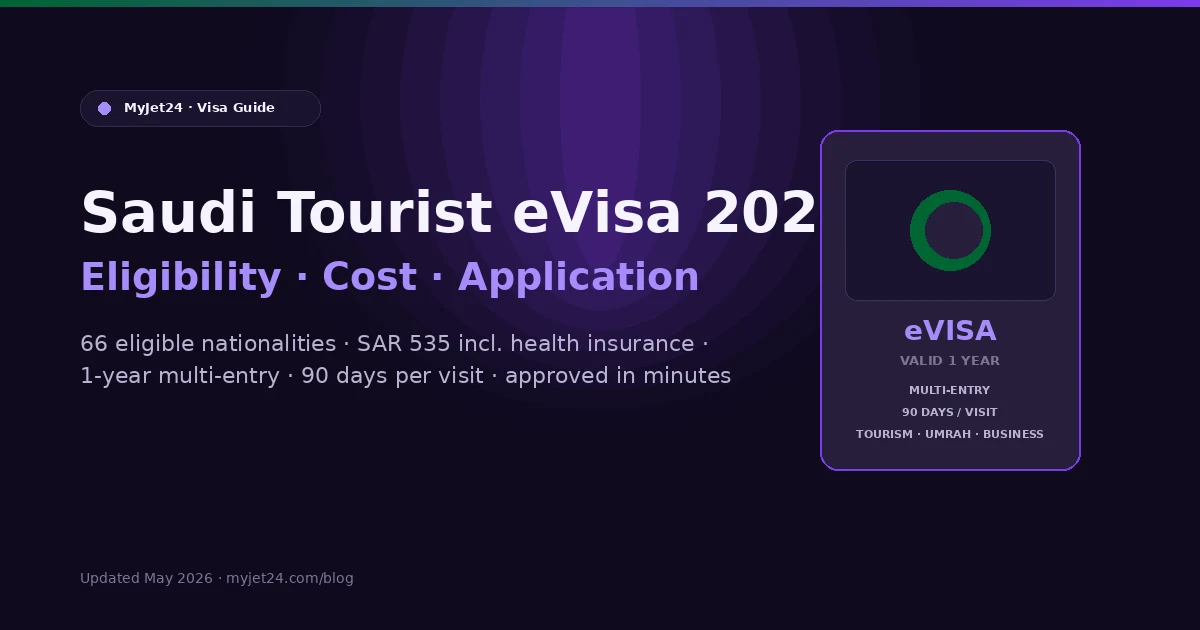
- The Saudi tourist eVisa is a 1-year, multi-entry visa allowing 90 days per visit for tourism, family visits, business meetings and Umrah outside the Hajj season.
- 66 nationalities can apply directly online; GCC residents of any profession can also apply if their residency is valid for at least 3 months.
- Total cost is SAR 535 (approximately USD 142): SAR 300 base fee, ~SAR 180 mandatory health insurance, ~SAR 55 VAT and processing.
- Apply at visa.visitsaudi.com; most decisions arrive in 5–30 minutes, rarely up to 24 hours.
- You must show a passport valid 6+ months, a return-flight reservation and accommodation evidence — a verified dummy ticket works.
Quick answer for travellers
The Saudi tourist eVisa is an electronic 1-year multi-entry visa for citizens of 66 eligible countries, plus residents of any GCC state. It costs SAR 535 (≈ USD 142) including mandatory health insurance, allows 90-day stays, and is approved within minutes through the official Visit Saudi portal. Applicants must hold a passport valid for at least 6 months and present a confirmed return-flight reservation and accommodation booking.
Table of contents
- What is the Saudi tourist eVisa?
- Who can apply: 66 eligible nationalities + GCC residents
- Cost breakdown: where the SAR 535 actually goes
- Documents required for the eVisa
- How to apply: 5-step process at visa.visitsaudi.com
- Tourist eVisa vs Hajj vs Umrah vs Business visa
- Flight reservation and hotel booking — what consulates accept
- The 2026 GCC Schengen-style unified visa
- If your country is not on the list: alternative pathways
- At Riyadh/Jeddah/Dammam airport: what officers actually ask for
- Common mistakes that lead to refusal or delay
- Frequently asked questions
What is the Saudi tourist eVisa?
The Saudi tourist eVisa is an electronic visa issued by the Saudi Arabian government to nationals of 66 eligible countries, plus residents of any Gulf Cooperation Council (GCC) state. It allows multiple entries over one year, with a maximum stay of 90 days per visit, and covers tourism, family visits, attendance at events, business meetings and Umrah pilgrimage performed outside the Hajj season.
Saudi Arabia launched the tourist eVisa in September 2019 as part of the Vision 2030 economic diversification programme — moving the kingdom away from being a Hajj-and-Umrah-only inbound tourism market. By 2026, the system has been progressively expanded: GCC residents of any profession became eligible (a major 2024 expansion), processing times have dropped to minutes, and the Vision 2030 target of 100 million annual tourist visits is reshaping the visa infrastructure.
The eVisa is issued through visa.visitsaudi.com, the official portal operated by the Ministry of Tourism. There is no need to visit a Saudi embassy or consulate — the entire process is online, and the visa arrives by email as a printable PDF.
Who can apply: 66 eligible nationalities + GCC residents
Eligibility for the Saudi tourist eVisa is based on nationality, with three distinct pathways: direct eVisa for the 66 listed countries, GCC-resident eVisa for foreign residents of any of the six Gulf states, and visa-exempt entry for GCC nationals themselves.
Direct eVisa — 66 eligible countries
Citizens of these countries can apply directly online, grouped by region:
- Europe (35): Andorra, Austria, Belgium, Bulgaria, Croatia, Cyprus, Czech Republic, Denmark, Estonia, Finland, France, Germany, Greece, Hungary, Iceland, Ireland, Italy, Latvia, Liechtenstein, Lithuania, Luxembourg, Malta, Monaco, Montenegro, Netherlands, Norway, Poland, Portugal, Romania, San Marino, Slovakia, Slovenia, Spain, Sweden, Switzerland, United Kingdom, Vatican City.
- Asia (10): Brunei, China, Hong Kong, Japan, Kazakhstan, Macau, Malaysia, Singapore, South Korea, Taiwan (issuance varies — verify before applying).
- Americas (10): Argentina, Brazil, Canada, Costa Rica, Mexico, Panama, Peru, United States, Uruguay (and limited Caribbean states).
- Oceania (2): Australia, New Zealand.
- Other: Maldives, Mauritius, South Africa, Tajikistan, Turkey, Ukraine and select additional jurisdictions.
Verify the current list at the official Visit Saudi portal before applying — the eligibility list is reviewed periodically and additions/removals happen.
GCC residents of any profession
Since 2024, the Saudi government has eligible all foreign residents of GCC states (United Arab Emirates, Kuwait, Qatar, Bahrain, Oman) to apply for the tourist eVisa, regardless of profession. This is a major expansion: previously, only specific professional categories were accepted.
"All Gulf Cooperation Council residents are now eligible to obtain a single- or multiple-entry e-visa to Saudi Arabia, regardless of their profession." — Saudi Ministry of Tourism, 2024 expansion.
To qualify under the GCC-resident pathway, your residency permit must be valid for at least 3 months at the time of application, and your passport for at least 6 months. First-degree relatives (spouse, children, parents) and domestic workers travelling with their GCC-resident sponsor can be added to the application.
GCC nationals — visa-exempt
Citizens of Bahrain, Kuwait, Oman, Qatar, and the United Arab Emirates do not need a visa to enter Saudi Arabia. They can stay up to 90 days for tourism, business or family purposes. Entry is processed at the airport against the GCC national identity card or passport.
Cost breakdown: where the SAR 535 actually goes
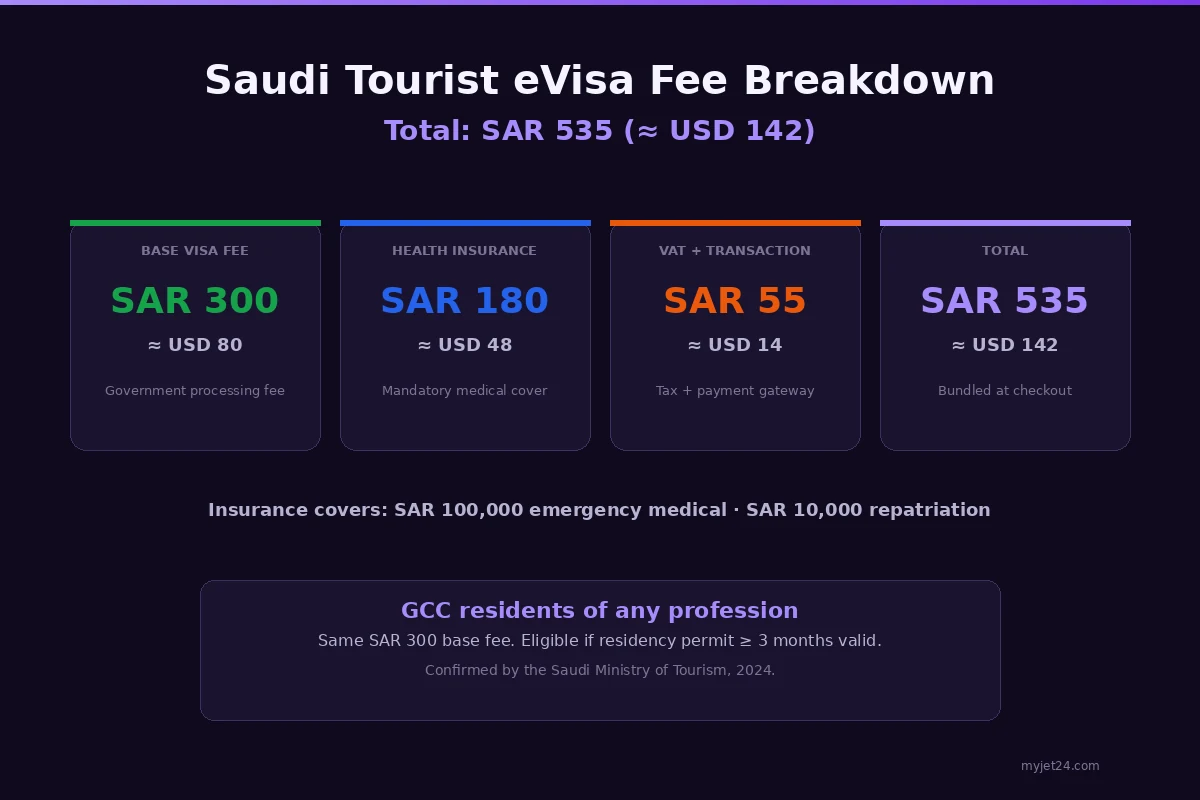
The total Saudi eVisa fee is SAR 535 (approximately USD 142), but most search results show this number without explaining the structure. Here is the actual breakdown:
| Component | SAR | USD (approx.) | What it covers |
|---|---|---|---|
| Base visa fee | 300 | ≈ 80 | Government processing fee |
| Mandatory health insurance | ≈ 180 | ≈ 48 | Emergency cover up to SAR 100,000 + repatriation up to SAR 10,000 |
| VAT and transaction fees | ≈ 55 | ≈ 14 | Tax + payment gateway |
| Total | ≈ 535 | ≈ 142 | Bundled at checkout |
The bundled health insurance is mandatory and cannot be opted out of, even if you already hold travel insurance. Coverage is minimal by international standards — SAR 100,000 (≈ USD 27,000) for emergency medical and SAR 10,000 (≈ USD 2,700) for repatriation — so most travellers add a comprehensive policy for adventure activities, longer stays or family travel.
Documents required for the Saudi eVisa
The eVisa application is online but requires specific documents uploaded as JPEG or PDF:
- Passport bio page scan: valid for at least 6 months from the intended date of entry, with at least 2 blank pages.
- Recent photograph: JPEG or JPG, 100–200 KB file size, white background, no head covering for non-religious applicants, taken within the last 3 months.
- Confirmed return-flight reservation: a real, verifiable booking — not a screenshot of a website mock-up. A free dummy ticket with a real PNR code satisfies this requirement without forcing you to buy a non-refundable fare.
- Accommodation evidence: hotel booking, host invitation, or proof of relative's residence in Saudi Arabia. Cancellable hotel bookings are widely accepted.
- Bank statement or employer letter (for some applicants): demonstrates financial means to cover the trip.
- Valid debit or credit card for paying the SAR 535 fee at checkout.
How to apply: 5-step process at visa.visitsaudi.com
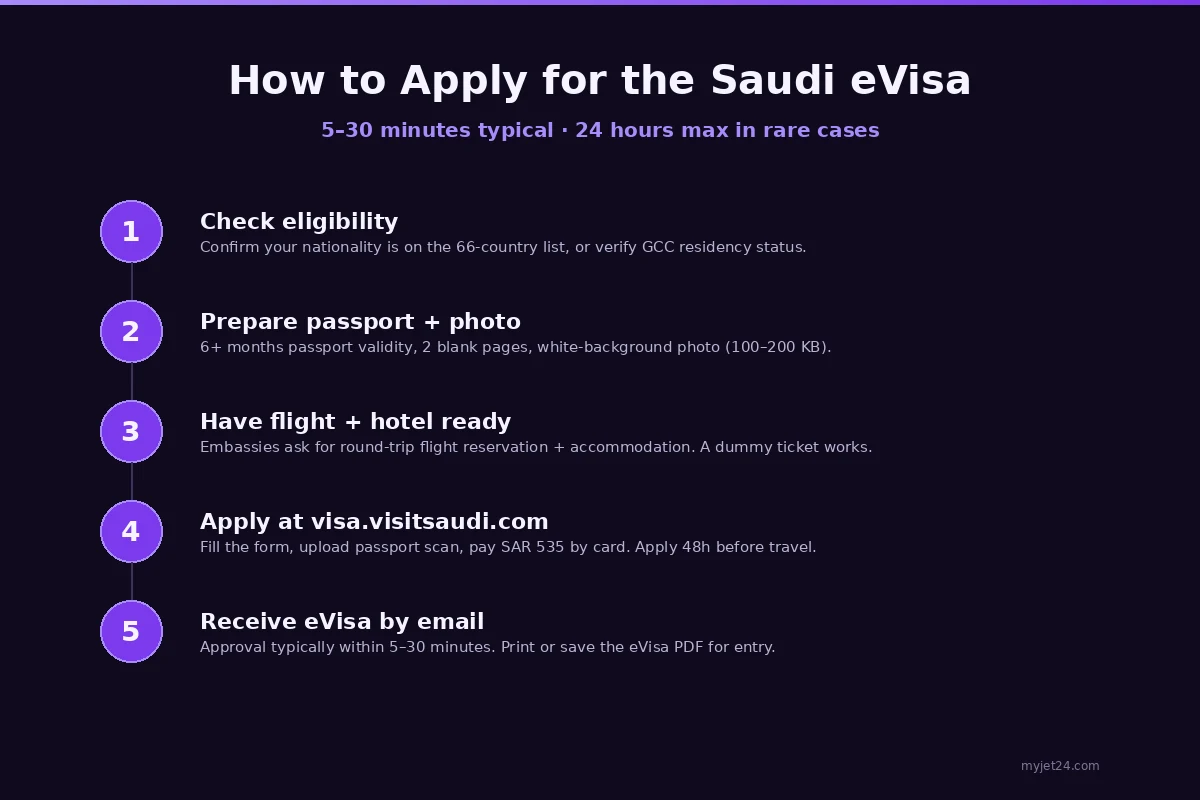
- Confirm eligibility. Check the official 66-country list, or verify your GCC residency status. Apply directly online if eligible.
- Prepare your passport, photo and supporting documents. Passport must be 6+ months valid with 2 blank pages. Photo must meet the 100–200 KB JPEG specification. Have flight and hotel reservations ready.
- Generate a flight reservation and book accommodation. Saudi border officers and the application system both expect proof of onward travel and accommodation. Generate a verified dummy ticket for the eVisa application — embassies treat verified PNRs identically to purchased tickets, with no financial loss if the visa is refused.
- Apply online at visa.visitsaudi.com. Complete the application form, upload your passport scan and photograph, declare the purpose of travel, and pay the SAR 535 fee by debit or credit card. Apply at least 48 hours before your travel date to allow for any rare verification delays.
- Receive your eVisa by email. Most applications are approved within 5 to 30 minutes. In rare cases, additional verification can take up to 24 hours. Print or save the eVisa PDF — you will need to present it at boarding and on arrival in Saudi Arabia.
Tourist eVisa vs Hajj vs Umrah vs Business visa
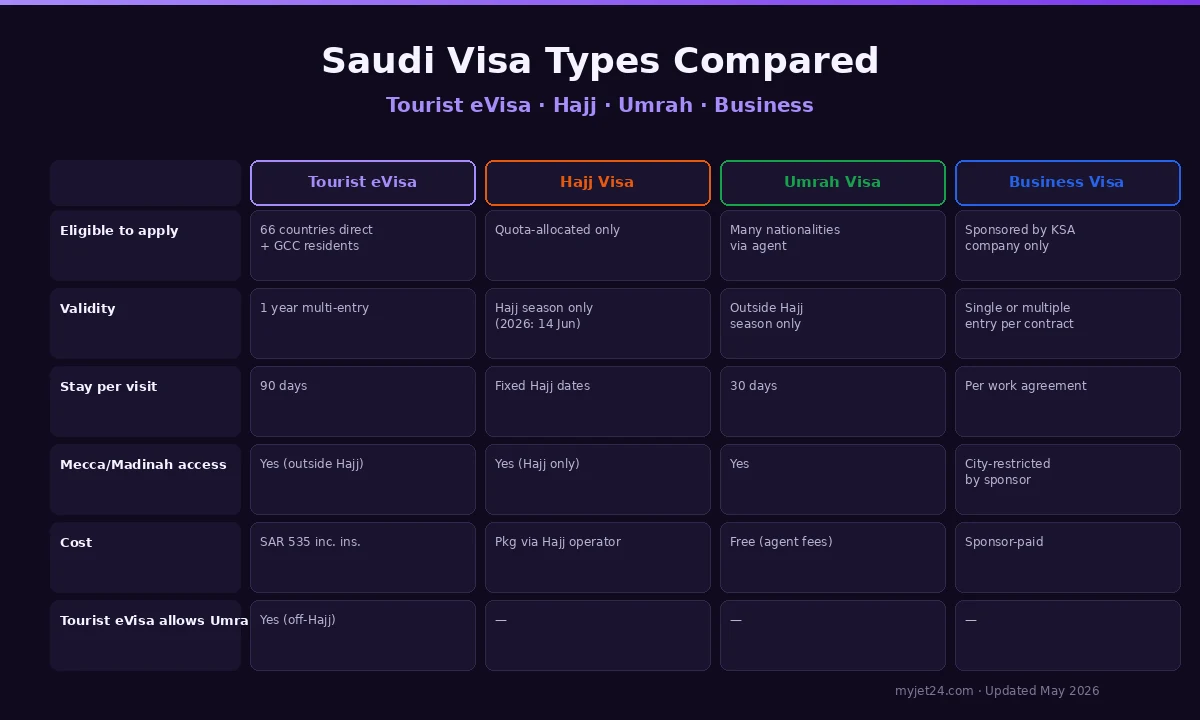
One of the most-asked questions about the Saudi eVisa is whether it covers religious pilgrimage. The short answer: the tourist eVisa covers Umrah outside the Hajj season, but it does not replace the dedicated Hajj visa. Here is the practical comparison:
| Aspect | Tourist eVisa | Hajj Visa | Umrah Visa | Business Visa |
|---|---|---|---|---|
| Eligible to apply | 66 countries direct + GCC residents | Allocated only via national Hajj quota | Many nationalities via licensed agent | Sponsored by KSA-based company |
| Validity | 1 year multi-entry | Hajj season only | Outside Hajj season only | Single or multiple entry per contract |
| Stay per visit | 90 days | Fixed Hajj dates | 30 days | Per work agreement |
| Mecca/Madinah access | Yes, outside Hajj | Yes, Hajj only | Yes | Restricted to sponsor city |
| Cost | SAR 535 incl. insurance | Package via Hajj operator | Free (agent fees apply) | Sponsor-paid |
| Tourist eVisa allows Umrah? | Yes (off-Hajj) | — | — | — |
The tourist eVisa is the most flexible single visa for visiting Saudi Arabia — but it is not a substitute for Hajj. Hajj remains tightly quota-controlled and routed through national Hajj operators in your home country.
Flight reservation and hotel booking — what consulates accept
The eVisa application form requires you to declare your arrival date, departure date and accommodation. Saudi border officers at Riyadh, Jeddah and Dammam airports also frequently ask to see proof of return travel and where you will stay. Most travellers fail this requirement by misunderstanding what counts as valid evidence.
What works:
- Verified flight reservation with a real PNR code — issued by a real Global Distribution System (GDS), retrievable on the airline website. A dummy ticket from a reputable provider creates exactly this evidence without you paying for a non-refundable fare.
- Cancellable hotel bookings — most large hotel chains and Booking.com offer free-cancellation rates. The reservation is accepted as evidence; you can cancel after entry if plans change.
- Host invitation letter if visiting family — must include the host's Saudi residence permit (iqama) details, address and contact information.
What does not work:
- Screenshot of a flight search engine (no PNR, no airline confirmation).
- An expired or cancelled previous reservation.
- An unverifiable hotel "voucher" from an unknown source.
The 2026 GCC Schengen-style unified visa
The GCC unified visa is a planned single-entry tourist visa that, once operational, will allow holders to travel across all six GCC states (Saudi Arabia, United Arab Emirates, Kuwait, Qatar, Bahrain, Oman) on one application. The Saudi Minister of Tourism confirmed at the November 2025 Manama Forum that the rollout is targeted for 2026.
Practical implications when launched:
- One application, one fee, six countries — directly modelled on the EU Schengen framework.
- Major appeal for Western tourists doing multi-stop Gulf itineraries (Dubai + Doha + Riyadh in a single trip).
- The Saudi tourist eVisa will continue to exist alongside the unified visa; travellers visiting only Saudi Arabia will still use the eVisa.
- The unified visa is initially expected to apply to passports already eligible for the Saudi tourist eVisa — meaning the 66-country list is the practical baseline.
As of May 2026, the unified visa is announced but not yet operational. We will update this guide as the rollout begins. Until then, the tourist eVisa remains the active route for visiting Saudi Arabia.
If your country is not on the list: alternative pathways
Citizens of countries not on the 66-country list — including most South Asian, Sub-Saharan African and some Middle Eastern nationalities — cannot apply for the eVisa directly. But three alternative pathways exist:
- GCC residency. If you hold a residence permit in the UAE, Kuwait, Qatar, Bahrain or Oman with at least 3 months remaining validity, you qualify for the eVisa under the GCC-resident pathway. Same SAR 300 base fee plus mandatory health insurance.
- Sponsor-issued tourist visa. A Saudi-based individual, hotel, tour operator or licensed agency can sponsor a paper tourist visa application. Processing typically takes 5–10 working days through the Saudi embassy or consulate in your country, plus agency fees.
- Hajj or Umrah dedicated visa. Pakistani, Indonesian, Bangladeshi, Egyptian, Indian and Nigerian nationals applying specifically for religious pilgrimage are routed through their respective national Hajj/Umrah agents. These visas do not allow general tourism — they are tied to specific religious itineraries and pre-approved accommodation.
For example, a Pakistani national living in Pakistan would route through (3) for Hajj/Umrah travel; the same Pakistani national working in Dubai with a UAE residence permit would qualify under (1) for general tourism. See our Pakistan passport visa requirements guide for the full picture.
At Riyadh/Jeddah/Dammam airport: what officers actually ask for
The Saudi eVisa is electronic, but border officers at the three main international airports — King Khalid International (Riyadh), King Abdulaziz International (Jeddah) and King Fahd International (Dammam) — apply standard secondary-inspection processes for first-time tourist arrivals.
What officers commonly request:
- The eVisa PDF (printed or on phone) with the QR code visible for scanning.
- The passport used to apply for the eVisa.
- Your return-flight reservation — this is most often verified through the airline check-in system at point of entry.
- Proof of accommodation for at least the first night.
- A short conversation about purpose of travel — keep your answers consistent with what you declared in the eVisa application.
Common entry refusal causes are inconsistent purpose of travel (declared as tourism but answers suggest work), missing accommodation evidence, or eVisa for someone else (different passport details). The system is rapid for prepared travellers and forgiving for honest applicants who answer clearly.
Common mistakes that lead to refusal or delay
- Applying with a passport that expires within 6 months of intended entry. This is an automatic refusal — the system rejects the application before it reaches a human reviewer.
- Photo not meeting the 100–200 KB JPEG specification. Wrong size, wrong format, dark background or head covering for a non-religious application all trigger rejection. Use a VFS-affiliated photo service or follow the Visit Saudi specification exactly.
- Buying a non-refundable flight before approval. Most travellers do not need a purchased ticket — a verified reservation is sufficient. Use a dummy ticket for the eVisa application and only buy the actual ticket once approval is confirmed.
- Inconsistent travel narrative. Declaring tourism in the application but having a hotel booked next to a corporate office or repeated short trips can trigger purpose-of-travel scrutiny.
- Applying less than 48 hours before travel. While most applications process in minutes, the official guidance is to apply at least 48 hours ahead — this protects against the rare 24-hour verification delay.
Frequently asked questions
Detailed FAQs are rendered in the dedicated section below this article. Quick highlights:
- Apply 48 hours+ before travel for safety.
- The eVisa allows Umrah outside Hajj season — but not Hajj itself.
- SAR 535 includes mandatory health insurance you cannot opt out of.
- GCC residents of any profession qualify since 2024.
- The unified GCC Schengen-style visa is targeted for 2026 launch but not yet operational as of May 2026.
Next step: prepare your flight reservation
If you are eligible for the Saudi tourist eVisa, the next practical step is preparing the supporting documents — and the one most travellers stumble on is the flight reservation. Buying a non-refundable ticket before approval risks a substantial loss; submitting a screenshot of a flight search does not pass verification.
Generate a free dummy flight ticket with a real PNR code in 60 seconds:
Get a verified flight reservation for your Saudi eVisa
Real PNR · embassy-accepted · ready in 60 seconds · free
Generate free dummy ticket →For a wider view of pre-application planning, see our 2026 visa application checklist and proof of onward travel requirements by country.
Last reviewed: 5 May 2026 · Author: Marc Hoffmann, Senior Visa Consultant at MyJet24 · Sources: Visit Saudi (official), Saudi Ministry of Tourism, GCC Secretariat communiqués 2024–2026.
