Do Schengen embassies accept a dummy ticket for visa applications?
Yes. All 27 Schengen member states accept dummy tickets (also called flight itineraries or flight reservations) under the EU Visa Code. Most Schengen embassies explicitly advise applicants not to purchase confirmed tickets before visa approval — a reservation or itinerary is the correct document to submit.
Which Schengen embassy processes visa applications fastest?
Processing times vary by embassy and season. In 2026, Germany, Netherlands, and Czech Republic typically process applications within 5–15 business days. France and Italy can take 2–6 weeks, especially in summer. Always apply at the embassy of your main destination country.
Does my dummy ticket need to show entry into and exit from the Schengen Area?
Yes. Your flight itinerary must clearly show your arrival airport in a Schengen country and your departure from the Schengen Area, with dates that fall within the requested visa validity period.
Can I apply for a Schengen visa without buying any real flight ticket?
Yes — and most Schengen embassies recommend you do not buy confirmed tickets before your visa is approved. A free dummy ticket from MyJet24 with a PNR code is the correct and expected document for a Schengen visa application.
What is the Schengen Area and how many countries are in it?
The Schengen Area is a zone of 27 European countries that have abolished internal border controls. Citizens of non-EU countries can travel freely within it on a single Schengen visa for up to 90 days in any 180-day period. Members include Germany, France, Italy, Spain, Netherlands, Portugal, Greece, Austria, Switzerland, Belgium, Czech Republic, Hungary, Poland, Sweden, Norway, Denmark, Finland, Iceland, Croatia, Slovakia, Slovenia, Estonia, Latvia, Lithuania, Luxembourg, Malta, and Liechtenstein.
Do I need a separate dummy ticket for every Schengen country I visit?
No. A single Schengen visa covers all 27 member states. Your dummy ticket only needs to show entry into and exit from the Schengen Area as a whole. Apply at the embassy of the country where you will spend the most time.
What flight details do Schengen consulates require in a flight itinerary?
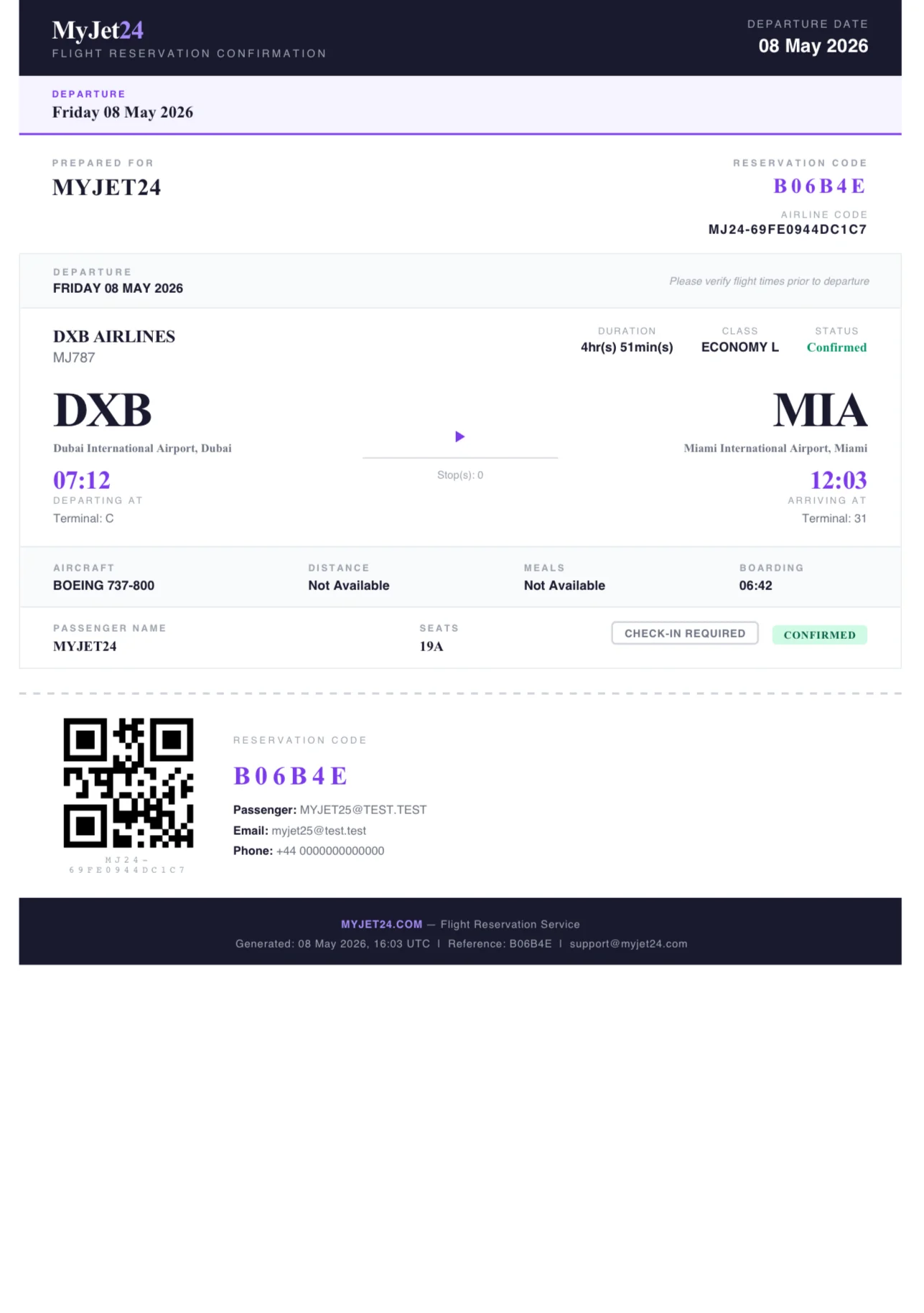
Schengen embassies require: your full name (matching passport), departure and arrival airports (with IATA codes), flight number and airline, outbound and return travel dates, a booking reference (PNR), and itinerary type (round-trip). A QR code strengthens the document. All these elements are included in a MyJet24 dummy ticket.
Can I use a one-way dummy ticket for a Schengen visa application?
Not recommended. Consulates require proof that you plan to leave the Schengen Area before your visa expires. A one-way ticket does not demonstrate this. Always use a round-trip itinerary showing your return or onward departure from the Schengen Area.
Does the German embassy accept dummy tickets for Schengen visa applications?
Yes. German missions worldwide explicitly advise applicants to provide a flight reservation — not a confirmed ticket. The guidance states: do not purchase flights before your visa is issued. A round-trip dummy ticket from MyJet24 with PNR code meets the German embassy flight itinerary requirement.
Does the French consulate require a confirmed flight booking for Schengen visas?
No. France Visa and TLScontact guidance lists a flight reservation as the required document — not a confirmed booking. Confirmed ticket purchase is not required at the application stage.
Which embassy should I apply to if I am visiting multiple Schengen countries?
Apply at the embassy of the Schengen country where you will spend the most nights. If you plan equal time in multiple countries, apply at the embassy of the country where you will enter the Schengen Area first.
How far in advance should I submit my Schengen visa application?
Schengen visa applications can be submitted up to 6 months before travel, but no less than 15 days before departure. For popular summer destinations, apply 4–8 weeks in advance.
What is the Schengen Area 90/180-day rule?
The 90/180-day rule means you can stay in the Schengen Area for a maximum of 90 days in any rolling 180-day period. Overstaying results in fines, entry bans, and can affect future visa applications.
Do I need proof of accommodation for every Schengen country I visit?
Not necessarily for every night, but you should have proof for your main destination and ideally the first and last nights. Booking.com cancellable reservations are accepted. Accommodation dates should align with your flight itinerary dates.
Does the Italian embassy require a round-trip flight itinerary?
Yes. Italian Schengen applications require a round-trip itinerary showing arrival in Italy or another Schengen country and departure before visa validity ends. A dummy ticket with the required elements is accepted by Italian consulates worldwide.
Can a digital nomad or remote worker apply for a Schengen visa?
Digital nomads can apply for short-stay Schengen visas as tourists (90 days). For stays longer than 90 days, some Schengen countries offer specific digital nomad visas: Germany Freelance Visa, Portugal D8, Greece Digital Nomad Visa.
What travel insurance is required for a Schengen visa?
Schengen visa applicants must provide travel insurance with a minimum coverage of €30,000, valid for the entire Schengen Area for the full duration of the stay. It must cover emergency medical expenses, hospitalisation, and repatriation.
Is a MyJet24 dummy ticket accepted by all 27 Schengen embassies?
Yes. MyJet24 generates dummy tickets in the standard airline reservation format with PNR code, QR code, passenger name, airports, flight numbers, and travel dates — all elements required by Schengen embassies. Thousands of Schengen applicants use MyJet24 successfully each month.
What documents do I need alongside my dummy ticket for a Schengen visa?
Alongside your flight itinerary, a Schengen visa application typically requires: valid passport (min 2 blank pages, valid 3 months beyond stay), passport photos (35×45mm), completed visa application form, proof of accommodation, travel insurance (min €30,000), bank statements, cover letter, and proof of ties to your home country.
Can I enter the Schengen Area with ETIAS once it launches?
ETIAS (European Travel Information and Authorisation System) is expected to launch in late 2026. It is a pre-travel authorisation for visa-exempt nationals — not a visa. Citizens currently requiring a Schengen visa will still need to apply through embassies. ETIAS applicants will also be required to have a return or onward travel itinerary as part of the application.