
Last updated: 10 July 2026 · Reading time: 14 min · Author: Joshua White, Travel Documentation Writer at MyJet24
TL;DR — Key Facts
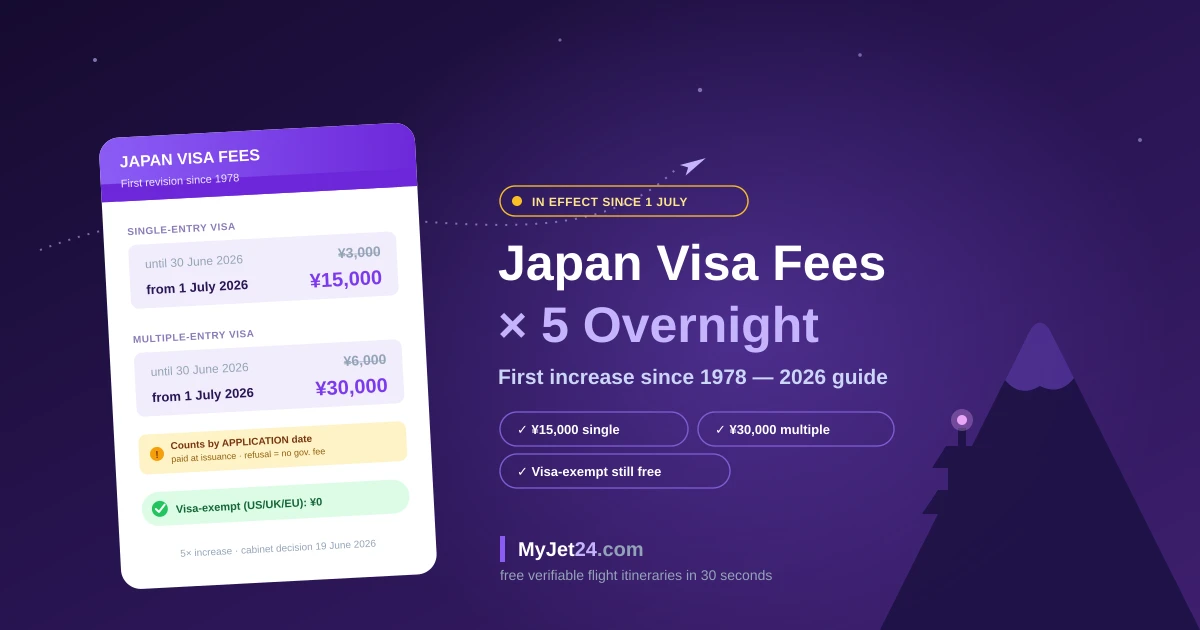
- Japan quintupled its visa fees on 1 July 2026 — a single-entry visa went from ¥3,000 to ¥15,000 (about $100), a multiple-entry visa from ¥6,000 to ¥30,000 (about $200). Approved by cabinet on 19 June 2026, it is the first revision of Japan's visa fees since 1978.
- The trigger is your application date, not your travel date. Applications submitted on or after 1 July 2026 pay the new amounts; the fee itself is collected when the visa is issued at the embassy or consulate.
- Most Western tourists pay nothing — still. Citizens of the ~70 visa-exempt countries (US, UK, EU, Canada, Australia and more) don't need a visa for short stays, so the increase doesn't touch them until Japan's JESTA authorization arrives around 2028.
- The increase lands hardest on visa-required nationalities — India, China, Vietnam, the Philippines, Indonesia and others — where ¥15,000 often exceeds what neighboring destinations charge, and where a refusal now wastes real money.
- A refusal doesn't refund your preparation costs. With ~$100 riding on a single-entry approval, the old advice matters more: never buy a non-refundable flight before approval — a free verifiable flight reservation covers the itinerary requirement without the gamble.
Japan raised its visa fees on 1 July 2026 for the first time in 48 years: a single-entry visa now costs ¥15,000 (up from ¥3,000, roughly $100) and a multiple-entry visa ¥30,000 (up from ¥6,000, roughly $200) — a fivefold increase approved by Japan's cabinet on 19 June 2026. The new rates apply to visa applications submitted on or after 1 July 2026, with the fee collected at issuance. Travelers from Japan's ~70 visa-exempt countries, including the US, UK, EU and Australia, are unaffected because they need no visa for short stays — the change primarily affects applicants from countries like India, China, Vietnam and the Philippines.
For 48 years, the price of a Japanese visa barely registered as a line item in anyone's travel budget. Set in 1978 and never revised, ¥3,000 — about twenty dollars at recent exchange rates — bought a single entry into one of the world's most visited countries. That era ended on 1 July 2026. Following a cabinet decision on 19 June, Japan multiplied its visa fees five times over: ¥15,000 for a single entry, ¥30,000 for multiple entries, the first fee revision in nearly half a century and one of the sharpest single adjustments any major destination has made.
Because the change arrived quickly — twelve days from cabinet approval to effect — the reporting around it has been a mess of half-facts: wrong effective dates, confusion about whether existing applications are caught, and headlines implying every tourist to Japan now pays $100 to enter. Most don't. This guide sorts the confirmed facts from the noise: the exact new price list, the application-date rule that decides what you pay, why the world's largest group of Japan tourists is untouched, what the increase means country by country for the travelers who actually pay it — and why getting the application right the first time just became worth real money. It pairs with our Japan eVisa application guide, which covers the process itself step by step.
What Changed on 1 July 2026: the New Price List
| Visa type | Until 30 June 2026 | From 1 July 2026 | Change |
|---|---|---|---|
| Single-entry visa | ¥3,000 (~$20) | ¥15,000 (~$100) | 5× |
| Multiple-entry visa | ¥6,000 (~$40) | ¥30,000 (~$200) | 5× |
The structure of the system did not change — only the amounts. The fee is still paid in local currency at the Japanese embassy, consulate or authorized visa agency handling your application, and it is still collected when the visa is issued, not when you file. A refused application continues to cost nothing in government fees (agency service charges, where applicable, are separate) — but everything you spent preparing it stays spent, which is where the real cost of a refusal now lives.
Exchange-rate note: dollar figures in this guide are approximations at mid-2026 rates. The yen amounts are the fixed, official numbers — budget in yen.
Why Now, After 48 Years
Japan's government gave three overlapping reasons, and none of them is "discouraging tourism":
- Five decades of inflation and exchange-rate drift. A fee set in 1978 no longer covered the administrative cost of processing a visa in 2026 — Japan's foreign minister said as much when announcing the change. Most comparable countries revised their fees repeatedly over the same period; Japan simply never did.
- A growing foreign population to administer. The additional revenue is earmarked for immigration infrastructure: staffing, processing systems, measures against illegal overstaying — and, notably, Japanese-language education programs for foreign residents.
- Alignment with international norms. At ¥3,000, Japan was charging a fraction of what peer destinations charge; at ¥15,000 (~$100), it sits in the same range as a UK visitor visa or a US B1/B2 application fee — expensive, but no longer an outlier in either direction.
Officials stated they expect no significant impact on inbound tourism — a reasonable bet, since the overwhelming majority of Japan's visitors come from visa-exempt countries and pay nothing under either the old or new schedule. The increase is real money only for the minority who apply for visas at all — which is exactly why the country-by-country picture below matters more than the headline.
The Date That Decides What You Pay
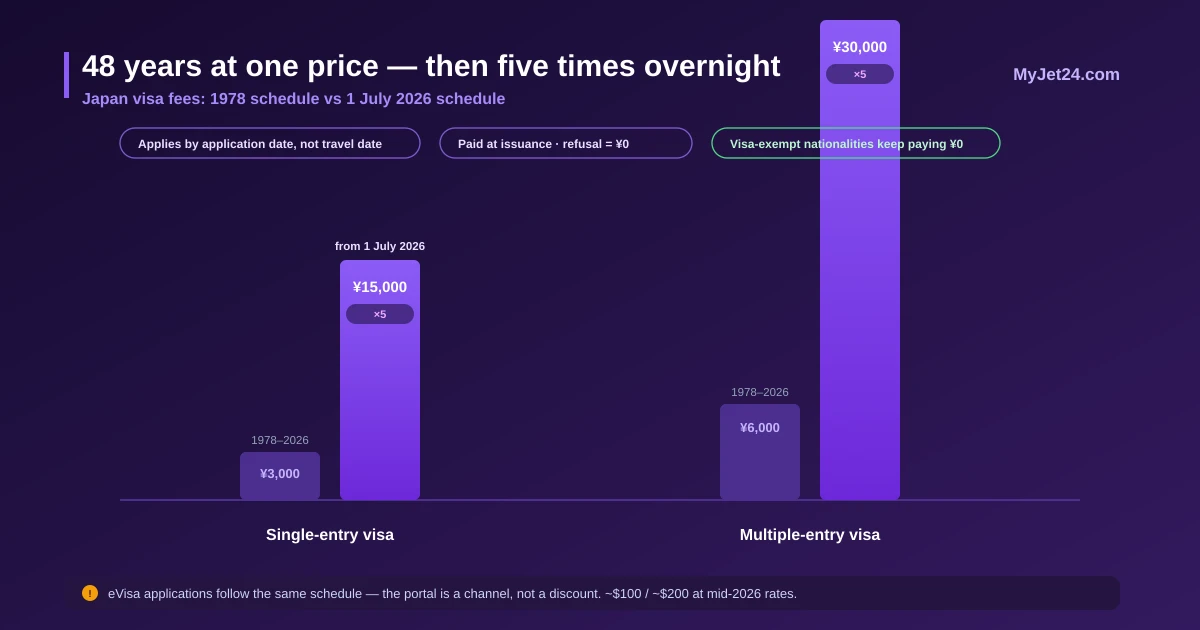
The rule is cleaner than most fee transitions: what you pay is decided by the date your application is submitted.
- Application filed on or before 30 June 2026 — old fees apply (¥3,000 / ¥6,000), even if the visa is issued in July or later.
- Application filed on or after 1 July 2026 — new fees apply (¥15,000 / ¥30,000), collected when the visa is issued.
Two practical consequences. First, if you filed in late June and your visa is issued now, you should be charged the old amount — if a consulate or agency quotes the new fee for a pre-July application, query it politely with your submission receipt. Second, for everyone applying from now on, the transition is simply over: budget ¥15,000 or ¥30,000, in local currency, and treat any lower number you find online as an outdated page.
Who Pays More — and Who Pays Nothing at All
| Traveler group | Effect of the July 2026 increase |
|---|---|
| Citizens of ~70 visa-exempt countries (US, UK, EU, Canada, Australia, South Korea, Singapore and more) on short stays | None. No visa needed, no fee paid — before or after the change. This covers the large majority of Japan's tourists. |
| Tourist and business visa applicants (India, China, Vietnam, the Philippines, Indonesia and other visa-required nationalities) | Full increase. ¥15,000 single / ¥30,000 multiple for applications from 1 July 2026 — including eVisa applications, which follow the same fee schedule. |
| Students and workers applying for long-stay visas | Full increase on the visa itself; separate (and much larger) immigration application fee rises are planned later — see below. |
| Travelers with visas already issued | None. Issued visas remain valid as issued; nothing is re-charged. |
The asymmetry is the story: the increase is invisible to most of Japan's visitors and very visible to the rest. For a family of four from Manila or Mumbai applying for single-entry tourist visas, the government fee alone went from roughly $80 to roughly $400 overnight — before flights, hotels, or the documents the application requires.
What It Means by Country: India, China, Vietnam, the Philippines
India. Indian applicants use the agency route for most tourist applications, adding service charges on top of the government fee — the total cost of a Japan trip's paperwork now starts around ¥15,000 plus agency fees, several times what a Thailand or Sri Lanka trip requires in fees (both currently free for Indians). Japan remains an aspirational destination; the calculus that changes is the cost of a refusal, which now wastes meaningful money. Our Japan visa documentation guide covers the file that approves first time.
China. Chinese tourists are Japan's largest visa-required group, and single-entry applications dominate. The fivefold jump lands directly on every applicant, though for group tours the fee is one line in a larger package price — expect tour operators to absorb visibility of the increase into package totals rather than itemize it.
Vietnam. Vietnamese applicants already navigate one of the more document-heavy Japan processes via designated agencies. The new fee raises the stakes of an incomplete file: agency charges plus ¥15,000 make a rejected application an expensive lesson. Financial documentation and a consistent itinerary matter more than ever.
The Philippines. Filipino travelers apply through accredited agencies, and the ¥15,000 government fee now typically exceeds the agency handling charge itself — a reversal of the old proportions. Budget both lines, and treat the itinerary and funds evidence as the parts worth perfecting; a verifiable flight itinerary and confirmed accommodation cover the travel-plan requirement without buying anything non-refundable.
Visa-Exempt Today, JESTA Tomorrow: the 2028 Horizon
If you hold a passport from one of Japan's visa-exempt countries and felt relieved reading this far — one nuance belongs on your radar. Japan has legislated JESTA, an electronic travel authorization modeled on the US ESTA, planned for around fiscal 2028. When it arrives, visa-exempt travelers will pre-register online and pay a small fee (expected in the ¥2,000–3,000 range) before boarding — the same shift the UK made with its ETA and Europe is making with ETIAS.
Nothing is required in 2026 or 2027: visa-exempt entry works exactly as it always has, with one long-standing condition that surprises first-time visitors — Japan expects arriving visitors to hold a return or onward ticket, and airlines flying to Japan check it at check-in. If your trip is one-way or open-ended, a free verifiable onward ticket answers that check in about 30 seconds.
What's Next: the Immigration Fee Increases Still Coming
The visa fee revision is stage one of a broader repricing of Japan's immigration system. Separate increases to in-country immigration application fees have been proposed with implementation anticipated as early as October 2026 — the headline example being permanent residence applications rising from ¥10,000 to ¥200,000, a twentyfold jump. Status-of-residence and extension fees are expected to rise in the same wave.
For tourists this changes nothing further; for anyone planning to study, work or settle in Japan, the message is that the era of nominal Japanese immigration fees is ending across the board — if a long-stay application is on your horizon and already prepared, filing before the next wave lands is worth real money.
Protecting a ¥15,000 Application: Documents That Approve First Time
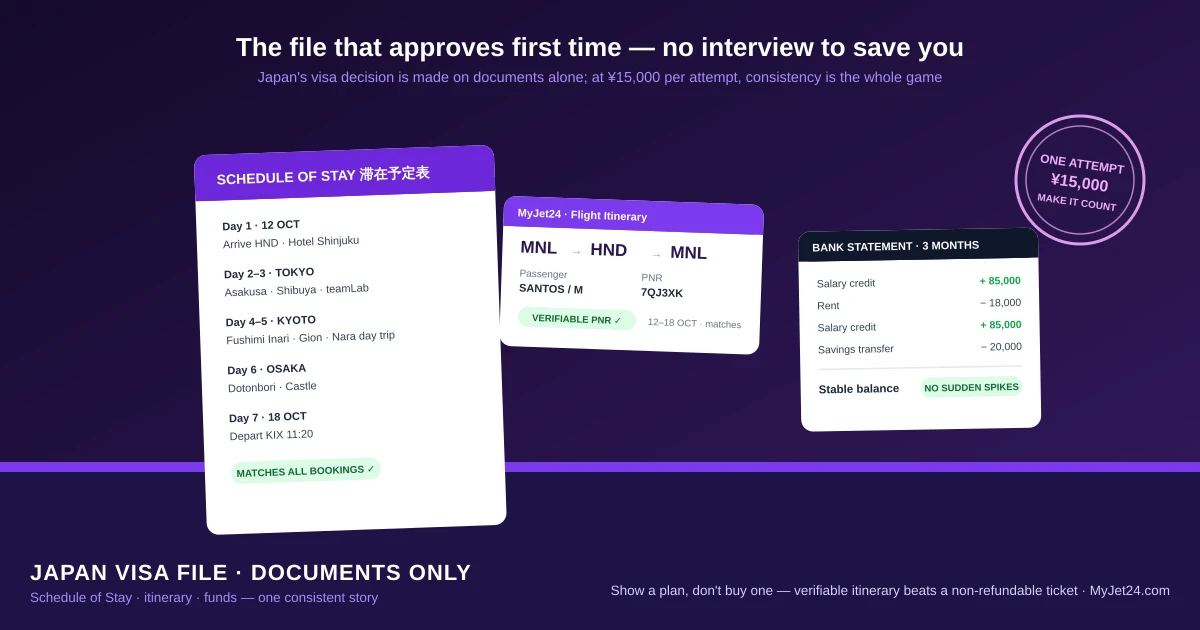
Japan's visa process is document-driven and unforgiving of inconsistency — there is usually no interview to explain yourself in, so the file speaks alone. With five times the fee riding on the outcome:
- Build the Schedule of Stay first. Japan's day-by-day itinerary form is the spine of the application; every other document should agree with it — flight dates, hotel nights, cities.
- Show a travel plan, don't buy one. Consulates and agencies expect a flight itinerary, not a purchased ticket. A verifiable reservation with a live PNR plus a hotel booking confirmation satisfies the requirement with zero financial exposure if the decision goes the wrong way.
- Make the money story boring. Stable balances, consistent income, funds plausibly covering roughly ¥15,000–20,000 per day of stay — sudden large deposits raise questions that a tourist application doesn't need.
- Match every name and date across documents. Passport spelling, bank statements, bookings, the Schedule of Stay — one inconsistent date is the cheapest refusal reason there is.
- Use the correct route for your nationality. Direct eVisa where available, accredited agency where required — the wrong channel wastes weeks before the file is even read.
Five Misunderstandings Already Spreading
- "Everyone visiting Japan now pays $100." No — the ~70 visa-exempt nationalities pay nothing, exactly as before. The fee touches visa applicants only.
- "It applies based on when you travel." No — it applies to applications submitted from 1 July 2026. A June application issued in July pays the old fee.
- "The eVisa has a different, cheaper price." No — the eVisa is a channel, not a discount; it follows the same fee schedule.
- "My existing visa needs a top-up payment." No — issued visas are unaffected entirely.
- "A refusal costs ¥15,000." No — the fee is collected at issuance, so a refusal costs no government fee. What it wastes is your preparation spend and time, which is why the documents section above exists.
Frequently Asked Questions
How much does a Japan visa cost in 2026?
For applications submitted on or after 1 July 2026: ¥15,000 (about $100) for a single-entry visa and ¥30,000 (about $200) for a multiple-entry visa, paid in local currency when the visa is issued. Applications filed before that date pay the old fees of ¥3,000 and ¥6,000. Agency service charges, where your nationality uses the agency route, come on top.
When did Japan's visa fee increase take effect?
1 July 2026, following a cabinet decision on 19 June 2026. It is Japan's first visa fee revision since 1978 — a 48-year gap — and raised both main visa types fivefold.
Why did Japan raise visa fees five times over?
Officially: 48 years of inflation and exchange-rate change had left the 1978 fee far below the real cost of processing, and the revenue funds immigration administration — staffing, systems, anti-overstay measures and Japanese-language programs for foreign residents. The new level also brings Japan in line with what comparable destinations charge.
Do US, UK and EU citizens have to pay the new Japan visa fee?
No — not because of an exemption from the fee, but because they don't need a visa at all for short stays. Citizens of Japan's ~70 visa-exempt countries enter fee-free for tourism, exactly as before the change. That remains true until Japan's JESTA electronic authorization launches around 2028.
Does the new fee apply if I applied before 1 July 2026?
No. The new amounts apply to applications submitted on or after 1 July 2026. If you filed in June and your visa is issued later, the old fee applies — keep your submission receipt in case a payment counter quotes the new rate in error.
Does the Japan eVisa cost the same as a regular visa now?
Yes — the eVisa is an application channel, not a separate price category. Applications from 1 July 2026 pay ¥15,000 for single entry regardless of whether they run through the eVisa portal or a consulate or agency.
Do I lose ¥15,000 if my Japan visa is refused?
No — the fee is collected at issuance, so a refusal costs no government fee. What a refusal does waste is everything you spent preparing (agency charges, document costs, time) and your travel plans, which is why submitting a complete, consistent file the first time matters more at the new price level.
Is a Japan visa now more expensive than other countries' visas?
It's now in the same range rather than dramatically cheaper. At roughly $100, a Japan single-entry visa costs about the same as a UK visitor visa and less than a US B1/B2 application once the US Integrity Fee is included. Against regional alternatives that are visa-free for many Asian nationalities (Thailand, Malaysia), Japan is now clearly the more expensive paperwork.
Do children pay the full new Japan visa fee?
Japan's fee schedule applies per visa issued, and family applications are priced per applicant. Some nationality-specific waivers and gratis arrangements exist under bilateral agreements — check the fee page of the Japanese embassy serving your country for the exact schedule that applies to your passport.
Will Japan's visa fee increase reduce tourism?
Japan's government expects no major impact, and the structural reason is simple: the large majority of Japan's visitors come from visa-exempt countries and never pay visa fees. The increase is most noticeable for visa-required nationalities, where it may shift some price-sensitive travelers toward visa-free regional alternatives — but Japan's demand has consistently outrun its paperwork costs.
What is JESTA and when will visa-free travelers have to pay it?
JESTA is Japan's planned electronic travel authorization for visa-exempt nationalities, modeled on the US ESTA and legislated in 2026 with a launch planned around fiscal 2028. It is expected to cost in the ¥2,000–3,000 range. Nothing is required for 2026 or 2027 travel — visa-exempt entry currently works unchanged.
Are more Japanese immigration fee increases coming?
Yes — separate increases to in-country immigration application fees have been proposed with implementation anticipated as early as October 2026, the most dramatic being permanent residence applications rising from ¥10,000 to ¥200,000. Long-stay applicants with files ready should consider submitting before the next wave takes effect.
Does Japan require proof of onward travel?
Yes — visa-exempt visitors are expected to hold a return or onward ticket, and airlines flying to Japan verify it at check-in; visa applicants document their itinerary as part of the application instead. In both cases a verifiable flight reservation with a live PNR satisfies the check without buying a non-refundable ticket before your plans are certain.
Should I buy my flight before my Japan visa is approved?
No — and the new fee strengthens the old advice. Japan's application requires an itinerary, not a purchased ticket, and with ¥15,000 already committed to the visa, adding a non-refundable airfare to the risk makes no sense. A verifiable itinerary covers the requirement; buy the real ticket after approval.
Sources & further reading
- Ministry of Foreign Affairs of Japan — official visa fees page
- The Japan Times — first fee revision in 48 years (cabinet decision, 19 June 2026)
- Fragomen — application-date rule and fee details
- CNBC — context on the increase and tourism outlook
Fee schedules vary by nationality under bilateral arrangements; confirm the exact amount with the Japanese embassy or consulate serving your country before applying. This guide reflects conditions documented as of July 2026.
