
Last updated: May 10, 2026 · Reading time: 13 min · By Joshua White, Travel Documentation Writer
- Eligible countries: ~100 countries can apply — some directly via the MOFA Japan portal, others through a registered travel agency. Indian passport holders must now use VFS from March 2026.
- Cost: ¥15,000 for a single-entry visa (¥30,000 multiple-entry) for applications submitted on or after 1 July 2026 — Japan’s first fee revision since 1978 raised fees fivefold. Collected at issuance; a refusal costs no government fee. See our Japan visa fee increase guide for the full breakdown.
- Processing time: 5–10 business days standard; up to 14 days during cherry blossom season (March–April). Apply at least 14 days before travel.
- At the airport: You must display your eVisa on a smartphone with a live internet connection. Printed copies are not accepted by Japanese immigration as standalone proof.
- Dummy ticket required: Every Japan eVisa application requires a verifiable flight reservation showing your return or onward departure from Japan.
A Japan eVisa is an electronic travel authorization issued by Japan's Ministry of Foreign Affairs (MOFA) that replaces the traditional sticker visa in your passport. Travelers from approximately 100 eligible countries apply online, pay a fee of roughly JPY 3,000–4,000, and receive digital approval in 5–10 business days. The visa is single-entry, permits stays of up to 90 days, and covers tourism, short-stay business, and cultural exchange purposes. You present it at check-in and Japanese immigration by displaying it on your smartphone — printed copies alone are not accepted.
What's in this guide
- What is the Japan eVisa?
- Eligible countries in 2026
- eVisa vs embassy visa: which to choose
- Documents required
- How to apply: 8-step walkthrough
- Fees in 2026 (April revision explained)
- Processing time and peak season delays
- How to display your eVisa at the airport
- Japan eVisa for Indian passport holders
- Rejection reasons and how to reapply
- JESTA vs Japan eVisa: what's the difference?
- FAQ
What is the Japan eVisa?
The Japan eVisa is a digitally issued single-entry permit that allows eligible foreign nationals to travel to Japan for tourism, transit, short-stay business meetings, or cultural exchange without visiting a consulate. It was introduced by MOFA in 2020 for a limited number of countries and has expanded steadily — by 2026, roughly 100 nationalities can access Japan through the eVisa route or a registered agency equivalent.
Unlike an ESTA or ETIAS (which are travel authorizations with no fixed visa sticker), the Japan eVisa functions as a full short-stay visa and counts against Japan's annual visa quota for your nationality. It replaces the type-C short-stay visa sticker previously issued at Japanese consulates.
Japan received 36.9 million international visitors in 2024 — a record. The eVisa expansion was a direct policy response to that demand, designed to cut consulate queues while maintaining immigration control. For travelers, it means faster processing without leaving home.
Japan eVisa eligible countries in 2026
MOFA divides eligibility into two tracks: countries that apply directly through the MOFA online portal, and countries that must use a registered travel agency as intermediary. Both tracks produce the same eVisa — the distinction is procedural.
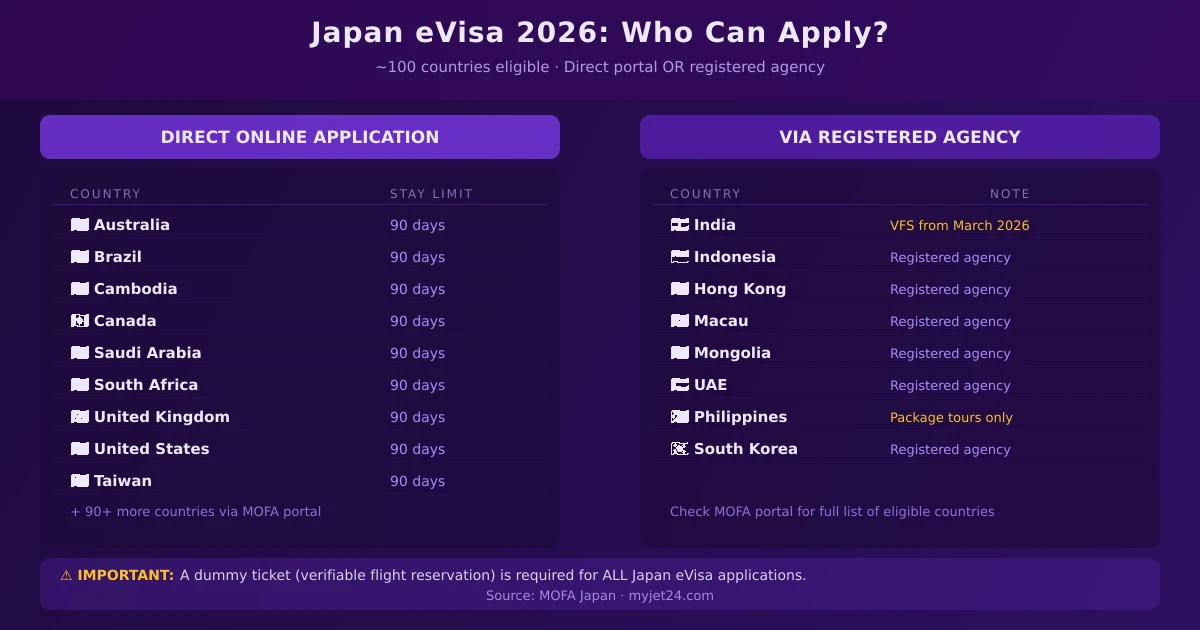
Direct online application (MOFA portal)
Citizens of the following countries apply directly at the MOFA Japan eVisa portal without any intermediary:
| Country | Max stay | Visa types covered |
|---|---|---|
| Australia | 90 days | Tourism, business, cultural |
| Brazil | 90 days | Tourism, business, cultural |
| Cambodia | 90 days | Tourism, business, cultural |
| Canada | 90 days | Tourism, business, cultural |
| Saudi Arabia | 90 days | Tourism, business, cultural |
| South Africa | 90 days | Tourism, business, cultural |
| Taiwan | 90 days | Tourism, business, cultural |
| United Kingdom | 90 days | Tourism, business, cultural |
| United States | 90 days | Tourism, business, cultural |
| + 90+ additional countries — check the full list at mofa.go.jp | ||
Via registered travel agency
Some high-volume applicant countries use a registered-agency route for additional identity verification. The resulting eVisa is identical — only the application channel differs:
- India — must apply via VFS Global or a MOFA-registered agency from March 2026 (new requirement, see India section)
- Indonesia — registered agency required
- Hong Kong / Macau — registered agency required
- Mongolia — registered agency required
- UAE — registered agency required
- South Korea — registered agency required
- Philippines — package tour groups only via registered agency
For up-to-date eligibility, always verify with the MOFA Japan website before applying — country eligibility has changed quarterly since 2023. The Visa Checker also shows current Japan entry requirements by passport in real time.
Japan eVisa vs embassy visa: which should you choose?
For travelers from eligible countries, the eVisa is almost always the better option. The exception: if your trip requires a multiple-entry visa or a purpose not covered by the eVisa (study, work, family visit), you must apply through a consulate.
| Factor | Japan eVisa | Embassy / Consulate Visa |
|---|---|---|
| Application method | Online only | In person or by post |
| Processing time | 5–10 business days | 5–15+ business days |
| Cost | ~JPY 3,000–4,000 | JPY 3,000 + service fees |
| Entry type | Single entry only | Single or multiple entry |
| Max stay | Up to 90 days | Up to 90 days (short-stay) |
| Visa in passport | No sticker — digital only | Physical sticker in passport |
| Passport interview | Not required | May be required |
| Best for | Tourism, short business trips | Study, work, multiple entries |
"The Japan eVisa is functionally equivalent to a consulate-issued short-stay visa — same legal standing, same immigration checks at arrival, same max stay. The only thing missing is the sticker."
Documents required for Japan eVisa
Japan eVisa required documents are the same regardless of which eligible country you apply from. The MOFA portal accepts PDF and JPEG formats for uploads.
- Passport bio-data page scan — must be valid for at least 6 months beyond your planned return date from Japan
- Passport-style photo — color, neutral background, taken within the last 6 months, no glasses, no headwear (except religious attire)
- Flight itinerary (dummy ticket) — a verifiable reservation showing your inbound flight to Japan AND your departure or onward flight out of Japan. The reservation must contain a real PNR (booking reference) that can be verified by airline systems. See our Japan dummy ticket guide for the exact format MOFA accepts
- Accommodation proof — hotel booking confirmation or a letter of invitation from a host in Japan
- Travel itinerary — a day-by-day plan showing your activities, cities visited, and departure date
- Proof of funds — a recent bank statement showing sufficient balance for your stay (typically JPY 15,000–20,000 per day as a guideline, though no hard threshold is published)
Documents for the agency route (India and others)
Applicants using the agency route (India, Indonesia, UAE, etc.) typically also need:
- Completed agency application form
- Employment letter or enrollment proof (to establish ties to home country)
- Income tax returns (India: ITR for the last 1–2 years) or salary slips
How to apply for a Japan eVisa: 8-step walkthrough
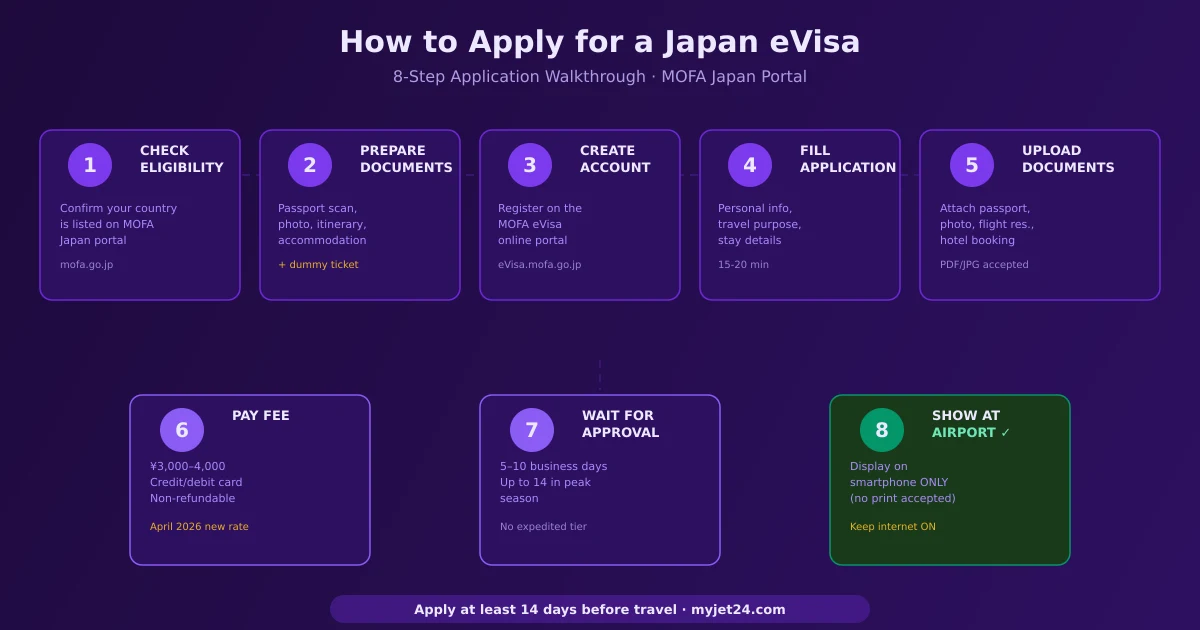
- Confirm your country is eligible. Check the current eligible country list at mofa.go.jp. If your country uses the agency route, find a MOFA-registered agency for your country instead of accessing the portal directly.
- Prepare your documents at least 3 weeks before travel. The critical document most applicants forget is the outbound flight reservation — you need a departure date from Japan listed in the application. Generate a verifiable free dummy ticket with a real PNR, routing, and your name matching your passport exactly.
- Create an account on the MOFA eVisa portal. The portal is at eVisa.mofa.go.jp. Use a valid email address you check regularly — all correspondence, including your approval, arrives there.
- Fill out the application form. Personal information, purpose of visit, planned entry and departure dates, accommodation details, and your Japan itinerary. Allow 15–20 minutes — you can save and return.
- Upload required documents. Each upload must be under the file size limit (usually 4MB per file). PDF is preferred for itineraries and bookings; JPEG for photos and passport scan.
- Pay the eVisa fee. JPY 3,000–4,000 depending on your nationality and visa category, as of the April 2026 revision. Payment is by credit or debit card only. The fee is non-refundable even if your application is refused.
- Wait for the approval email. Standard processing is 5–10 business days. During peak seasons (golden week late April to early May, cherry blossom in March–April, summer holidays July–August), processing can extend to 14 business days. Do not book non-refundable flights until you have approval in hand.
- Download and display at the airport. Your approval arrives as a link to the MOFA portal — not a downloadable PDF. At airline check-in and Japanese immigration on arrival, you display the visa on your smartphone with a live internet connection. See the airport presentation guide below for exactly how this works.
Japan eVisa fees in 2026: what changed in April
April 2026 marked Japan's first eVisa fee revision since the system launched in 2020 (and, importantly, aligned with the country's first overall visa fee update since 1978). Here is what you pay now:
| Visa category | Fee (JPY) | Notes |
|---|---|---|
| Short-stay tourism / transit | ¥3,000 | Most common category |
| Short-stay business | ¥3,000 | Same as tourism |
| Cultural exchange / other | ¥4,000 | Certain categories only |
| Agency service fee (India) | ¥500–¥1,500 | Charged by agency on top |
| Third-party "visa service" markup | ¥5,000–¥25,000+ | Avoid — provides no benefit |
The fee is non-refundable regardless of outcome. There is no expedited tier and no group discount. Payments are processed in JPY at the current exchange rate — the actual charge in your currency will vary with exchange rates on the day of payment.
Japan eVisa processing time: what to expect by season
MOFA's official processing window is 5–10 business days. In practice, processing speed varies significantly by season, nationality, and application completeness:
| Period | Expected time | Reason |
|---|---|---|
| Standard (low season) | 3–5 business days | Normal volume |
| Golden Week (late April – early May) | 10–14 business days | Peak application volume |
| Cherry blossom season (March – April) | 10–14 business days | Highest annual volume |
| Summer holidays (July – August) | 7–12 business days | Elevated volume |
| Winter (January – February) | 3–5 business days | Lowest annual volume |
"Apply 14 business days before travel during cherry blossom or Golden Week season. If you've left it under 10 days and the peak season table above applies to your travel date, consider whether to proceed or postpone — Japan doesn't offer expedited eVisa processing."
Incomplete applications are the single biggest cause of delay. A missing accommodation booking, a flight reservation with an unverifiable PNR, or a photo that doesn't meet spec will generate a clarification request — adding 3–5 days to your total wait. Check the PNR validity guide before submitting your flight reservation to make sure it'll hold through the processing window.
How to display your Japan eVisa at the airport (the part no guide explains)
This section covers something nearly every other Japan eVisa guide overlooks: the smartphone display requirement is stricter than it sounds, and unprepared travelers have been turned back at check-in counters.
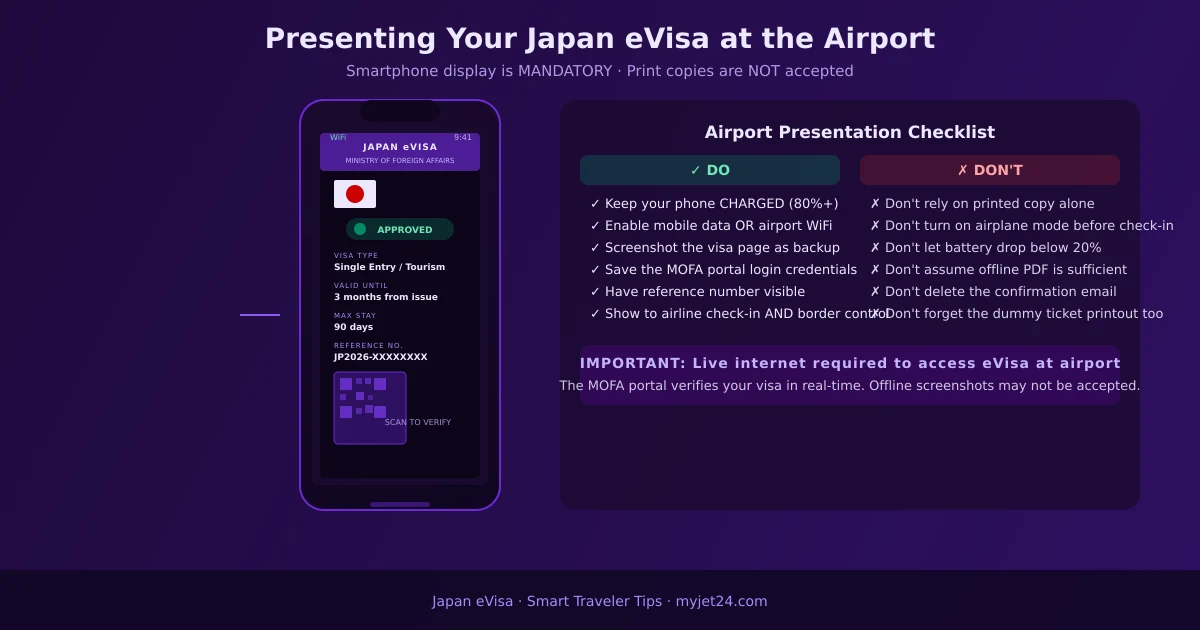
When Japan introduced the eVisa, it decided not to issue a downloadable PDF. Instead, the approval is accessible only by logging into the MOFA portal — which requires an active internet connection. The implication:
What works
- Displaying the MOFA portal approval page on your phone at airline check-in
- Showing the QR code on the approval page to Japanese immigration (they scan it to verify)
- Using airport WiFi to log in, but only if you've confirmed it works before reaching the check-in queue
What doesn't work (confirmed rejection scenarios)
- A screenshot of the approval email alone — not sufficient as standalone proof
- A PDF printout — some immigration officers accept it as secondary evidence, but it is not the official method
- Being in airplane mode — your phone must be online to access the live portal page
- A forwarded screenshot from a travel agent — must be your own portal login
Pre-flight checklist
- Charge your phone to at least 80% before leaving for the airport
- Enable international roaming or confirm your airport's WiFi is accessible before check-in
- Log into the MOFA portal the night before departure and screenshot the approval page as an emergency backup
- Have your MOFA portal email and password written somewhere accessible (not only in your phone's password manager)
- Show your dummy ticket departure reservation at the same time — many airlines check both simultaneously
Japan eVisa for Indian passport holders: new VFS requirements (March 2026)
Indian nationals were among the first non-Western citizens included in Japan's eVisa expansion. As of March 2026, however, the application route changed: Indian applicants must now submit through VFS Global or an MOFA-registered travel agency rather than directly through the MOFA portal. This brought India in line with Indonesia, UAE, and other high-volume eVisa countries on the agency track.
What changed for Indian applicants
- Direct MOFA portal applications are no longer accepted for Indian passport holders
- Applications go through VFS Global India or an accredited agency
- An additional agency/service fee of approximately INR 500–1,500 applies on top of the government fee
- Processing times through VFS are typically 7–10 business days — slightly longer than the old direct route
What stays the same
The required documents, maximum stay (90 days), visa type (single entry), and approval process are identical. The eVisa India applicants receive is the same document issued to Australian or UK applicants.
For Indian travelers, this change means planning earlier and factoring in the VFS appointment booking step. Approval rates for Indian applicants are high — roughly 85–90% — but weak travel itineraries account for approximately 70% of rejections across all nationalities. A detailed Japan day-by-day plan and a verifiable flight reservation significantly reduce that risk. Learn more in our proof of onward travel guide.
Japan eVisa rejection: common reasons and how to reapply
Japan's overall eVisa rejection rate is low by global standards, but when it happens, the reasons are almost always fixable. MOFA issues a rejection notice but does not provide a detailed reason — you must diagnose the issue yourself.
| Rejection reason | Estimated share | Fix |
|---|---|---|
| Weak or vague travel itinerary | ~70% | Submit a detailed day-by-day plan with specific hotel names, activities, and city-to-city movement |
| Unverifiable flight reservation (fake PNR) | ~12% | Use a real PNR from a dummy ticket service — MOFA verifies PNRs with airline GDS systems |
| Photo doesn't meet spec | ~8% | Neutral background, no glasses, no headwear, taken within last 6 months |
| Passport under 6 months validity | ~5% | Renew passport before reapplying |
| Name mismatch (passport vs form) | ~3% | Match every character including hyphens and middle names |
| Previous immigration violation | <2% | Requires consular review — apply through embassy with supporting explanation |
If rejected, you can reapply immediately — there is no mandatory waiting period. The original application fee is forfeited; you pay again on resubmission. Most travelers who address the root cause on resubmission receive approval within the standard 5–10 day window.
"MOFA verifies your flight reservation PNR against airline reservation systems. A dummy ticket with a fake or expired PNR fails this check — which is why a real, verifiable reservation from a credible source matters far more than the price."
JESTA vs Japan eVisa: what's the difference?
In 2025, Japan began discussing the JESTA (Japan Electronic System for Travel Authorization), modeled after the US ESTA and Australian ETA. JESTA is specifically designed for visa-exempt nationalities — countries like Singapore, South Korea (under reciprocal arrangements), and EU passport holders who currently don't need a visa to enter Japan for short stays.
JESTA and the Japan eVisa are separate systems for separate traveler profiles:
| Feature | Japan eVisa | JESTA (proposed) |
|---|---|---|
| Who it's for | Nationalities that require a visa | Visa-exempt nationalities |
| Legal status | Full short-stay visa | Travel authorization (pre-screening) |
| Launch status (2026) | Live and operational | Proposed — not yet launched |
| Fee | ~JPY 3,000–4,000 | Expected ~JPY 500–1,000 |
If you currently need a Japan visa, JESTA does not apply to you — your route is the eVisa. JESTA (when launched) will affect Singaporean, European, and other historically visa-exempt travelers who will need to pre-register before entry. Watch the MOFA announcements page for a launch date, which as of May 2026 has not been confirmed.
Frequently asked questions
Do I need a return ticket to get a Japan eVisa?
You need a verifiable flight reservation showing departure from Japan — this is listed in the application form. The reservation doesn't have to be a fully paid airline ticket; a dummy ticket with a real PNR is what MOFA checks. Your departure can be to any country. Use the free dummy ticket generator to get a MOFA-compatible flight reservation in 30 seconds. Detailed format requirements are in the Japan dummy ticket guide.
Can I extend my Japan eVisa once I'm in the country?
No. The Japan eVisa is single-entry only and cannot be extended from within Japan. If you need more time, you must leave Japan, reapply for a new eVisa from outside the country, and re-enter. Overstaying your authorized period is a serious violation that results in deportation and a Japan entry ban — typically 5 years for first offenses.
Can I work in Japan on an eVisa?
No. The Japan eVisa covers tourism, short-stay business meetings, transit, and cultural exchange only. Paid employment of any kind — including remote work for a foreign employer — requires a Japan work visa. Japan's immigration authorities take this seriously; violations can result in deportation and future visa refusals.
Is the Japan eVisa valid for multiple entries?
No. All Japan eVisas issued through the MOFA portal are single-entry only. Each time you leave Japan and want to re-enter, you need a new eVisa application and a new fee payment. Multiple-entry Japan visas are only available through embassy/consulate applications and are typically granted for business travel with a documented Japan-based business relationship.
My Japan eVisa was rejected. Can I appeal?
There is no formal appeal process for Japan eVisa rejections — you reapply with corrected information. MOFA does not disclose the specific rejection reason, so you must diagnose the issue from your original application. The most common fix is a stronger travel itinerary plus a verifiable dummy ticket. If you've been rejected twice, a consulate application with a cover letter explaining your travel purpose often yields different results.
How far in advance should I apply for a Japan eVisa?
Apply at least 14 business days before your departure date, and 21 days if traveling during cherry blossom season (March–April), Golden Week (late April – early May), or the summer holidays (July–August). This buffer absorbs processing delays and leaves time to reapply if needed. Never apply within 5 business days of travel — there's no expedited processing option.
What's the difference between a Japan eVisa and a Japan visa-free entry?
Citizens of about 68 countries can enter Japan visa-free for 90 days under bilateral exemption agreements (including most EU citizens and US nationals). These travelers don't need to apply for anything in advance. The Japan eVisa is for citizens of countries not covered by visa-free agreements — they must obtain a visa before arrival, and the eVisa is the online route for eligible nationalities. Check your exact entry requirements via the Visa Checker.
Will Japan ever accept print copies of the eVisa at the airport?
As of May 2026, MOFA's official position is that the smartphone-displayed digital visa is the primary valid document. Print copies from some travelers' experiences have been accepted as supporting evidence by some airline staff, but it is not the official method and cannot be relied upon. Japanese immigration uses QR code scanning on the live portal page. Always plan for smartphone display with an active internet connection.
Conclusion: get your Japan eVisa right the first time
The Japan eVisa removes the consulate queue but introduces its own requirements: a solid itinerary, a verifiable flight reservation, and a smartphone with internet at the airport. Miss any of these and you risk a rejection or a turned-back check-in — neither of which Japan allows you to resolve in 24 hours.
The correct order of operations is: generate your dummy ticket first (to fill in the departure flight field accurately), then build your day-by-day Japan itinerary, then submit the eVisa application 14+ days before travel. That sequence resolves the two most common rejection causes before they become problems.
Ready to apply? Generate the verifiable flight reservation MOFA requires in 30 seconds — it's free, real PNR, and the format Japan's portal accepts:
Last updated: May 10, 2026. Visa rules change frequently. Always verify current requirements at mofa.go.jp before travel.
