
Last updated: 6 May 2026 · Reading time: 13 min · Author: James Mitchell, CEO & Founder of MyJet24
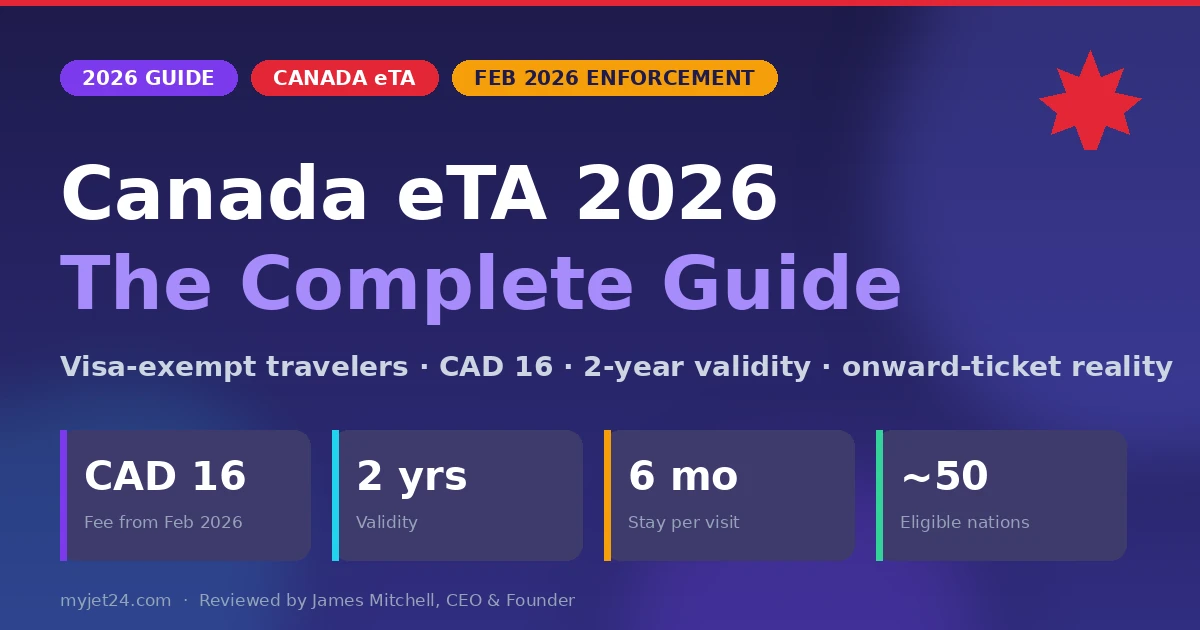
If you are a citizen of the UK, Germany, France, Australia, New Zealand, Japan, South Korea, Singapore, or any of the other ~50 visa-exempt countries and you are flying to Canada in 2026, the rules quietly tightened on you. As of February 2026, Canada's Electronic Travel Authorization — the Canada eTA — is being fully enforced for the first time. The fee jumped from CAD 7 to CAD 16. Validity dropped from five years to two. Same-day transit travelers, who used to slip through, are now in scope.
I have spent the last few months walking thousands of travelers through this on the MyJet24 platform, and I can tell you the part that catches people off guard isn't the application form — it is what airlines and the Canada Border Services Agency now check at the boarding gate and the primary inspection line at Pearson, Vancouver, and Montréal. This guide covers both halves: the eTA application itself, and the things every commercial guide skips.
Quick answer: Do I need a Canada eTA in 2026?
Yes — if you are a visa-exempt foreign national flying to or transiting through Canada by air. The Canada eTA costs CAD 16 from February 2026, is valid for two years (or until your passport expires), permits multiple entries of up to six months per visit, and is approved automatically in minutes for most travelers. United States citizens and permanent residents are fully exempt. Visa-required nationals cannot apply for an eTA and must apply for a Temporary Resident Visa instead.
TL;DR — Canada eTA 2026 in 5 Bullets
- Full enforcement from February 2026 — airlines now receive automatic "no-board" instructions for any visa-exempt passenger without an approved eTA on file.
- Fee raised to CAD 16 (from CAD 7 since 2015) — payable only on the official canada.ca eTA portal. Anything else charging USD 50–100 is a third-party scam.
- Two-year validity, multiple entries, up to six months stay per visit — tied digitally to the passport you applied with.
- Decision usually in minutes, but apply at least 72 hours before departure. Manual review can extend to several days.
- An approved eTA does not exempt you from CBSA questions on arrival or from proof of onward travel at the border. Carry a return or onward ticket.
Table of Contents
- What Is the Canada eTA?
- Who Needs a Canada eTA in 2026
- Canada eTA Cost, Validity and Stay Limits
- How to Apply: Step-by-Step
- Documents You Need to Apply
- Canada eTA vs Canadian Visitor Visa
- Why Canada eTAs Get Refused (and DUI Issues)
- At the Canadian Border: What CBSA Still Asks
- Canada eTA + Onward Travel Proof
- The "Free Canada eTA" Scam Ecosystem
- Mistakes That Get You Stopped at the Boarding Gate
- FAQ
What Is the Canada eTA?
The Canada eTA is an Electronic Travel Authorization issued by Immigration, Refugees and Citizenship Canada (IRCC). It is a digital permission to fly to Canada for tourism, family visits, short business trips, transit or short study (under six months). It is not a visa. In design it sits next to the United States ESTA, the United Kingdom's ETA, and South Korea's K-ETA — a pre-screening that airlines and border officers can verify against your passport before you board and on arrival.
The system was launched in March 2016. For nearly a decade enforcement was selective. Travelers from Western Europe and the Asia-Pacific were occasionally waved through without an eTA on file, particularly during the pandemic when IRCC capacity was constrained. February 2026 ends that. Carriers now run automatic checks against the IRCC database before issuing a boarding pass — and a "no-board" instruction lands in the carrier system instantly when the passport is not linked to a valid authorization. There is no "I'll deal with it on the plane" option anymore.
An eTA does not let you live, work or study long-term in Canada. It does not give you permanent residence. It does not replace a visa for nationals of countries that need one. And — the part nearly every commercial guide buries — it does not give you an automatic right to enter. CBSA officers at primary inspection still have full discretion at the port of entry, and they use it.
Who Needs a Canada eTA in 2026
The Canada eTA is required of any non-Canadian, non-American visa-exempt national travelling to Canada by air for less than six months without a Canadian visa. The full list runs to about 50 nationalities. The most relevant ones for international travelers:
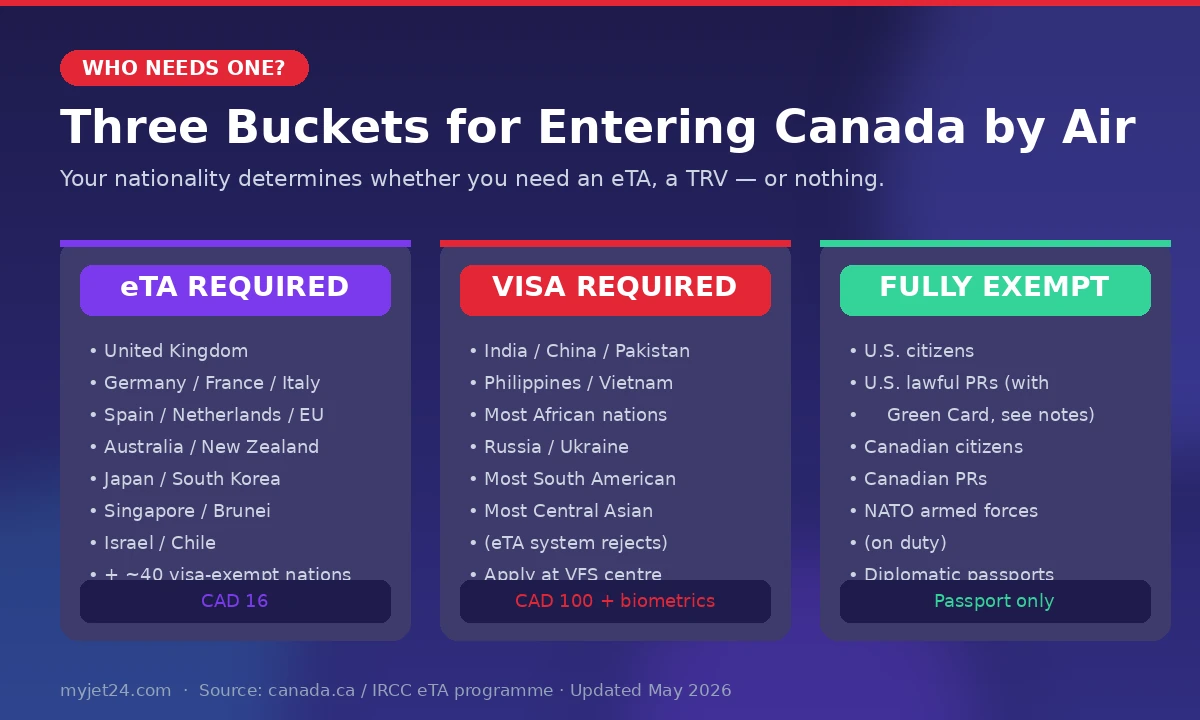
You need a Canada eTA if you are a citizen of:
- Europe: United Kingdom, Ireland, Germany, France, Italy, Spain, Netherlands, Sweden, Norway, Switzerland, Iceland, Liechtenstein, Czech Republic, Slovakia, Slovenia, Estonia, Latvia, Lithuania and the rest of the EU/EEA bloc
- Asia-Pacific: Japan, South Korea, Singapore, Brunei, Hong Kong (HKSAR passport only), Taiwan (with personal ID number), Israel
- Oceania: Australia, New Zealand, Papua New Guinea
- Latin America & Caribbean: Chile, Mexico (under recent restrictions, see below), Bahamas, Barbados, Saint Kitts and Nevis, several others
You do NOT need a Canada eTA if you are:
- A United States citizen — fully exempt from the eTA. A valid US passport (or NEXUS card on land) is enough.
- A US lawful permanent resident — from 1 March 2026 you must show a valid Green Card and a valid passport from your country of citizenship. There has been an additional eTA-equivalent registration requirement on the table; check IRCC before you fly.
- A Canadian citizen or permanent resident entering on a Canadian passport or PR card.
- A citizen of a visa-required country — you cannot get an eTA. You need a Temporary Resident Visa (TRV).
- An accredited diplomat, member of the armed forces of a NATO country on duty, or a passenger on a flight that lands in Canada only because of an emergency.
"Mexico is the country to watch in 2026. Canada partially reinstated visa requirements for Mexican nationals in February 2024, then refined the carve-outs in 2025. If you hold a Mexican passport, do not assume an eTA is enough — check your specific situation on canada.ca before you book the flight."
Canada eTA Cost, Validity and Stay Limits
The Canada eTA fee was CAD 7 from launch in 2015 until January 2026 — the longest-running unchanged fee in the IRCC system. From February 2026 the fee is CAD 16, paid online by credit card during the application. There is no family discount. Every applicant needs their own eTA, including infants travelling on a separate passport.
An approved Canada eTA is digital. It is electronically linked to the passport you applied with. There is no sticker, no email-printout, no QR code — the airline check-in system reads your passport, queries the IRCC database, and confirms or denies a boarding pass. If you renew your passport, your eTA does not transfer; you have to apply again.
Validity is two years from the date of approval, or until the passport expires, whichever comes first. This is a step down from the previous five-year validity. Within those two years the eTA permits an unlimited number of entries, with each visit lasting up to six months. The CBSA officer at primary inspection ultimately decides the length of your stay — their decision overrides the default six-month presumption.
Cost comparison: official vs. third-party
| Channel | Cost | Notes |
|---|---|---|
| canada.ca (official) | CAD 16 | Only legitimate channel. Direct to IRCC. |
| Third-party "expedite" services | USD 50–100+ | No expedite power. Just resells the same form. Refund disputes are common. |
| Travel agency / airline portal | CAD 16 + agency fee | Sometimes bundled with bookings. Compare with applying yourself. |
| Sponsored Google ad results | USD 75–150 | Often the worst offenders. Look for "canada.ca" in the URL before clicking. |
How to Apply: Step-by-Step
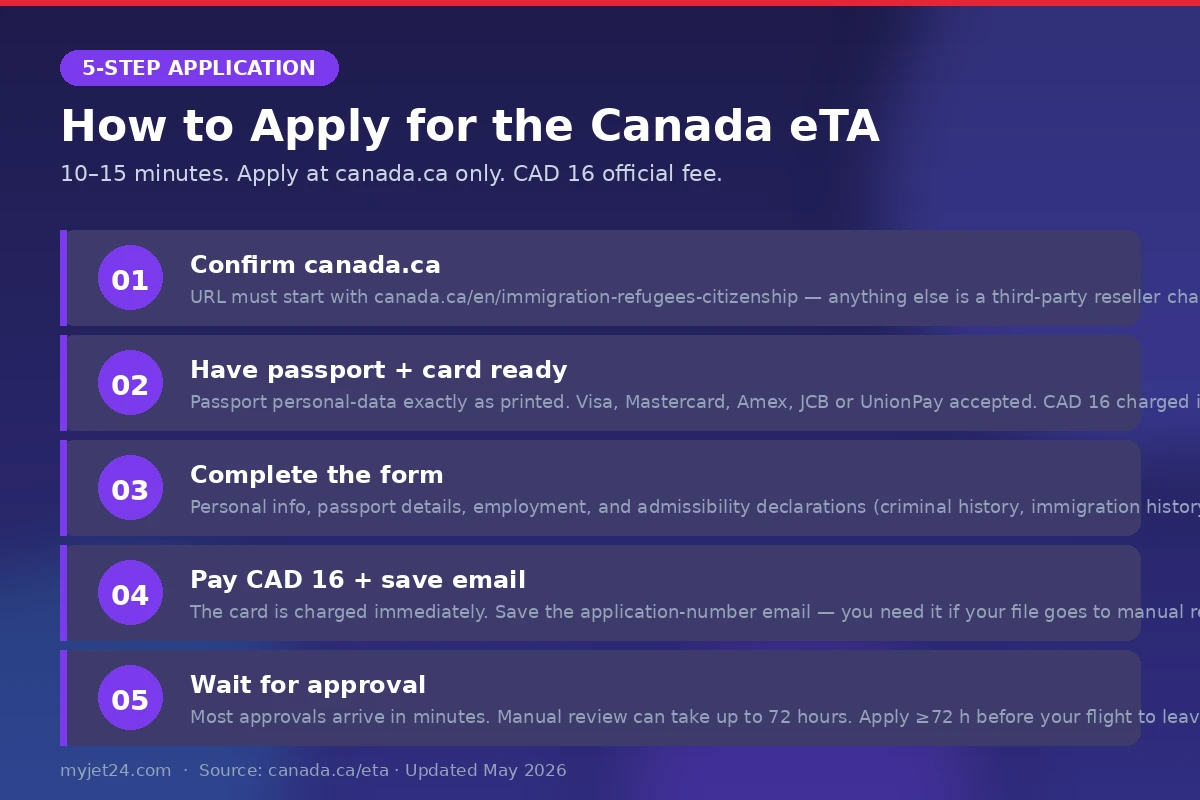
The application takes most people around 10–15 minutes if their passport is in front of them. Here is the sequence on the official portal:
- Confirm you are on canada.ca. The URL must start with
https://www.canada.ca/en/immigration-refugees-citizenship. Anything else is a third-party reseller. - Have your passport ready. You need the full machine-readable zone — passport number, issue and expiry dates, country of issue, and the personal data exactly as printed.
- Have a valid credit or debit card. Visa, Mastercard, American Express, JCB and UnionPay are accepted. Prepaid cards from some issuers are rejected.
- Complete the online form. Personal information, passport details, contact details, employment background, and the standard admissibility declarations (criminal history, immigration history, medical conditions). Honest answers always — misrepresentation is one of the most common refusal grounds.
- Pay CAD 16. The card is charged immediately. Save the confirmation email; it contains your application number, which you will need if anything goes to manual review.
- Wait for the decision. Most approvals arrive in minutes. If your file goes to manual review, expect 72 hours and watch your inbox — IRCC sometimes asks for additional documents (a police certificate, a recent immigration medical, or a sworn statement clarifying a past issue).
- Verify approval before booking your flight — or at least before checking in. Approval is silent: you simply receive an email confirming the eTA is linked to your passport. Refusal triggers a separate notification with the reason.
Documents You Need to Apply
- The passport you will travel with. Do not apply with one passport and travel with another — the eTA is tied to a passport number, not to you.
- A valid email address you actually monitor. The approval (or refusal, or request for documents) lands here.
- A credit or debit card for the CAD 16 fee.
- Approximate Canadian arrival date — the form asks but does not bind you. Approved eTAs allow any travel date within the two-year validity.
- Truthful answers to the admissibility questions. If you have a criminal conviction (including DUI, see below), a previous visa refusal anywhere, or a Canadian deportation in your history, you must declare it.
Canada eTA vs Canadian Visitor Visa
| Canada eTA | Temporary Resident Visa (TRV) | |
|---|---|---|
| Who applies | Visa-exempt nationals (UK, EU, JP, AU, etc.) | Visa-required nationals (India, China, Philippines, etc.) |
| Cost | CAD 16 | CAD 100 + biometrics CAD 85 |
| Where applied | canada.ca online form | canada.ca + VFS biometrics centre |
| Validity | 2 years (or passport expiry) | Up to 10 years (officer's discretion) |
| Entry mode | By air only | By air, land or sea |
| Decision time | Minutes (most cases) | Several weeks |
| Stay per entry | Up to 6 months | Up to 6 months |
| Requires biometrics | No | Yes (fingerprints + photo) |
You cannot choose between the two. The system locks you in based on your nationality. If you hold a passport from a visa-required country, no eTA application will approve — the form rejects the passport in the first screen.
Why Canada eTAs Get Refused (and the DUI Issue)
Most Canada eTA applications are approved within minutes. The ones that get refused tend to fall into a small number of buckets, and the biggest one of those buckets is criminal inadmissibility — especially for travelers from countries where impaired driving is treated as a minor offence.
Per IRCC's published inadmissibility reasons, an eTA can be refused for:
- Criminality, including DUI. Since December 2018 impaired driving has been classified as serious criminality in Canada with a maximum penalty of 10 years. A single DUI conviction in your home country — even from 20 years ago — is sufficient grounds for refusal. There are pathways back: deemed rehabilitation after a fixed period, application for criminal rehabilitation, or a Temporary Resident Permit. None are quick. Apply for them through canada.ca, not through any third party.
- Misrepresentation. Lying or omitting on the application form. The IRCC system cross-references your declarations against US, UK, Five Eyes and Interpol databases. The penalty is a five-year ban from Canadian admission.
- Medical inadmissibility. Active tuberculosis, untreated infectious disease, or a condition expected to cause excessive demand on Canadian health services. Rare for eTA applicants.
- Security concerns. Espionage, terrorism, or organized crime affiliations. Almost never an issue for typical travelers, but the screening exists.
- Previous Canadian removal or deportation. If Canada has previously removed you, you usually need an Authorization to Return to Canada (ARC) before any new entry, eTA included.
- Passport problems. Expired, near-expiry, or non-machine-readable passports. The eTA cannot be issued against a passport that does not validate against the IRCC system.
If your eTA is refused, you receive an email with the specific ground. There is no formal right of appeal on an eTA. Your three real options are: address the underlying issue and apply again, apply for a TRV instead (where you can submit supporting evidence and reasons), or apply for a Temporary Resident Permit if you must travel before rehabilitation is possible.
At the Canadian Border: What CBSA Still Asks
Here is the part that surprises travelers most. An approved eTA gets you onto the plane. It does not guarantee entry. Every traveler arriving at a Canadian airport — Toronto Pearson (YYZ), Vancouver (YVR), Montréal (YUL), Calgary (YYC), and the rest — passes through Primary Inspection. Most clear it in under two minutes via the Primary Inspection Kiosk or eGate. Some get pulled into Secondary.
The questions CBSA officers actually ask, in roughly the order they ask them:
- What is the purpose of your visit? Tourism, business meeting, visiting family. Brief and specific.
- How long are you staying? Specific dates beat "a few weeks". Specific dates that match your return ticket beat any vague answer.
- Where are you staying? Hotel name, address, or the address of the family member you are visiting. Carry the booking confirmation or address on your phone.
- Can I see your return ticket? This is where most under-prepared travelers fumble. CBSA can and does ask for proof of onward travel. A confirmed return ticket is best. A verifiable flight reservation with a real PNR is acceptable. A vague "I'll book once I'm here" answer is a fast track to Secondary.
- How are you funding the trip? Credit card, savings, family hosting. They occasionally ask to see card balances. They are looking for evidence you will not become a public charge.
- Have you ever been refused entry to Canada or any other country? The answer must match what you declared on the eTA application. Inconsistency triggers Secondary review.
Canada eTA + Onward Travel Proof
The Canada eTA application form does not ask for a return ticket. The CBSA officer at Pearson very often does. This gap is the most under-discussed part of every other Canada eTA guide on the internet.
Here is the practical position. If you are flying with Air Canada, WestJet, or any major international carrier, the airline check-in agent in your departure airport may also ask — especially if you booked one-way. Most airlines treat one-way bookings to Canada as a flag, and the gate agent has discretion to require evidence of onward travel before issuing a boarding pass. This is the same airline-liability rule that operates everywhere: if they bring a passenger Canada will not admit, they pay the return-flight cost.
Three options that work, in order of preference:
- A confirmed return or onward flight ticket matching your stated stay duration. Always best.
- A bus, train or ferry ticket exiting Canada to the United States within your stay window. VIA Rail, Greyhound, ferry-to-Alaska. Less common but accepted.
- A verifiable flight reservation — a dummy ticket with a real airline PNR — if your real onward plans are not yet finalised. MyJet24 generates onward ticket reservations for Canada with a real PNR, valid 14 days, accepted by airlines and CBSA at primary inspection. Do not use a fake PDF or screenshot — CBSA can and does verify by phoning the carrier reservations line.
The "Free Canada eTA" Scam Ecosystem
Search "Canada eTA application" in any Western country and the first three Google results are almost always paid ads from third-party sites. Most charge USD 50 to 150 for the same form that costs CAD 16 on canada.ca. They are not illegal. They are not faster than the official channel. They use SEO and brand-imitation tricks — domain names like "canada-eta-online" or "official-canada-eta" — to look like the government.
What they actually do: take your money, fill out the canada.ca form on your behalf, charge you CAD 16 plus their markup, and bank the spread. The application goes through the official IRCC system either way. Approvals do not arrive faster. Refusals do not get appealed. If your eTA is refused you cannot get a refund of the third-party fee, only sometimes the CAD 16 portion.
How to spot the official site:
- The URL starts with canada.ca. Not "canada-eta.com", not "ca-eta-application.com", not "official-eta-canada-2026.com". The IRCC service is hosted only on canada.ca.
- The fee shown at checkout is CAD 16, never USD. If a site quotes USD 49 or USD 89, it is not the official site.
- The page footer references the Government of Canada with the wordmark and the maple leaf. Third-party sites mimic this graphic to deceive.
- There is no upsell on canada.ca. Third-party sites push "express review", "guaranteed approval", "premium customer support" — all meaningless because the same IRCC system handles every application identically.
Mistakes That Get You Stopped at the Boarding Gate
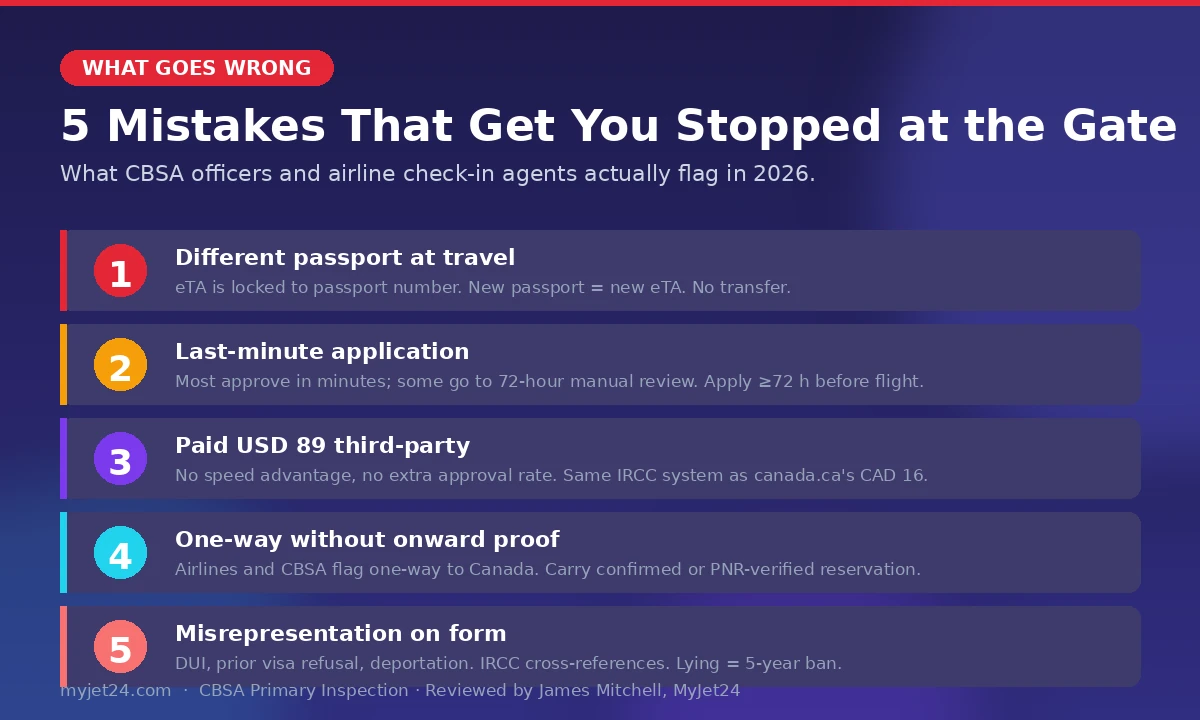
From watching what trips travelers up most often, the recurring patterns:
- Applying with one passport and travelling with another. The eTA is locked to the passport number. New passport, new eTA. Period.
- Believing approval is automatic. Most are. Some go to manual review. Apply at least 72 hours before departure, never on the morning of the flight.
- Paying a third party USD 89 instead of CAD 16. No additional speed, no additional approval rate. Wasted money.
- One-way booking with no onward proof. Carrier check-in routinely flags one-way to Canada. Carry a confirmed or reservation ticket.
- Misrepresenting on the form. An old DUI, a previous visa refusal in another country, a deportation history. IRCC cross-references. Lying gets you a five-year ban.
- Forgetting the eTA exists. Travelers who flew to Canada in 2017 without trouble assume the rules are still loose. Since February 2026, they are not. Airlines run automatic checks at check-in.
FAQ
How much does the Canada eTA cost in 2026?
The Canada eTA costs CAD 16 from February 2026, raised from CAD 7. The fee is paid online by credit or debit card during the application on canada.ca. Anything charging USD 50 or more is a third-party reseller, not the official channel.
How long is a Canada eTA valid?
An approved Canada eTA is valid for two years from the date of issue, or until the passport you applied with expires — whichever comes first. Within those two years it allows multiple entries with stays of up to six months per visit. The two-year validity replaced the previous five-year validity in February 2026.
How long does Canada eTA approval take?
Most Canada eTA applications are approved automatically within minutes of submission. A minority go to manual review and can take up to 72 hours, occasionally several days if IRCC requests supporting documents. Apply at least three working days before your scheduled flight to leave room for review.
Can I work in Canada with an eTA?
No. The Canada eTA only permits short visits for tourism, family visits, business meetings, transit, and short courses up to six months. Paid employment, freelance work for a Canadian client, and long-term study require a specific work or study permit obtained from IRCC.
Does my Canada eTA exempt me from CBSA questions on arrival?
No. An approved eTA gets you onto the plane and into the primary inspection line. CBSA officers retain full discretion at the port of entry. They routinely ask for purpose of visit, length of stay, accommodation, return-ticket evidence, and proof of funds. An approved eTA does not override their decision to send you to secondary inspection or deny entry.
What if my Canada eTA is refused because of a DUI?
A single DUI conviction in your home country can result in eTA refusal because Canada classifies impaired driving as serious criminality. Three pathways back: deemed rehabilitation after a fixed period (typically 10 years from sentence completion), formal application for criminal rehabilitation through IRCC, or a Temporary Resident Permit for a specific trip. None are quick — budget several months and apply through canada.ca, not through any third party.
Do US citizens need a Canada eTA?
No. United States citizens are fully exempt from the Canada eTA requirement. A valid US passport is enough to fly to Canada. US lawful permanent residents need a valid passport from their country of citizenship plus a Green Card, and from 1 March 2026 some additional registration requirements apply — check IRCC before flying.
Do I need a Canada eTA if I am only transiting through a Canadian airport?
Yes, in almost all cases as of February 2026. The previous loophole that exempted same-day airside connections has been closed. Transit travelers from visa-exempt countries now need an eTA even for short connections in Toronto, Vancouver or Montréal — unless they fall under the China Transit Program, the Transit Without Visa programme, or one of a handful of bilateral exemptions.
What is the difference between Canada eTA and US ESTA?
The Canada eTA and the US ESTA are sister systems but separate. Canada eTA is for travel to Canada and costs CAD 16 with two-year validity. US ESTA is for travel to the United States under the Visa Waiver Program and costs USD 21 with two-year validity. They are issued by different governments. Travelling to both countries on the same trip requires both authorizations.
Can I apply for a Canada eTA at the airport?
No. The Canada eTA must be applied for and approved before you check in for your flight. Airlines query the IRCC database before issuing a boarding pass. If the eTA is not on file, you do not board. Apply at least 72 hours before scheduled departure to allow time for any manual review.
Do children and babies need a Canada eTA?
Yes. Every traveler regardless of age needs their own Canada eTA, including newborns and toddlers travelling on a separate passport. The fee is CAD 16 per person — there is no family discount or child rate. Airlines refuse boarding to children without an approved eTA on file.
Conclusion: What to Do Before Your Canada Flight
If you are visa-exempt and flying to Canada in 2026, the workflow is straightforward provided you do not skip any of it:
- Apply for the Canada eTA at canada.ca and pay CAD 16, at least three working days before departure.
- Verify approval before you book or check in — the IRCC email is your confirmation.
- Carry proof of onward travel for both airline check-in and CBSA primary inspection. Generate a free Canada onward ticket on MyJet24 if your real plans are not yet finalised.
- Be honest on the eTA form, and have a clear answer for CBSA: purpose, duration, accommodation, funds, exit plan.
- If you have any criminal history — even a DUI — sort out admissibility well in advance. Refusal at the gate is far worse than a delayed eTA.
Need a Canada onward ticket for your eTA flight?
Get a free, verifiable flight reservation with a real airline PNR — ready in 30 seconds, accepted by Air Canada, WestJet and CBSA. No credit card, no signup, no risk if your visa or eTA is denied.
Generate Free Canada Onward Ticket →About the author
James Mitchell is the CEO and Founder of MyJet24, the travel-tools platform serving travelers across 190+ countries with visa checkers, dummy ticket generation, embassy finders and professional travel documentation. Based in Dubai, James founded MyJet24 in 2021 to remove the barriers travelers face navigating visa applications and travel documentation.
Last updated: 6 May 2026 · Next review: August 2026 (post enforcement-data review)
