
You got your acceptance letter. Maybe it's from the University of Toronto, or UCL, or Monash, or a German Hochschule for an Erasmus exchange. Your I-20 just arrived. Your CAS letter is sitting in your inbox. Your parents are equal parts proud and terrified. And now the visa application checklist mentions — almost as an afterthought — that you need proof of travel.
Here's the problem nobody tells you about upfront: you cannot book a real flight until you have your visa. But the embassy wants to see a flight reservation before they'll grant you one. It's a catch-22 that trips up thousands of international students every year. And it's the reason the term "dummy ticket for student visa" gets searched millions of times globally as September and January intake seasons approach.
This guide cuts through all the confusion. We'll cover exactly what flight proof each major student visa requires — F-1, UK Tier 4, Australia subclass 500, Schengen, and Canada study permit — and show you how to get a free dummy ticket that actually satisfies embassy requirements. Check our visa application blog for country-specific guides, and if you're not sure whether you even need a student visa for your destination, start with our visa requirement checker.
Quick Answer
Yes — a dummy ticket (a real temporary flight reservation with a verifiable PNR) is accepted by US embassies for F-1 visas, UK UKVI for Tier 4, DHA for Australia subclass 500, Schengen consulates, and IRCC for Canadian study permits. You do not need to purchase a confirmed ticket before your visa is approved.
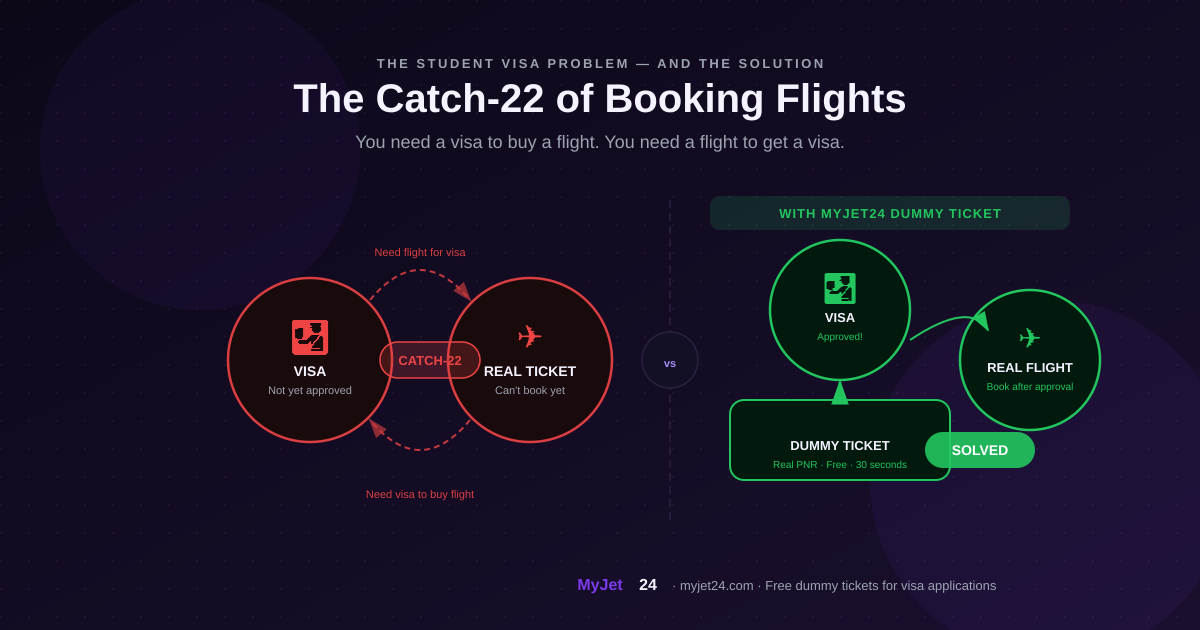
Why Student Visas Need Different Flight Proof
Tourist and business visa applicants usually have a rough idea of when they're travelling. Student visa applicants? They're staring down a much more complex situation — and embassies know it.
Think about it from an immigration officer's perspective. A student applying in June for a September 2026 intake at the University of Edinburgh is not going to know their exact flight date three months in advance. They haven't sorted accommodation. They don't know if their course starts the 14th or the 21st. Their parents might want to accompany them for the first week, which changes the entire booking. Buying a non-refundable flight that early — before even knowing if the visa will be granted — would be genuinely reckless.
So here's what you actually need to understand: most embassies ask for a flight reservation or itinerary, not a confirmed, paid ticket. Read your embassy's document checklist carefully. You'll almost always find language like "flight booking confirmation," "travel itinerary," or "proof of intended travel" — not "confirmed non-refundable flight ticket." That wording is intentional. And it's exactly what a properly generated dummy ticket provides.
There are also some student-specific nuances that don't apply to tourist visas. One-way tickets, for instance, are perfectly normal for long-term students — you're not planning to come home in two weeks. Dependent family members joining at a later date means your flight itinerary may not match your spouse's or child's. Intake delays — increasingly common post-pandemic — mean your original travel dates might shift after submission. A dummy ticket handles all of this gracefully because you're not locked into a paid booking. For a broader primer on what a dummy ticket actually is, read our complete dummy ticket explainer.
The MyJet24 flight reservation tool generates real temporary flight holds — not fabricated PDFs — specifically because embassies verify PNR codes in live airline systems. If you're curious about how legality works here, our guide on dummy ticket legality has the full breakdown.
USA F-1 Visa: Flight Reservation Requirements
The F-1 student visa is one of the most heavily documented immigration pathways in the world — and the flight requirement is, perhaps surprisingly, one of the more flexible parts of it.
Let's get the acronyms out of the way. Your I-20 is your Certificate of Eligibility, issued by your US university's Designated School Official (DSO) once you've been accepted and paid the SEVIS fee. SEVIS — the Student and Exchange Visitor Information System — is the federal database that tracks your status from the moment you register. Your visa interview at the US consulate or embassy will draw on both of these. But flight proof? That's just your intended travel itinerary. The DS-160 form asks for your intended date of travel, and your supporting documents package should include a flight reservation showing that date.
One-way tickets are entirely acceptable for F-1 applicants. You're going to study for one, two, potentially four-plus years. Nobody expects you to have a return ticket booked before you've even sat in a lecture hall. That said, your travel dates should align realistically with your I-20 program start date. If your I-20 lists a program start of August 25, 2026, don't submit a flight showing arrival on December 1st.
The other F-1 consideration worth flagging: port of entry. CBP officers at US airports can and do ask about your onward travel plans verbally, even if you enter on a one-way ticket. You don't need a physical document, but you should be able to articulate your plans confidently. Our US visa dummy ticket guide covers the port-of-entry nuances in more detail. And if you've got an upcoming visa interview, our F-1 interview preparation guide walks you through what consular officers actually ask — and how to answer without tripping yourself up.
Practical tip for September 2026 applicants
Most US universities begin their fall semester in the last week of August or first week of September. If you're applying for your F-1 in May or June, use a travel date roughly 3–7 days before your I-20 program start date. This gives you orientation week buffer and looks realistic to a consular officer reviewing your file.
UK Tier 4 (Student Visa): Travel Proof Rules
The UK Student visa — formerly known as Tier 4 General — operates through the points-based system. Your university issues a CAS (Confirmation of Acceptance for Studies) letter, which is essentially your sponsor reference. Without a valid CAS number, the application doesn't proceed. But the CAS is just one piece of a fairly substantial documentation puzzle.
UK Visas and Immigration (UKVI) does not require a confirmed return flight as a mandatory document. What they do want to see is evidence that your trip is genuine and time-limited — which for a degree student is your CAS start and end dates, your accommodation proof, and yes, a travel itinerary showing your intended arrival around your course start date. A UK student visa flight reservation covering your inbound journey satisfies this.
A few UK-specific details worth knowing. If you're applying from certain countries (Pakistan, Bangladesh, Ghana, Nigeria, Sri Lanka, and others), you'll also need a tuberculosis (TB) test certificate from an approved clinic — this is processed separately and can take a week or two. Factor that into your timeline. And your student bank statement needs to show funds covering both tuition and living expenses — the exact amounts depend on your study location and course length, and UKVI publishes updated maintenance thresholds annually.
My roommate from Mumbai when I was at Warwick went through this in 2023. She spent two weeks agonising over whether to buy a proper return ticket before her visa arrived. Her visa took 5 weeks. Flights had gone up 40% by the time she checked again. A dummy ticket at the application stage, and booking once approved, would have saved her both the anxiety and the £200 price hike.
Australia Subclass 500: What the DHA Wants
Australia's student visa — subclass 500, administered by the Department of Home Affairs (DHA) — has some characteristics that confuse a lot of applicants because it sits within a broader genuineness framework.
The key concept is the Genuine Temporary Entrant (GTE) criterion. DHA assesses whether you genuinely intend to study and then return home (or move on) rather than use the student visa as a backdoor immigration pathway. This is assessed through your statement of purpose, your ties to your home country, your choice of institution and course, and yes — your travel documentation.
Flight proof for subclass 500 follows the same general principle: a flight itinerary showing your intended travel to Australia around your semester start. One-way is fine — DHA does not require you to show a return ticket as a condition of the subclass 500. What matters far more is your GTE statement and supporting evidence. Your OSHC (Overseas Student Health Cover) insurance is mandatory and must be arranged before you arrive, so include that in your documentation alongside your flight reservation. Our Australia student visa dummy ticket guide goes into more depth on the subclass 500 process, and our student travel insurance overview covers what OSHC does and doesn't cover.
If you're applying for the February 2027 intake at institutions like the University of Melbourne or UNSW, you'll typically need to lodge your subclass 500 application by November 2026 at the latest. Start generating your dummy ticket around that same window.
Schengen Student Visa: Erasmus & Degree Programs
The Schengen student visa is actually a national visa — called a Type D or long-stay visa — issued by the specific country where you'll be studying. So if you're doing an Erasmus exchange at TU Berlin, you apply to the German consulate. Studying at Sciences Po in Paris? French consulate. Each country has slight variations, but the core documentation requirements across the Schengen zone are broadly similar.
One of the standard requirements is proof of return or onward travel. This is where Schengen differs most from F-1: you generally do need to show a flight or transport reservation out of the Schengen area. For a one-semester Erasmus student, this is typically a flight back to your home country at the end of the semester. For a two-year master's degree student, it might just be an onward travel document showing eventual departure intentions. Our Schengen student visa dummy ticket guide covers the exact documentation format each member state's consulate expects.
Other standard Schengen student documents: your university's official enrollment certificate or letter of acceptance, proof of a blocked account (Germany's requirement is typically around €11,208 in a blocked account to cover living expenses), health insurance valid across the Schengen area, and accommodation proof. Our proof of onward travel page and student travel itinerary tool can help you prepare both the inbound and outbound reservation documents in one go.
Canada Study Permit: IRCC Flight Proof
Canada's study permit — processed by Immigration, Refugees and Citizenship Canada (IRCC) — is technically not a visa in the same sense, but it functions as one. And yes, it requires flight documentation as part of the application package.
Your Letter of Acceptance (LOA) from a Designated Learning Institution (DLI) is the anchor document. If you're applying through the Student Direct Stream (SDS) — available to citizens of certain countries including India, China, the Philippines, and others — you'll also need a Guaranteed Investment Certificate (GIC) of $20,635 CAD as proof of funds for your first year. Non-SDS applicants need to show equivalent financial proof through bank statements.
Flight reservation requirements for the IRCC application are straightforward: an itinerary showing your intended travel to Canada around your program start. One-way is accepted. The key is matching your arrival date to your LOA start date — if your LOA says January 6, 2027 program start, don't submit a reservation for March.
Our dedicated Canada student visa flight reservation guide covers the SDS and non-SDS documentation requirements in full, including the GIC requirement and the most common reasons IRCC requests additional information. For financial documentation generally, our financial proof guide is worth a read.
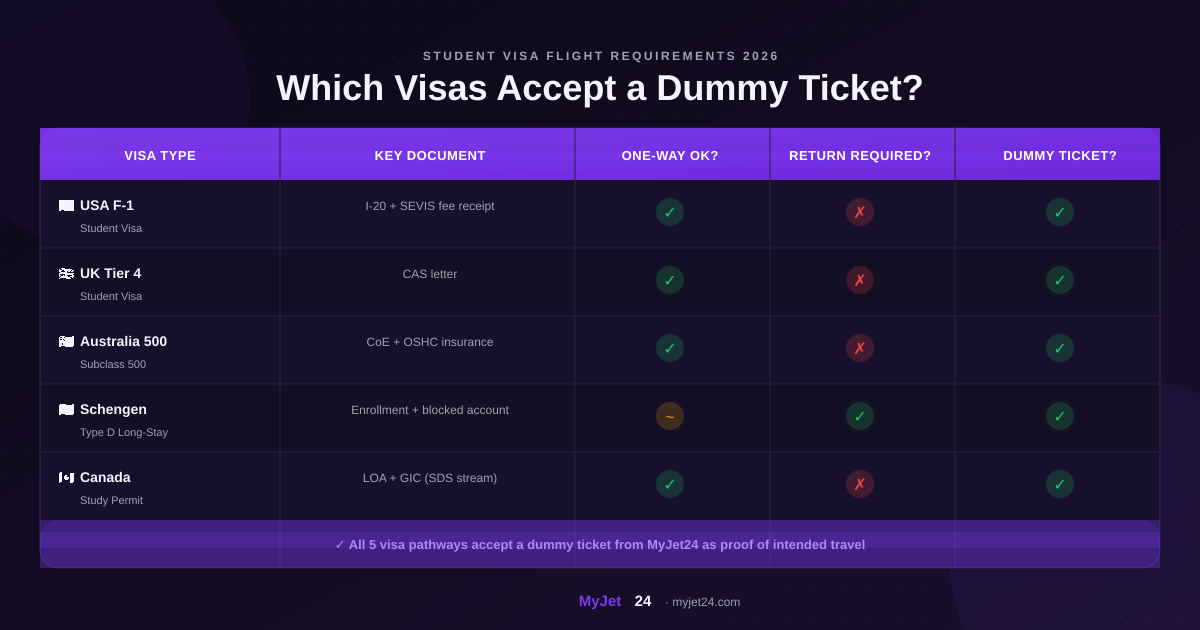
Student Visa Flight Requirements at a Glance
| Visa Type | Key Document | One-Way OK? | Return Required? | Dummy Ticket Accepted? |
|---|---|---|---|---|
| USA F-1 | I-20, SEVIS fee receipt | Yes | No | Yes |
| UK Tier 4 / Student | CAS letter | Yes | Not mandatory | Yes |
| Australia Subclass 500 | CoE, OSHC insurance | Yes | No | Yes |
| Schengen (Type D) | Enrollment letter, blocked account | Depends | Usually yes | Yes |
| Canada Study Permit | LOA, GIC (SDS stream) | Yes | No | Yes |
| Japan (Student) | COE (Certificate of Eligibility) | Yes | Not typically | Yes |
For Japan specifically, the COE (Certificate of Eligibility) process adds an extra step — your institution applies for it on your behalf before you can even submit your visa application. Our Japan student visa flight proof guide covers the COE timeline and what to submit at each stage.
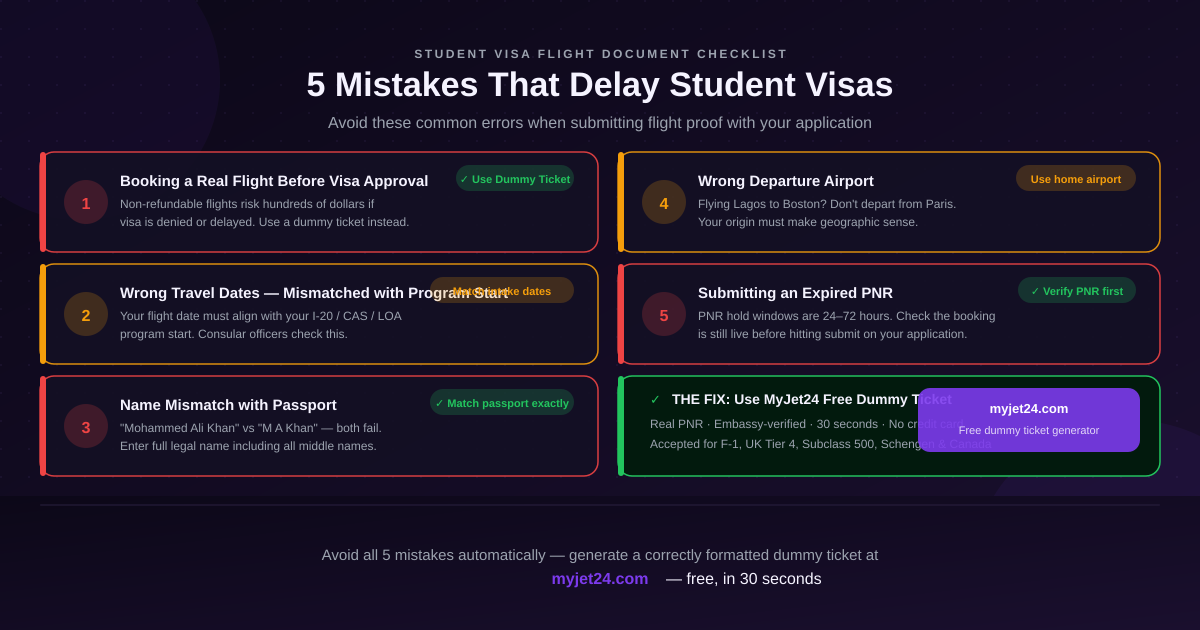
Common Student Mistakes That Cause Visa Delays
Having reviewed hundreds of student visa document checklists (and talked to more than a few students post-rejection), a few mistakes come up over and over again.
Booking flights before the visa is approved. This is the most financially damaging mistake. Some students buy a confirmed, non-refundable ticket thinking it will make their application look more serious. It doesn't — and if your visa is denied or delayed, you've lost the ticket cost. A dummy ticket signals the same level of travel intent without the financial exposure. Here's our full breakdown of dummy ticket vs refundable flight costs if you want the numbers.
Wrong travel dates. Your flight reservation should align with your program start date, not be six weeks off. Consular officers notice mismatches between your I-20 / CAS / LOA start date and your travel itinerary — it raises questions about the application's coherence.
Name mismatches. This one sounds obvious but it's genuinely a top rejection trigger. Enter your full legal name exactly as it appears on your passport — middle names included if they're in your passport. "Mohammed Ali Khan" and "M A Khan" will cause a verification failure. Always verify your dummy ticket PNR before submission to make sure all details are clean.
Mismatched departure airports. If you live in Lahore, your flight should logically depart from Lahore (LHE) or Islamabad (ISB) — not some random international hub that makes no geographic sense for your situation.
Submitting an expired reservation. If your dummy ticket PNR window closes and you haven't submitted yet, regenerate it. Submitting a document with an expired PNR is the same as submitting no document at all. Check the dummy ticket reservation legality page to understand what a "live" PNR means. And if you're weighing different services, our comparison of the best student-friendly reservation tools has an honest breakdown.
Generate your student visa dummy ticket — free, in 30 seconds
Real PNR. Embassy-accepted. No payment. No signup. Works for F-1, Tier 4, subclass 500, Schengen & Canada study permit.
Get My Free Student Dummy TicketFrequently Asked Questions
Ready? Generate Your Student Dummy Ticket Now
The visa process is stressful enough without the flight ticket catch-22 adding to it. The solution is genuinely simple: use a free dummy flight ticket for students from MyJet24, submit your application confidently, and book your actual flights once you have the visa stamp in hand.
Whether you're heading to Boston for an MBA, Manchester for a master's in computer science, Melbourne for an undergraduate degree, or Berlin for an Erasmus semester — the process is the same. Your flight reservation needs to look real because it is real. That's what separates a MyJet24 student travel proof from a fake ticket: a live PNR in an actual airline system, verifiable by any embassy worldwide.
September 2026 & January 2027 Intakes
Get Your Free Student Visa Dummy Ticket
Real PNR · Embassy-accepted · 30 seconds · No payment · No signup
