
Last updated: 15 May 2026 · Reading time: 11 minutes · Author: Marc Hoffmann, Senior Visa Consultant
TL;DR — China 240-Hour Visa-Free Transit Policy 2026
- 55 eligible nationalities can stay in China up to 240 hours (10 days) without a visa when transiting to a third country.
- Entry must be through one of 65 designated ports across 24 provinces (Tibet, Xinjiang, Gansu, Qinghai, Ningxia, Inner Mongolia and Jilin are excluded).
- You must hold a confirmed onward ticket to a third country or region — Hong Kong, Macau and Taiwan count as separate regions, so are accepted.
- Passport must have at least 3 months validity at entry; the 240-hour clock starts at midnight after arrival.
- Most denials come from wrong onward destination, non-designated port arrival, or airline staff refusing boarding — all preventable with the correct documentation.
China's 240-hour visa-free transit policy is a Chinese government scheme that allows citizens of 55 eligible countries to enter China for up to 240 hours (10 days) without applying for a visa, provided they hold a confirmed onward ticket to a third country and arrive through one of 65 designated ports. The policy, expanded from the previous 144-hour scheme in November 2024, opens 24 Chinese provinces to short-stay travelers with zero application fee. It is the single most significant simplification of Chinese entry policy in a decade.
Table of Contents
- What is the 240-hour visa-free transit?
- Complete list of 55 eligible countries
- 65 designated ports across 24 provinces
- The "third country" rule — and the trap
- Step-by-step: how to use the policy
- Documents required at the border
- 7 excluded provinces you cannot visit
- 8 common refusals at the 240h counter
- 240h transit vs. L Tourist Visa: when to use what
- Airline boarding refusals — and how to prevent them
- Using a dummy ticket as proof of onward travel
- Frequently asked questions
What is the 240-hour visa-free transit?
The 240-hour visa-free transit is China's expanded transit policy effective from 17 December 2024, replacing the earlier 72-hour and 144-hour schemes. Eligible travelers receive a temporary entry permit on arrival at one of 65 designated ports, valid for up to 240 hours (10 days) of stay across 24 Chinese provinces.
The 240-hour stay clock starts at 00:00 on the day after arrival, not at the moment you land. This means a midnight arrival gives you almost an extra full day compared to a morning arrival — a small detail worth planning around.
Unlike the L Tourist Visa, which costs USD 30-185 and requires an in-person appointment at a Chinese Visa Application Service Center (CVASC), the 240-hour transit is free, paperless, and granted on arrival. For travelers who plan trips of 10 days or less and meet the eligibility criteria, it is by far the cheapest legal entry to China.
Complete list of 55 eligible countries
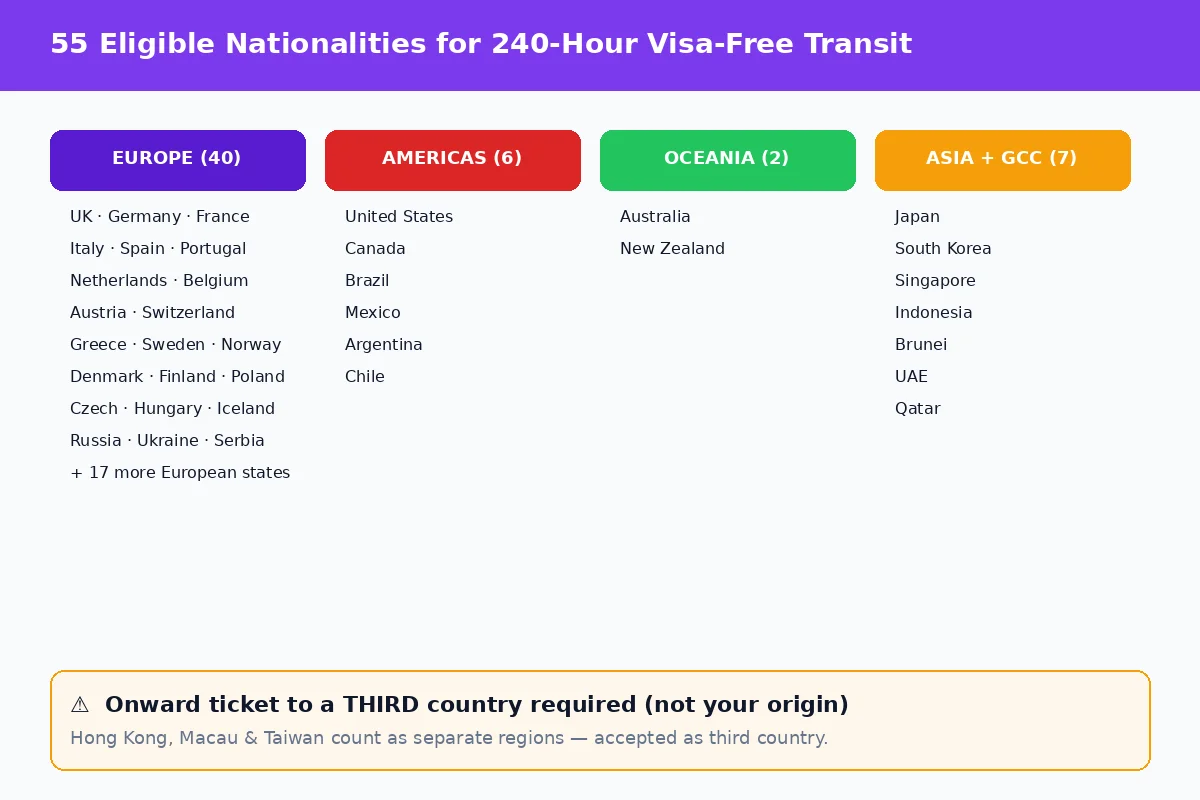
The Chinese National Immigration Administration publishes a definitive list of 55 nationalities eligible for 240-hour transit. The list is grouped by region:
| Region | Count | Countries |
|---|---|---|
| Europe | 40 | All 26 Schengen states + UK, Ireland, Cyprus, Bulgaria, Romania, Ukraine, Serbia, Croatia, Bosnia, Montenegro, North Macedonia, Albania, Monaco, Belarus, Russia |
| Americas | 6 | USA, Canada, Brazil, Mexico, Argentina, Chile |
| Oceania | 2 | Australia, New Zealand |
| Asia + GCC | 7 | Japan, South Korea, Singapore, Indonesia, Brunei, UAE, Qatar |
If your passport is not on this list — most notably citizens of India, Pakistan, Bangladesh, Vietnam, the Philippines and most African countries — you cannot use the 240-hour transit and must apply for the L Tourist Visa through COVA + CVASC. We cover the application process in our complete China visa guide.
65 designated ports across 24 provinces
The 240-hour transit is valid only at 65 specific ports — primarily international airports, plus selected seaports and land borders. The top air entry points used by international travelers are:
| Airport Code | City | Province |
|---|---|---|
| PEK / PKX | Beijing (Capital / Daxing) | Beijing Municipality |
| PVG / SHA | Shanghai (Pudong / Hongqiao) | Shanghai Municipality |
| CAN | Guangzhou Baiyun | Guangdong |
| SZX | Shenzhen Bao'an | Guangdong |
| CTU / TFU | Chengdu (Shuangliu / Tianfu) | Sichuan |
| KMG | Kunming Changshui | Yunnan |
| XIY | Xi'an Xianyang | Shaanxi |
| HGH | Hangzhou Xiaoshan | Zhejiang |
| WUH | Wuhan Tianhe | Hubei |
| + 56 others | NKG, CKG, TAO, SYX, etc. | Across remaining 22 provinces |
A critical 2024 expansion added Guangzhou, Zhuhai (Hengqin), Zhongshan, the Hong Kong-Zhuhai-Macao Bridge land border, and the West Kowloon Station of the Guangzhou-Shenzhen-Hong Kong Express Rail Link — making cross-border rail and bridge transit qualifying ports for the first time. The full 65-port list is published by the Chinese National Immigration Administration.
The "third country" rule — and the trap
The single biggest source of refused 240-hour transit applications is misunderstanding the "third country" rule. Your onward ticket must depart China heading to a country or region different from where you started. A roundtrip ticket from your home country to China and back will NOT qualify — even though it shows departure from China, the destination is not a third country.
"Hong Kong, Macau and Taiwan count as separate regions for the purpose of this policy. A flight from Beijing to Hong Kong satisfies the third-country rule even though Hong Kong is part of the People's Republic."
— Chinese National Immigration Administration, 2024 policy explainer
This special-region treatment makes Hong Kong, Macau and Taiwan the most popular onward destinations for travelers who want to use the 240-hour transit as a de-facto China tourism visa. Worked examples:
| Route | Qualifies? | Reason |
|---|---|---|
| USA → China → USA | ❌ No | Return to origin = not third country |
| USA → China → Japan | ✅ Yes | Japan is a third country |
| USA → China → Hong Kong | ✅ Yes | Hong Kong is a separate region |
| UK → China → Hong Kong → UK | ✅ Yes | Hong Kong leg satisfies the rule, final UK return is OK |
| Australia → China → Singapore → Australia | ✅ Yes | Singapore is a third country |
| Germany → Hong Kong → China → Germany | ❌ No | The flight LEAVING China returns to origin Germany |
Step-by-step: how to use the policy
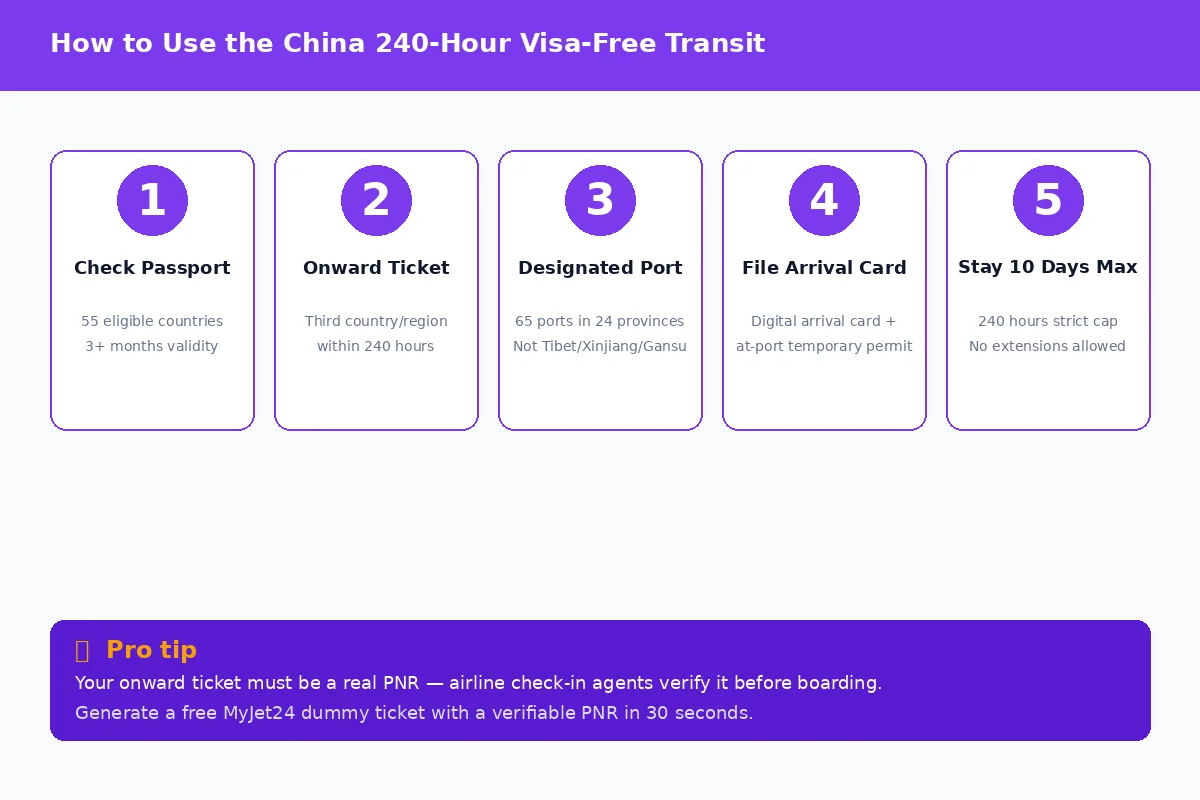
- Confirm your passport qualifies. Check the list of 55 nationalities and verify your passport has at least 3 months validity beyond the date of entry, plus two blank visa pages.
- Book a confirmed onward ticket. Departure must be within 240 hours of arrival, going to a country or region different from where you entered. A flight reservation with a real PNR is sufficient — many travelers use a free MyJet24 dummy ticket while finalising plans.
- Arrive at one of 65 designated ports. Major options: PEK, PVG, CAN, SZX, CTU, KMG. Less-known qualifying ports include the Hong Kong-Zhuhai-Macao Bridge land border and West Kowloon Express Rail Station.
- Complete the China Digital Arrival Card. Available online before flight or at airport kiosks on arrival. The digital arrival card is mandatory regardless of visa-free status.
- Approach the 240h visa-free transit counter. Most major airports have a dedicated lane. Present passport, boarding pass for onward flight, and arrival card confirmation. The officer issues a temporary entry permit stamp.
- Register accommodation within 24 hours. Hotels do this automatically. If staying with friends or in a non-registered Airbnb, visit the local Public Security Bureau (PSB) within 24 hours of arrival.
- Leave China within 240 hours. The 240-hour clock starts at 00:00 the day after arrival. Even one minute over the limit triggers a fine of CNY 500 per day and may affect future entry. Time your departure flight conservatively.
Documents required at the border
Compared to a full visa application, the 240-hour transit document requirements are minimal:
- Valid ordinary passport from one of the 55 eligible countries (3 months validity beyond entry, 2 blank pages).
- Confirmed onward ticket to a third country/region with assigned seat and departure within 240 hours.
- Completed China Digital Arrival Card (QR code, free, online).
- Optional but recommended: printed hotel booking for the first night, travel insurance certificate, contact details for your stay.
Diplomatic, official and special-category passport holders apply different rules. Service-passport holders should consult their consulate before travel.
7 excluded provinces you cannot visit
The 240-hour transit grants you stay within 24 designated provincial-level regions. Seven Chinese regions are completely excluded — visiting them requires a separate visa or special permit:
| Excluded Region | Why Excluded |
|---|---|
| Tibet | Requires Tibet Travel Permit + visa, regardless of visa-free policy |
| Xinjiang | Security-sensitive region with additional permit requirements |
| Gansu | Borders Xinjiang and Tibet — excluded as security buffer |
| Qinghai | Borders Tibet — excluded |
| Ningxia | Hui Autonomous Region — excluded |
| Inner Mongolia | Border-sensitive region — excluded |
| Jilin (NE border) | Border with North Korea — excluded |
If your travel plans include any of these regions, apply for the L Tourist Visa instead. The visa-free transit cannot be combined with Tibet or Xinjiang permits.
8 common refusals at the 240h counter
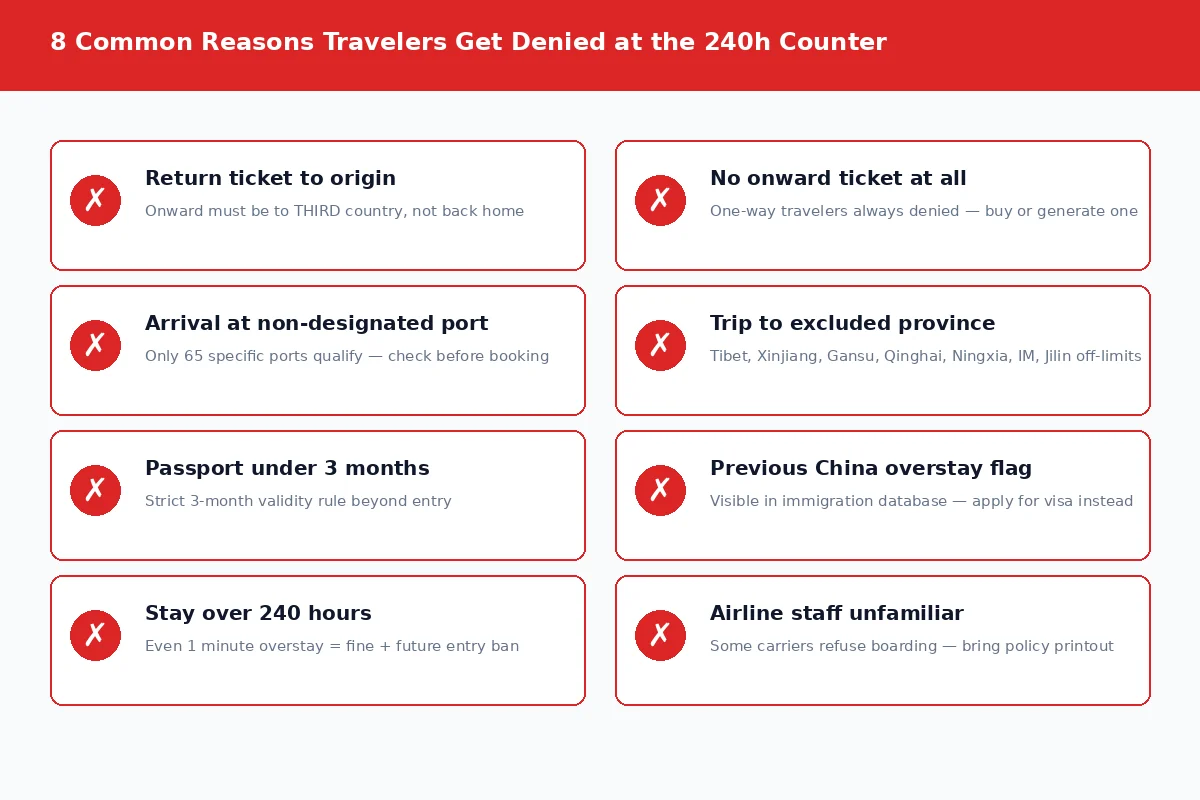
Refusal at the 240-hour counter is rare for properly-prepared travelers but happens daily across major Chinese airports. The top eight reasons:
- Onward ticket returns to origin country. The third-country rule is strict. Buy a real onward ticket to a different country, OR generate a verifiable dummy reservation for the qualifying leg.
- No onward ticket at all. Travelers arriving with one-way tickets are denied without exception. Even bookings shown on phone screens must be confirmed reservations with PNR.
- Arrival at non-designated port. Smaller regional airports like Hohhot, Lhasa or Urumqi do not qualify even though they are international gateways. Confirm your entry port is on the 65-port list before booking.
- Planned travel to excluded province. Mentioning Tibet, Xinjiang or border regions when asked the purpose of visit triggers refusal. Keep the answer focused on permitted provinces.
- Passport validity under 3 months. Strict rule. Renew before travel — the airline at check-in often catches this first.
- Previous China overstay flag. Visible in immigration database. Travelers with previous overstays must apply for a visa rather than rely on visa-free transit.
- Booking past the 240-hour window. Even one hour over the cap = refusal. Book your onward ticket for hour 230-235 maximum.
- Airline staff unfamiliar with policy. Some carriers — particularly outside SkyTeam and Star Alliance — refuse boarding because their gate staff don't recognise the 240h policy. Carry a printout of the policy from the National Immigration Administration to show.
240h transit vs. L Tourist Visa: when to use what
If you qualify for the 240-hour transit AND your trip fits within 10 days within designated provinces, it is almost always the better choice. The L Tourist Visa has its own use cases though:
| Factor | 240-Hour Transit | L Tourist Visa |
|---|---|---|
| Cost | Free | USD 30-185 |
| Max stay | 10 days (240 hours) | 30-90 days per entry |
| Entries | Single (per qualifying onward ticket) | Single, multiple or 10-year multi-entry |
| Application | No application — granted at border | COVA online + CVASC in-person appointment |
| Processing time | Instant at arrival | 4 working days standard |
| Excluded provinces | 7 (Tibet, Xinjiang, etc.) | None (plus separate Tibet permit) |
| Best for | Layover travelers, short city breaks | Full tourism, business trips, family visits |
Airline boarding refusals — and how to prevent them
A growing number of 240-hour transit travelers report being denied boarding by airline staff who are unaware of the policy. Airlines verify visa documentation before flights to China because they pay heavy fines under Chinese carrier-liability law if they fly inadmissible passengers.
Carriers with stronger institutional knowledge of the policy: Air China, China Eastern, China Southern, Cathay Pacific, Singapore Airlines, Lufthansa, KLM, Air France, British Airways, Emirates, Qatar Airways. Less-trained gate staff often appear at smaller carriers, regional codeshares, or at non-Chinese hub airports.
Three protective measures:
- Print the official 240-hour transit policy explainer from the National Immigration Administration and bring it to check-in.
- Show the onward ticket clearly — both the booking confirmation AND a screenshot of the airline's booking record showing departure within 240 hours.
- If denied boarding by mistake, escalate to a duty manager and reference the policy URL. Filing a formal complaint with the airline post-incident has resulted in compensation for several documented cases.
Using a dummy ticket as proof of onward travel
The 240-hour transit policy requires a confirmed onward ticket — but you don't need to buy and burn a real flight just to satisfy the rule. A dummy ticket with a verifiable PNR works as long as it shows:
- A real airline (Air China, Cathay Pacific, Singapore Airlines, etc.).
- An assigned PNR that resolves on the airline website or Amadeus / Sabre lookup.
- Confirmed seat and departure within 240 hours of your arrival.
- Departure to a third country or region (Hong Kong, Macau, Taiwan count).
MyJet24 generates a free dummy ticket PDF with a real Amadeus / Sabre PNR in 30 seconds — accepted by Chinese immigration officers at all 65 designated 240-hour transit ports. See our China dummy ticket page for the application-side details, or our China onward-ticket guide for border procedures. For the broader topic of verifying a dummy ticket PNR, see how to verify your dummy ticket PNR.
Frequently asked questions
Is the 240-hour visa-free transit free?
Yes. The 240-hour transit costs nothing. The temporary entry permit is issued on arrival at no charge. The only related costs are your existing flights and accommodation. By contrast, the L Tourist Visa costs USD 30-185 depending on nationality plus USD 30-65 CVASC service fee.
Can I extend the 240 hours?
No. The 240-hour cap is absolute. There are no extensions. If you need more time, you must leave China and either re-enter on a fresh 240-hour transit (with a new qualifying onward ticket) or apply for an L Tourist Visa for your next visit.
Do I need to register with police?
Yes. All foreign visitors to China must register their accommodation with the local Public Security Bureau within 24 hours of arrival under the Exit and Entry Administration Law. Hotels handle this automatically when you check in. If staying in a private residence or unregistered Airbnb, visit the local PSB in person with passport and host details.
Can I work or study during the 240 hours?
No. The 240-hour transit is for tourism, short business meetings, family visits and casual leisure. Paid work, formal studies, journalism, religious activities and similar require a dedicated visa category (Z Work, X Student, J Journalist, Q Family, etc.).
Can I travel between Chinese provinces during the 240 hours?
Yes — within the 24 designated provinces. Travel from Beijing to Shanghai, Beijing to Xi'an, Shanghai to Hangzhou or Guangzhou to Shenzhen is all permitted. You cannot enter Tibet, Xinjiang, Gansu, Qinghai, Ningxia, Inner Mongolia or Jilin under this policy.
What happens if I overstay the 240 hours?
Overstaying triggers a fine of CNY 500 per day (capped at CNY 10,000), possible short detention, and a permanent record in the immigration database that may affect future Chinese visa applications. The 240-hour clock is strict — even a one-hour overstay is recorded. Always book your onward flight conservatively, aiming for hour 230 or earlier.
Does the 240-hour transit cover Hong Kong, Macau or Taiwan?
No. The 240-hour transit applies to Mainland China only. Hong Kong and Macau have their own visa-free regimes (most travelers get 90-180 days without a visa). Taiwan has separate immigration policy. For 240-hour transit purposes, these three regions count as third countries — meaning a flight from Mainland China to Hong Kong, Macau or Taiwan qualifies as the onward leg.
Can my children use the 240-hour transit?
Yes. Children of eligible nationalities qualify under the same rules. Each child needs their own passport with 3 months validity and is included on the family's onward ticket. Border officers may ask about custody arrangements for solo-parent travel — bring a notarised parental consent letter if travelling without one parent.
Will airline check-in agents always recognise the policy?
Most carriers serving China (Air China, China Eastern, China Southern, Lufthansa, Emirates, Singapore Airlines, etc.) train staff on the 240-hour policy. Less-frequent China carriers and smaller regional partners may not. Carry the official policy explainer from the National Immigration Administration on your phone or printed. If denied boarding incorrectly, escalate to a duty manager — there are documented cases of compensation for wrongful denial.
Next steps — plan your China trip without a visa
Ready to use the 240-hour transit?
Step 1: confirm you have a qualifying onward ticket to a third country or region. If you don't, MyJet24 generates a free dummy ticket with a verifiable PNR in 30 seconds — accepted at all 65 designated 240-hour ports.
Generate Free China Onward Ticket →For travelers whose trip exceeds 10 days, includes excluded provinces, or who don't qualify for the 240-hour transit, the L Tourist Visa is the path forward. Our China dummy ticket guide covers the full COVA + CVASC application process step-by-step.
About the author
Marc Hoffmann — Senior Visa Consultant & Travel Documentation Expert. Marc has helped over 50,000 travelers navigate visa applications across 195+ countries since founding MyJet24 in 2021. His expertise covers Schengen visa requirements, proof of onward travel regulations, China visa-free transit, and embassy documentation standards worldwide.
Last updated: 15 May 2026 · Edited and fact-checked against the Chinese National Immigration Administration policy publication of November 2024.
