
Last updated: 8 July 2026 · Reading time: 15 min · Author: Joshua White, Travel Documentation Writer at MyJet24
TL;DR — Key Facts
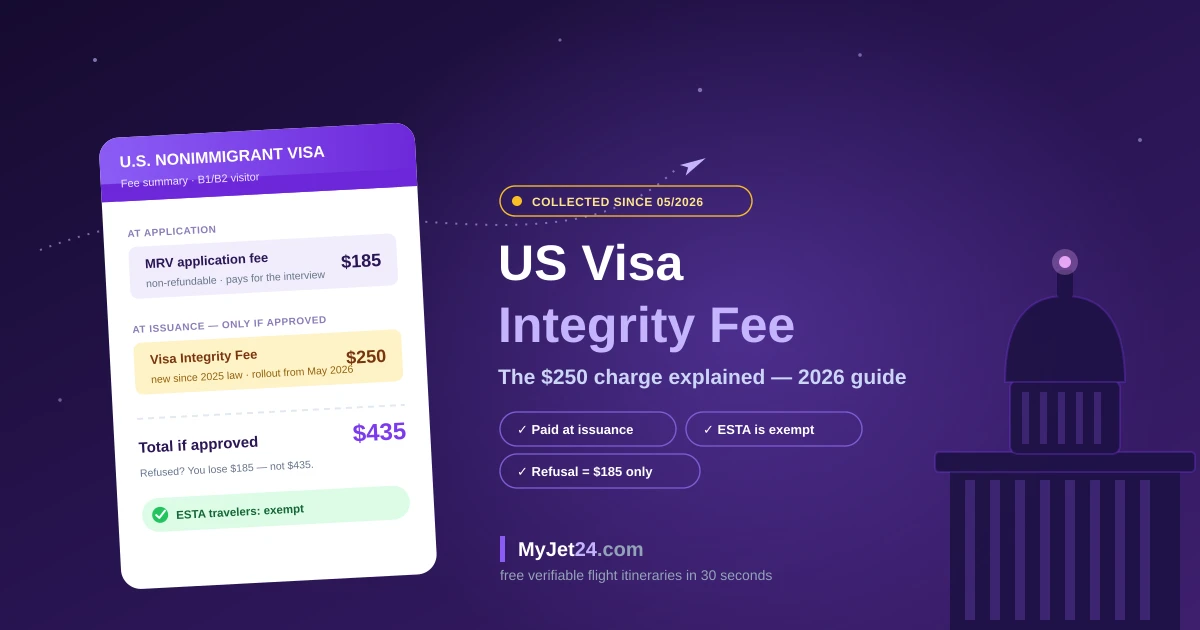
- The Visa Integrity Fee is a $250 surcharge on most US nonimmigrant visas — B1/B2 visitor visas, F-1 student visas, H-1B work visas and more — created by the One Big Beautiful Bill Act signed on 4 July 2025. It sits on top of the standard $185 application fee, not instead of it.
- The rollout has been messy, and that's the part everyone gets wrong. On paper it applies to visas issued on or after 1 October 2025. In reality, consulates only began charging it around May 2026 — and not all of them at once. Whether you pay depends on which post issues your visa and when.
- You pay at issuance, not at application. The $185 MRV fee is due when you apply; the $250 Integrity Fee is only collected if and when your visa is actually approved and issued. A refusal costs you $185, not $435.
- ESTA travelers don't pay it. The fee targets visa applicants — Visa Waiver Program travelers under ESTA and most Canadian visitors are outside its scope entirely.
- It's theoretically refundable — practically, don't count on it. The law allows a refund if you leave the US on time and comply with your visa conditions, but no refund mechanism exists yet, and Congress's own budget office expects very few people to ever claim it.
- A stronger application matters more than ever. With up to $435 at stake per attempt, walking into the interview with complete documents — including a verifiable flight itinerary instead of an expensive purchased ticket — is the cheapest insurance there is.
The US Visa Integrity Fee is a $250 surcharge on most nonimmigrant visas — including B1/B2, F-1 and H-1B — created by the One Big Beautiful Bill Act of 4 July 2025 and applying to visas issued on or after 1 October 2025. It is collected when the visa is issued, not when you apply, and it comes on top of the standard $185 application fee, bringing the typical total for an approved B1/B2 visa to $435. In practice, consulates only began charging it around May 2026, and the rollout remains uneven — ESTA travelers under the Visa Waiver Program and most Canadian visitors are exempt.
Few travel fees have generated as much confusion as the US Visa Integrity Fee. Since mid-2025, headlines have announced a "$250 fee for visiting America," travel forums have quoted totals ranging from $185 to $472, and applicants have walked into visa interviews genuinely unsure what they'd be asked to pay — or when, or whether the number they'd budgeted was already out of date. Even carefully maintained guides quote the $435 total as if it had applied uniformly since October 2025. It didn't.
The confusion isn't the applicants' fault. The fee was created in a sweeping budget law, took effect on paper months before anyone could actually pay it, and then began appearing at some consulates but not others through the spring of 2026. This guide reconstructs the full picture from the legal text and consular practice: what the fee is, the three-stage timeline that explains every contradictory headline, who is exempt, when the money actually leaves your account, the refund clause that sounds better than it is — and what a visitor-visa applicant should do differently now that a refusal effectively wastes more money than ever. For the documents side of that preparation, our guide to the B1/B2 interview checklist pairs directly with this one.
What the Visa Integrity Fee Is — and Where It Came From
The Visa Integrity Fee is a $250 surcharge on most US nonimmigrant visas, created by the One Big Beautiful Bill Act (OBBBA), the budget reconciliation law signed on 4 July 2025. It amended the Immigration and Nationality Act to require the fee from "any alien issued a nonimmigrant visa at the time of such issuance" — language that covers the overwhelming majority of temporary US visas:
- B1/B2 visitor visas — tourism, family visits, business trips; by far the largest affected group.
- F and M student visas — including F-1 university students.
- H-1B and other work visas — paid by the visa holder at issuance, on top of employer petition costs.
- J exchange visas, O, P, and most other nonimmigrant categories.
Three design details distinguish it from the fees travelers already know. First, it cannot be waived or reduced — the law gives consular officers no discretion. Second, it is indexed to inflation, so the $250 baseline can rise in future fiscal years. Third — and this is the detail that shapes everything else in this guide — it is charged at issuance, which splits the cost of a US visa into two separate payment moments for the first time.
The Timeline Everyone Gets Wrong: Law vs Reality
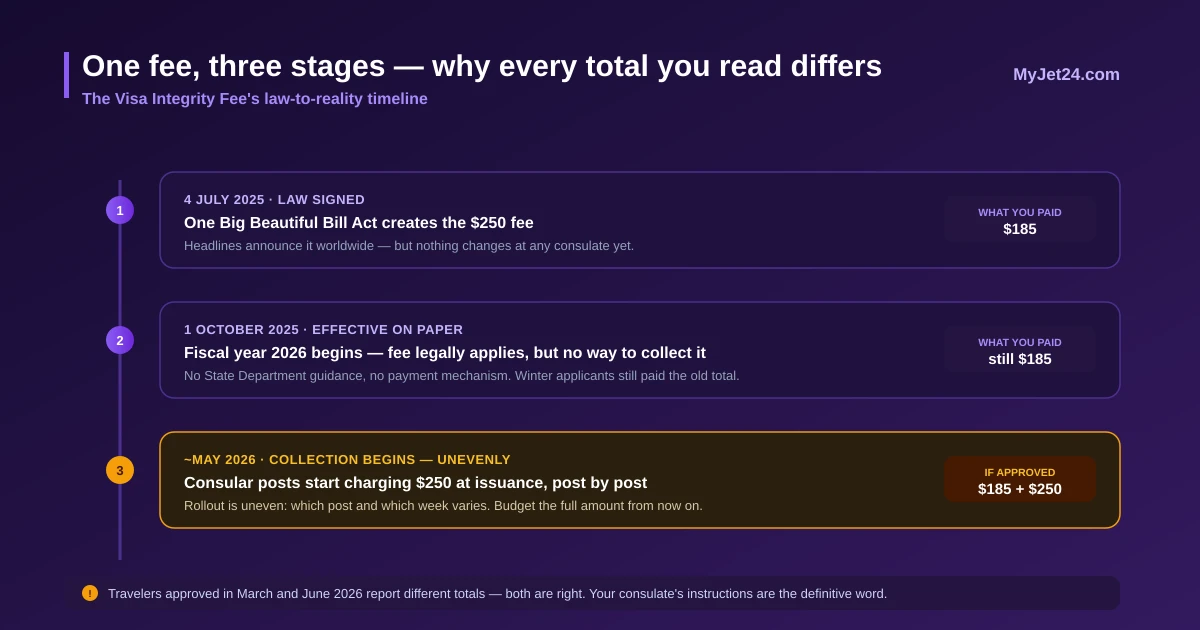
Every contradictory number you've read about this fee traces back to one fact: the legal effective date and the practical start of collection were more than half a year apart. The rollout happened in three distinct stages:
| Stage | What was true |
|---|---|
| 4 July 2025 Law signed |
The OBBBA creates the fee. Headlines announce "$250 to visit the US" — but nothing changes at any consulate yet. |
| 1 October 2025 Effective on paper |
Fiscal year 2026 begins; the fee legally applies to visas issued from this date. But the State Department had issued no implementation guidance — consulates had no mechanism to collect it, and applicants through the winter reported paying only the standard $185. |
| ~May 2026 Collection begins |
Reports from university international offices confirm some consular posts have started charging the $250 at issuance. The rollout is uneven — which post, which week, and which payment method varies. By mid-2026, paying it is the norm at a growing number of posts, but not yet universal. |
This is why one traveler swears their visa cost $185 in March and another paid $435 in June — both are telling the truth. The practical takeaway for anyone applying now: budget the full $435 and treat anything less as a pleasant surprise. The direction of travel is one-way; posts are switching collection on, not off. If your interview is scheduled soon, the consulate's own instructions (or your interview confirmation letter) are the definitive word on what you'll pay and how.
Who Pays It — and Who Is Exempt
| Traveler type | Pays the $250 Integrity Fee? |
|---|---|
| B1/B2 visitor visa applicants | Yes — at issuance, where collection is active |
| F-1 students, H-1B workers, J-1 exchange visitors | Yes — same rule, same moment |
| ESTA travelers (Visa Waiver Program, 40+ nationalities) | No — no visa is issued, so the fee never applies |
| Canadian citizens visiting the US | Mostly no — most Canadians enter visa-free; the fee only touches the categories where Canadians actually need a visa |
| Diplomatic and official visa holders (A, G categories) | No — exempt under the law |
| Refused applicants | No — the fee is only collected when a visa is issued; a denial costs the $185 application fee only |
The exemption logic is simpler than it looks: the fee is attached to the physical act of issuing a visa. No visa issued — because you travel under ESTA, because you're a visa-exempt Canadian, or because your application was refused — means no Integrity Fee. That's also why the fee has quietly become one more argument in the ESTA-vs-visa decision for dual-eligible travelers, covered below.
When You Pay: Application vs Issuance
US visa costs now arrive in two separate moments, and keeping them apart prevents most of the arithmetic confusion:
- At application — $185 (MRV fee). Paid when you book your interview, non-refundable regardless of outcome. This is the fee you lose if the visa is refused.
- At issuance — $250 (Integrity Fee). Collected only if the visa is approved and issued, at posts where collection is active. Payment logistics vary by consulate.
Two consequences follow. First, a refusal does not cost $435 — it costs $185, because the Integrity Fee never becomes due. Second, every re-application after a refusal restarts the ledger: a second attempt means a second $185, and a second $250 if approved. An applicant refused once and approved on the second try pays $185 + $185 + $250 = $620 in government fees alone. That math is exactly why the preparation section of this guide exists. (Since 1 July 2026 there is also an optional $750 fast-track that books the interview within about 10 days — a separate charge covered in our fast-track interview guide.)
The Full Cost of a US Visitor Visa in 2026
For a standard B1/B2 applicant at a post where Integrity Fee collection is active:
| Item | Amount | When |
|---|---|---|
| MRV application fee | $185 | At application, non-refundable |
| Visa Integrity Fee | $250 | At issuance, only if approved |
| Total for an approved visa | $435 | Across the two stages |
| Reciprocity fee (some nationalities) | Varies | At issuance, country-specific |
Note what is not in that table: flights, hotels, or any booking the interview might touch on. Those are your choices — and with $435 of fees already committed, the case against buying a non-refundable plane ticket before approval has never been stronger. Consulates themselves advise against purchasing final tickets before the visa is in hand; a verifiable flight itinerary satisfies the documentation need without the financial exposure.
The Refund That Exists on Paper
The law's most-quoted quirk: the Integrity Fee is theoretically refundable. An applicant who complies with all visa conditions — including departing the United States no more than five days after their authorized stay ends, or adjusting to lawful status — can, per the statute, apply for reimbursement after the visa expires.
The practice looks different from the statute:
- No refund mechanism exists yet. As of mid-2026, there is no form, no portal, and no published procedure for claiming the money back.
- The waiting period is long by design. Refund eligibility attaches to the visa's expiration — for a ten-year multiple-entry B1/B2, that's a decade after you paid.
- Congress's own scorekeepers don't expect payouts. The Congressional Budget Office projected that few travelers will ever claim the refund, and scored the fee as revenue accordingly.
The honest planning advice: treat the $250 as a cost, not a deposit. If a refund procedure eventually appears, keep proof of your timely departure — boarding passes, passport stamps, I-94 history — and consider any recovered money a bonus.
ESTA vs Visa: What the Fee Changes for Your Choice
For the roughly 40 nationalities eligible for the Visa Waiver Program, the Integrity Fee widens an already large cost gap. An ESTA authorization costs a fraction of a visa, is approved online in minutes to days, and — because no visa is ever issued — sits entirely outside the Integrity Fee's reach.
The fee therefore matters most to VWP-eligible travelers who are considering a B1/B2 visa anyway, typically because they need more than 90 days, expect frequent long stays, or have had an ESTA denied. That trade-off now carries a $435 price tag on one side. If you're VWP-eligible and your trips fit inside 90-day stays, ESTA remains overwhelmingly the cheaper and faster route — with its own onward-ticket rule, covered in our US entry requirements guide. Remember that ESTA's rules differ in one important way: under the VWP you must hold a return or onward ticket as a condition of entry, so the money you save on the visa shouldn't be spent on a non-refundable flight bought in a hurry — a free verifiable onward ticket covers that requirement in about 30 seconds.
How to Protect Your $435: Getting the Application Right
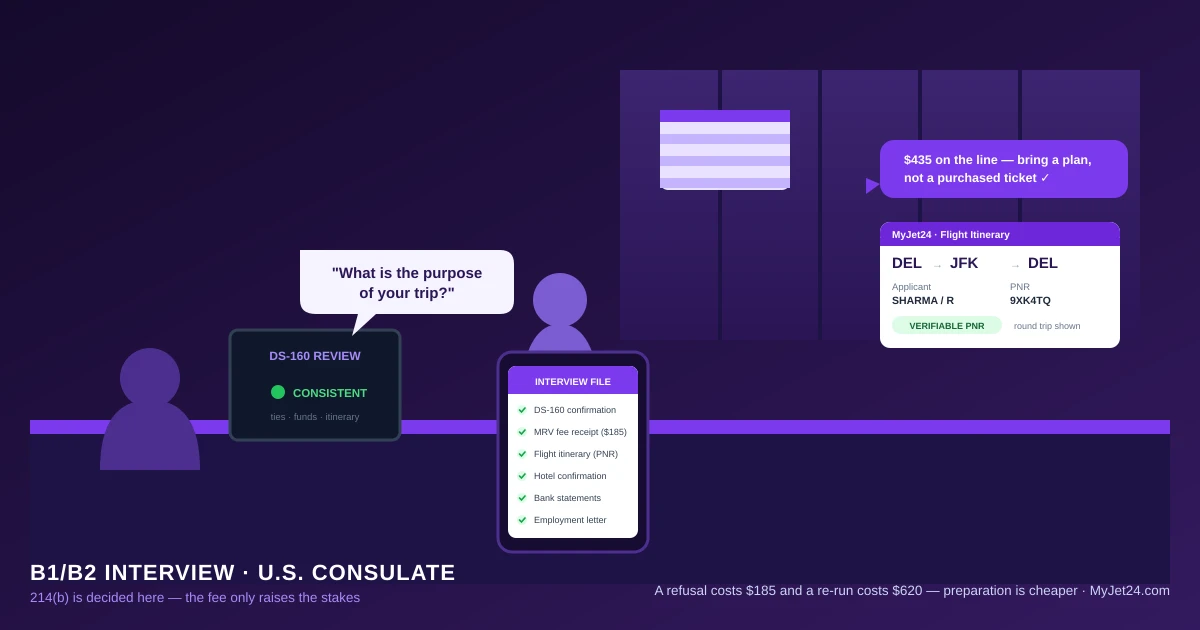
B visitor visas are refused at rates between a quarter and a third of applications globally, most under Section 214(b) — the presumption that every applicant is an intending immigrant until they demonstrate otherwise. Each refusal now burns $185 and pushes the eventual approved-visa total toward $620 or beyond. The preparation that protects that money is unglamorous and effective:
- Make the DS-160 and your documents tell one consistent story. Dates, employer, purpose of trip, funding — the officer cross-checks; contradictions are the fastest route to 214(b).
- Demonstrate ties to home. Employment letter, property, family obligations, studies — evidence that your life pulls you back after the trip.
- Show a concrete, plausible travel plan — without buying it. A flight itinerary with a verifiable reservation and a hotel booking confirmation show planning without risking airfare on an uncertain outcome. Officers know the difference between a plan and a purchase — they explicitly do not require paid tickets.
- Bring financial evidence that matches the trip. Bank statements that plausibly fund the itinerary you're presenting — see our guide to presenting financial proof.
- If refused, fix the weakness before re-applying. There's no mandatory waiting period, but re-applying with an unchanged case buys the same refusal for another $185. Our guide on recovering from a visa refusal covers what actually changes outcomes.
Six Costly Misunderstandings About the Fee
- "I'll pay $435 when I apply." No — $185 at application, $250 only at issuance. Budget both, pay them at different moments.
- "The fee started in October 2025, so everyone since then has paid it." No — collection only began around May 2026, post by post. Travelers issued visas over the winter typically paid $185 total.
- "ESTA costs $250 more now too." No — the Integrity Fee does not touch ESTA. (ESTA's own fee has its own history, but this $250 isn't part of it.)
- "If I'm refused, I lose $435." No — a refusal costs the $185 application fee; the Integrity Fee is never collected on a denial.
- "I'll just get the $250 back when I leave." In theory. In practice there is no refund mechanism yet, eligibility attaches to visa expiry (up to ten years out), and official projections assume most people never claim it.
- "It's a scam if my consulate asks for $250 at pickup." No — collection at issuance is exactly how the fee works. What would be suspicious is a third-party website offering to "pre-pay" or "waive" the Integrity Fee for you; the fee is paid through official consular channels only.
Frequently Asked Questions
What is the US Visa Integrity Fee?
A $250 surcharge on most US nonimmigrant visas, created by the One Big Beautiful Bill Act signed on 4 July 2025. It applies to visas issued on or after 1 October 2025, is collected at issuance on top of the standard $185 application fee, cannot be waived, and is indexed to inflation in future years.
How much does a US tourist visa cost in 2026 in total?
$435 for an approved B1/B2 visa at posts collecting the Integrity Fee: $185 paid at application plus $250 paid at issuance. Some nationalities owe an additional reciprocity fee. A refused application costs only the $185, since the Integrity Fee is never charged on a denial.
When did the Visa Integrity Fee actually start being collected?
Legally it applies to visas issued on or after 1 October 2025, but consulates had no collection mechanism through the winter — reports confirm some posts only began charging it around May 2026, with an uneven rollout continuing since. Which is why travelers approved in March and June of 2026 can report genuinely different totals.
Do ESTA travelers pay the Visa Integrity Fee?
No. The fee attaches to the issuance of a nonimmigrant visa, and ESTA travelers under the Visa Waiver Program never receive a visa. ESTA has its own, much smaller fee and its own conditions — including the requirement to hold a return or onward ticket.
Do Canadians pay the Visa Integrity Fee?
Mostly no. Canadian citizens generally enter the US without a visa, so no issuance occurs and no fee applies. Canadians who need one of the specific visa categories that do apply to them (for example E treaty or K fiancé visas) pay it like any other applicant at posts where collection is active.
Is the Visa Integrity Fee refundable?
On paper, yes — the law allows reimbursement for visa holders who comply with all conditions and depart on time, claimable after the visa expires. In practice, no refund mechanism exists yet, the wait can be up to a decade for long-validity visas, and official budget projections assume few travelers will ever claim it. Treat it as a cost, keep departure proof, and regard any future refund as a bonus.
Do I pay the $250 if my visa application is refused?
No. The fee is collected at issuance only. A refusal costs you the $185 MRV application fee. If you re-apply and are approved, you pay a new $185 plus the $250 — which makes getting the application right the first time worth real money.
Does the fee apply to students and workers, or just tourists?
It applies to most nonimmigrant categories: B1/B2 visitors, F-1 and M students, H-1B and other work visas, J-1 exchange visitors, O, P and more. Diplomatic A and G categories are exempt. For work visas, the fee is owed by the visa applicant at issuance, separate from any employer petition fees.
Can the Visa Integrity Fee be waived or reduced?
No. The statute sets it as a mandatory minimum with no waiver authority, and it adjusts upward with inflation in future fiscal years. Any website offering to waive, reduce or "pre-clear" the fee for you is not legitimate — it is paid through official consular channels only.
Does the Integrity Fee change my chances of approval?
No — it is a fee, not a screening criterion. Approval still turns on the interview and Section 214(b): consistent documents, ties to home, plausible funding and a concrete travel plan. What the fee changes is the price of failure, which makes thorough preparation more valuable than before.
Should I buy my flight ticket before the visa interview now that fees are higher?
No — consulates explicitly advise against purchasing non-refundable tickets before a visa is issued, and with $435 in fees already at stake, adding airfare to the risk makes even less sense. A verifiable flight itinerary with a live reservation shows the officer a concrete plan without the financial exposure, and it's the standard instrument travel agencies use during visa processing.
Is the Visa Integrity Fee the same as the visa bond program?
No. They are separate measures. The Integrity Fee is a flat $250 on most nonimmigrant visas at issuance. The visa bond pilot is a separate program requiring refundable bonds of $5,000–$15,000 from applicants of specific countries with high overstay rates. An applicant can be subject to both, one, or neither.
Will the $250 amount increase?
The law allows it: the fee is set as a minimum of $250 for fiscal year 2025 terms and is indexed to inflation for subsequent years, so expect gradual increases rather than a fixed price. Always check the current amount when you apply.
Where do I pay the Integrity Fee — is there an official website?
Payment happens through official consular channels at issuance; the exact logistics (payment at pickup, bank deposit, or another method) vary by post and are communicated in your consulate's instructions. There is no separate central "Integrity Fee website" — and any third-party site claiming to collect or waive it for you should be treated as a scam.
Sources & further reading
- Congress.gov — H.R. 1, One Big Beautiful Bill Act (creates the Visa Integrity Fee)
- U.S. Department of State — official visa fee schedule
- Boston University ISSO — report of consular posts beginning collection (May 2026)
- Alliance for International Exchange — rollout timing commentary
Fee amounts and collection practice are changing post by post during the 2026 rollout; confirm current figures with your consulate and travel.state.gov before you apply. This guide reflects conditions documented as of July 2026.
