
Multiple entry sounds better. And it usually is. But here's the question nobody answers clearly: does a multiple entry visa actually change what flight proof you need? Most people assume it does. A lot of visa officers would disagree. The answer depends on which country issued the visa, which trip you're on, and — critically — whether you're applying or arriving. Get this wrong and you end up either overpaying for documentation you don't need, or arriving at a port of entry without the proof you do. Neither outcome is fun.
I've helped thousands of travelers navigate this through the MyJet24 flight reservation tool and our visa application blog. This guide is the definitive answer — entry type by entry type, country by country, trip by trip. Let's get into it.
Quick Answer: Do I need a return ticket for a multiple entry visa?
Yes — for your first entry. Most embassies require onward or return travel proof for the initial trip, even on a multiple entry visa. After that, requirements at the border vary by country and officer discretion. Always carry some form of onward proof of onward travel.
Single Entry vs Multiple Entry: The Real Difference
Most people mix these up. I did too, the first time I applied for a Schengen visa. Here's the thing — entry type and visa validity are two completely different concepts printed on the same sticker, and conflating them causes a specific kind of confusion that leads to wrong documentation.
Single entry (01 or "S"): You can enter the country once. Once you exit — even briefly, even into an adjacent Schengen state you didn't realize was a different "area" — the visa is consumed. Done. If you want to re-enter, you need a new visa. The visa validity period (the window during which you can make that one entry) might be 3 months, but you only get one shot at using it. If you understand what a dummy ticket actually is, single entry is the scenario where round-trip proof matters most.
Double entry (02 or "D"): You can enter twice within the visa validity period. This is rarer — mostly seen in older Schengen applications or some Asian visas — and the grey areas around documentation are real. We'll cover those separately.
Multiple entry (MULT or "M"): Enter and exit as many times as you like within the visa's validity and each stay's duration limit. A 2-year multiple entry US B1/B2 lets you visit repeatedly, as long as CBP approves each entry and you don't overstay your permitted duration. Understanding what flight itinerary for visa application means in this context is different for each entry type.
Crucially: visa stickers display entry type, validity dates, and duration of stay as separate fields. A multiple entry visa can still have a 30-day duration of stay limit — meaning you can enter repeatedly but can never stay longer than 30 days per visit. Entry type and duration of stay are not the same thing. Confusing them leads people to assume multiple entry means fewer documentation requirements. It doesn't, necessarily.
Single Entry Visa: Flight Proof Rules
This one's the clearest. Single entry visas have the most straightforward — and strictest — flight documentation requirements. Because you're only entering once, and because the embassy needs to trust you'll actually leave, a round-trip itinerary is essentially mandatory.
What does "round trip" mean in practice? Your proof of onward travel needs to show both an inbound flight (into the destination country) and an exit flight (out of the country before your visa or duration of stay expires). The exit date must realistically fall within your permitted stay. If your single entry Schengen visa allows 30 days and your "exit flight" is booked for day 45 — that's a problem. Officers catch it.
Specific requirements by destination:
- Schengen single entry: The Schengen dummy ticket guide covers this in full detail. VFS and embassy checklists explicitly request a "round-trip flight booking or itinerary." A temporary reservation (dummy ticket) is widely accepted. Exit date must precede visa expiry.
- India single entry e-Visa: The Indian e-Visa portal requires onward travel proof at both application and arrival. See our India visa dummy ticket guide for the exact format.
- Thailand and Indonesia single entry: Immigration officers at land and air borders routinely ask for onward tickets. Our Thailand visa guide and Indonesia and Bali dummy ticket guide both outline what's accepted.
Which countries require onward travel proof as a visa condition? Most of them. Our full breakdown of which countries require onward travel in 2026 has the complete list.
Need a Round-Trip Dummy Ticket for Your Single Entry Visa?
Generate a free, embassy-accepted flight reservation in under 30 seconds. Real PNR. No payment required.
Generate Free Dummy Ticket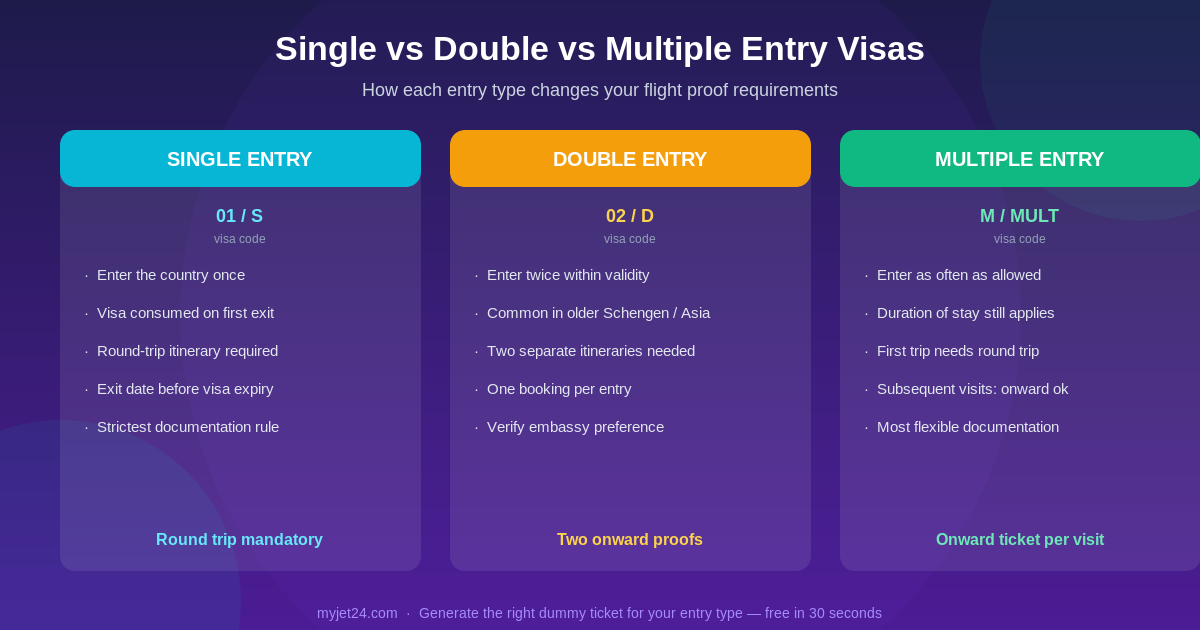
Multiple Entry Visa: Do You Still Need a Return Ticket?
Short answer: yes, for your first trip. Longer answer: it depends on the country, and the requirement shifts as you move from the application stage to the arrival stage to subsequent visits.
At the visa application stage: Embassies issuing multiple entry visas still want to see flight proof for the initial trip you're applying around. The US consulate, for example, typically wants your travel itinerary for the specific trip that prompted the B1/B2 application — even if the visa will subsequently allow you to visit indefinitely. Our US B1/B2 dummy ticket guide explains what the consulate actually expects to see.
At the port of entry, first visit: CBP, UK Border Force, and most other immigration authorities can — and do — ask for evidence of your return or onward travel. Not always, but often enough that arriving without it is a gamble. Use our entry requirement checker to confirm what's required for your specific passport and destination combination.
Subsequent visits on the same multiple entry visa: This is where it gets more flexible. Many frequent travelers with, say, a 10-year US B1/B2 or a 5-year UK Standard Visitor visa travel on one-way bookings with onward tickets booked separately. Border officers generally focus on two things: proof you won't overstay, and evidence of ties to your home country (employment, property, family). An onward ticket helps with the first. Your travel history helps with both. Check your visa approval predictor to understand how your profile looks to a border officer.
For multi-country itineraries — common with multiple entry visas — you need an exit ticket from the final destination, not necessarily a return to your home country. My aunt got a 10-year US visa and immediately planned a month-long US-Canada-Mexico trip. She needed a flight out of Mexico at the end of the trip, not a direct flight back from the US. This is where a travel itinerary builder becomes genuinely useful — for both documentation and planning.
The UK Standard Visitor visa also deserves a specific mention. It explicitly requires that each visit demonstrates you intend to leave. The UK visa dummy ticket guide goes deep on what UKVI considers sufficient proof of departure intent.
Double Entry & Transit: The Grey Areas
Double entry visas are the confusing middle child nobody talks about. They come up most often in older Schengen applications, some Chinese visas, and certain bilateral arrangements. The documentation logic is: you need onward proof for both uses of the visa. In practice, that means two separate round-trip or onward itineraries — one for each entry period.
Transit visas are a different beast entirely. Airport transit visas (TWOV — Transit Without Visa) typically don't require entry-style flight proof, but they do require confirmation of your onward flight. That's your connecting booking, which obviously needs to be real. Our Canada visa dummy ticket guide covers the nuances of transit through Canadian airports — a common point of confusion for travelers connecting between the US and elsewhere.
The Australia subclass 600 guide is worth reading if you're dealing with a double entry situation in the Asia-Pacific region — the Department of Home Affairs' documentation expectations are more prescriptive than most.
Country-Specific Entry Type Rules (2026)
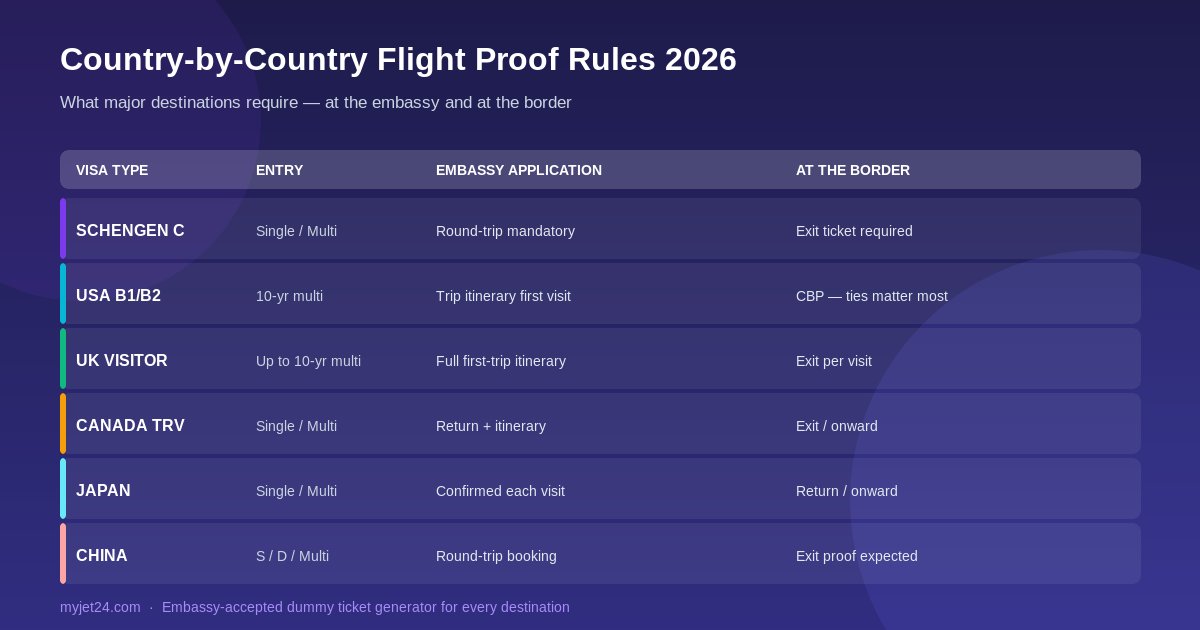
Here's the breakdown for major destinations. Every link goes to the complete country guide.
| Country / Visa Type | Entry Type | Flight Proof at Application | Flight Proof at Border |
|---|---|---|---|
| Schengen C Visa | Single or Multiple | Round-trip or onward itinerary — mandatory | Exit ticket required; officer may verify |
| USA B1/B2 | Multiple (10-year common) | Trip itinerary for initial visit | Onward ticket helpful; CBP focuses on ties |
| UK Standard Visitor | Multiple (up to 10 years) | Full itinerary for first trip | Exit evidence required per visit |
| Canada TRV | Single or Multiple | Return ticket + itinerary | Exit ticket or onward booking |
| Japan | Single or Multiple | Confirmed itinerary for each visit | Return or onward ticket required |
| China | Single, Double, or Multiple | Round-trip booking or itinerary | Exit proof expected |
The Schengen D (national long-stay) visa is worth separating from the C (short-stay). A Schengen D visa is issued by one specific country for stays over 90 days. It also allows unlimited movement within the Schengen zone during the stay. Flight documentation for D visas is typically more extensive — expect proof of accommodation, means of support, and a return or onward itinerary for the full duration. Our Schengen dummy ticket guide distinguishes between C and D requirements explicitly.
Dummy Ticket Strategy by Entry Type
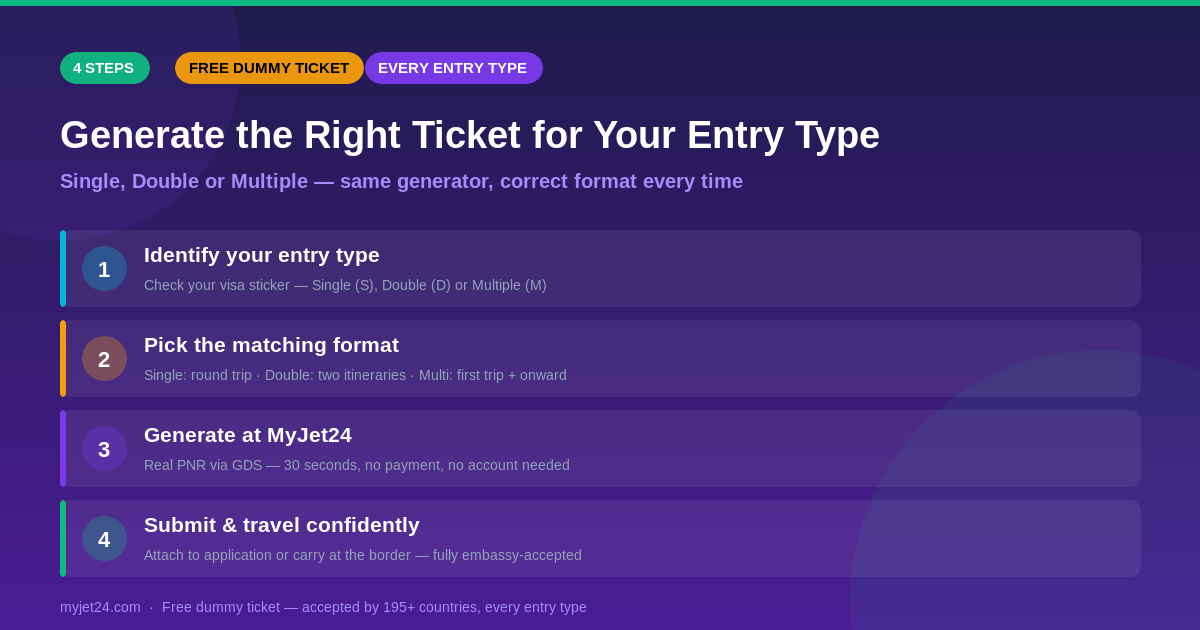
Now that we've covered the rules, let's talk about how to actually generate the right documentation using the free dummy flight ticket tool. The format differs meaningfully by entry type.
Single entry: You need a clear inbound and outbound itinerary in the same booking. Both legs should be realistic — compatible with your visa validity period and duration of stay. Don't put an exit date that's 15 days into a 14-day permitted stay. The dates don't need to be your absolute final travel dates, but they need to pass a basic plausibility check from a visa officer.
Multiple entry (first trip): Same as single entry for the initial application. You need a round-trip or onward itinerary for the specific trip you're applying around. For subsequent trips on the same visa, a temporary flight reservation showing your exit from the country is sufficient for most border situations.
Double entry: Generate two separate booking references — one per entry. Some embassies want to see both itineraries bundled; others accept them separately. Check the specific embassy checklist first, then generate accordingly. Our dummy ticket validity and PNR expiry guide is essential reading here — because timing matters when you need two separate reservations active simultaneously.
Multi-country itineraries: Use the travel itinerary builder for complex multi-destination trips. When your exit flight departs from a different country than your entry, the documentation needs to reflect the full routing — not just a point-to-point return.
One more thing worth knowing: dummy tickets vs. refundable flights is a real consideration for multiple entry visa holders who travel frequently. If you're making six trips a year on the same visa, buying and cancelling refundable tickets each time is expensive and unnecessary. The dummy ticket route is faster, cheaper, and equally accepted.
Know Your Entry Type? Generate the Right Ticket.
Use MyJet24 to generate the exact dummy ticket format for your visa type. Free, instant, real PNR.
Get My Free Dummy TicketFrequently Asked Questions
Know Your Entry Type. Generate the Right Ticket.
The confusion between single entry, double entry, and multiple entry visa flight requirements is real — and expensive when you get it wrong. But the fix is straightforward: know your entry type, understand whether you're at the application stage or the arrival stage, and generate the right documentation before you go. Our free dummy flight ticket tool handles the documentation side in under a minute.
For destination-specific documentation rules, our country guides cover every major visa market: Schengen flight reservation, American multiple entry flight proof, British visitor visa flight proof, Canadian multiple entry travel proof, Australia subclass 600 flight reservation, Japanese multiple entry flight proof, and Chinese multiple entry travel proof.
Still weighing up dummy tickets against refundable flights? The cost comparison makes the decision obvious. And if you're not sure what to call what you need, start with flight itinerary free — it explains the terminology cleanly.
Trusted by 50,000+ Travelers
Your free dummy ticket is 30 seconds away
Real PNR. Embassy-accepted. 195 countries. Zero cost.
