
Last updated: June 20, 2026 · 12 min read
TL;DR
- Under EU261, a delay of 3+ hours at arrival, a cancellation with under 14 days' notice, or being denied boarding can pay €250–€600 per passenger.
- The amount is fixed by flight distance, not your ticket price: €250 (≤1,500 km), €400 (1,500–3,500 km), €600 (over 3,500 km). UK261 mirrors it in pounds.
- No payout if the airline proves extraordinary circumstances (weather, ATC, strikes) — but a technical fault is usually the airline's problem and still pays.
- You can claim it yourself for free. Claim agencies keep 25–35% — on €600 that is up to €210 gone.
- From 2026, airlines must notify eligible passengers within 96 hours and respond to claims within 30 days.
If your flight was badly delayed, cancelled, or you were bumped, you may be owed cash compensation — separate from any refund — and most travellers never claim it. European air passenger rights (EU Regulation 261/2004, plus the UK's retained version) are some of the strongest in the world, yet airlines rarely volunteer them. This guide gives you the exact amounts, who qualifies, what “extraordinary circumstances” really means, what changed in 2026, and how to claim every euro yourself without handing a third of it to an agency.
Quick answer
EU261 flight delay compensation is a fixed cash payment of €250 to €600 per passenger when a covered flight arrives 3+ hours late, is cancelled with less than 14 days' notice, or you are denied boarding — unless the airline proves extraordinary circumstances. The amount depends on distance: €250 up to 1,500 km, €400 for 1,500–3,500 km, and €600 over 3,500 km. It applies to flights leaving the EU/EEA (any airline) or arriving in the EU/EEA on an EU/EEA airline, and you can claim it directly from the airline for free.
On this page
What is EU261?
EU261 is the nickname for EU Regulation 261/2004, the law that sets air passenger rights for delays, cancellations and denied boarding. It does two separate things. First, it gives a right to care and a refund or re-routing whenever your flight is seriously disrupted. Second — and this is the part people miss — it can give a fixed cash compensation of €250–€600 per passenger on top of that, when the disruption is the airline's responsibility. The compensation is not a refund of your ticket; it is a separate penalty the airline pays for the disruption itself. The official rules are published by the EU at Your Europe.
"A refund gives you your money back. Compensation is extra cash for the disruption — and airlines almost never offer it unless you ask."
How much flight delay compensation can you claim?
Compensation is fixed by flight distance, not by what you paid. Someone on a €40 sale fare and someone on a €900 ticket on the same flight are owed the same amount.
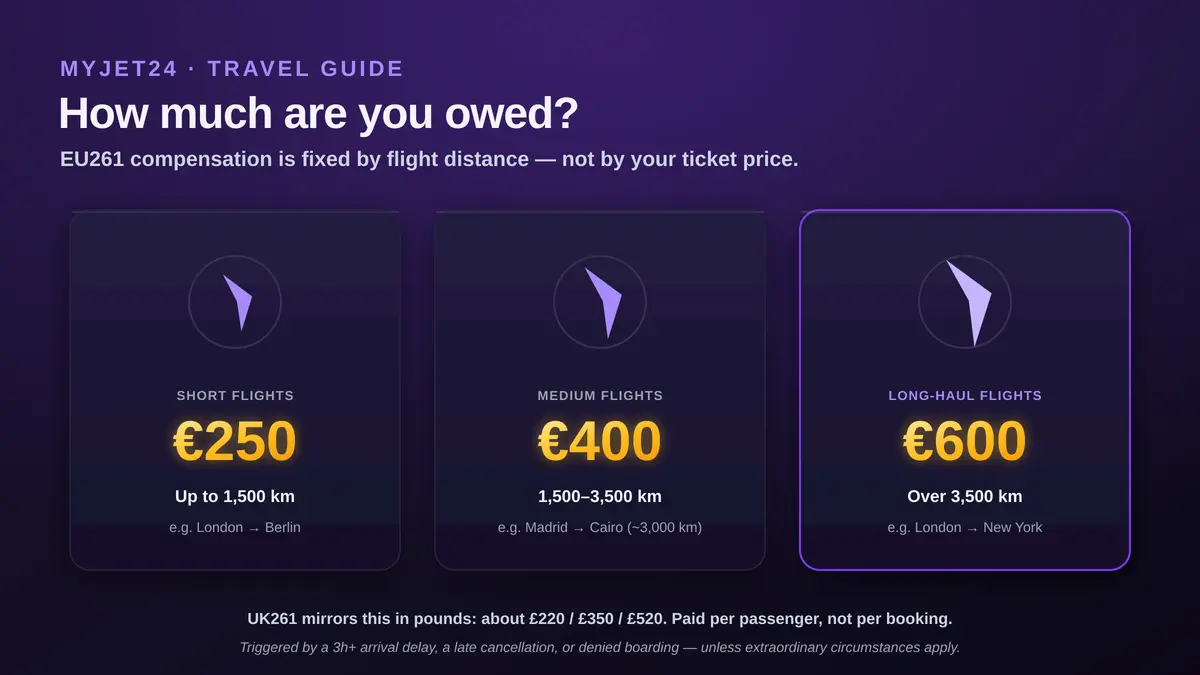
| Flight distance | EU261 | UK261 (approx.) |
|---|---|---|
| Up to 1,500 km | €250 | £220 |
| 1,500–3,500 km | €400 | £350 |
| Over 3,500 km | €600 | £520 |
One nuance: for very long flights, if the airline gets you there with a delay of 3–4 hours (rather than more), the €600 can be reduced by 50% to €300. Otherwise the figures above are what each passenger on the booking is owed — including children on a paid seat.
Are you eligible? The four checks
Eligibility comes down to four questions. If all four point your way, you have a claim.
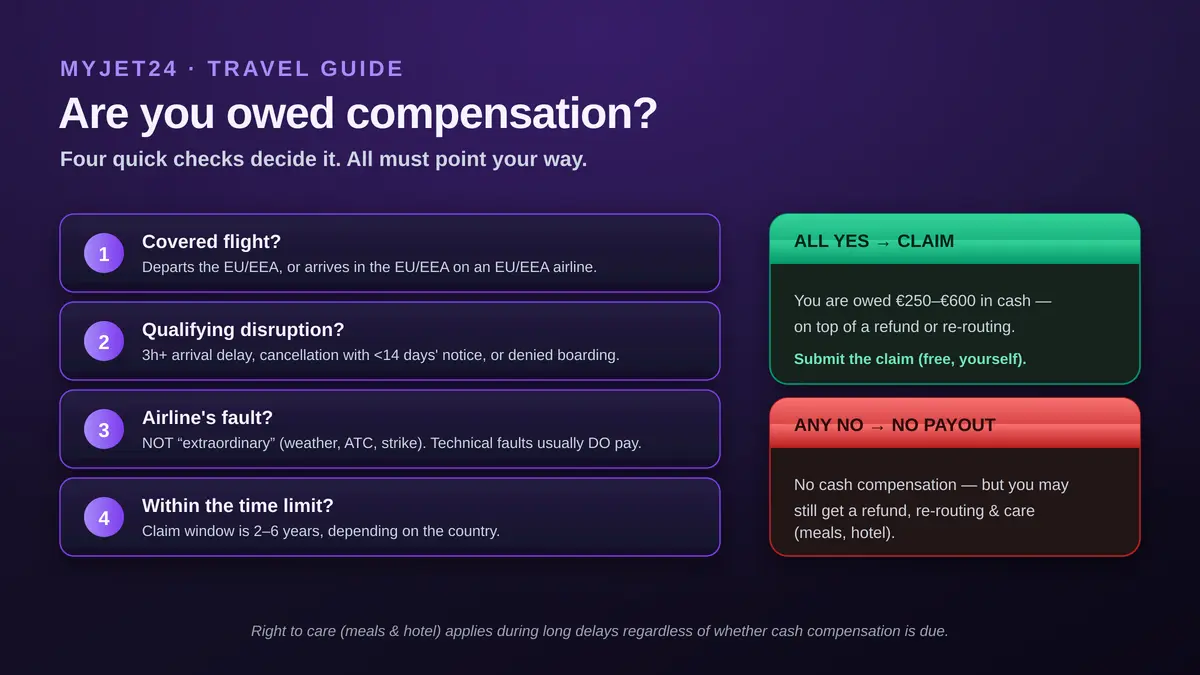
- Covered flight? It departs the EU/EEA (any airline), or arrives in the EU/EEA on an EU/EEA airline.
- Qualifying disruption? A 3+ hour arrival delay, a cancellation with less than 14 days' notice, or involuntary denied boarding.
- Airline's fault? The cause is not an extraordinary circumstance (see below).
- Within the time limit? Claim windows run roughly 2–6 years depending on the country.
Note that being denied boarding for lacking the right travel documents is different — that is on you, not the airline, and it does not pay compensation. We cover that scenario in when airlines can deny boarding.
Which flights are actually covered?
This is the most misunderstood part, so be precise. EU261 covers: any flight departing from an airport in the EU/EEA (regardless of the airline's nationality), and any flight arriving in the EU/EEA operated by an EU/EEA airline. The EEA here includes Iceland, Norway and Liechtenstein, and Switzerland applies equivalent rules.
Two quick examples. A Dubai-based traveller flying Frankfurt → Dubai on any carrier is covered, because the flight departs the EU. The same traveller flying Dubai → Frankfurt is covered only if the airline is an EU/EEA carrier; on a non-EU airline that inbound leg is not covered by EU261 (though the UK or other local rules may apply). Knowing this before you claim saves a wasted email.
“Extraordinary circumstances” — when the airline doesn't pay
Extraordinary circumstances are events outside the airline's control that it could not have avoided even with all reasonable measures — and they cancel the cash compensation (though not your right to care and a refund). The distinction matters enormously, because airlines lean on this exemption heavily.
| Usually NO payout (extraordinary) | Usually DOES pay (airline's fault) |
|---|---|
| Severe weather, storms | Technical / mechanical faults |
| Air-traffic-control restrictions | Crew shortages or rostering |
| Security alerts, political unrest | Overbooking |
| Strikes by third parties (e.g. airport staff) | Airline's own staff strikes (often) |
"A routine technical fault is not extraordinary — courts have repeatedly ruled that maintenance is part of running an airline. If they blame ‘technical issues’, you probably still have a claim."
Right to care, refund and re-routing
Cash compensation is separate from your right to care, which applies during any long delay regardless of the cause — even in extraordinary circumstances. Once your wait crosses the thresholds, the airline must provide meals and drinks, two free phone calls or emails, and hotel accommodation plus transfers if you are delayed overnight. If a flight is cancelled, you also choose between a full refund or re-routing to your destination at the earliest opportunity. Keep every receipt: if the airline fails to provide care, you can claim reasonable out-of-pocket costs back. This is also where proof of your continued journey matters — if a cancellation forces you to rebook and your trip requires evidence of onward travel, see our proof of onward travel guide.
EU261 vs UK261: what Brexit changed
After Brexit, the UK retained EU261 as “UK261”, so the structure is almost identical — same triggers, same exemptions, same right to care. The main differences are the currency and which authority enforces it. UK compensation is paid in pounds (about £220 / £350 / £520), and the regulator is the UK Civil Aviation Authority (caa.co.uk). For a flight between the UK and the EU, you may be covered by one scheme or the other depending on the departure airport and airline — but you are rarely left with no cover at all.
How to claim flight compensation yourself (for free)
You do not need a claim agency. They advertise “no win, no fee,” but the fee is 25–35% of your payout — on a €600 claim that is up to €210 gone for filling in a form you could complete in ten minutes.
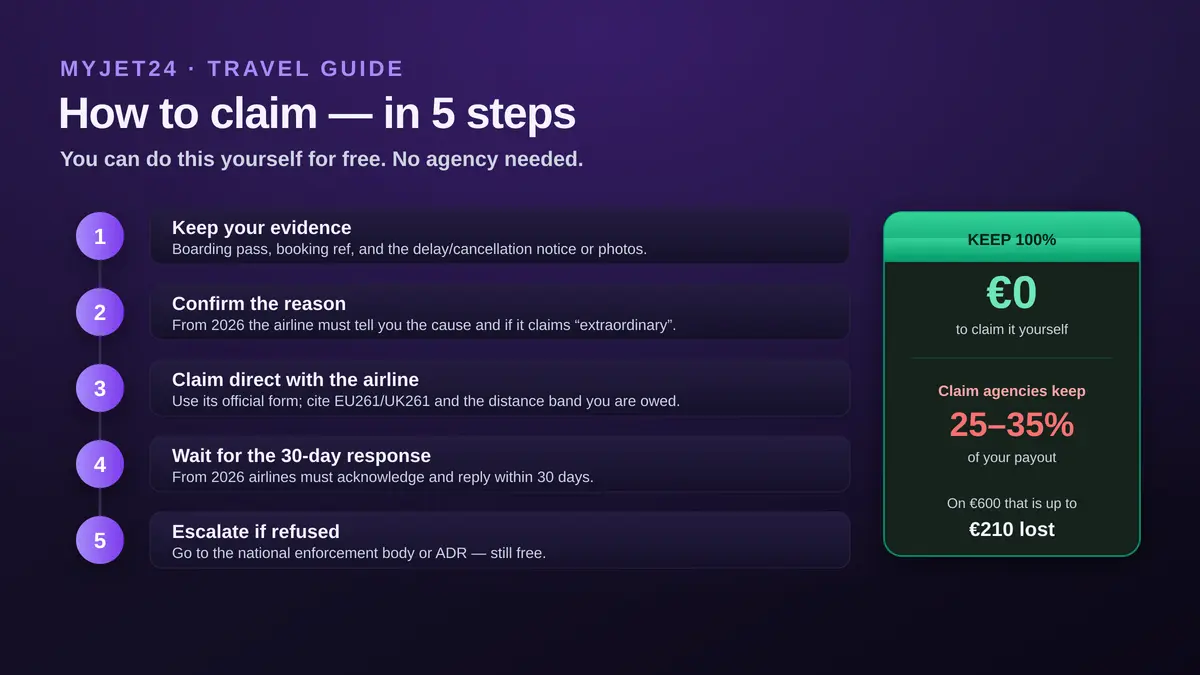
- Keep your evidence — boarding pass, booking reference, and the delay or cancellation notice (a photo of the board helps).
- Confirm the reason — from 2026 the airline must tell you the cause and whether it claims extraordinary circumstances.
- Claim directly with the airline — use its official form, cite EU261/UK261, and state the distance band and amount you are owed.
- Wait for the response — from 2026 airlines must acknowledge and reply within 30 days.
- Escalate if refused — take it to the national enforcement body or an ADR scheme; this is also free.
What changed in 2026
After years of debate, the headline amounts and the 3-hour trigger survived the 2026 reform unchanged — a win for passengers. What the reform added is transparency and speed. Airlines must now proactively notify eligible passengers of their rights within 96 hours of the disruption, state the reason for it (including whether they are claiming an exemption), and acknowledge and respond to claims within 30 days. The list of extraordinary circumstances has also been written into the regulation rather than left purely to case law. In practice this means fewer claims quietly ignored — but you still have to file.
Common mistakes that cost you the payout
- Accepting a voucher — a goodwill voucher is not your EU261 cash; you can decline it and claim the full amount.
- Confusing refund with compensation — taking a refund does not waive your separate right to compensation.
- Believing “technical issues” — these usually still pay; ask for the specific reason in writing.
- Missing the time limit — claim within your country's window (often a few years).
- Paying an agency by default — try the free direct route first; escalate to the regulator if refused.
Conclusion & next steps
European air passenger rights are generous, but they are opt-in by claim — the money only moves when you ask for it. Check the four boxes (covered flight, qualifying disruption, airline's fault, within the time limit), look up your distance band, and send a direct, evidence-backed claim citing EU261 or UK261. Keep your refund or re-routing and your right to care separate in your mind from the cash compensation, and don't give away a third of it to an agency for a form you can submit yourself.
Frequently asked questions
How much compensation for a delayed flight?
Under EU261, €250 for flights up to 1,500 km, €400 for 1,500–3,500 km, and €600 for flights over 3,500 km, per passenger — provided the arrival delay is 3+ hours and it is the airline's fault. UK261 pays roughly £220, £350 and £520.
Do I get compensation if the delay was due to weather?
No. Weather is an extraordinary circumstance, so no cash compensation is due. You still keep your right to care (meals, hotel) and a refund or re-routing if the flight is cancelled.
Rebooking after a cancellation?
If your new route needs proof of onward travel for a visa or border check, generate a verifiable flight reservation with a real PNR in under a minute — from just $7.90, no non-refundable fare.
Create a flight reservation →Last updated: June 20, 2026. This is general information, not legal advice — rules and amounts change, so confirm with the official EU (Your Europe) or UK CAA sources before you claim.
Marc Hoffmann
Travel-documents specialist at MyJet24. Covers air passenger rights, proof of onward travel and entry requirements for travellers worldwide.
