
Last updated: 31 July 2026 · Reading time: 15 min · Author: Marc Hoffmann, Travel Documentation Writer at MyJet24
TL;DR — Key Facts
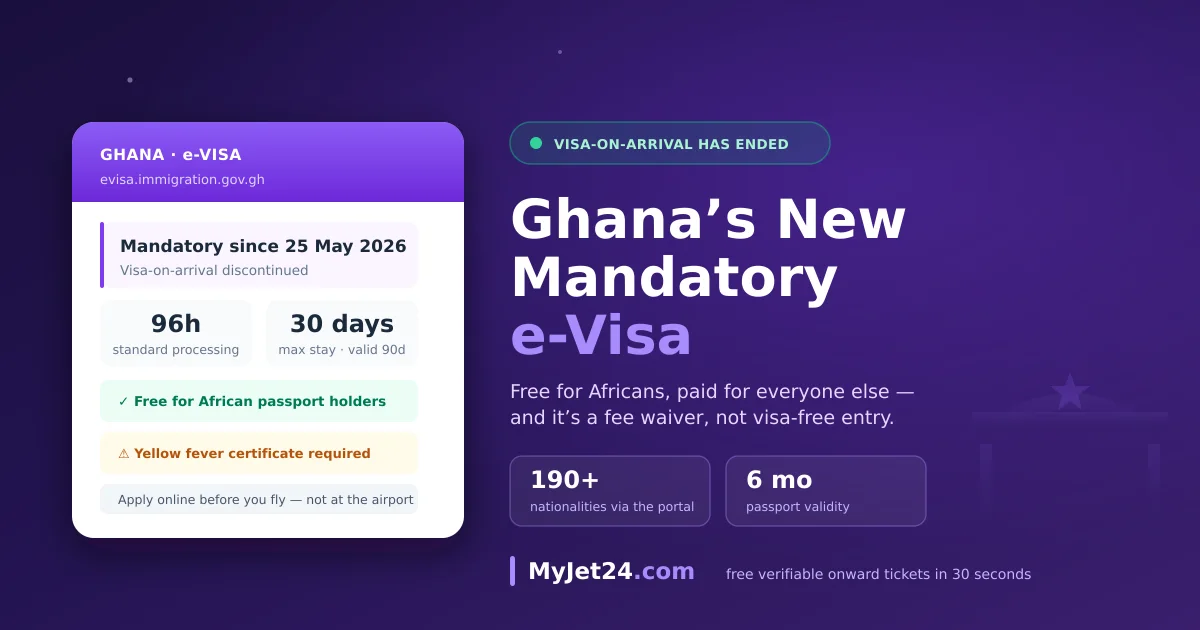
- Ghana launched a mandatory e-Visa on 25 May 2026, at evisa.immigration.gov.gh, and discontinued the old visa-on-arrival system. You now apply online before you fly.
- "Free for all Africans" is real — but it's a fee waiver, not visa-free entry. African passport holders still have to apply for the e-Visa (a free travel authorisation); they just don't pay the fee.
- Standard processing is 96 hours, so apply at least four days ahead. A single-entry e-Visa is valid for 90 days from issue and allows a stay of up to 30 days.
- A yellow fever vaccination certificate is mandatory to enter Ghana — checked at the border, no exceptions for travellers over nine months old.
- The application asks for your travel dates and where you'll stay. A return or onward ticket isn't an itemised e-Visa requirement, but airlines check it at check-in and immigration can ask, so carry a confirmed booking.
- ECOWAS nationals need no visa at all — that's separate from the African fee waiver, which applies to Africans who would otherwise need one.
Ghana replaced its visa-on-arrival system with a mandatory online e-Visa on 25 May 2026, applied for at evisa.immigration.gov.gh before travel. Standard processing takes 96 hours; a single-entry e-Visa is valid for 90 days from issue and permits a stay of up to 30 days. All African passport holders are exempt from the visa fee for tourism or business, but they must still apply for the e-Visa — it is a fee waiver on a mandatory travel authorisation, not visa-free entry, which only ECOWAS and certain other nationals enjoy. A yellow fever vaccination certificate is required to enter Ghana. The application requires a passport valid at least six months, a photo, your travel dates and proof of accommodation; a return or onward ticket is commonly requested by airlines and at the border.
In this guide
What changed on 25 May 2026
For years, many travellers could turn up at Kotoka International Airport in Accra and buy a visa at the counter. That era ended on 25 May 2026 — African Union Day — when President John Dramani Mahama inaugurated Ghana's national e-Visa portal at evisa.immigration.gov.gh, run by the Ghana Immigration Service with the Ministry of Foreign Affairs. The government's framing is blunt: travellers now "apply for a visa exclusively through the new online platform, discontinuing the previous visa-on-arrival system."
The reason given is security. Ghana describes the e-Visa as "a secured, technology-driven online system capable of identifying security risks before travellers arrive" — the same pre-screening logic behind electronic travel authorisations worldwide. In practice, it means one thing above all for you: sort your visa before you fly, not at the airport. Arriving without an approved e-Visa is no longer a problem you can fix at a counter in Accra.
One honest caveat on scope. Ghana's official statements frame the change most explicitly around African travellers and the fee waiver (below). The visa-on-arrival system is described as discontinued, and the online portal is now the channel for applications. If your nationality previously used visa-on-arrival, treat it as gone — apply online. Ghana's move mirrors what Kenya and others across the continent have already done with electronic authorisations; our Kenya eTA guide covers a close parallel, and South Africa's digital traveller declaration is another example of the same continental shift toward pre-arrival systems.
"Free for Africans": what it really means
The headline that travelled fastest was "Ghana scraps visa fees for all Africans." It's true — and it's the part most coverage gets subtly wrong. The distinction matters, because it changes what you actually have to do.
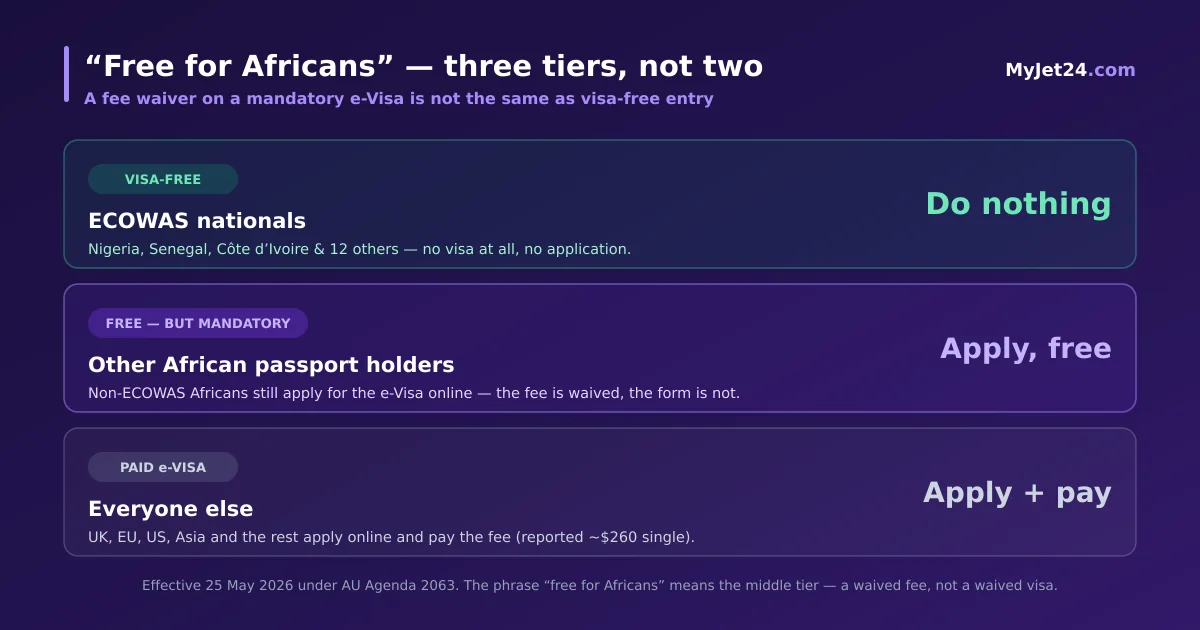
From 25 May 2026, all African passport holders are exempt from Ghana's visa fee for tourism or business — a policy President Mahama framed under the African Union's Agenda 2063 vision of free movement across the continent. But read the wording carefully: it is a fee waiver on a still-mandatory e-Visa. African travellers who would otherwise need a visa must still apply online and pass the pre-departure screening; they simply pay nothing for it. In effect, they receive a free electronic travel authorisation, not an exemption from the process.
That's different from being visa-free, which a separate group already is:
| Who you are | What you do |
|---|---|
| ECOWAS national (Nigeria, Senegal, Côte d'Ivoire, and 12 others) | No visa at all. Enter freely under ECOWAS free movement. |
| Other African passport holder (non-ECOWAS) | Apply for the e-Visa online — free of charge, but still mandatory. |
| Everyone else (UK, EU, US, Asia, etc.) | Apply for the e-Visa online and pay the fee. |
So the mental model is three tiers, not two: visa-free for ECOWAS, free-but-required for other Africans, and paid-and-required for the rest of the world. Getting this right saves an African traveller from assuming they can skip the portal — and saves everyone else from expecting a fee waiver that isn't theirs.
Cost, processing and validity
Here's where precision matters, because a lot of the fee figures circulating online are not official. Ghana's e-Visa portal does not publish a clear fee table in the pages we could access, so the amounts below should be treated as reported rather than a confirmed government schedule — verify the exact fee for your nationality on the portal at the time you apply.
| Item | Detail |
|---|---|
| Fee (African passports) | Free — waived for tourism and business since 25 May 2026. |
| Fee (everyone else) | Reported at around US$260 single-entry / ~$468 multiple-entry (standard). Faster priority and express tiers are reported at higher prices by secondary sources — confirm on the portal. |
| Standard processing | 96 hours (stated on the official portal). Apply at least four days before travel. |
| Validity (single-entry) | 90 days from date of issue — you must enter within that window. |
| Maximum stay | Up to 30 days. |
The 96-hour standard turnaround is the number to plan around. It's not an instant approval, so a last-minute trip to Accra needs either the (reported) express service or, better, some forward planning. Note the difference between the two clocks: your e-Visa is valid 90 days from issue, but your stay is capped at 30 days once you arrive.
How to apply, step by step
The process is a standard online visa application. Have your documents ready as digital files before you start.
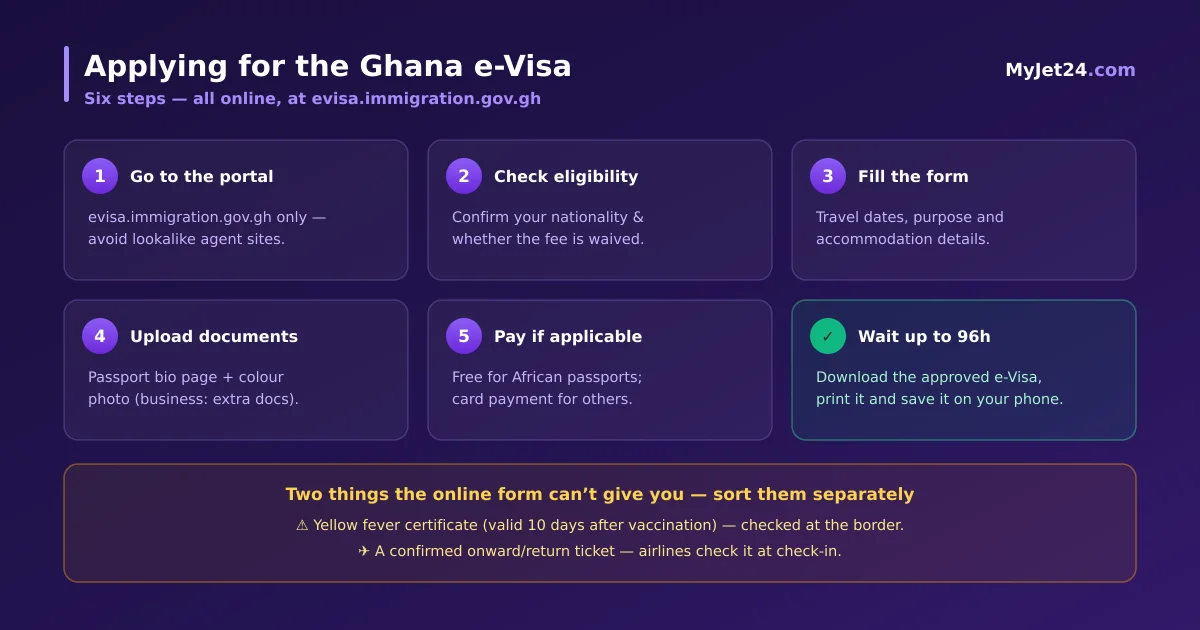
- Go to the official portal — evisa.immigration.gov.gh. Use only this government site; there are lookalike agents that charge a markup for a form you can complete yourself.
- Check your eligibility by nationality using the portal's checker, and confirm whether the fee applies to you (African passports: waived).
- Complete the application: personal details, passport information, your travel dates, purpose of visit, and your accommodation — a hotel reservation or a host's address.
- Upload the documents: passport bio page, a recent colour photo, and — for a business visa — a certificate of incorporation and invitation letter.
- Pay the fee (if applicable) with a valid card, and submit.
- Wait up to 96 hours, then download the approved e-Visa from your email. Print a copy and keep it on your phone for check-in and the border.
What you must have, including yellow fever
Two categories of requirement apply: what the e-Visa application asks for, and what you must present physically at the Ghanaian border. Don't confuse them — the second list is checked on arrival regardless of your approved visa.
| Requirement | Detail |
|---|---|
| Passport | Valid for at least six months beyond your intended stay. |
| Yellow fever certificate | Mandatory. A valid vaccination certificate must be presented on arrival, for all travellers aged nine months and over. This is a hard border requirement. |
| Accommodation | A hotel reservation or a host's address, entered in the application. |
| Photo & payment | A recent colour photo, a valid payment method (where a fee applies), and an active email address. |
| Travel dates / departure plan | The application asks for your dates of travel; a confirmed onward or return itinerary is commonly expected (see below). |
The yellow fever certificate is the one that most often catches travellers out, because it has nothing to do with the visa and everything to do with the border. Ghana is in a yellow-fever-endemic region; the vaccination is required for entry and is checked on arrival. Get it well in advance — the certificate becomes valid ten days after vaccination.
Do you need a return ticket?
This is worth being precise about, because it's easy to overstate. A return or onward ticket is not listed as an itemised requirement on Ghana's official e-Visa page — so we won't claim the Ghanaian government mandates one for the application itself. What is true is more practical, and it still means you should have one.
Two forces make a confirmed onward booking the sensible default:
- The application asks for your travel dates and a departure plan. You're declaring when you arrive and, implicitly, that you intend to leave. A vague or open-ended answer is exactly the kind of thing a security-screening system is built to flag.
- Airlines and the border check it. Under carrier-liability rules, airlines routinely ask for proof of onward travel at check-in before boarding you to Ghana, and immigration officers can request it at the port of entry. Secondary guidance for Ghana states plainly that "evidence of a return or onward travel ticket may be required at airport check-in or at a port of entry."
The practical answer: carry a confirmed onward or return itinerary even though the e-Visa page doesn't list it as mandatory. If your plans are open — a common situation for business travellers and those touring West Africa overland — a verifiable onward ticket gives the airline and the border a real, checkable booking without committing you to a fixed, paid departure. It's the clean way to answer the "when are you leaving?" question that a pre-screening visa regime is designed to ask. Our guide to airline boarding refusals explains why the check-in desk, not the border, is usually where it matters, and the country-by-country onward-travel roundup shows where else it applies. For a Ghana-specific reservation, our Ghana flight-reservation page produces one in about thirty seconds.
Who enters Ghana visa-free
Keep this cleanly separate from the fee waiver. Genuine visa-free entry — no e-Visa, no application — applies to a specific set of nationals:
- ECOWAS member states enter visa-free under the bloc's free-movement protocol: Nigeria, Senegal, Côte d'Ivoire, The Gambia, Benin, Togo, Sierra Leone, Liberia, Guinea, Guinea-Bissau, Burkina Faso, Mali, Niger and Cabo Verde.
- A number of other nationals — certain non-ECOWAS African states and a few others — are reported to enter visa-free for up to 60 days. Confirm your own nationality's status on the official portal, as visa-free lists change.
The line to remember: ECOWAS and other visa-free nationals do nothing before travel; other African nationals apply for a free e-Visa; the rest of the world applies and pays. Three different obligations that the single phrase "free for Africans" tends to blur.
Seven mistakes to avoid
- Expecting visa-on-arrival. It's gone. Apply online before you fly, or you may not board.
- Thinking "free for Africans" means no application. It's a fee waiver — African travellers still complete the mandatory e-Visa.
- Leaving it to the last minute. Standard processing is 96 hours. Apply at least four days ahead.
- Forgetting the yellow fever certificate. It's mandatory, checked at the border, and becomes valid only ten days after vaccination.
- Flying in one-way with no departure plan. The airline can refuse boarding without proof of onward travel, even if the e-Visa page doesn't list it.
- Using a lookalike visa agent. Apply only at evisa.immigration.gov.gh; third-party sites add cost for a form you can file yourself.
- Confusing the 90-day validity with your stay. The e-Visa is valid 90 days from issue, but you can stay a maximum of 30.
Frequently asked questions
Does Ghana still offer visa on arrival in 2026?
No. Ghana launched a mandatory e-Visa on 25 May 2026 and discontinued the visa-on-arrival system. Travellers now apply online at evisa.immigration.gov.gh before departure. If your nationality previously relied on visa-on-arrival, you must obtain the e-Visa in advance — you can no longer buy a visa at the airport.
Is Ghana really free for all Africans now?
Yes, but it's a fee waiver, not visa-free entry. Since 25 May 2026, all African passport holders are exempt from Ghana's visa fee for tourism or business — however, they must still apply for the e-Visa online and pass screening. They receive a free electronic travel authorisation rather than an exemption from the process. True visa-free entry (no application) applies only to ECOWAS nationals and certain others.
How much does the Ghana e-Visa cost?
It's free for African passport holders. For everyone else, the fee is reported at around US$260 for a single-entry visa and about $468 for multiple-entry (standard processing), with faster priority and express tiers reported at higher prices. These figures come from secondary sources rather than a published government table, so confirm the exact fee for your nationality on the official portal when you apply.
How long does the Ghana e-Visa take to process?
Standard processing is 96 hours, as stated on the official portal, so you should apply at least four days before travel. Faster priority and express options are reported by secondary sources but not clearly confirmed on the portal. Don't rely on same-day approval — plan ahead, especially since a yellow fever certificate must be valid at entry too.
How long is the Ghana e-Visa valid and how long can I stay?
A single-entry e-Visa is valid for 90 days from the date of issue, meaning you must enter Ghana within that window. The maximum stay once you arrive is 30 days. These are two separate clocks — the 90-day validity is your entry deadline, not your permitted length of stay.
Do I need a yellow fever vaccination to enter Ghana?
Yes. A valid yellow fever vaccination certificate is mandatory to enter Ghana and is checked at the border, for all travellers aged nine months and over. The certificate becomes valid ten days after vaccination, so arrange it well in advance. This is an entry requirement independent of your visa.
Do I need a return or onward ticket for Ghana?
It's not listed as an itemised requirement on Ghana's official e-Visa page, but it's strongly advisable. The application asks for your travel dates, airlines routinely check for proof of onward travel at check-in under carrier-liability rules, and immigration can request it at the port of entry. Carrying a confirmed return or onward booking — a verifiable reservation is enough — avoids problems at both points.
Which countries can enter Ghana visa-free?
ECOWAS member states enter visa-free under the bloc's free-movement protocol: Nigeria, Senegal, Côte d'Ivoire, The Gambia, Benin, Togo, Sierra Leone, Liberia, Guinea, Guinea-Bissau, Burkina Faso, Mali, Niger and Cabo Verde. A number of other nationals are reported to enter visa-free for up to 60 days. This is separate from the fee waiver for African passport holders, who still need a (free) e-Visa. Confirm your status on the official portal.
Where do I apply for the Ghana e-Visa?
At the official government portal, evisa.immigration.gov.gh, operated by the Ghana Immigration Service. Apply only through this site — third-party agents charge a markup for a form you can complete yourself. You'll need a passport valid six months, a photo, your travel dates, accommodation details and, for business visas, an incorporation certificate and invitation letter.
Can I extend my stay in Ghana beyond 30 days?
The e-Visa permits a maximum stay of 30 days. Extensions are handled by the Ghana Immigration Service inside the country and are not guaranteed; if you know you'll need longer, discuss the right visa category before you travel rather than relying on an extension. Overstaying can lead to fines and complications on departure.
Is the Ghana e-Visa the same as an ETA?
Functionally, for African passport holders it works like a free Electronic Travel Authorisation — a mandatory online clearance with no fee. For fee-paying nationalities it is a full e-Visa. Either way, it's an advance online authorisation that replaced visa-on-arrival, and it involves pre-departure security screening rather than a decision made at the airport.
Why did Ghana end visa on arrival?
For security and to modernise entry. The government describes the e-Visa as a technology-driven system that identifies security risks before travellers arrive, replacing counter-based issuance. The parallel "free for Africans" fee waiver reflects Ghana's push, under the African Union's Agenda 2063, to make intra-African travel easier while still screening every arrival in advance.
The bottom line
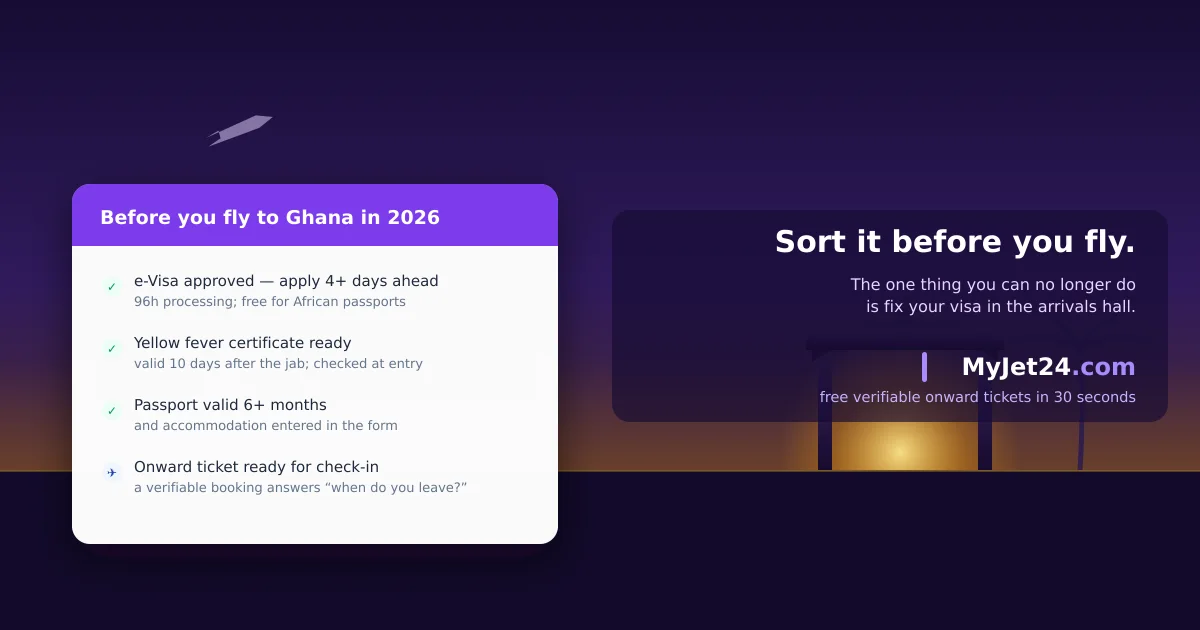
Ghana's shift to a mandatory e-Visa is a modernisation with a headline that's easy to misread. Yes, it's now "free for all Africans" — but that's a fee waiver on an authorisation you still have to obtain, not a licence to skip the process. And yes, visa-on-arrival is gone — which means the one thing you can't do any more is sort your paperwork in the arrivals hall. The upside is a cleaner, plan-ahead system; the catch is that it punishes the last-minute traveller.
So the checklist is short and worth doing early. Apply online at the official portal at least four days out, get your yellow fever certificate sorted (it needs ten days to take effect), keep your passport's six months of validity in mind, and — because a pre-screening regime is built to ask how and when you'll leave — carry a verifiable proof of onward travel. Ghana doesn't itemise it as a visa requirement, but the airline will ask, and a real reservation answers the question in thirty seconds. Get the front end right and the rest of Ghana — the coast, the forts, the welcome — takes care of itself.
Sources
- Ghana Ministry of Foreign Affairs — Ghana Launches e-Visa Portal: https://mfa.gov.gh/index.php/ghana-launches-e-visa-portal/
- Ghana Ministry of the Interior — Ghana Launches e-Visa Platform: https://www.mint.gov.gh/ghana-launches-e-visa-platform/
- Ghana e-Visa official portal (Ghana Immigration Service): https://evisa.immigration.gov.gh/
- Fragomen — Ghana visa fee waiver for African passport holders implemented: https://www.fragomen.com/insights/ghana-visa-fee-waiver-for-african-passport-holders-implemented.html
- UK Government (FCDO) — Ghana travel advice, entry requirements: https://www.gov.uk/foreign-travel-advice/ghana/entry-requirements
This guide reflects Ghana's e-Visa system as launched on 25 May 2026 by the Ghana Immigration Service and Ministry of Foreign Affairs, with entry requirements per the official e-Visa portal and the UK FCDO, as of 31 July 2026. Fee amounts for non-African nationalities are reported by secondary sources and not confirmed on a government schedule; visa rules, fees and eligibility can change. Verify on evisa.immigration.gov.gh before you travel. This article is informational and not legal or immigration advice.
