
Last updated: June 28, 2026 · 11 min read
TL;DR
- A child travel consent letter is a signed statement from a non-travelling parent or guardian allowing a minor to travel — carry one whenever the child is not travelling with both parents.
- It is not always legally required, but border officers can ask for it when entering or leaving a country, and without it a child can be delayed or refused boarding.
- Notarization is strongly recommended (Canada's CBSA and US CBP both advise it) — it cuts questioning at the border.
- Include the child's and parents' details, travel dates, destinations, signatures, an emergency-medical clause, and a copy of the absent parent's passport/ID.
- Carry the original signed letter — not a photo or scan — and check the child's passport is still valid.
If your child is flying without both parents — with you alone, with grandparents, on a school trip, or unaccompanied — one missing piece of paper can end the trip at the check-in desk. A child travel consent letter is the document border officers and airlines use to confirm a minor is travelling with permission. This guide explains exactly when you need one, what to put in it, whether to notarize it, and gives you a ready-to-copy template.
Quick answer
A child travel consent letter is a signed (ideally notarized) statement from a non-travelling parent or legal guardian giving a minor permission to travel. You should carry one whenever a child travels internationally without both parents — with one parent, with relatives, with a group, or alone. It must name the child, the accompanying adult, the travel dates and destinations, and include the absent parent's contact details and signature. It is not universally mandatory, but border officials frequently request it, so travelling without one risks delays or refused boarding.
On this page
What is a child travel consent letter?
A child travel consent letter — also called a minor travel authorization or parental consent letter — is a short written statement in which a parent or legal guardian who is not travelling confirms that a minor has permission to travel with a named adult (or alone). Its job is to reassure border officers and airline staff that the child is not being taken across a border without the other parent's knowledge — a safeguard against child abduction. It names the child, the accompanying adult, the dates and the destinations, and is signed (and ideally notarized) by the absent parent.
When do you need a consent letter?
The simple rule: if the child is not travelling with both parents, carry a consent letter. The common scenarios:
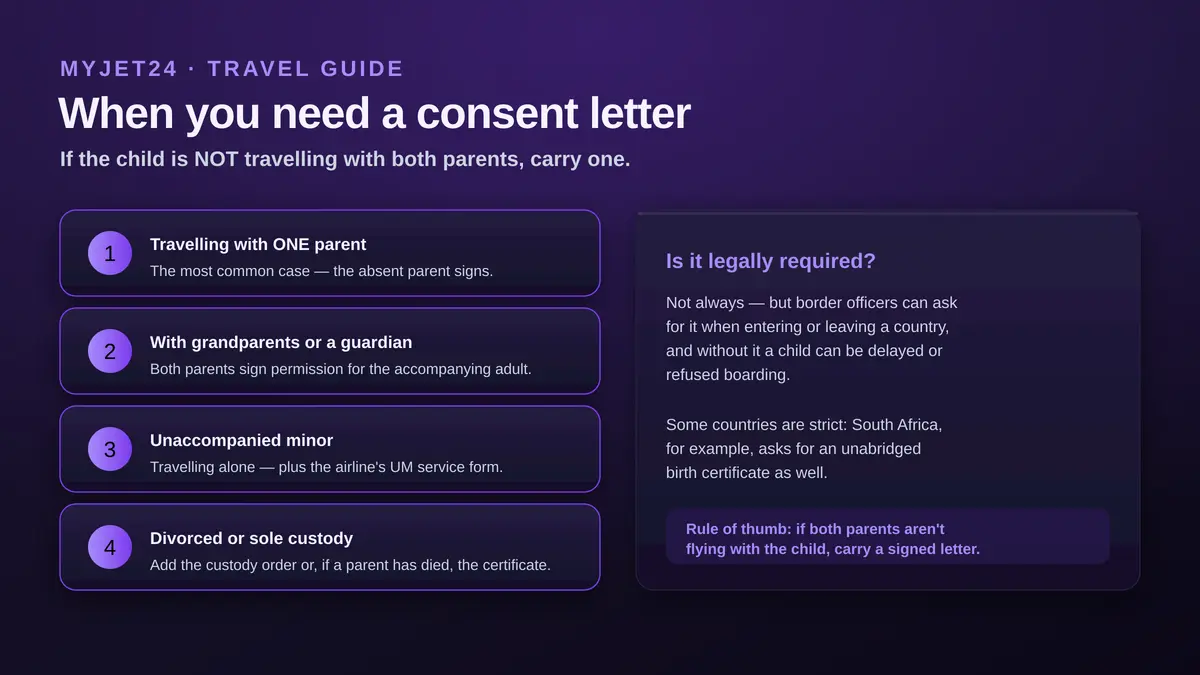
- With one parent: the most common case — the other parent signs the letter.
- With grandparents or a guardian: both parents sign permission for the accompanying adult.
- Unaccompanied minor: travelling alone — plus the airline's own UM (unaccompanied minor) service form.
- Divorced or sole custody: add the custody order, or a death certificate if a parent has died.
Is a child travel consent letter legally required?
Not everywhere — but that is the wrong question to ask. It is not universally mandatory, yet border officials can request it when a minor enters or leaves a country, and airlines can refuse to board a child whose documentation looks incomplete. In other words, even where no law forces you to carry one, not carrying one is a real risk: questioning, delays, or being turned away. Some countries are notably strict — South Africa, for example, has historically required additional proof such as an unabridged birth certificate for minors. The safe approach is to treat the letter as standard whenever both parents are not present.
"‘Not legally required’ doesn't mean ‘not needed.’ The officer who asks for it at 6am doesn't care that it was optional — they just won't let the child through without it."
What to include in the letter
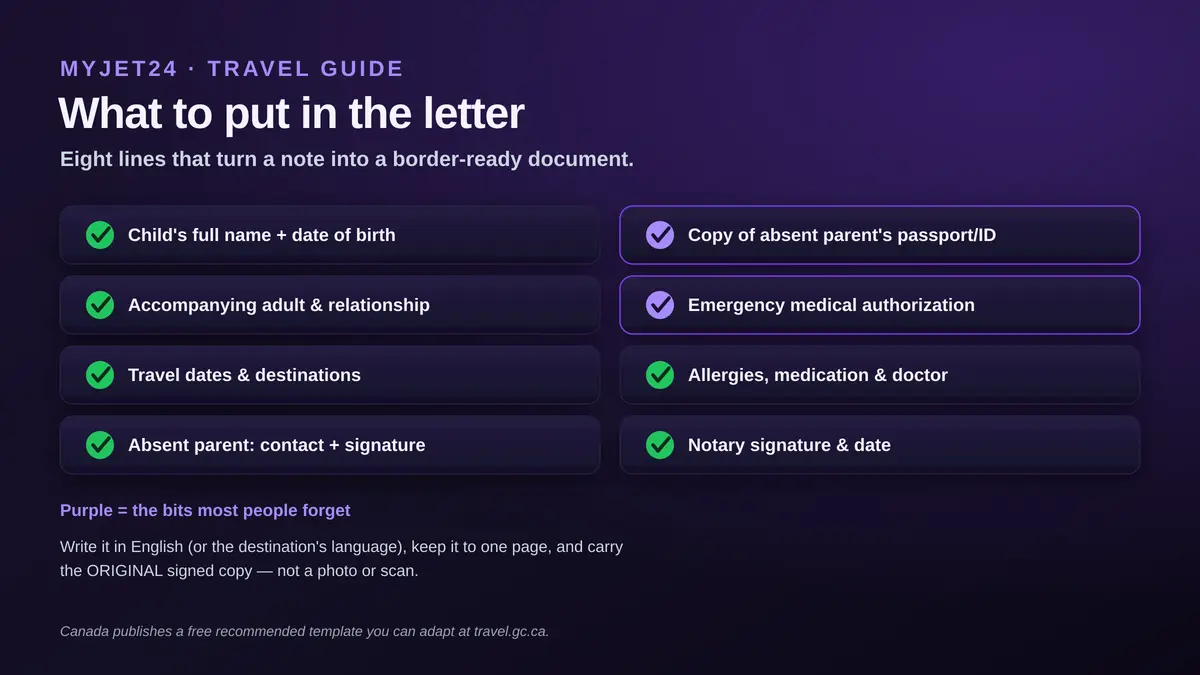
- Child's full name and date of birth (as on the passport).
- Accompanying adult's name and relationship to the child.
- Travel dates and destinations (and return).
- Non-travelling parent(s): full name, address, phone, and signature.
- A copy of the absent parent's passport or ID attached.
- Emergency medical authorization — permission for the travelling adult to approve urgent treatment.
- Allergies, medication and the child's doctor's contact.
- Notary signature and date (recommended).
Free child travel consent letter template
Copy and adapt the wording below. Keep it to one page, write it in English (or the destination's language), and have the absent parent sign it in front of a notary.
CONSENT FOR A MINOR TO TRAVEL
I, [absent parent full name], holder of passport/ID no. [number], residing at [address, phone, email], am the parent/legal guardian of [child full name], born [date of birth], passport no. [number].
I give my consent for my child to travel with [accompanying adult full name], [relationship], passport/ID no. [number], from [departure date] to [return date], to [destination(s)].
I authorize [accompanying adult] to consent to any necessary emergency medical treatment for my child during this travel. Relevant medical information: [allergies / medication / doctor's name and phone].
I can be reached at [phone] and [email] for the duration of the trip.
Signature: ______________________ Date: ____________
(Notary public: signature, seal & date)
Should you notarize the consent letter?
Strictly, any adult can witness the signature — but notarization is strongly recommended. Both Canada's CBSA and US Customs and Border Protection advise a notarized letter, especially when a child crosses a border with one parent or an unrelated adult, because a notary's seal makes the document far harder to dispute and noticeably reduces questioning at the border. A notary appointment is inexpensive and quick; given what's at stake — a child being held up or turned back — it is worth doing for any international trip. Keep the notarized original with the travelling adult.
How to make your consent letter valid
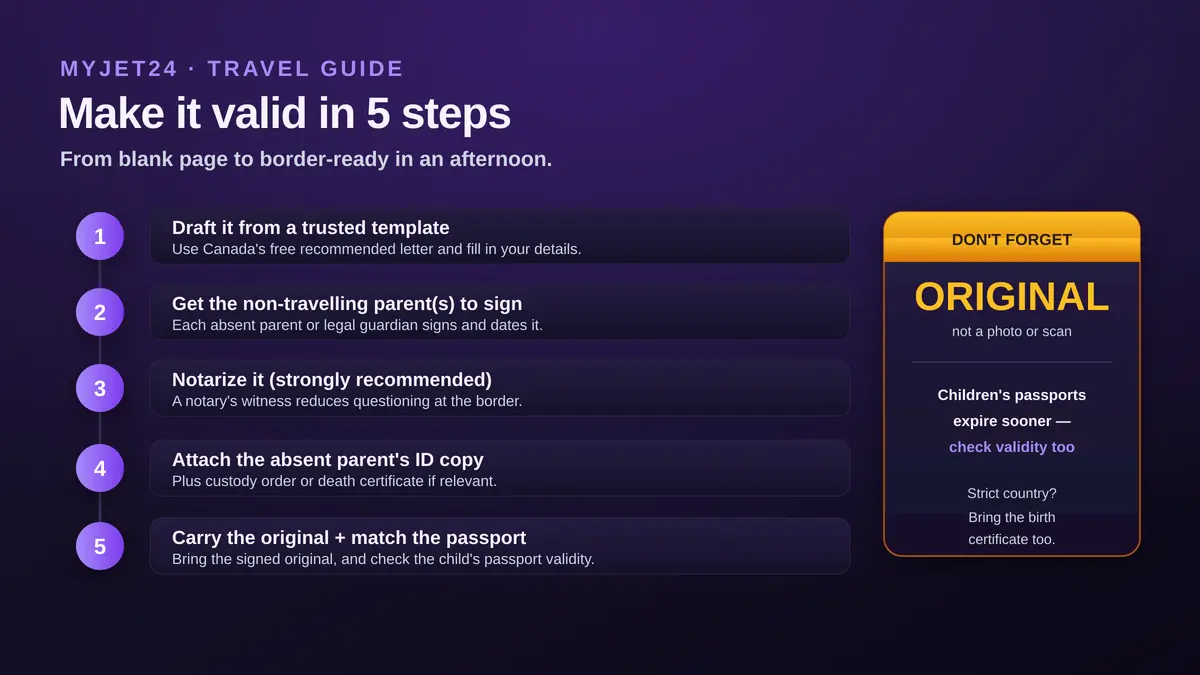
- Draft it from a trusted template — Canada publishes a free recommended letter at travel.gc.ca you can adapt.
- Get the non-travelling parent(s) to sign — each absent parent or guardian signs and dates it.
- Notarize it — a notary's witness reduces border questioning.
- Attach the absent parent's ID copy — plus a custody order or death certificate if relevant.
- Carry the original and match the passport — bring the signed original and confirm the child's passport is valid.
That last point matters more than people expect: children's passports are usually issued for shorter terms and expire sooner, so check the passport validity rules for every child before you travel. The US government's overview of travel documents for children is a useful second reference.
Sole custody, deceased parent & strict countries
Some situations need extra paperwork. If you have sole custody, carry the court order proving it; if the other parent has died, carry the death certificate — these replace the absent parent's signature. For a child with a different surname from the accompanying parent, a copy of the birth certificate linking them helps. And research your destination: a handful of countries impose stricter rules (additional birth-certificate or consent requirements) and will enforce them at the border. When a trip also involves a visa, build the consent letter into the wider document set — see our visa application checklist and, for authorization documents generally, the NOC guide.
Common consent-letter mistakes
- Carrying a photo or scan — bring the signed original.
- Skipping notarization — it's the cheapest way to avoid border questions.
- Forgetting the emergency-medical clause — vital if the child needs treatment.
- No copy of the absent parent's ID — officers often want to verify the signer.
- Names that don't match the passport — use exact passport spelling.
- Ignoring the child's passport expiry — it may lapse sooner than yours.
Conclusion & next steps
A child travel consent letter is a five-minute task that prevents a worst-case scenario at the border. If both parents aren't flying with the child, draft the letter from a trusted template, include the medical clause and the absent parent's ID copy, notarize it, and carry the original. Pair it with a valid passport and any custody documents, and your child's trip stays exactly as smooth as it should be.
Frequently asked questions
Does a child need a consent letter to travel with one parent?
It is strongly recommended. When a minor travels internationally with only one parent, border officers can ask for written, ideally notarized, consent from the absent parent. It is not mandatory everywhere, but without it the child can face questioning, delays or refused boarding.
Does the consent letter have to be notarized?
Not legally in every case, but it is strongly advised. Canada's CBSA and US CBP both recommend a notarized letter because a notary's seal makes it far harder to dispute and reduces questioning at the border. Notarization is cheap and quick relative to the risk.
Travelling abroad with the family?
If your trip needs a flight reservation for a visa or proof of onward travel, generate a verifiable reservation with a real PNR in under a minute — from just $7.90, no non-refundable fare.
Create your reservation →Last updated: June 28, 2026. This is general information, not legal advice — requirements vary by country and change, so confirm with official sources (e.g. travel.gc.ca, the destination's embassy) before you travel.
Marc Hoffmann
Travel-documents specialist at MyJet24. Covers travel consent letters, passport rules, proof of onward travel and entry requirements for families worldwide.
