
Last updated: June 19, 2026 · 11 min read
TL;DR
- Most countries apply the 6-month rule: your passport must stay valid for at least six months beyond your travel dates.
- The Schengen Area uses a 3-month rule (valid three months beyond the date you leave) and the passport must be less than 10 years old.
- The UK, USA, Canada, Ireland, Australia and New Zealand only require your passport to be valid for the duration of your stay.
- Carry at least two blank passport pages for stamps and visas; some countries demand more.
- Validity is checked first by the airline at check-in (carrier liability) — which is where most travellers are stopped, before they ever reach the border.
Passport validity rules decide whether you board your flight — and they are enforced at check-in, not just at the border. The confusion is understandable: different countries count the required validity from different dates, the “six-month rule” is famous but not universal, and blank-page requirements quietly catch frequent travellers. This guide sets out exactly how the rules work in 2026, who checks them, and how to avoid the single most expensive mistake in travel — being turned away at the airport with a valid ticket and a passport that is technically too close to expiry.
Quick answer
Passport validity is the minimum time your passport must remain valid to enter a country. Most destinations require six months beyond your trip; the Schengen Area requires three months beyond departure; and the UK, US, Canada and Australia require validity only for your stay. You also need blank pages — at least two is safe. Airlines check this at check-in and can deny boarding, so confirm your passport meets the destination’s rule before you book.
On this page
What passport validity actually means
Passport validity is the minimum remaining validity your passport must have for a country to let you in. It is not the same as the printed expiry date — it is a buffer measured against that date. A country that applies the six-month rule will refuse a passport that expires in five months, even though the document is still technically valid today. The buffer exists for a practical reason: if your passport lapses while you are abroad, you can be stuck, unable to fly home until you obtain an emergency document. Governments push that risk back onto travellers and airlines by requiring the cushion up front. Because the rule varies by destination, the only safe habit is to check it for each trip rather than assume your in-date passport is automatically accepted.
The three validity rules in 2026
Almost every destination falls into one of three tiers. Learn the three and you can place any country quickly.
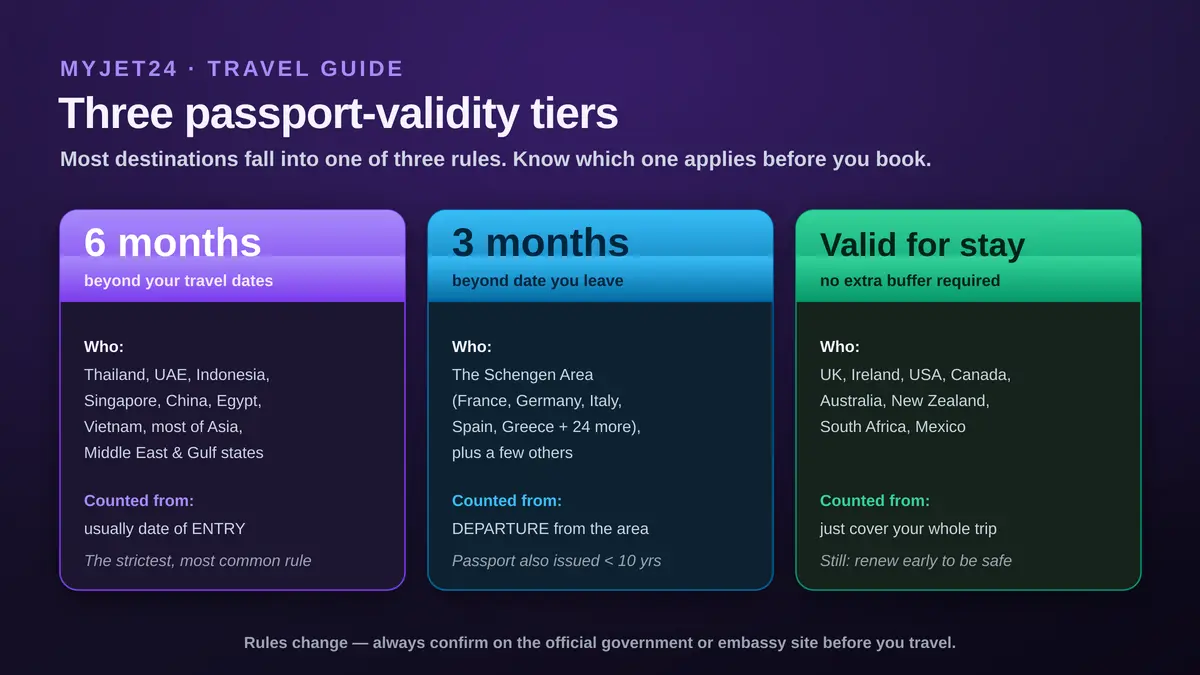
| Rule | Counted from | Example destinations |
|---|---|---|
| 6 months beyond trip | usually date of entry | Thailand, UAE, Indonesia, Singapore, China, Egypt, Vietnam |
| 3 months beyond departure | date you leave the area | Schengen Area (France, Germany, Italy, Spain, Greece + 22 more) |
| Valid for the stay | your whole trip | UK, Ireland, USA, Canada, Australia, New Zealand, South Africa |
Treat the table as a starting map, not gospel — individual countries change requirements, and a few have quirks (South Africa, for example, is strict on blank pages). Always confirm against the official source for your destination, which we link below.
The 6-month rule explained
The 6-month rule is the most common and the strictest of the three: your passport must remain valid for at least six months beyond your intended travel. It dominates Asia, the Middle East and the Gulf — Thailand, the UAE, Indonesia, Singapore and China all apply it. The catch is that “six months beyond travel” is interpreted differently across countries, and getting the reference date wrong is how careful travellers still get caught. The United States publishes a list of countries in this group, sometimes nicknamed the “six-month club,” on the official travel.state.gov site, and it is the cleanest reference if you hold a US passport.
"An in-date passport is not the same as a valid-for-travel passport. The six-month rule fails the document months before it actually expires."
The arrival-vs-departure trap
Here is the detail almost every competitor glosses over. Some countries measure the required validity from your date of arrival, others from your date of departure. With a six-month rule, that difference equals the length of your trip — and it can flip a passport from “fine” to “refused.”
Work a real example. Say your passport expires on 1 March 2027 and you plan a two-week trip arriving 20 August 2026 and leaving 3 September 2026. If the country needs six months from arrival, it counts from 20 August 2026 — you need validity to 20 February 2027, and you pass. If it needs six months from departure, it counts from 3 September 2026 — you need validity to 3 March 2027, and you fail by two days. Same passport, same trip, opposite outcome. The safe rule of thumb: always count from the later date (departure) and add a margin, so a borderline interpretation never costs you the flight.
Schengen’s 3-month rule (and the 10-year catch)
The Schengen Area runs its own standard: your passport must be valid for at least three months beyond the date you intend to leave the area, and — the part travellers miss — it must have been issued within the previous ten years. That second condition trips up holders of older passports that were extended beyond a decade, or that show a long validity due to added months at renewal. Both conditions must be true on the day you travel. The official short-stay rules are published by the European Commission at ec.europa.eu. If you are also tracking how long you can stay, pair this with our Schengen 90/180-day rule guide and the full Schengen visa checklist.
Blank-page requirements
Validity is only half the document check. Most countries also require a minimum number of completely blank pages for entry stamps and visa labels. The typical demand is one to two blank pages; some, such as South Africa, ask for more, and India expects two for its visa stamp. Pages that already carry stamps do not count, and a visa often needs a full blank page to itself. The practical standard is to keep at least two genuinely blank pages before any international trip; if you are a frequent traveller running low, add pages or renew early rather than gamble at the gate. A passport with plenty of validity but no room for a stamp can still be refused.
Who actually checks your passport validity
Most travellers assume the border officer is the gatekeeper. In reality there are three checkpoints, and the first is the one that stops people.
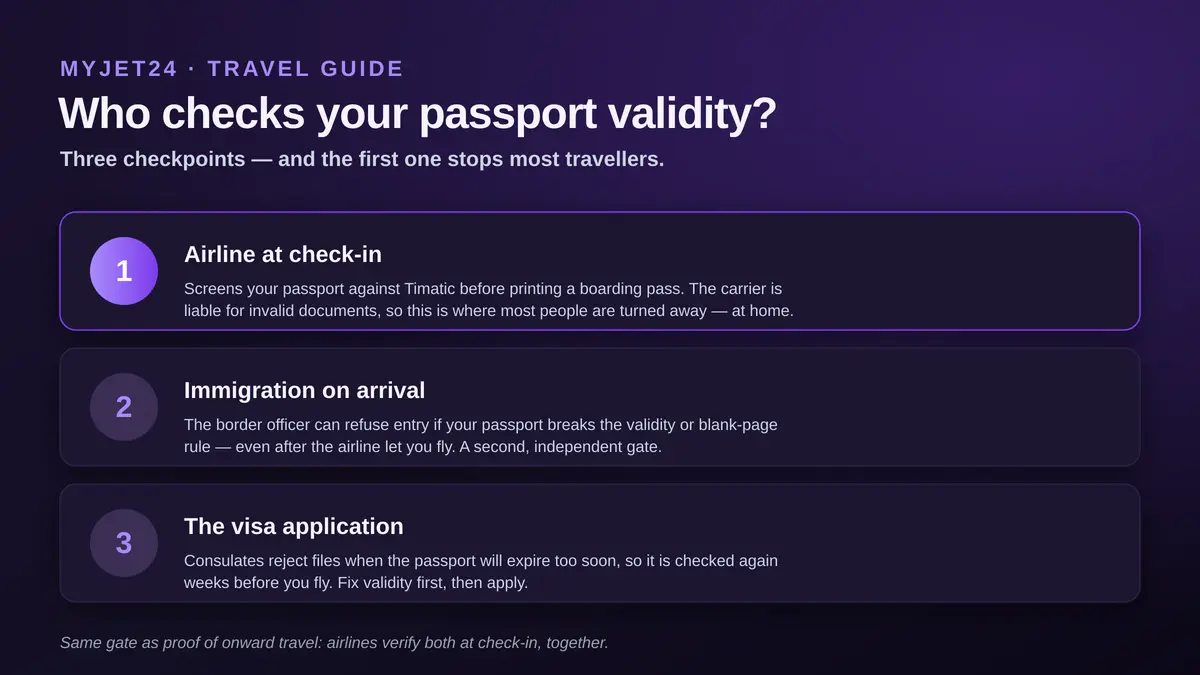
- The airline at check-in. Before printing your boarding pass, the carrier screens your passport against Timatic, the industry database of entry rules. Airlines are financially liable for carrying improperly documented passengers, so they enforce validity strictly — and this is where most people are turned away, at their home airport.
- Immigration on arrival. The border officer is a second, independent gate. They can refuse entry on validity or blank-page grounds even if the airline let you fly.
- The visa application. If your destination needs a visa, the consulate checks validity weeks earlier and will reject a file when the passport expires too soon.
That first checkpoint is the same one that enforces proof of onward travel — airlines verify both your passport validity and your return or onward ticket together at check-in. If you are unclear on the onward-ticket side, see our pillar on proof of onward travel by country and the explainer on when airlines can deny boarding.
How to check your passport before you book
A two-minute check before you pay for flights prevents the entire problem. Follow these steps in order.
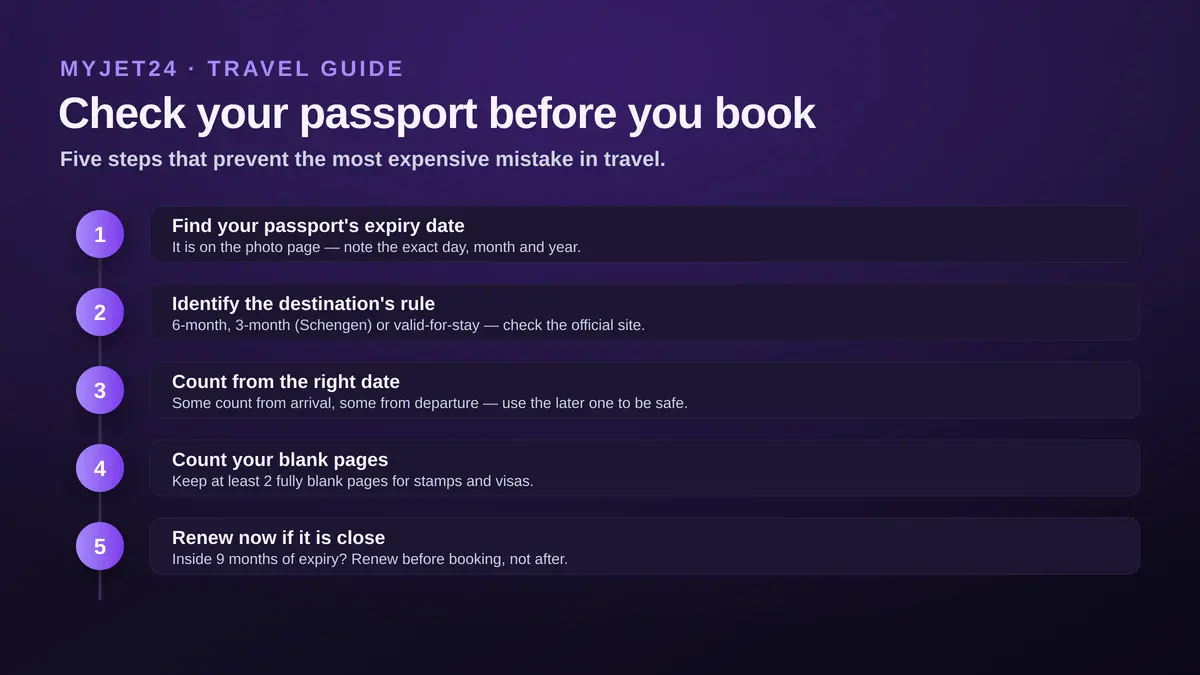
- Find your expiry date on the passport photo page — note the exact day, month and year.
- Identify the destination’s rule — six-month, three-month (Schengen) or valid-for-stay — using the official government or embassy site.
- Count from the correct date — if unsure whether it is arrival or departure, use departure to stay safe.
- Count your blank pages — keep at least two fully blank.
- Renew now if it is close — if you are within roughly nine months of expiry, renew before booking, not after.
It is worth adding passport validity to your wider trip prep. Our visa application checklist and the guide to documents for a US visa interview both assume a passport that comfortably clears the validity bar.
What to do if you discover it too late
If you realise your passport is too close to expiry, act on the timeline, not in panic. With several weeks before travel, a standard renewal usually clears in time in most countries. With days, look into your country’s expedited or urgent renewal service — many issue an emergency or fast-track passport for an extra fee. UK travellers can check current processing and urgent options at gov.uk. If renewal genuinely cannot happen in time, it is cheaper to move the trip than to lose non-refundable bookings at check-in. Whatever you do, do not fly hoping the airline will overlook it — Timatic does not make exceptions, and the carrier has no incentive to take your risk.
Special cases: families, dual nationals and long stays
A few situations deserve extra care. Children’s passports are often issued for shorter terms (typically five years), so they expire sooner than parents expect — check each child separately. Dual nationals must travel on a passport that satisfies the destination’s rule and use the same passport at check-in and immigration; mixing documents causes delays. Long-stay travellers, digital nomads and anyone chaining several countries should measure validity against the end of the whole journey, not the first leg, because a six-month rule applied at your final destination can require far more runway than your initial flight suggests.
Conclusion & next steps
Passport validity is one of the few travel rules that is both strict and entirely within your control. Identify which of the three tiers your destination uses, count the buffer from the safer (departure) date, keep two blank pages spare, and renew early whenever you are close. Do that and you remove the most avoidable reason travellers are turned away at the airport. Because the airline checks your passport and your return or onward ticket at the same moment, it pays to have both ready before you fly.
Frequently asked questions
Does my passport really need 6 months validity?
For many destinations, yes — most of Asia, the Middle East and the Gulf require six months beyond your trip. But the Schengen Area needs only three months beyond departure, and the UK, US and Canada require validity just for your stay. Always check the specific destination.
Who checks passport validity — the airline or immigration?
Both, but the airline checks first at check-in via the Timatic database and can deny boarding, because carriers are liable for improperly documented passengers. Immigration is a second, independent check on arrival.
Passport sorted? Don’t forget proof of onward travel
Airlines check your passport and your return or onward ticket together at check-in. Generate a verifiable flight reservation with a real PNR in under a minute — from just $7.90, no non-refundable fare.
Create your onward ticket →Last updated: June 19, 2026. Rules change frequently — always verify with the official government or embassy source before you travel.
Marc Hoffmann
Travel-documents specialist at MyJet24. Covers passport rules, visas, proof of onward travel and entry requirements for travellers worldwide.
