
TL;DR
- The Schengen 90/180-day rule lets visa-exempt visitors and short-stay (Type C) visa holders stay a maximum of 90 days within any rolling 180-day period across the whole 29-country Schengen Area.
- The 180 days is a rolling window, not a fixed calendar block. On any date, count backwards 180 days; your Schengen days inside that window must not exceed 90.
- Days are counted area-wide: time in France, Spain, Germany and the other members adds into one total. Both your entry day and exit day count as full days.
- Since 10 April 2026 the EU Entry/Exit System (EES) records every crossing biometrically and calculates the rule automatically — overstays are now flagged at the border.
- Overstaying triggers fines, deportation, a Schengen-wide entry ban (typically 1–5 years), and a SIS II alert that follows you onto future visa and ETIAS applications.
The Schengen 90/180-day rule is the law that caps short stays in Europe at 90 days within any 180-day period. It applies to the entire Schengen Area as a single territory, and the 180-day window moves forward every day. If you are visa-exempt or hold a short-stay Schengen visa, this single rule decides how long you can legally stay — and, since 2026, a biometric system does the counting for you.
What is the Schengen 90/180-day rule?
The 90/180-day rule is a short-stay limit. It permits a maximum of 90 days of presence in the Schengen Area within any 180-day period. The rule is set out in the Schengen Borders Code (Regulation EU 2016/399) and applies uniformly to all 29 member countries.
It governs short stays only — tourism, business trips, family visits, conferences, and transit. It does not govern national long-stay visas or residence permits, which are issued by individual countries under their own rules.
The 29 Schengen countries are Austria, Belgium, Bulgaria, Croatia, Czechia, Denmark, Estonia, Finland, France, Germany, Greece, Hungary, Iceland, Italy, Latvia, Liechtenstein, Lithuania, Luxembourg, Malta, the Netherlands, Norway, Poland, Portugal, Romania, Slovakia, Slovenia, Spain, Sweden, and Switzerland. Bulgaria and Romania became full members in March 2025, so their days now count toward the same 90.
"The single most common mistake travelers make is treating each country as a separate 90-day allowance. There is no per-country limit. The Schengen Area is one zone, and one 90-day budget covers all of it."
How the rolling 180-day window works
The 180-day window is rolling, which means it is recalculated on every single day. It is not a fixed semester or a calendar quarter. To check any date, look back exactly 180 days from that date; the number of days you were physically present in the Schengen Area during that period must be 90 or fewer.
Because the window moves, days "expire" out of it as time passes. A trip you took seven months ago no longer counts today, which slowly frees up allowance. This is why two travelers with identical passport stamps can have completely different remaining balances depending on when they want to enter.
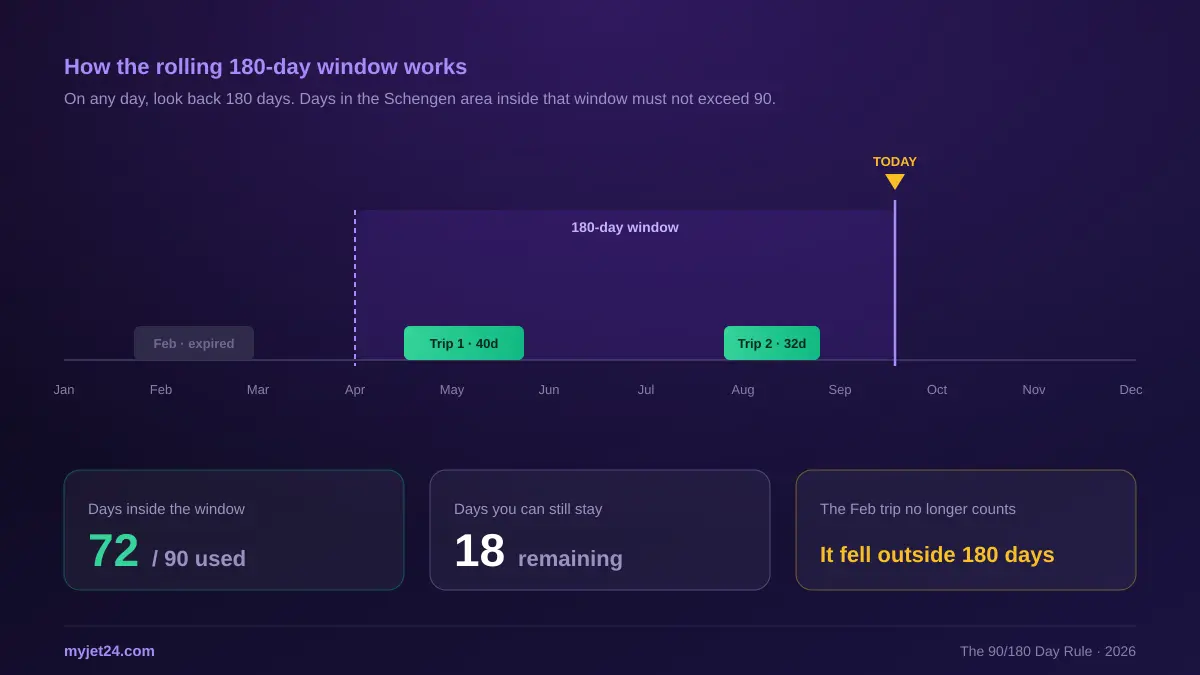
Worked example: it is 15 August 2026 and you want to enter again. Your window opened on 17 February 2026. Inside it you spent 40 days in spring and 32 days in summer — 72 days total. A trip back in early February already fell outside the 180-day window, so it no longer counts. You have 90 − 72 = 18 days of stay left on 15 August.
How to calculate your remaining Schengen days
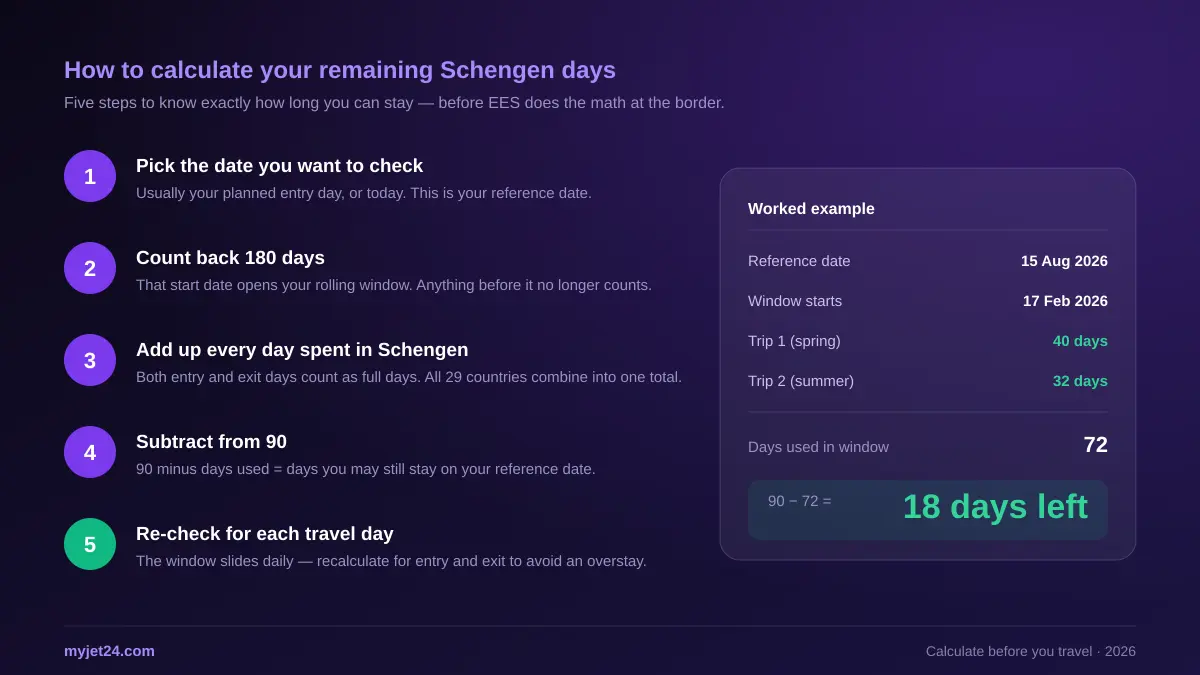
Calculating your balance is simple arithmetic once you fix the window. Follow these five steps for any date you plan to enter or exit:
- Pick the date you want to check. This is usually your planned entry day, or today. It becomes your reference date.
- Count back 180 days. That start date opens your rolling window. Anything before it is irrelevant.
- Add up every day you were in the Schengen Area inside the window. Entry and exit days both count as full days, and all 29 countries combine into one figure.
- Subtract from 90. Ninety minus the days used equals the days you may still stay on that reference date.
- Re-check for every travel day. The window slides daily, so recalculate for both your planned entry and exit to be sure the whole trip fits.
The official European Commission short-stay calculator does this math for you, and from 2026 the EES kiosk shows your remaining days on screen at the border. Still, do the calculation before you book flights — the border is the wrong place to discover you are three days over.
What counts as a day under the rule
A "day of stay" is any calendar day on which you are present in the Schengen Area, even for a few hours. The day you arrive and the day you leave both count as full days. There is no grace period and no rounding in your favor.
Airport transit inside the Schengen Area counts as presence. A layover in Frankfurt on the way to a non-Schengen country uses a day. Time spent in non-Schengen countries such as Ireland or Cyprus does not count, and neither does time in the United Kingdom, which left the EU and runs its own rules.
- Counts: tourism, business, visiting family, study trips under 90 days, conferences, and Schengen airport transit.
- Does not count: days in Ireland, Cyprus, the UK, or any non-Schengen country, and days you hold a valid national long-stay (Type D) visa or residence permit.
Where the clock stops: Schengen vs non-Schengen Europe
Europe is not the same as the Schengen Area, and the difference decides where your clock pauses. Leaving the Schengen Area for a non-Schengen country stops new days from being added — but it does not erase days already used inside the window.
- Ireland and Cyprus are in the EU but outside the Schengen Area, so days spent there do not count toward the 90.
- The United Kingdom sits fully outside; a trip to London pauses the Schengen clock and runs under separate UK entry rules.
- The Western Balkans — Albania, Serbia, Montenegro, North Macedonia, and Bosnia — are common "wait-out" destinations while days expire from the window.
- Micro-states Monaco, San Marino, Vatican City, and in practice Andorra have open borders with Schengen members, so time there counts as Schengen presence.
Treat the map as two zones. Inside the Schengen Area the meter runs; outside it the meter pauses. Hopping to a non-Schengen country for a long weekend only buys real breathing room if enough days are about to roll out of your 180-day window anyway.
Who the 90/180 rule applies to
The rule applies to two groups. First, visa-exempt nationals — passport holders from countries such as the United States, Canada, Australia, the UK, Japan, and Brazil who can enter the Schengen Area without a visa. Second, holders of a uniform short-stay (Type C) Schengen visa, whose visa sticker states the permitted number of days.
It does not apply to holders of a national long-stay (Type D) visa or a residence permit. Those documents grant the right to stay in the issuing country beyond 90 days under that country's national law, separate from the short-stay budget.
"A multiple-entry Schengen visa valid for five years does not give you five years of stay. It still caps you at 90 days in 180 — the long validity only saves you from re-applying."
The 90/180 rule by nationality
The rule is identical for every visa-exempt nationality — the same 90 days in 180 — but the context differs by passport.
US citizens enter visa-free and are one of the largest groups affected; from late 2026 they will also need a €20 ETIAS authorization, yet their 90-day cap is unchanged. Canadian and Australian travelers follow the same path. UK citizens lost EU freedom of movement after Brexit and are now treated as third-country nationals, fully subject to the 90/180 rule — a major shift for Britons who own second homes in Spain, France, or Portugal.
Nationals who need a short-stay visa, such as many Indian, Nigerian, or Chinese passport holders, receive a Type C visa that already states the permitted days; the 90/180 ceiling still caps the total even on a multiple-entry sticker. Whatever your passport, the arithmetic is the same — only the paperwork needed to reach the border differs.
How EES changed the 90/180 rule in 2026
The EU Entry/Exit System (EES) is the biggest practical change to the rule in a decade. EES is an automated biometric border system that became fully operational on 10 April 2026, after a phased rollout that began on 12 October 2025. It replaces manual passport stamps with a digital record of every entry and exit.
For travelers, the consequence is concrete: the system now calculates your 90/180 balance automatically and stores it. There is no more relying on faded ink stamps or a forgiving officer who cannot count back six months. An overstay of even one day is logged and visible to every border post and consulate.
EES also captures four fingerprints and a facial image on first entry, which speeds up later crossings but ties your travel history firmly to your biometrics. The takeaway is simple — the rule did not get stricter, but enforcement did. Our full EES guide covers what to expect at the kiosk.
EES vs ETIAS vs the 90/180 rule: what each one does
Three terms get confused constantly. They are separate things that work together. The 90/180 rule sets how long you can stay. EES records when you cross. ETIAS decides whether you may board in the first place. The table below clarifies each.
| Feature | 90/180 Rule | EES | ETIAS |
|---|---|---|---|
| What it is | Stay limit (a law) | Biometric entry/exit register | Pre-travel authorization |
| What it controls | How long you stay | When you crossed | Whether you can board |
| Live since | Long-standing | 10 April 2026 (full) | Expected Q4 2026 |
| Cost | Free | Free | €20 per authorization |
| Changes the 90-day limit? | It is the limit | No — only tracks it | No — only gates boarding |
Bottom line: when ETIAS launches, you will pay €20 for permission to travel, but you will still get the same 90 days in 180. For a deeper split, read ETIAS vs EES explained and the complete ETIAS 2026 guide.
Five common 90/180 miscalculations
Most overstays are honest math errors, not deliberate. These five myths cause the majority of them:
- The "reset" myth. Leaving the Schengen Area for a weekend does not reset your counter. The window keeps rolling; only the passage of 180 days frees up days.
- The per-country myth. Spending 90 days in France and then "starting fresh" in Spain is an overstay. All 29 countries share one budget.
- The calendar-year myth. The limit is not 90 days per calendar year. It is 90 days in any rolling 180-day period, which can straddle two years.
- The exit-day myth. Many travelers forget the departure day counts. A 90-day trip that includes both the arrival and departure days is exactly at the limit, not under it.
- The visa-length myth. A long-validity multiple-entry visa does not extend stay. The 90/180 cap still applies inside its validity.
What happens if you overstay
Overstaying the 90/180 rule is an immigration violation with real, lasting penalties. Since EES now detects overstays automatically, the days of leaving unnoticed are over.
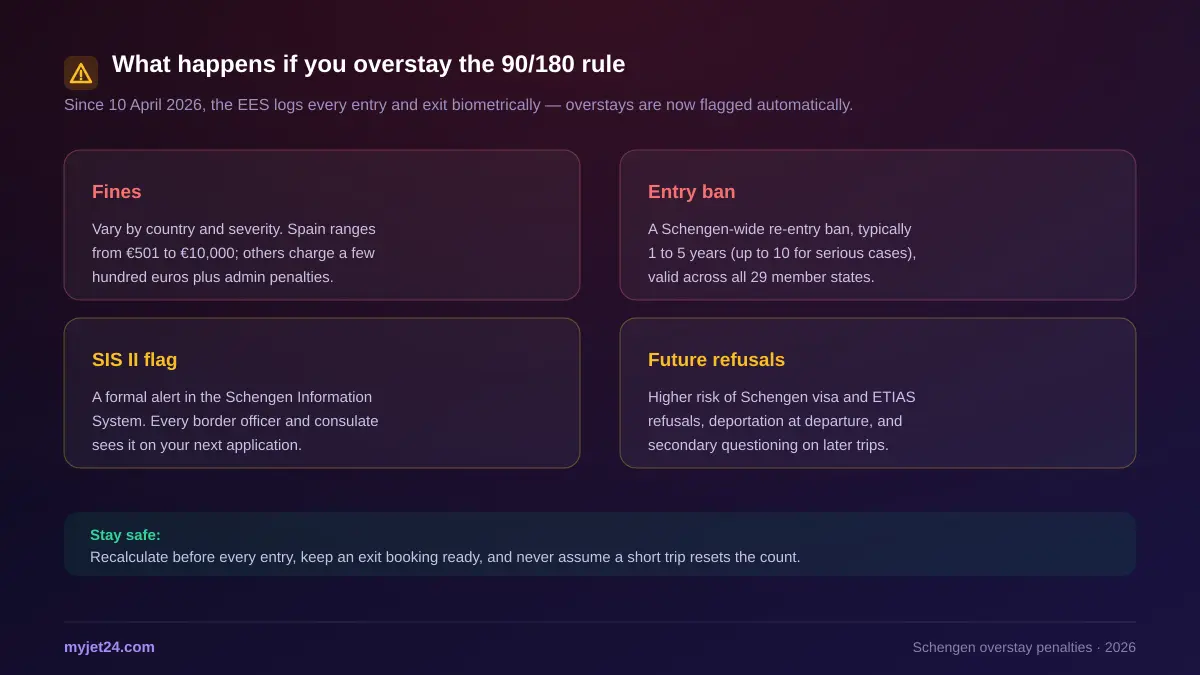
The consequences scale with how long and how often you overstay:
- Fines. Penalties vary by country. Spain's range runs roughly from €501 to €10,000; other states charge a few hundred euros plus administrative costs.
- Entry ban. A Schengen-wide re-entry ban, typically 1 to 5 years and up to 10 for serious cases, valid across all 29 members.
- SIS II alert. A formal record in the Schengen Information System that every border officer and consulate sees on your next application.
- Future refusals. A higher risk of Schengen visa and ETIAS refusals, deportation at departure, and secondary questioning on later trips.
According to the European Commission, around 1.73 million of the 11.7 million short-stay visa applications in 2024 were refused — and a prior overstay is among the fastest ways to land on the wrong side of that statistic.
How to legally stay longer than 90 days
If 90 days is not enough, you do not break the rule — you change your category. There are three legitimate routes.
- Apply for a national long-stay (Type D) visa from the country where you will spend most time. These are issued under national law for work, study, retirement, or digital-nomad schemes and sit outside the 90/180 budget.
- Use a bilateral visa-waiver agreement. A handful of Schengen states keep older agreements that, in narrow cases, allow extra days beyond the 90 for certain nationalities. Confirm with the specific embassy before relying on one.
- Split your time with the rolling window. Spend up to 90 days, leave for the time needed for days to expire, then re-enter. Plan re-entry dates with the calculation above.
Whichever route you choose, airlines still check that you can leave. When you re-enter on a fresh balance, carry proof of onward travel so the gate agent and the EES officer see a clear exit plan. A verifiable flight reservation does this without locking up the cost of a real ticket — see which countries require proof of onward travel.
Three real scenarios where the rule trips people up
Abstract rules are easy to misread, so here are three situations that catch travelers out — and the fix for each.
The two-long-summers trap. A retiree spends 88 days in Portugal from June to September, flies home, then wants to return in late November for the holidays. Because the September days are still inside the rolling window in November, only a handful have expired — re-entering for a full month would overstay. The fix is to wait until enough September days roll past the 180-day mark, then enter on a balance you have actually recalculated.
The back-to-back trips trap. A consultant takes 45 days across France and Germany in spring, then a 50-day project in Italy that autumn. Each trip feels fine on its own, but together they total 95 days inside one window — five days over. Splitting the second trip across the window boundary, or trimming it to 45 days, keeps the total at or under 90.
The transit trap. A traveler who has already used exactly 90 days books a connecting flight through Amsterdam to reach Turkey. The Schengen layover counts as a day of presence, quietly pushing the total to 91. Choosing a non-Schengen transit hub such as Istanbul, London, or Doha avoids the extra day entirely.
In every case the EES now flags the overrun automatically, so a two-minute calculation before booking is the cheapest insurance a frequent traveler can buy. The travelers who never have a problem are simply the ones who count their days before the border does.
Conclusion and next steps
The Schengen 90/180-day rule is fixed and simple: 90 days of stay inside any rolling 180-day window, shared across 29 countries. What changed in 2026 is enforcement — EES now counts for you, and ETIAS will gate boarding from late 2026, but neither alters the 90-day budget. Calculate before every trip, remember that entry and exit days both count, and never assume a short hop resets the clock. Keep a simple log of your entry and exit dates, recalculate before you book each leg of a trip, and treat the 90-day figure as a hard ceiling rather than a target — the small habit of counting first is what separates relaxed travelers from the ones pulled aside at the border.
Planning your next Schengen entry? Make sure your paperwork is airtight. Use the 2026 Schengen document checklist, check realistic visa processing times, and generate a free, embassy-ready flight reservation and proof of onward travel in under a minute — no card, no risk of buying a ticket you may not use.
