
TL;DR
- The SG Arrival Card (SGAC) is a free, mandatory electronic arrival declaration that almost every foreign visitor must submit before entering Singapore. It includes an electronic health declaration.
- Submit it within 3 days before arrival, counting your arrival day — only through ICA's official e-Service or the MyICA app. It is always free; paid "submission" sites are not endorsed by ICA.
- From 30 January 2026, a No-Boarding Directive lets airlines stop you at the departure gate if your passport, SGAC, onward ticket, or visa is missing. Airlines face fines up to SGD 10,000 per breach.
- The SGAC is not a visa and not an entry guarantee — it is a pre-arrival declaration. Final entry is decided by an immigration officer at the checkpoint.
- After submitting you receive an email with a QR code and PDF. Changi now offers automated, passport-free clearance in roughly 30 seconds.
The Singapore Arrival Card (SGAC) is a free electronic form that foreign visitors must submit to Singapore's Immigration & Checkpoints Authority (ICA) within three days before arrival. It replaces the old paper disembarkation card and bundles an electronic health declaration. You submit it online at the official ICA e-Service or in the MyICA app, receive a QR-code confirmation, and present it on arrival. Submission is always free of charge.
What is the Singapore Arrival Card (SGAC)?
The SG Arrival Card is Singapore's digital arrival declaration for inbound travelers. It is a short online form that records your identity, passport details, travel itinerary, accommodation in Singapore, and a mandatory electronic health declaration. ICA introduced it to replace the paper embarkation/disembarkation card and to pre-screen travelers before they reach the checkpoint.
The card is not a visa, not a boarding pass, and not a guarantee of entry. It is an administrative pre-arrival step. Think of it as telling Singapore who you are and where you will stay before you land, so the actual border crossing is faster. The same system underpins the country's move to contactless, passport-free immigration lanes at Changi Airport.
ICA introduced the digital card in 2020, retiring the paper disembarkation slip that crews once handed out mid-flight. The electronic health declaration was folded in during the pandemic and has remained as a permanent disease-control measure. Today the SGAC is the backbone of Singapore's contactless border, linking your declaration to biometric clearance so the physical queue all but disappears for compliant travelers.
Singapore's SGAC sits alongside the other major regional arrival cards. If you are mapping a multi-country Asia trip, our Asia digital arrival cards 2026 guide compares the SGAC with Thailand's TDAC, Malaysia's MDAC, and the Philippines eTravel system in one place.
Who needs to submit the SGAC (and who is exempt)?
Almost every foreign visitor entering Singapore must submit an SGAC. This includes short-term visitors who are visa-free, visitors who hold a Singapore visa, and most pass holders re-entering the country. If you are arriving by air, sea, or land and you will clear immigration, you almost certainly need one.
There are narrow exemptions. The main exempt groups are:
- Pure transit passengers who do not clear Singapore immigration and stay airside at Changi.
- Singapore Citizens, Permanent Residents, and Long-Term Pass holders entering through land checkpoints (Woodlands and Tuas).
Everyone else — tourists, business visitors, families, students arriving for the first time — must file the card. A common mistake is assuming children are exempt. They are not: each traveler needs their own SGAC, although one person can submit a group declaration for a family in a single session.
"One SGAC per traveler. A parent can file for the whole family in one group submission, but every passport — including infants — needs its own card."
When to submit: the 3-day window
The SGAC submission window is the three days before arrival, and that count includes your arrival day. In practice, if you land on a Friday, you can submit from the preceding Wednesday onward. File it any earlier and the system will not accept it yet.
This tight window catches travelers off guard. People often try to complete the card weeks ahead while organizing documents, only to find the form rejects the date. The safest habit is to submit one or two days before departure, once your flights and hotel are locked in, and well before you reach the airport.
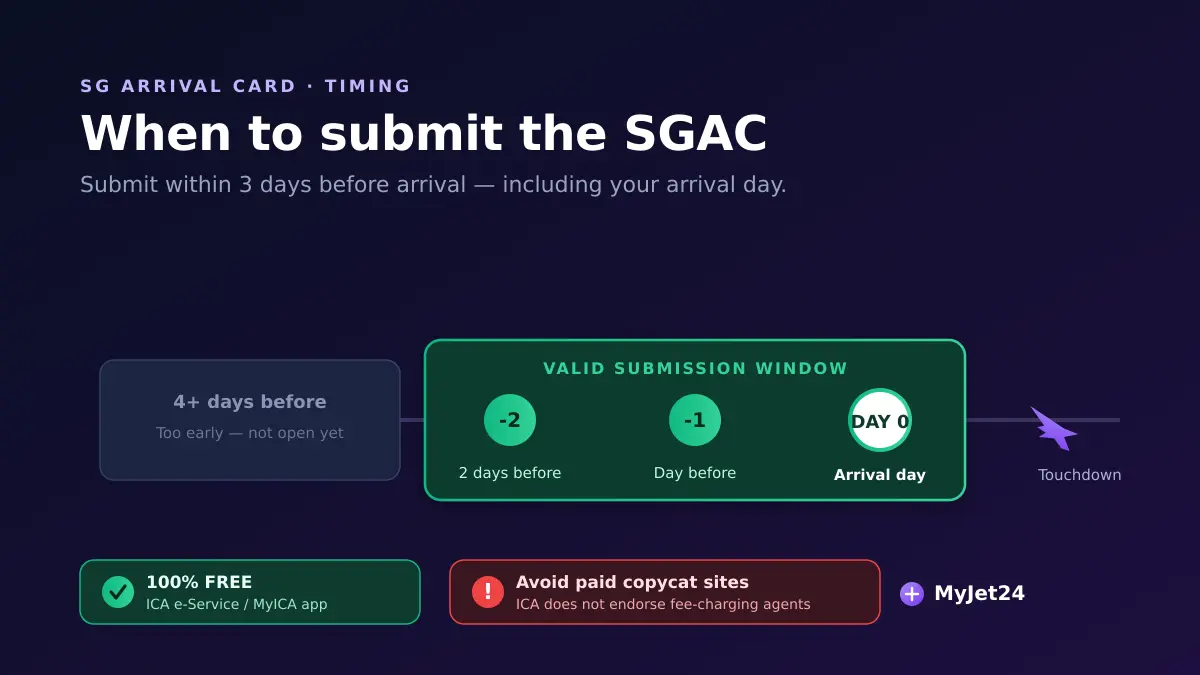
Do not leave it until you are at the boarding gate. Under the 2026 enforcement rules described below, airline staff now check for a submitted SGAC before they let you board, so a last-minute scramble on airport Wi-Fi is a real risk.
What you need before you file the SGAC
Filing the SGAC takes about three minutes if you have your details ready. Gathering them first prevents the typos that trigger manual checks at the border. Before you open the form, have the following on hand:
- Your passport, valid for at least six months beyond your arrival date, with the number and expiry to hand.
- Your inbound travel details — flight number, vessel name, or land checkpoint, plus the arrival date.
- Your Singapore address — the hotel name and address, or a host's address for the first night.
- An email address you can access on the road, because the QR-code confirmation is sent there.
- Proof of onward or return travel, since airlines now check it before boarding.
If you are filing for a family, collect every passenger's passport before you begin so you can complete a single group submission without losing the session. Having a confirmed onward ticket ready at this stage also means you are covered for the gate check the moment you reach the airport.
How to submit the SG Arrival Card in 5 steps
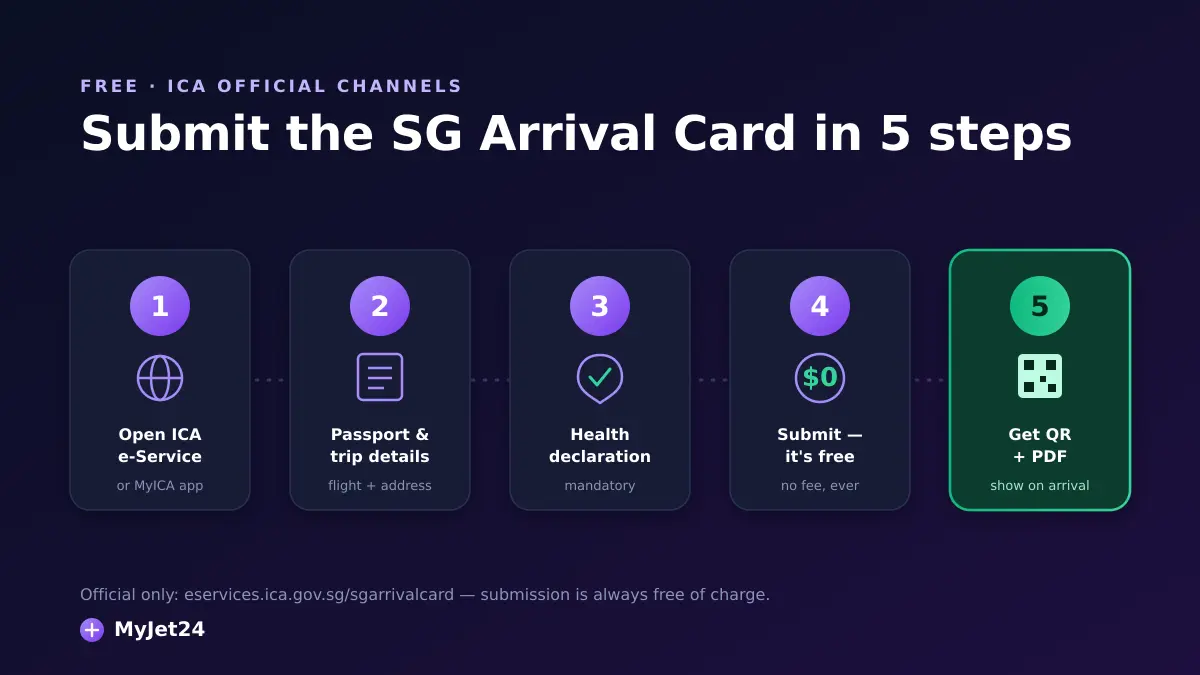
Submitting the SGAC is a five-step online process that takes about three minutes. Use only the official ICA e-Service or the MyICA mobile app. Here is the exact sequence:
- Open the official ICA e-Service. Go to eservices.ica.gov.sg/sgarrivalcard or open the MyICA app. Check the address bar — the official domain ends in ica.gov.sg.
- Enter your passport and trip details. Provide your passport data, arrival date and flight or vessel number, and your Singapore address (hotel name is fine).
- Complete the electronic health declaration. Answer the short health questions honestly. This is a legal declaration, not an optional extra.
- Submit — it is free. Review and submit. ICA never charges for the SGAC, so you should never be asked for a card payment on the official site.
- Save your QR code and PDF. You will receive a confirmation email with a QR code and PDF. Screenshot it and keep it offline so you can show it without signal.
The SGAC is free — avoid paid copycat sites
SGAC submission is free, and ICA has issued a public advisory warning travelers about commercial sites that charge for it. These third-party operators copy the look of an official portal, take a "service fee" of USD 10 to USD 40, and then simply file the same free form you could have submitted yourself — sometimes with errors.
According to ICA's own guidance, the authority "does not support or endorse" fee-charging submission services, and the card should be filed only through the official e-Service or MyICA app. Two quick checks protect you: confirm the URL ends in ica.gov.sg, and stop the moment any site asks for a payment to submit. You can read the warning directly on the ICA public advisory and the official SG Arrival Card page.
"If a website asks you to pay for the SG Arrival Card, it is not the government. The official SGAC is free, every single time."
The 2026 No-Boarding Directive: documents checked before you board
The No-Boarding Directive (NBD) is a 2026 enforcement rule that shifts Singapore's document checks to your departure airport. From 30 January 2026, ICA requires airlines to verify each passenger's core entry requirements before issuing a boarding pass, rather than discovering problems on arrival at Changi.
At the gate, the airline confirms four things: a passport valid for at least six months, a submitted SG Arrival Card, proof of onward or return travel, and a valid visa where one is required. If any item is missing, the passenger receives a No-Boarding Directive and is refused boarding. Airlines that board inadmissible passengers face fines of up to SGD 10,000 per breach, which is exactly why gate agents now enforce this strictly.
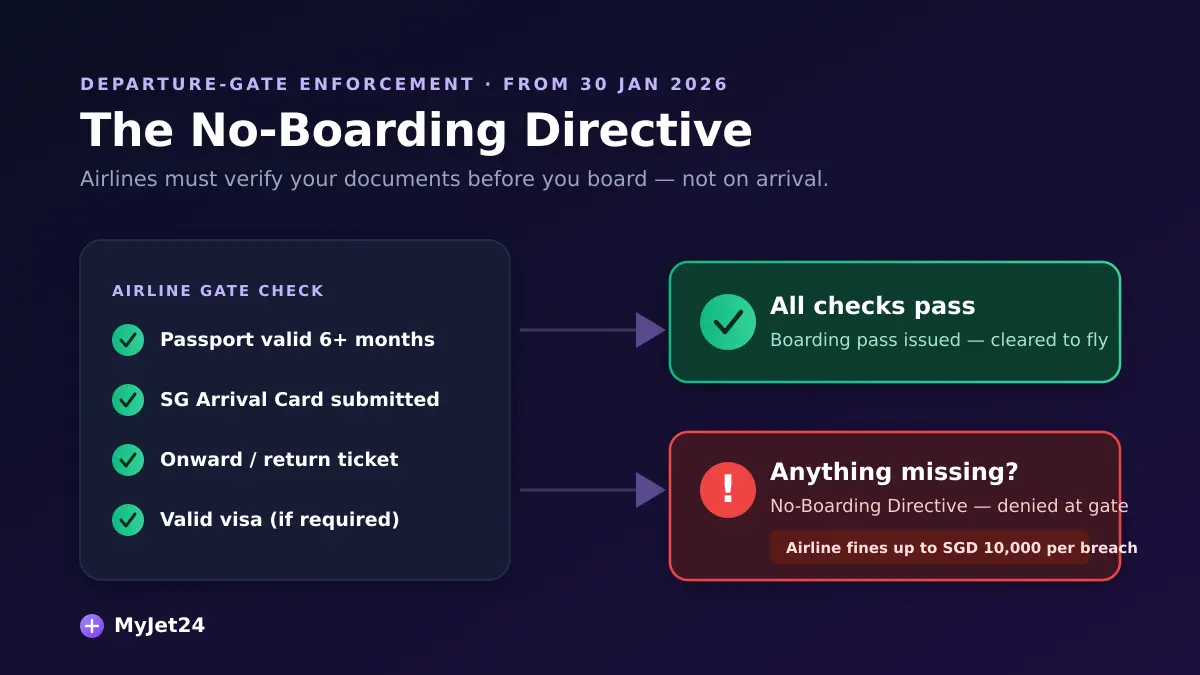
The onward-ticket requirement is the one travelers underestimate. Many visitors arrive on one-way tickets intending to buy onward travel later, and airlines will not risk a fine on that. If you do not yet have a confirmed exit, a verifiable onward or return reservation solves the problem. Our guide to the dummy ticket for Singapore and the ICA no-boarding directive explains exactly what Changi airlines check, and our overview of which countries require proof of onward travel in 2026 shows how widespread the rule has become.
SGAC vs visa vs eTA: what the arrival card is not
The SGAC is a pre-arrival declaration, not permission to enter. Travelers frequently confuse it with a visa or an electronic travel authorization, and that confusion causes denied boardings. The table below separates the three documents.
| Feature | SG Arrival Card | Singapore visa | eTA / authorization |
|---|---|---|---|
| Purpose | Arrival + health declaration | Permission to seek entry | Pre-travel screening (other countries) |
| Who needs it | Almost all visitors | Only visa-required nationalities | N/A for Singapore |
| Cost | Free | Visa fee applies | Varies by country |
| When | Within 3 days of arrival | Before travel | Before travel |
| Guarantees entry? | No | No | No |
The key takeaway: even with a valid visa, you still file an SGAC, and even with an SGAC, an immigration officer can still refuse entry. They are separate layers. Singapore offers visa-free entry to most Western nationalities for short stays, but every one of those visitors still needs the arrival card.
Automated, passport-free clearance at Changi
Automated immigration clearance is now the default at Changi Airport for arriving and departing travelers. Since 2024, Singapore has rolled out automated lanes that use facial and iris recognition, allowing many travelers to clear immigration without handing over a physical passport and in roughly 30 seconds. First-time visitors can use the lanes with no prior enrolment.
The SGAC is what makes this speed possible: your declaration is already in the system, so the lane only needs to match your face to your record. You can see the current process on the official Changi Airport immigration guide. Keep your SGAC QR code handy anyway — manual counters and secondary checks still exist, and staff may ask to see it.
Common SGAC mistakes that delay travelers
Most SGAC problems come from a handful of avoidable errors. Knowing them in advance keeps your arrival smooth.
- Submitting too early. The form only opens three days before arrival. Earlier attempts fail and travelers assume the site is broken.
- Paying a third party. The card is free; a payment request means you are on a copycat site.
- Passport typos. A mismatch between your SGAC and your passport can trigger a manual check or, at the gate, a refusal.
- Forgetting onward travel. Under the No-Boarding Directive, a one-way ticket without proof of exit can stop you boarding.
- Assuming transit always exempts you. Only pure airside transit is exempt; if you clear immigration, you need the card.
"The two failures that actually get people turned away at the gate are no submitted SGAC and no proof of onward travel. Both are free or cheap to fix before you leave home."
The SGAC in the wider Asia arrival-card landscape
The SG Arrival Card is one of several digital arrival cards now standard across Asia. Thailand, Malaysia, Indonesia, and the Philippines all run their own versions, each with different timing windows and quirks. Filing the wrong card, or filing on the wrong site, is a growing cause of travel friction across the region.
If your itinerary includes neighbouring countries, file each card separately and early. Thailand's version must be filed before arrival too — see our Thailand Digital Arrival Card (TDAC) filing guide. Malaysia's free card is covered in our Malaysia Digital Arrival Card (MDAC) guide. Each one is free on its official portal, and each one now feeds the same kind of pre-boarding checks Singapore introduced.
How long can visitors stay in Singapore?
The SGAC does not set your length of stay — an immigration officer does. When you clear the checkpoint, you receive a Visit Pass, and the duration stamped or recorded electronically is at the officer's discretion. Most visa-free tourists are granted a social visit pass of up to 30 or 90 days depending on nationality, but the headline figure is a maximum, not an entitlement.
This matters for two reasons. First, your onward or return ticket should fall within the stay you are likely to be granted; a flight out eight months later on a tourist arrival invites questions. Second, overstaying in Singapore is treated severely, with fines, possible caning for long overstays, and entry bans. The practical rule is simple: enter with a realistic plan and a confirmed exit. If you need to extend, apply through ICA before your pass expires rather than overstaying.
Because the granted period is decided on arrival, travelers who present a clear itinerary, accommodation, and proof of onward travel tend to clear faster and with fewer secondary questions. The SGAC supplies that itinerary data in advance, which is part of why the automated lanes work.
Filing the SGAC for air, sea, and land arrivals
The SG Arrival Card requirement applies across all entry modes, but the details differ slightly. Air travelers arriving at Changi or Seletar file the card and typically use automated lanes. Sea travelers — including cruise passengers docking at the Marina Bay Cruise Centre or the Singapore Cruise Centre — also need an SGAC for each disembarking passenger, so cruise lines increasingly remind guests to file before the ship arrives.
Land arrivals via the Woodlands and Tuas checkpoints from Malaysia are the one area with broader exemptions: Singapore Citizens, Permanent Residents, and Long-Term Pass holders crossing by land do not need to file. Short-term foreign visitors crossing by bus, car, or on foot, however, still do. Frequent land commuters should note that a fresh SGAC is required for each entry, which is why many keep the MyICA app installed for quick re-filing.
Whatever your mode of travel, the constants hold: file within three days of arrival, file free on the official channel, and carry your QR confirmation. One group submission can cover a family travelling together, but each individual still gets their own card record.
Conclusion: file early, file free, fly clear
The SG Arrival Card is a small task with outsized consequences in 2026. Submit it free on the official ICA channel within three days of arrival, keep the QR code offline, and make sure your passport validity and onward ticket match what airlines now check at the gate. Do those four things and your Singapore arrival is a 30-second walk through an automated lane.
Flying into Singapore on a one-way ticket? Before you submit your SGAC, lock in your proof of onward travel so the No-Boarding Directive can never stop you at the gate. Generate a free onward ticket with MyJet24 in under a minute (verifiable with Premium, $7.90) — accepted for the ICA onward-travel check and 193 other countries.
