
TL;DR
- The Vietnam e-Visa is an official electronic visa issued online by Vietnam Immigration. Since August 2023 it is valid for up to 90 days, single or multiple entry.
- The official fee is $25 (single entry) or $50 (multiple entry) at evisa.gov.vn. It is non-refundable, even if rejected.
- Processing takes 3–5 working days (7–10 in peak season). Apply at least a week before travel.
- You need a passport valid 6+ months, a passport bio-page scan, and a photo (4×6 cm, white background, no glasses).
- Beware agencies charging $50–$100+ for the same government e-Visa. Airlines may still check proof of onward travel before boarding.
The Vietnam e-Visa is an official electronic visa you apply for online at evisa.gov.vn, valid up to 90 days with single or multiple entry. It costs $25 for single entry or $50 for multiple entry, is processed in 3–5 working days, and is issued as a PDF you print and show at the border. Most nationalities qualify, the whole process is online, and no agency or embassy visit is needed.
What is the Vietnam e-Visa?
The Vietnam e-Visa is a government-issued electronic visa that replaces the need to visit an embassy or use a paper visa. It is managed by the Vietnam Immigration Department and delivered as a PDF after an online application. Since 15 August 2023, the e-Visa covers stays of up to 90 days and can be issued for single or multiple entry, a major upgrade from the old 30-day single-entry version.
It is a real visa, not a pre-screening like the US ESTA or an eTA. Once approved, your e-Visa authorizes travel to Vietnam through any of the designated international ports. If you have used other electronic visas, the model is familiar — our Japan e-Visa guide and Brazil e-Visa guide follow the same online-application pattern.
The 2023 reform was significant. Before it, most visitors were limited to a 30-day single-entry e-Visa and often paid agencies for visa-on-arrival letters. The current 90-day, multiple-entry system makes Vietnam one of the more flexible destinations in Southeast Asia for long trips and regional loops. For digital nomads, backpackers, and multi-country travelers, a single e-Visa now covers an entire quarter and unlimited border crossings.
How much does the Vietnam e-Visa cost in 2026?
The Vietnam e-Visa costs $25 for single entry and $50 for multiple entry in 2026. These are the official government fees on evisa.gov.vn, paid by card during the application. The fee is an administrative processing charge and is non-refundable — you do not get it back if your application is rejected, so accuracy matters.
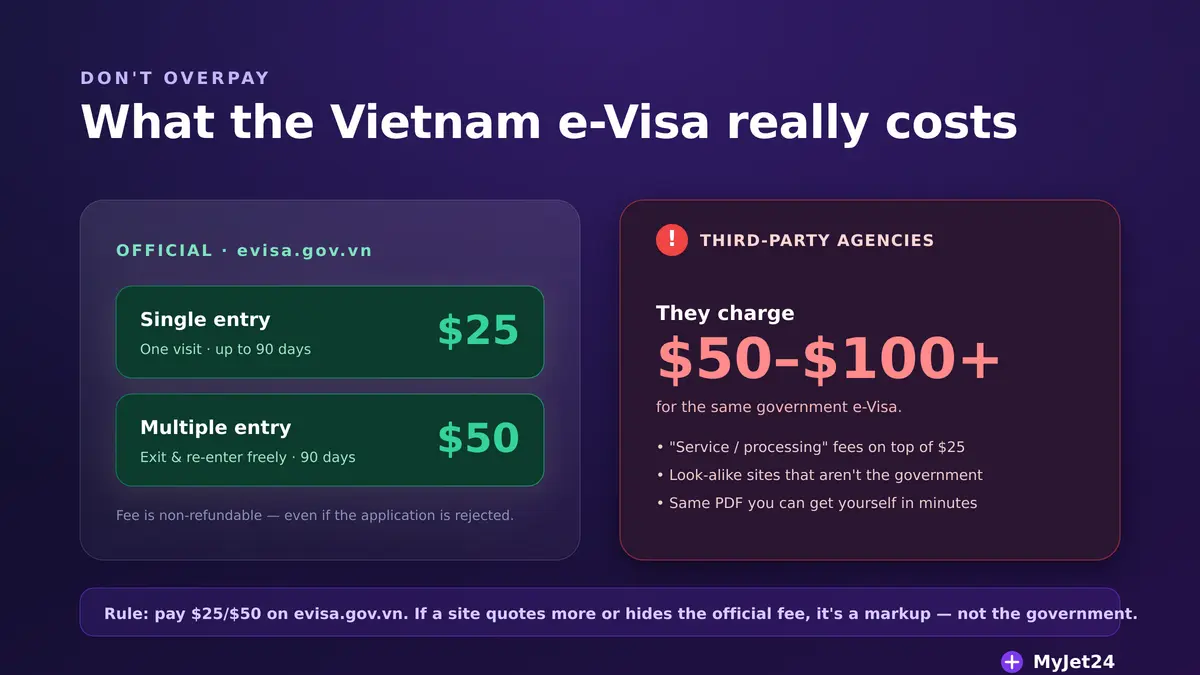
"If a site quotes more than $25 or $50, or hides the official fee behind a 'service charge', it is an agency markup — not the government."
Many third-party sites charge $50 to $100+ for the identical e-Visa, adding "service" or "express" fees on top of the $25. Some are look-alike pages designed to appear official. You can avoid every extra dollar by applying directly on the official portal.
Two checks protect you. First, confirm the domain is exactly evisa.gov.vn — government sites use the .gov.vn suffix. Second, be sceptical of "guaranteed 24-hour" or "express" promises; the government processing time is fixed at 3–5 working days, and no agency can override the immigration queue. Paying extra rarely buys real speed — it buys a middleman who submits the same form you could submit yourself.
Single vs multiple entry: which should you choose?
Choose single entry if you will enter Vietnam once, and multiple entry if you plan to leave and return. Both versions last up to 90 days; the difference is how many times you can cross the border. The $25 single-entry visa is voided the moment you exit Vietnam, even if days remain.
- Single entry ($25): best for a one-time trip with no side trips out of the country.
- Multiple entry ($50): worth it if you will hop to Cambodia, Laos, or Thailand and come back, or run a multi-country itinerary based in Vietnam.
The extra $25 for multiple entry is cheap insurance if there is any chance you will leave and re-enter. Within the validity window you can cross as often as you like.
A common scenario shows why this matters: travelers based in Ho Chi Minh City often take a short trip to Angkor Wat in Cambodia or the islands of Thailand mid-stay. With a single-entry visa, that side trip ends the Vietnam visa, forcing a second application to return. With multiple entry, the same $50 visa carries you back and forth for the full 90 days. If your plans are even slightly fluid, pay the extra and keep your options open.
e-Visa vs Visa-on-Arrival vs embassy visa
The e-Visa is the fastest, cheapest, and most flexible option for most travelers. Visa-on-arrival (VOA) still exists but is now niche — it requires a pre-arranged approval letter and only works at airports. An embassy visa is slower and more expensive, and is mainly for long stays or work.
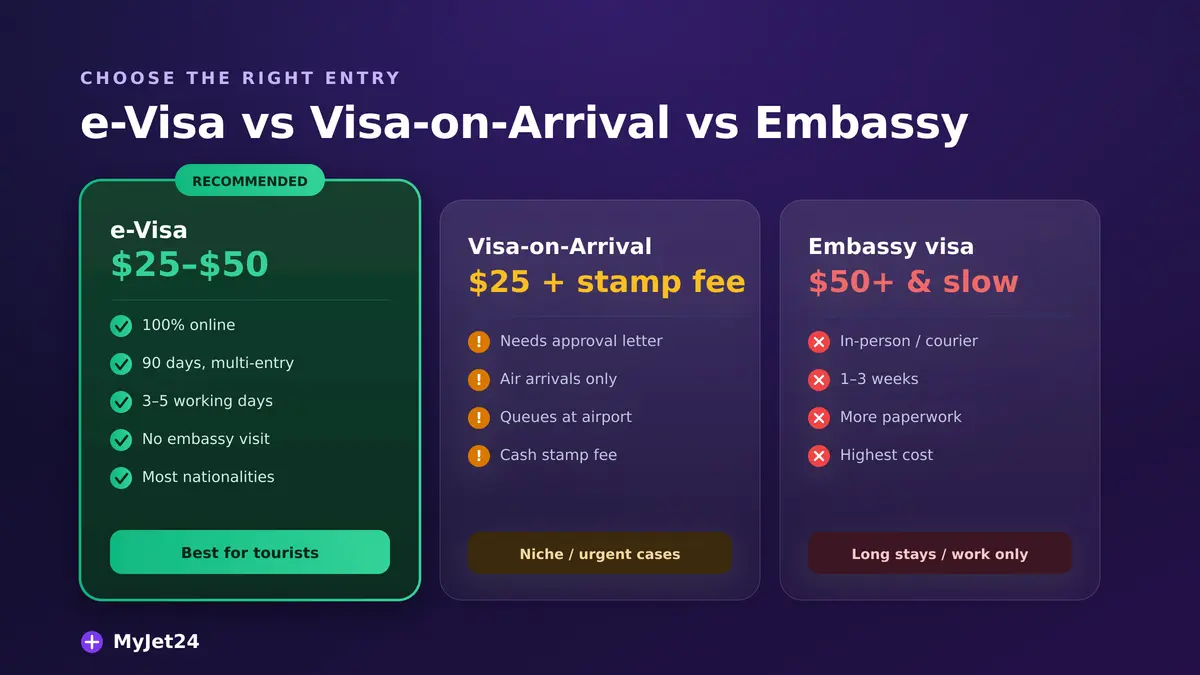
| Feature | e-Visa | Visa-on-Arrival | Embassy visa |
|---|---|---|---|
| Where | 100% online | Airport (with letter) | In person / courier |
| Cost | $25–$50 | $25 + stamp fee | $50+ |
| Speed | 3–5 days | Letter 2+ days | 1–3 weeks |
| Entry points | Air, land, sea | Air only | All |
| Best for | Tourists | Urgent/niche | Long stay / work |
Who needs a Vietnam e-Visa (and who is exempt)?
Most foreign visitors need a visa for Vietnam, and the e-Visa is open to citizens of essentially every country. A limited set of nationalities enjoy short visa-free entry under bilateral agreements, and those travelers may not need an e-Visa for short stays. Everyone else applies online.
The e-Visa also covers most travel purposes a tourist or short-term visitor needs: holidays, visiting friends and family, short business meetings, and transit. It does not cover paid employment or long-term residence, which require a work permit or a different visa category. For a standard trip of up to 90 days, though, the single tourist e-Visa is all the documentation Vietnamese immigration asks for.
Visa exemptions are time-limited (often 15–45 days) and vary by passport, so always confirm your own nationality's rule before booking. If your visa-free allowance is shorter than your trip, get the e-Visa to cover the full stay. When in doubt, the $25 e-Visa removes any uncertainty at the border.
Vietnam e-Visa for US, UK, EU and other travelers
The Vietnam e-Visa is available to nearly every nationality, and the process is identical regardless of passport. US, Canadian, Australian, and most non-exempt travelers must hold a visa for any visit, so the e-Visa is the default route. The fee, documents, and 90-day validity are the same for all eligible passports.
The difference between nationalities is the visa-free allowance, not the e-Visa itself. Citizens of the UK, France, Germany, Italy, Spain, and several other countries currently receive a short visa exemption (typically 45 days), which is enough for a quick trip but not for longer stays. If you are British or European and staying under that limit, you may skip the e-Visa; if you are American or staying longer, you apply online like everyone else. Always verify your specific allowance, because exemption schemes are extended or changed periodically.
"Visa-free entry is shorter than the e-Visa. If your trip is longer than your exemption, the 90-day e-Visa is the simpler, safer choice."
How to apply for the Vietnam e-Visa in 4 steps
Applying for the Vietnam e-Visa is a four-step online process that takes about 15 minutes. Use only the official portal, evisa.gov.vn, or the official mobile app. Here is the exact sequence:
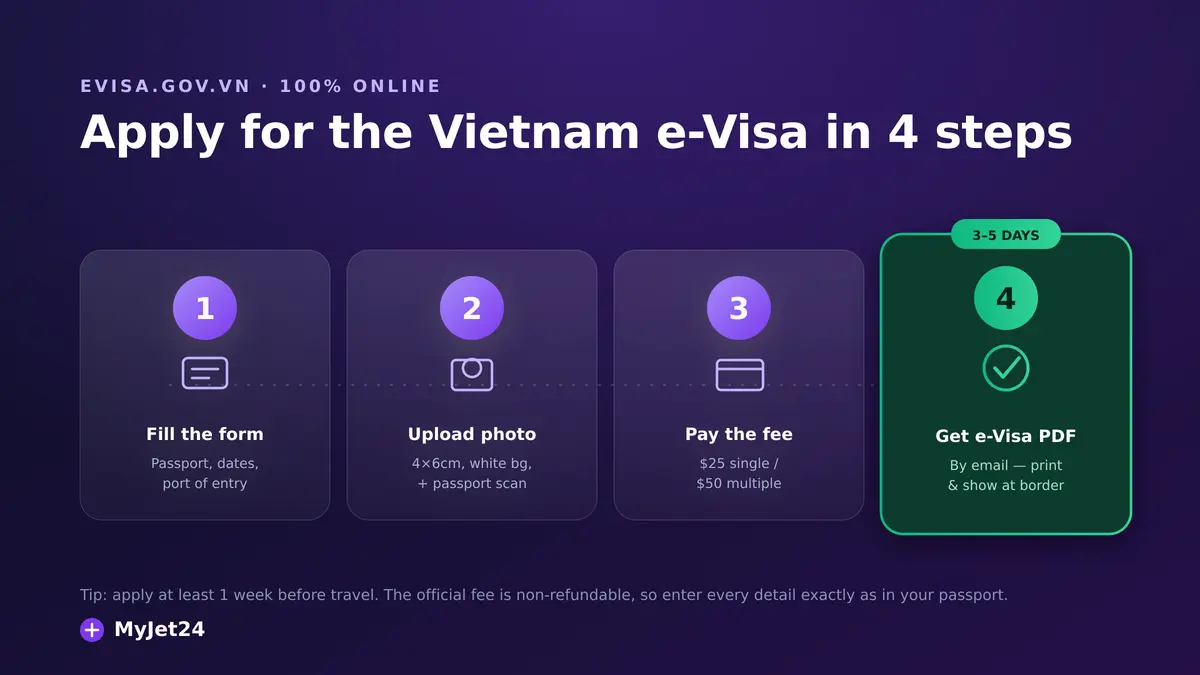
- Fill in the application form. Enter your passport details, your intended arrival and departure dates, and your chosen port of entry. Match every field exactly to your passport.
- Upload your photo and passport scan. Provide a JPEG of your passport bio page and a 4×6 cm portrait photo on a white background, no glasses.
- Pay the fee. Pay $25 for single entry or $50 for multiple entry by international card. Keep the registration code you receive.
- Receive your e-Visa PDF. In 3–5 working days you get an email with your e-Visa. Download it, print it, and carry it for boarding and immigration.
Save the registration code from step three — it lets you check your application status and re-download the visa if the email is lost. Print at least one paper copy of the final PDF and keep a photo of it on your phone. Vietnamese immigration officers expect a printed e-Visa at the counter, and some airlines ask to see it at check-in before they will issue a boarding pass.
"Apply at least a week before departure. The fee is non-refundable, so a typo in your passport number can cost you the visa."
Documents and photo requirements
The Vietnam e-Visa needs only a few documents, but the specifications are strict. Getting the photo wrong is the most common reason for delays. Prepare these before you start:
- Passport valid for at least six months beyond your arrival date, with blank pages.
- Passport bio-page scan in JPEG — clear, full page, no glare.
- Portrait photo 4×6 cm, white background, full face, no glasses and no head covering.
- Travel details — arrival/departure dates and your port of entry.
- A Vietnam address (hotel is fine) and an international payment card.
The photo is where most applications stumble. Use a recent, front-facing headshot against a plain white wall, with your full face visible, neutral expression, and no glasses, hats, or filters. A phone photo works if the lighting is even and the file is sharp. Crop to roughly 4×6 cm proportions and save as a clear JPEG — a blurry or shadowed image is the single most common cause of a delayed approval.
Processing time and when to apply
Standard Vietnam e-Visa processing is 3–5 working days, but you should treat that as a minimum. During peak travel periods such as Tet (Lunar New Year) and summer, processing can stretch to 7–10 days. Weekends and Vietnamese public holidays do not count as working days.
The safe approach is to apply at least one to two weeks before departure. Do not buy non-refundable flights that assume same-week approval. If you are still finalizing dates, note that you only need realistic entry/exit dates and a port of entry to apply — see our guide on whether you need a flight before applying for a visa.
One practical detail: the "start date" you choose controls when the 90-day clock begins, not the approval date. You can be approved a week early and still have the visa start on your arrival day. Set the start date to your planned entry, not the application day, so you do not waste validity sitting at home before the trip.
Ports of entry and the 90-day window
Your e-Visa is valid only at the port of entry you selected and for the dates on the document. Vietnam designates dozens of international air, land, and sea checkpoints that accept e-Visas, including Noi Bai (Hanoi), Tan Son Nhat (Ho Chi Minh City), and Da Nang airports. Choose the checkpoint that matches your inbound flight or border crossing.
The visa is active from the declared start date to the expiry date printed on it. With a multiple-entry e-Visa you can leave and re-enter through any designated port as often as you wish during that window. With single entry, the visa ends the moment you exit.
One important nuance: you can usually enter through a different checkpoint than the one listed if both accept e-Visas, but it is safest to travel as declared to avoid questions. If your itinerary changes and you arrive at a non-designated crossing, the e-Visa is not valid there. Check that your specific airport, land border, or seaport is on the official accepted-ports list before you commit to a route, especially for overland trips from Cambodia or Laos.
Do you need an onward or return ticket?
An approved e-Visa authorizes entry, but airlines can still require proof of onward or return travel before they let you board. Carriers face fines for bringing inadmissible passengers, so gate staff may ask to see a ticket out of Vietnam even when your visa is valid. Travelers on one-way tickets are the ones who get stopped.
If you have not booked your exit yet, a verifiable onward reservation solves this without committing to a full-price fare. Our overview of which countries require proof of onward travel explains where this applies, and the dummy ticket for Vietnam guide shows exactly what to present.
This catches more travelers than you would expect. Budget airlines flying into Hanoi and Ho Chi Minh City are strict about onward proof because they bear the cost of returning a refused passenger. A valid e-Visa proves you may enter Vietnam; it does not prove you intend to leave. The two checks are separate, and the gate agent enforces the second one. Carrying a confirmed onward booking — even to a neighbouring country — removes the only remaining reason an airline could deny you boarding.
Common reasons Vietnam e-Visas get delayed or rejected
Most e-Visa problems are self-inflicted and avoidable. Because the fee is non-refundable, a rejection costs you both time and money. The frequent causes are:
- Photo not to spec — glasses, shadows, wrong size, or a non-white background.
- Passport mismatch — name, number, or expiry that does not match the uploaded scan.
- Less than six months passport validity at the time of entry.
- Wrong port of entry — selecting a checkpoint that does not match your route.
- Blurry or cropped scans that immigration cannot read.
Double-check the preview before paying. Because the fee is charged upfront and not refunded on rejection, a 60-second review of your name, passport number, dates, and photo is the cheapest insurance you can buy.
What to do if your Vietnam e-Visa is rejected
A rejected Vietnam e-Visa cannot be appealed, but you can simply re-apply with corrected details. There is no formal appeal process for e-Visas; the practical fix is a fresh, accurate application. Because the original fee is non-refundable, treat the re-application as a clean start and fix whatever caused the issue.
- Identify the cause — usually a photo, a passport mismatch, or short passport validity.
- Correct the data — re-scan the passport, re-take the photo to spec, verify every field.
- Re-submit and pay again — a new $25/$50 application with the corrected details.
- Allow extra time — start earlier, since a second cycle adds another 3–5 working days.
If your departure is imminent and there is no time to re-apply, a visa-on-arrival approval letter at an airport can be a fallback in genuine emergencies — but for normal trips, a correct first e-Visa application is faster and cheaper.
Conclusion: apply official, fly prepared
The Vietnam e-Visa is the simplest way into the country in 2026: $25 to $50, fully online, up to 90 days, in 3–5 days. Apply only on evisa.gov.vn, match every detail to your passport, choose single or multiple entry to fit your route, and apply a week or two ahead. Get those four things right and the visa is a non-event — approved by email while you finish planning the trip.
Flying in on a one-way ticket? Before you submit your e-Visa, lock in proof of onward travel so no airline can stop you at the gate. Generate a free onward ticket with MyJet24 in under a minute (verifiable with Premium, $7.90) — for airline check-in and immigration in 190+ countries, so the only thing left to plan is the trip itself.
