
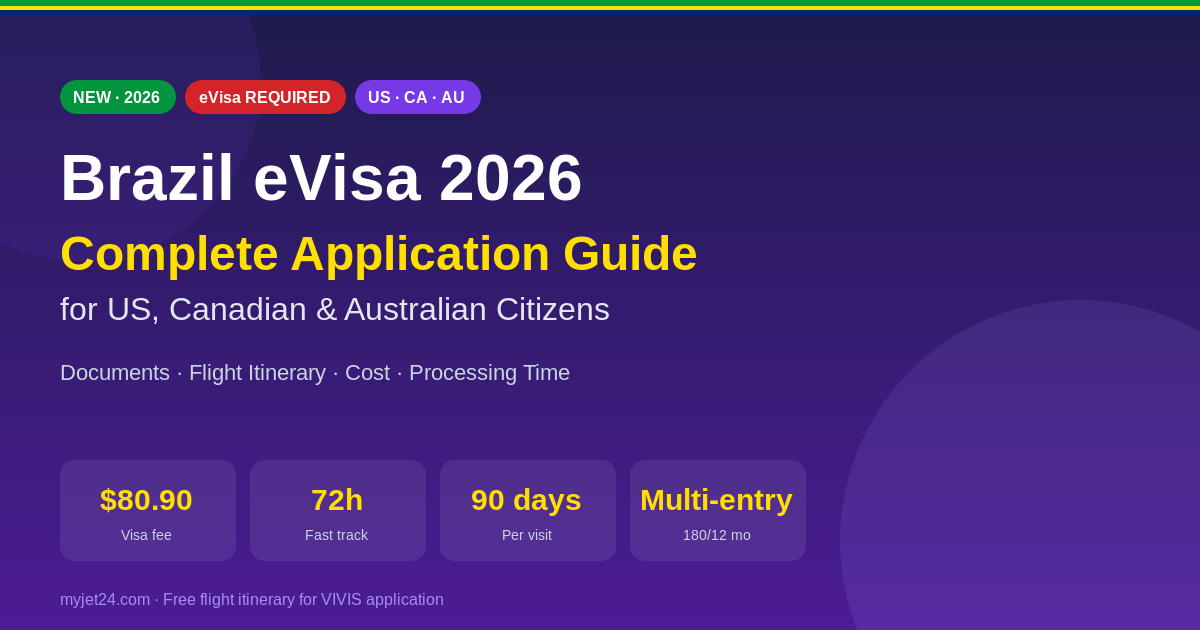
As of 1 January 2026, citizens of the United States, Canada, Australia, Mexico, France and Argentina need an electronic visa to enter Brazil. The visa-free policy that ran from 2019 to 2024 is over. Here is exactly how the Brazil eVisa works in 2026 — what it costs, what documents you need, how the round-trip flight itinerary requirement actually works, and the real timeline from application to approval.
TL;DR — Brazil eVisa 2026 in 5 bullets
- Cost: $80.90 USD — non-refundable, applied entirely online via the official VIVIS portal
- Validity: multi-entry, 90 days per visit, 180 days within any 12-month period
- Processing: 72 hours fast-track or up to 10 business days standard
- Round-trip flight itinerary required — name must match passport, dates must align with stated travel
- Most common rejection cause: photo with wrong background colour, followed by mismatched flight dates
Quick answer: US, Canadian and Australian citizens travelling to Brazil in 2026 must obtain a tourist eVisa before boarding. Apply online at brazil.vfsevisa.com, pay the $80.90 fee, upload a passport scan, a compliant photo, a round-trip flight itinerary with your full name, accommodation proof, and a bank statement showing approximately $2,000 for a 90-day stay. Decisions arrive within 72 hours to 10 business days. The visa allows multiple entries and 90 days per visit within a 180-day rolling window.
On this page
- Why did Brazil reintroduce the visa requirement?
- Who needs the Brazil eVisa in 2026
- The 6 documents you must submit
- The flight itinerary requirement explained
- How to apply step-by-step
- Cost breakdown and what's refundable
- Realistic processing timeline
- Why eVisa applications get rejected
- Multi-entry rules and the 180/12 calculation
- FAQ — 10 questions answered
Why Did Brazil Reintroduce the Visa Requirement?
Brazil's eVisa requirement is a reciprocity measure. In 2019, Brazil unilaterally waived visas for US, Canadian, Australian and Japanese passport holders to boost tourism. The expectation — never written into a binding agreement — was that those countries would reciprocate by easing entry for Brazilian citizens. None of them did.
By April 2025, with reciprocity still not granted, Itamaraty (Brazil's Ministry of Foreign Affairs) reactivated the visa requirement. The launch was originally scheduled for January 2024, then pushed to April 2024, then to April 2025, and finally activated on 10 April 2025. Full enforcement at all entry points — air, sea and land — began on 1 January 2026. Since that date, every traveller from the affected nationalities must show a valid eVisa before boarding a flight or vessel bound for Brazil.
The shift from sticker visa to fully digital eVisa is the bigger structural change. There is no more paperwork at consulates, no in-person interviews, and no passport mailing. The entire process happens at brazil.vfsevisa.com, the portal operated under contract with VFS Global on behalf of the Brazilian government.
Who Needs the Brazil eVisa in 2026?
The eVisa applies to citizens of countries that require Brazilian nationals to obtain a visa for short stays. As of April 2026, this list includes:
- United States — all passport holders, including dual nationals
- Canada — Canadian passport required for application
- Australia — applies to all Australian passport holders
- Mexico — added to the list in the 2025 reactivation
- France — included for reciprocity reasons related to French overseas territories
- Argentina — added in 2025
European Union citizens (other than France), United Kingdom passport holders, and most of the rest of Latin America continue to enter visa-free for stays up to 90 days. Japanese citizens were also affected by the original 2025 reactivation announcement but obtained a bilateral exemption in late 2025 and currently do not need an eVisa for tourism.
"The reciprocity principle is one of the foundations of Brazilian visa policy. We require visas from citizens of countries that require visas from us." — Brazilian Ministry of Foreign Affairs (Itamaraty), policy statement on the 2025 visa reactivation.
The 6 Documents You Must Submit
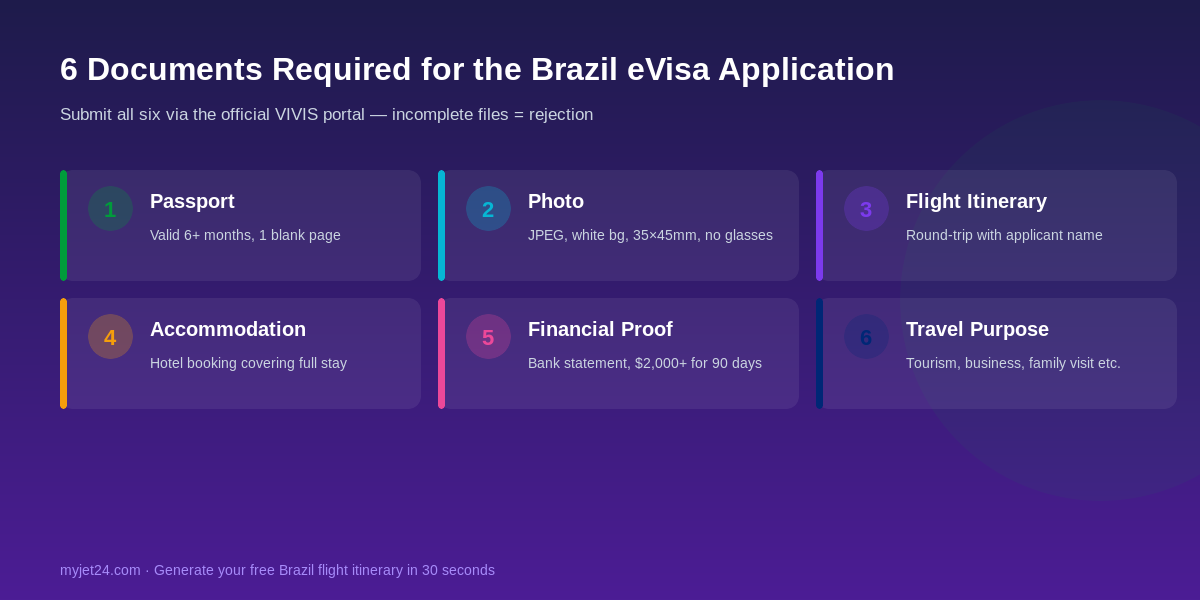
The eVisa application requires six items uploaded as digital files. Submitting an incomplete application is the fastest way to a rejection — VFS reviewers do not chase missing files; they refuse and you must reapply.
1. Passport scan
Colour scan of the bio-page. The passport must be valid for at least 6 months beyond your planned date of departure from Brazil and contain at least one blank visa page. Damaged, water-stained or heavily annotated passports are flagged for additional review.
2. Digital photograph
JPEG format, 35×45mm, white background, face occupying 70–80% of the frame, neutral expression, no glasses, taken within the last 6 months. Wrong background colour is the single most common rejection cause — a beige wall or off-white sheet does not pass automated photo checks. Use a true white backdrop or a passport photo service.
3. Round-trip flight itinerary
A flight itinerary showing both your entry into and exit from Brazil. The applicant's full name (matching the passport exactly) must appear on the document. The itinerary must show specific dates that align with the travel period stated elsewhere in your application. See the dedicated section below on what counts as an acceptable itinerary.
4. Proof of accommodation
Hotel bookings, an Airbnb confirmation, or a notarised invitation letter from a Brazilian host covering your full stay. Reservations must be in your name and cover the entire period between entry and exit dates from your flight itinerary.
5. Proof of financial means
Bank statement from the last 3 months showing approximately $2,000 USD or equivalent for a 90-day stay — roughly $22/day implied threshold. Sponsorship letters from a Brazilian resident plus their proof of funds are accepted as an alternative for travellers with limited personal funds.
6. Travel purpose statement
A short written statement of your reason for visiting (tourism, business meetings, family visit, attending a wedding, conference attendance, etc.). This is filled into the online form, not uploaded as a separate file. Be specific — "tourism, visiting Rio de Janeiro and São Paulo" is better than "travel".
The Flight Itinerary Requirement Explained
The flight itinerary is where most applicants overspend unnecessarily. The Brazilian government does not require you to have purchased and paid for a real airline ticket before applying. What it requires is documentation of your planned travel — and a flight itinerary or reservation document satisfies this completely. This is the same standard used by Schengen countries, the UK, Canada and most major visa-issuing nations.
For the Brazil eVisa specifically, the itinerary must include:
- Your full name as it appears on your passport (no nicknames, no missing middle names)
- Outbound flight: airline, flight number, departure and arrival airports (IATA codes), date and time
- Return flight: same details for the journey out of Brazil
- A booking reference (PNR) — typically a 6-character alphanumeric code
- Travel dates that match the stay period stated in your application
You can generate a free dummy ticket meeting all of these requirements using a service like MyJet24's dummy ticket generator in 30 seconds. The PDF includes a realistic booking reference and is formatted to airline industry standards. Embassies, consulates and the VIVIS reviewer all evaluate the document for completeness and consistency — not whether a real seat exists in an airline's database.
One-way tickets and the Brazil eVisa
One-way tickets are not accepted for the eVisa application. The system explicitly asks for entry and exit dates, and the supporting flight document must show both segments. If you genuinely intend to travel onward by land (overland to Argentina, Uruguay or Bolivia), document the planned departure with a bus or train reservation showing the same exit date.
How to Apply Step-by-Step
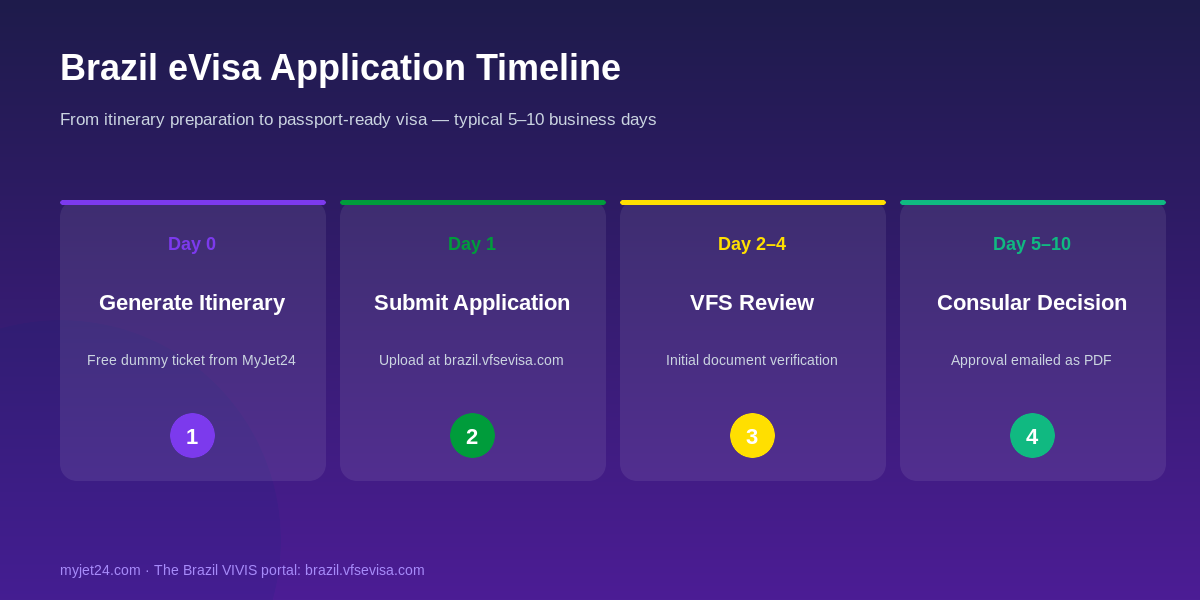
- Generate your flight itinerary first. A free dummy ticket with realistic dates lets you fill in the application form accurately. Trying to make up flight numbers and dates on the fly almost always produces inconsistencies that get flagged.
- Visit the official VIVIS portal at brazil.vfsevisa.com. Do not use third-party services that charge an additional handling fee — the official site is the only legitimate route.
- Create an account using your email. You'll receive a verification link; click it within 24 hours.
- Complete the application form — personal details, passport information, travel purpose, travel dates, accommodation address, point of entry into Brazil.
- Upload all six documents in the formats specified. Each file has a maximum size limit (typically 5MB) and must be JPEG or PDF.
- Pay the $80.90 fee via credit card. Payment is non-refundable regardless of the outcome.
- Submit and wait. You'll receive an automated confirmation email with your application number. Use this to track status.
- Receive the approved eVisa as a PDF. Save it on your phone and print a copy. You'll need to show it at airline check-in and at Brazilian immigration.
Cost Breakdown and What's Refundable
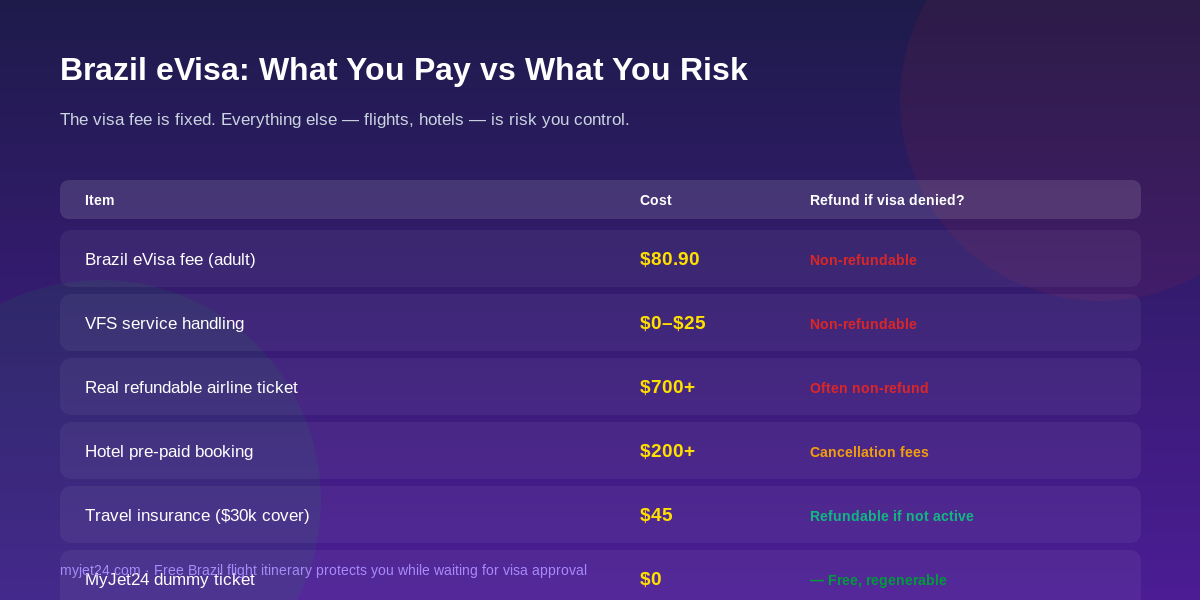
The visa fee itself is fixed and non-refundable. The risk you can control is everything else — the flights and hotels you buy before knowing whether your visa will be approved.
| Item | Cost (USD) | Refundable if denied? |
|---|---|---|
| Brazil eVisa fee | $80.90 | No |
| Real refundable airline ticket | $700–$1,400 | Partially (fees apply) |
| Hotel pre-paid bookings | $200–$800 | Depends on policy |
| Travel insurance ($30k cover) | $45–$90 | Often refundable |
| MyJet24 dummy ticket | $0 | — (free) |
The math is straightforward. A real refundable ticket might cost $1,000 and tie up your money for 2–6 weeks while the visa is being processed. A free dummy ticket satisfies the application requirement at zero cost and zero risk. Once your eVisa is approved, you book the actual flights with full price comparison and your choice of fare class — the same approach we recommend for Schengen visa applications and almost every other tourist visa worldwide.
Realistic Processing Timeline
The official VIVIS portal lists processing times of "up to 10 business days" with an optional fast-track at 72 hours. In practice, what most US, Canadian and Australian applicants experience in 2026:
- Standard applications submitted Monday–Wednesday: approval within 3–5 business days for clean files
- Applications submitted Thursday–Friday: processing pauses for the weekend, typically 5–7 business days
- Applications during Brazilian holidays (Carnival in February/March, Independence Day in September, Christmas/New Year): expect 10+ business days
- Fast-track 72h option: additional handling fee, available only for fully complete files with no flagged items
The official guidance is to apply at least one month before your intended departure date. This buffer absorbs any request for additional documents (RFD), holiday-season slowdowns, or the need to reapply after a denial. For the same reason, timing your flight itinerary 1–3 days before submitting the application is the practical sweet spot — fresh enough that nothing looks stale, recent enough that any travel-date adjustments can still be reflected.
Why eVisa Applications Get Rejected
Based on aggregated 2025–2026 reporting from the VFS Global Brazil portal, the most common rejection causes are remarkably consistent. Eight in ten denials trace to one of the following:
- Photo background is not pure white. Beige walls, light-grey curtains, off-white sheets all fail the automated photo check. Cost of fix: a $5 photo at any drugstore or pharmacy.
- Name typos. A single missing accent, transposed letters, or initial used instead of full middle name will cause rejection. The form must mirror the passport bio page exactly.
- Flight itinerary missing the return segment. One-way itineraries are flagged automatically. If you genuinely plan to leave Brazil overland, document the bus or train reservation as the exit segment.
- Mismatched dates between flight, hotel, and stated travel period. If your flight shows entry 5 May and exit 25 May, but your hotel booking is 8 May to 22 May, reviewers flag this. Align all documents to the same dates.
- Insufficient bank statement balance. Files showing less than the implied $2,000-for-90-days threshold are denied unless a sponsorship letter compensates.
- Passport with less than 6 months remaining validity at the date of intended departure from Brazil. This is checked automatically against the passport scan.
- Previous Brazilian overstay or refusal. The system cross-references prior immigration records.
- Inconsistent travel purpose. Stating "tourism" but booking a one-way to a city with no tourist attractions raises questions.
If you receive a denial, you'll get a written reason. You can reapply immediately on the same portal — there is no formal waiting period — but you'll need to fix the cited issue and pay the $80.90 fee again. For more detailed guidance on what happens after a refusal, see our visa refusal recovery guide.
Multi-Entry Rules and the 180/12 Calculation
The Brazil eVisa is multi-entry by default. Once issued, you can enter and exit Brazil multiple times during the visa's validity period. The constraint is on cumulative time:
- Maximum 90 days per single visit — you must leave Brazil before the 90-day mark
- Maximum 180 days within any rolling 12-month period — measured from any given date looking back one year
- The visa itself is typically valid for 10 years from the date of issue (matching the maximum US passport validity)
The 180/12 rolling rule is identical to the Schengen 90/180 mechanic but with longer windows. If you stay 90 days, leave for any length of time, then return, the second visit can also be up to 90 days as long as the cumulative time across the previous 12 months doesn't exceed 180.
For digital nomads and frequent visitors to South America, the 10-year multi-entry validity makes the $80.90 fee an excellent value — work it out per visit and the cost approaches zero across multiple trips.
FAQ — Brazil eVisa 2026
Do US citizens really need a visa for Brazil in 2026?
Yes. As of 1 January 2026, US passport holders must obtain an eVisa before travelling to Brazil. The visa-free policy that ran from 2019 to early 2025 has ended. Apply online at brazil.vfsevisa.com.
How much is the Brazil eVisa for Americans?
The Brazil eVisa costs $80.90 USD for US citizens, applied online via the official VIVIS portal. The fee is non-refundable regardless of the application outcome. There is no separate consular handling fee for the standard online application.
How long does the Brazil eVisa take to process?
Most applications are decided within 3–5 business days. The official maximum is 10 business days for standard applications, with a 72-hour fast-track available for an additional fee. Apply at least one month before your travel date to absorb any delays.
Is the Brazil eVisa valid for multiple entries?
Yes. The eVisa is multi-entry by default and typically valid for 10 years (or until your passport expires). You can stay up to 90 days per visit, with a maximum of 180 days in any rolling 12-month period.
Can I enter Brazil with a one-way ticket on an eVisa?
The eVisa application requires you to show evidence of onward or return travel. A one-way airline ticket alone is not accepted — you must either provide a round-trip flight itinerary or document an onward overland departure (bus, train) with the same exit date stated elsewhere in the application.
Why did my Brazil eVisa get denied?
The most common rejection causes are non-compliant photos (wrong background colour), name typos that don't match the passport exactly, missing return flight in the itinerary, mismatched dates between flight and hotel bookings, and insufficient bank statement balance. You can reapply immediately after fixing the issue and paying the $80.90 fee again.
Do I need to buy a real flight ticket before applying for the Brazil eVisa?
No. The application requires a flight itinerary showing your planned travel — not a paid airline ticket. Embassies and the VIVIS portal explicitly accept reservations and itinerary documents. Buying a real ticket before approval creates unnecessary financial risk if the visa is denied. A free dummy ticket from MyJet24 satisfies the requirement at zero cost.
Can Canadian and Australian citizens use the same Brazil eVisa system?
Yes. The Brazil eVisa applies equally to citizens of the United States, Canada, Australia, Mexico, France and Argentina. The application process, documents required, fee, and validity rules are identical regardless of nationality. Apply at the same brazil.vfsevisa.com portal.
What is the Brazil VIVIS visa?
VIVIS stands for "Visto de Visita" (Visitor Visa) and is the umbrella category for short-term visits to Brazil — tourism, business meetings, family visits, conferences, short courses, sports events, journalism. The eVisa for tourist purposes falls under the VIVIS category.
Can I work in Brazil on the eVisa?
No. The VIVIS tourist eVisa explicitly does not permit paid employment in Brazil. Remote work for a non-Brazilian employer falls into a grey area — most travellers do this without issue, but Brazil's digital nomad visa is the formal route for stays exceeding 90 days that involve remote work.
Conclusion — The Smart Order of Steps
The most expensive mistake you can make with the Brazil eVisa is buying a real flight ticket before your visa is approved. The visa fee is $80.90; a real round-trip ticket is typically $700+. If your application is denied or delayed past your intended travel date, you eat the cost of any non-refundable bookings on top of the $80.90.
The smart sequence is: generate a free flight itinerary, submit the eVisa application, wait for approval, then book the actual flights and hotels. This is the same approach official Brazilian, Schengen, Canadian and most major visa authorities recommend. It protects your money, gives you flexibility on travel dates after approval, and lets you compare fares with the visa already in hand.
Generate your free Brazil flight itinerary in 30 seconds
Round-trip PDF with realistic booking reference. Accepted by VIVIS. No credit card.
Generate Free Flight Itinerary →Related Reading on MyJet24
- Free Dummy Ticket Generator — main hub
- Schengen Visa Dummy Ticket Guide
- Proof of Onward Travel — Country Requirements
- Dummy Ticket vs Refundable Flight: Cost & Risk Comparison
- Visa Refused: What Happens Next & How to Recover
Sources & Official References
- Official Brazil eVisa Portal — brazil.vfsevisa.com (operated by VFS Global on behalf of Itamaraty)
- U.S. Embassy & Consulates in Brazil — visa information
- U.S. Department of State — Brazil International Travel Information
- Itamaraty (Ministry of Foreign Affairs of Brazil) — official policy statements on the 2025 visa reactivation
