
Update — 13 July 2026
The Financial Times reports the ETIAS launch is slipping to 2027 after the EES rollout’s border problems; the EU’s official site still lists Q4 2026 and no postponement has been formally confirmed. Full breakdown in our ETIAS delay explainer.
Quick answer
ETIAS and EES are two different European border systems launching in 2026 — they are not the same thing. EES (the Entry/Exit System) is an automated border-control database that registers every non-EU traveller’s entry and exit using biometrics (a facial image and fingerprints); it is free, done for you at the border, and replaces passport stamping. ETIAS (the European Travel Information and Authorisation System) is a pre-travel authorisation that visa-exempt visitors apply for online before they fly; it costs €20 and is valid for three years. The EES went fully operational on 10 April 2026; ETIAS follows in the last quarter of 2026. Most visa-exempt tourists — from the US, UK, Canada and Australia — will need both, and neither one removes the airline’s requirement to show a return or onward ticket at check-in.
If you are planning a trip to Europe in 2026, you have probably seen two unfamiliar acronyms attached to the news: ETIAS and EES. They sound interchangeable, travel forums treat them as the same announcement, and even airline staff occasionally blur the two. They are not the same. They are run by different people, cost different amounts, happen at different moments in your journey, and answer different questions. Confusing them is the single most common 2026 travel-prep mistake — and it can cost you a boarding denial.
This guide settles the difference in plain language: what each system is, who is affected, what it costs, when it starts, and exactly how the two work together when you reach a European airport.
ETIAS vs EES: The One-Sentence Difference
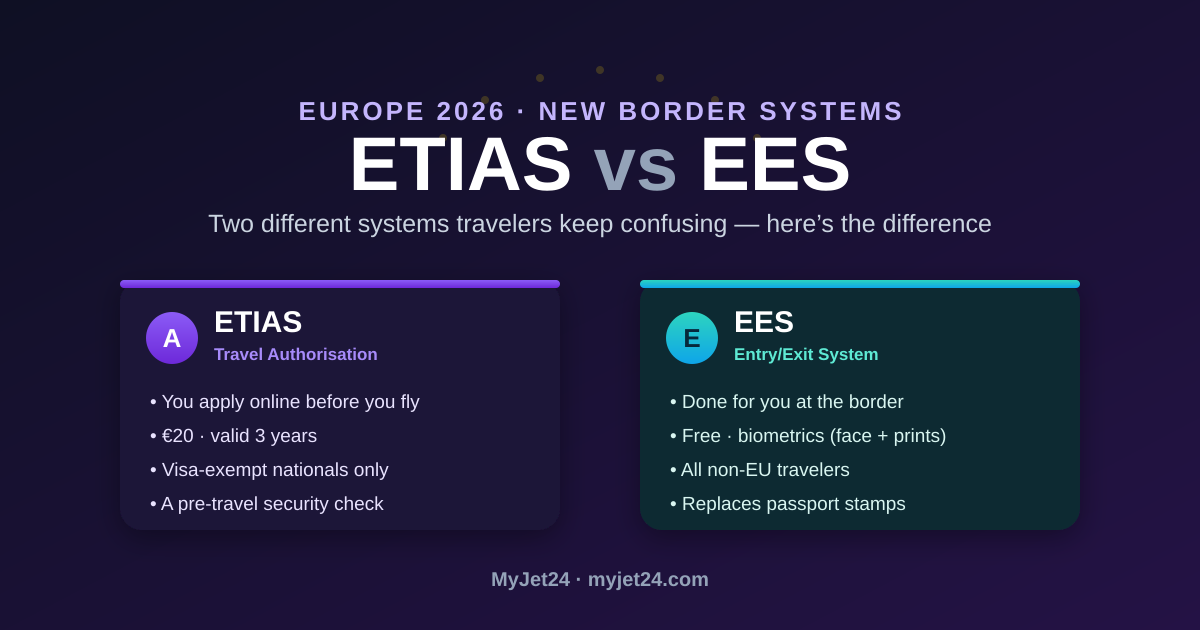
Here is the distinction in one line: EES records the fact that you crossed the border; ETIAS gives you permission to travel to the border in the first place.
EES is a registration system operated by the border authorities — you do nothing in advance and pay nothing; you simply appear at the border and your biometrics are captured. ETIAS is an authorisation you, the traveller, obtain yourself online before departure, for a €20 fee. One is a security pre-check tied to your passport; the other is a digital logbook tied to your physical crossing.
What ETIAS Is
ETIAS is a mandatory online travel authorisation for visa-exempt nationals visiting the Schengen Area and associated European countries. The name stands for the European Travel Information and Authorisation System. It is not a visa — it is a pre-travel screening check, conceptually identical to the United States ESTA or the United Kingdom ETA. You answer security and background questions on the official website, pay the fee, and receive an electronic authorisation linked to your passport.
Key facts about ETIAS:
- Who needs it: citizens of roughly 60 visa-exempt countries — including the US, UK, Canada, Australia, Japan and Brazil.
- Cost: €20 per application, free for applicants under 18 or over 70.
- Validity: three years, or until your passport expires — whichever comes first.
- Coverage: around 30 European countries.
- Processing: most approvals arrive within minutes, but allow up to 30 days in case of additional checks.
For the full step-by-step application, eligibility list and document requirements, see our dedicated ETIAS 2026 complete guide.
What the EES Is
The EES is an automated IT system that registers non-EU travellers each time they enter or exit the Schengen Area for a short stay. EES stands for Entry/Exit System. It replaces the manual stamping of passports with a digital record that captures your name, travel-document data, the date and place of every entry and exit, and your biometrics — a facial image and four fingerprints.
Crucially, you do not apply for the EES. There is no website, no form, and no fee. The registration happens at the border on your first crossing after the system goes live; on later trips, the process is faster because your biometrics are already on file. The system also automatically calculates your 90-days-in-any-180-days allowance, so overstays are flagged instantly.
The EES applies to all non-EU travellers for short stays — both those who need a Schengen visa and those who are visa-exempt. For real traveller reports on biometric enrolment and airport wait times, read our EES live-experience report, and for the documentation impact see how the EES changes your travel documentation.
ETIAS vs EES: Full Comparison
The table below sets the two systems against each other on every attribute travellers ask about.
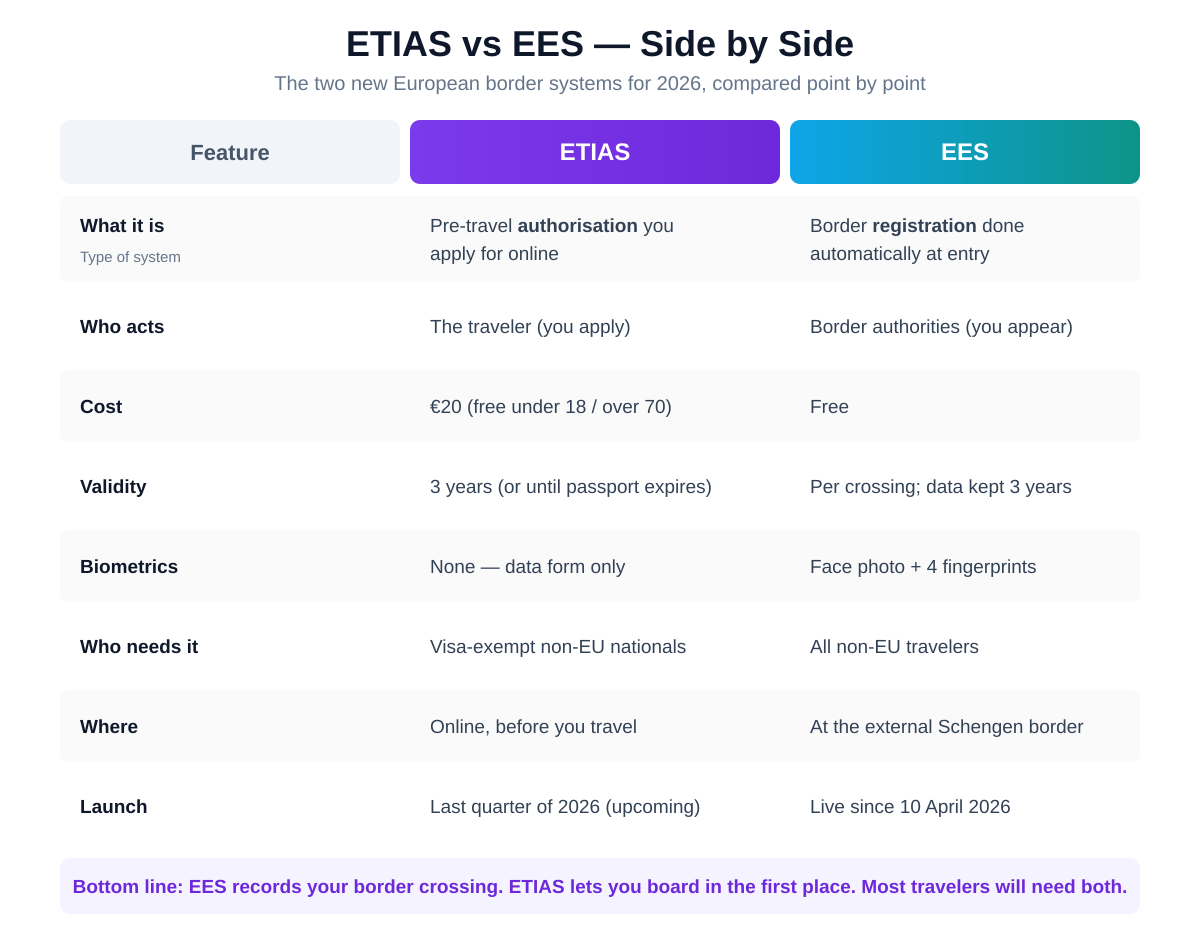
| Feature | ETIAS | EES |
|---|---|---|
| What it is | A pre-travel authorisation you apply for | A border registration done automatically |
| Who acts | The traveller (you apply online) | Border authorities (you just appear) |
| Cost | €20 (free under 18 / over 70) | Free |
| Validity | 3 years (or until passport expires) | Per crossing; data retained ~3 years |
| Biometrics | None — questionnaire only | Facial image + 4 fingerprints |
| Who needs it | Visa-exempt non-EU nationals | All non-EU travellers (short stay) |
| Where it happens | Online, before you travel | At the external Schengen border |
| Launch | Last quarter of 2026 (upcoming) | Live since 10 April 2026 |
“EES records your border crossing. ETIAS lets you board the plane in the first place. They are sequential checkpoints in one journey — not alternatives.”
Do You Need ETIAS, EES, or Both?
Your situation decides which systems apply. Use the decision path below.
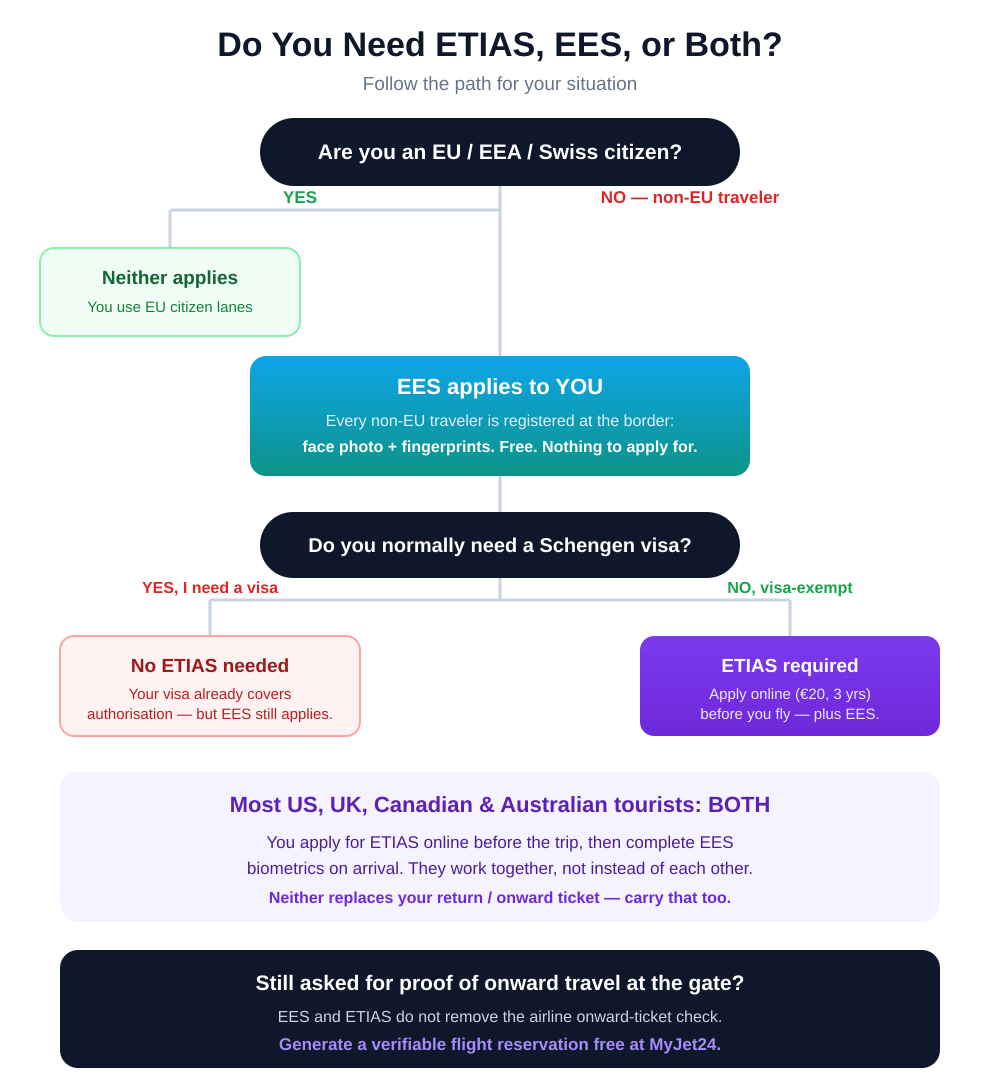
- EU, EEA or Swiss citizens: neither system applies — you use the EU citizen lanes.
- Visa-exempt non-EU travellers (US, UK, Canada, Australia, etc.): you need both — ETIAS before you fly, EES on arrival.
- Travellers who already require a Schengen visa: you do not need ETIAS (your visa covers authorisation), but EES still applies to you at the border.
When Do ETIAS and EES Launch?
The EES is already live; ETIAS follows in the last quarter of 2026. The Entry/Exit System reached full operation on 10 April 2026, so non-EU travellers crossing a European border today are already being registered biometrically. ETIAS then begins later in 2026 with a transitional period — during which travellers are strongly encouraged, but not yet refused entry, for not holding an authorisation — before it becomes strictly mandatory after a grace period.
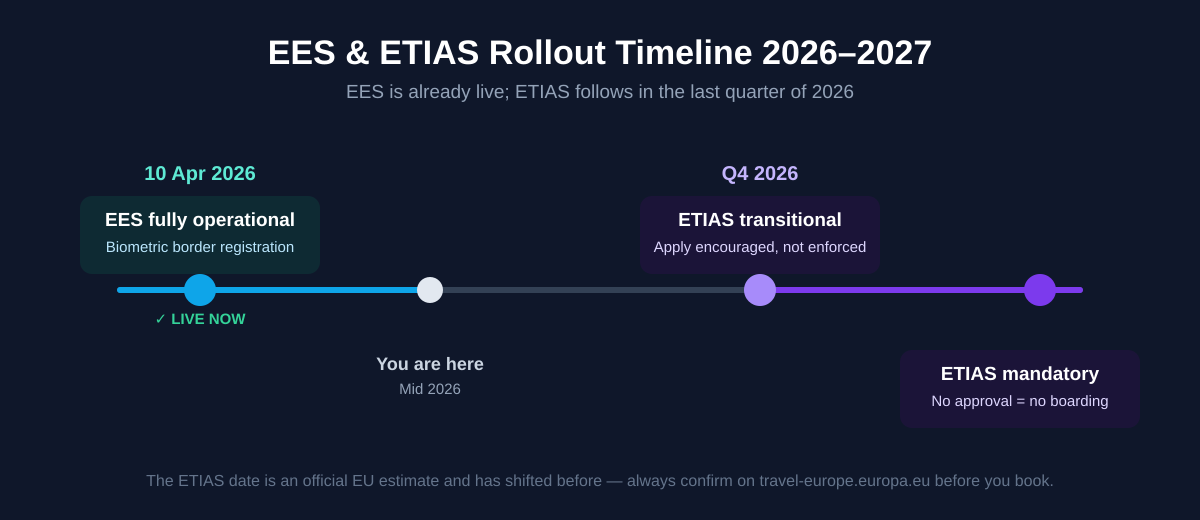
The ETIAS start date remains an official EU estimate and has been postponed several times in the past. Always confirm the current status on the official EU travel website before you book non-refundable travel.
How ETIAS and EES Work Together at the Airport
For a visa-exempt tourist, a single Europe trip in 2026 will touch both systems in this order:
- Before the trip — apply for ETIAS. Complete the online form, pay €20, and wait for approval (usually minutes). Do this well before booking deadlines in case of delays.
- At check-in — show proof of onward travel. The airline still verifies that you hold a valid ETIAS and a return or onward ticket before letting you board. Neither EES nor ETIAS removes this airline check.
- On arrival — complete EES registration. At the border, a kiosk or officer captures your facial image and fingerprints and logs your entry. First enrolment takes a few extra minutes; later trips are quicker.
- On departure — EES logs your exit. The system records when you leave and confirms you stayed within the 90/180-day limit.
What Neither System Replaces: Proof of Onward Travel
A dangerous assumption is that holding an ETIAS or being EES-registered means airlines will stop asking for a return ticket. They will not. The onward-travel requirement is an airline and immigration rule that exists independently of both systems. Carriers remain liable for passengers refused entry, so check-in agents continue to demand evidence of a planned departure within your permitted stay.
If you have not booked your return flight yet, a flight reservation (a verifiable PNR you do not have to pay full fare for) satisfies this check. See EES and proof of onward travel for Europe and our overview of proof of onward travel requirements for the full picture.
Need proof of onward travel for Europe?
Generate a verifiable flight reservation with a real PNR in about 30 seconds — free, with no account, accepted by airlines and EU border officers.
Create a free flight reservation →Common Mistakes Travelers Make Confusing ETIAS and EES
- “I registered for EES, so I’m done.” You cannot register for EES in advance — it only happens at the border. If you are visa-exempt, you still need to apply for ETIAS separately online.
- “ETIAS is a visa.” It is not. It is a security authorisation and does not grant the same rights or override the 90/180-day short-stay limit.
- “Either one lets me skip the return-ticket question.” Neither does. Proof of onward travel is a separate airline requirement.
- “Visa holders need ETIAS too.” No — if you already hold a Schengen visa, you skip ETIAS, but EES still records your crossing.
Conclusion
ETIAS and EES are complementary, not competing. EES is the automatic biometric logbook of who crosses the European border; ETIAS is the online permission visa-exempt travellers need to make that crossing. EES is free and unavoidable for every non-EU visitor; ETIAS costs €20 and applies only to visa-exempt nationals. EES launches first, ETIAS follows. Get your ETIAS early, expect a brief biometric enrolment on arrival, and — whatever the headlines say — keep a valid onward ticket in your travel folder, because no new European system has removed that requirement.
