
Last updated: June 30, 2026 · 13 min read
TL;DR
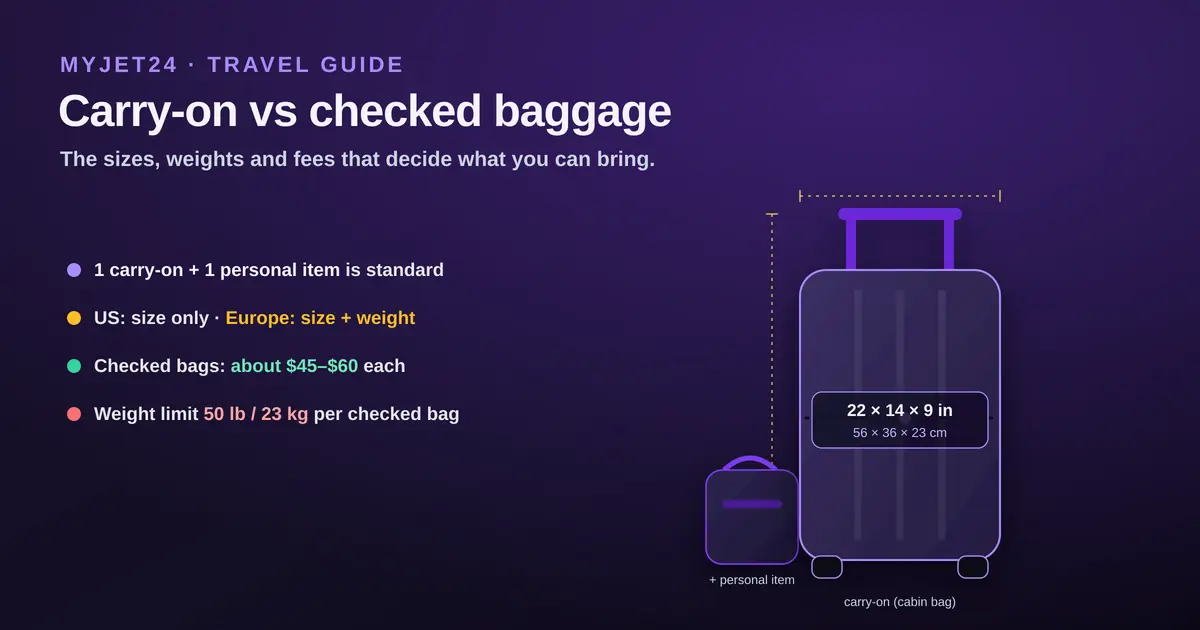
- You normally get one carry-on + one personal item free. A carry-on is about 22 × 14 × 9 in (56 × 36 × 23 cm); a personal item must fit under the seat.
- US airlines limit carry-ons by size only (no weight limit); European and low-cost carriers add a weight cap (typically 7–10 kg).
- Checked bags cost about $45–$60 each way on US domestic flights, with a 50 lb / 23 kg weight limit; going over triggers overweight and oversize surcharges.
- Liquids follow the 3-1-1 rule (containers ≤ 100 ml in one clear ~1 L bag). Power banks and spare lithium batteries must go in your carry-on, never checked.
- Watch basic economy: on some airlines (e.g. United) it's a personal item only, with no free carry-on.
Nothing turns a smooth departure into a stressful, expensive one faster than a baggage surprise at the gate. A bag that's an inch too big, a kilo too heavy, or a fare that quietly excludes your carry-on can cost you $50–$100 on the spot and a scramble to repack in front of a queue. The rules aren't complicated, but they differ sharply between US and European airlines and between fare types. This guide lays out exactly what you can bring, what it weighs, what it costs, and how to avoid paying more than you need to in 2026.
Quick answer
Most airlines let you bring one carry-on (about 22 × 14 × 9 in / 56 × 36 × 23 cm) and one personal item free. US carriers cap the carry-on by size only; European and budget airlines also cap the weight (often 7–10 kg). Checked bags cost roughly $45–$60 each way in the US, limited to 50 lb / 23 kg before overweight fees. Liquids must follow the 3-1-1 rule, and lithium batteries and power banks must travel in the cabin, not the hold.
On this page
- The three types of baggage
- Carry-on rules: size, weight & personal item
- Checked baggage: allowance, weight & fees
- Sports gear, instruments & special items
- Baggage rules by airline
- Liquids, batteries & what you can't pack
- What you can't bring at all
- The basic-economy carry-on trap
- How to avoid baggage fees
- If your bag is delayed or lost
- FAQ
The three types of baggage
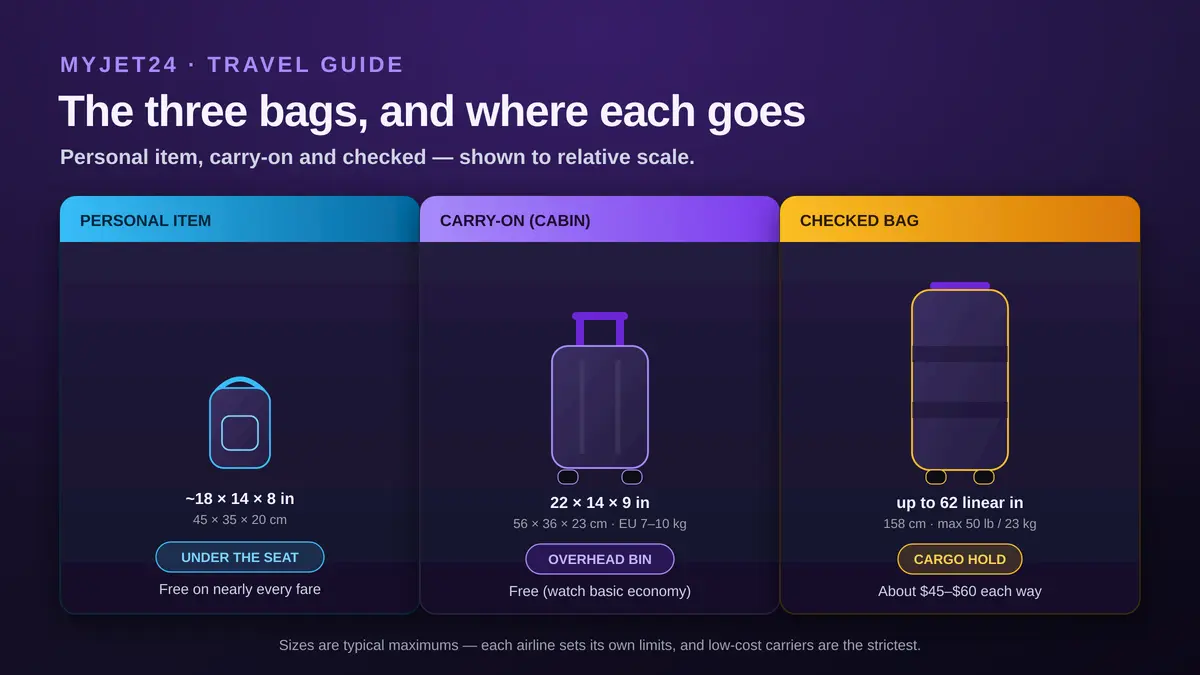
Almost every airline ticket is built around three categories of luggage, and knowing which is which is half the battle:
- Personal item: a small bag — handbag, laptop bag or small backpack — that fits under the seat in front of you. Almost always free.
- Carry-on (cabin bag): a larger bag that goes in the overhead bin. Free on most full-service fares, but size- and sometimes weight-limited.
- Checked baggage: larger cases that travel in the hold. Usually paid on short-haul and US domestic flights, often included on long-haul.
The image below shows the three side by side, to relative scale, with where each one travels. Getting this split right is the foundation of packing cheaply: the more you can move from the paid hold into the free cabin allowance, the less you spend — but only up to the point where your carry-on breaks a size or weight limit and gets charged anyway. The sweet spot for most short trips is a single well-packed carry-on plus a personal item, with nothing checked at all.
Carry-on rules: size, weight & personal item
The standard carry-on maximum on most airlines is 22 × 14 × 9 inches (56 × 36 × 23 cm), and crucially that measurement includes handles and wheels — the number printed on the bag by the maker is often the body only, which is how travellers get caught at the sizer. Your personal item is smaller and must slide under the seat; airlines like American quote around 18 × 14 × 8 in, United around 17 × 10 × 9 in.
The biggest source of confusion is weight, and here the world splits in two:
"The golden rule of hand luggage: American airlines care how big your bag is; European and budget airlines care how much it weighs."
On US carriers (American, Delta, United) there is no cabin weight limit in economy — if it fits the sizer and you can lift it into the bin, it flies. On European and low-cost carriers, a weight cap applies: Lufthansa allows 8 kg, easyJet up to 15 kg on its larger (paid) cabin bag, and Ryanair 10 kg only if you buy Priority. Miss that, and you pay at the gate.
Two practical points save grief. First, the metal bag sizer at the gate or check-in is the real test: if your bag doesn't drop in freely, it isn't a carry-on, however the label reads. Second, when the overhead bins fill on a busy flight, staff will gate-check the last carry-ons into the hold — usually free, but it means waiting at the carousel and losing access to anything you need in flight, so keep essentials in your personal item. Boarding earlier, or with a fare that boards earlier, makes gate-checking far less likely.
Checked baggage: allowance, weight & fees
Checked bags are where the money is. On US domestic flights in 2026, expect to pay around $45 for the first bag and $55 for the second on Delta and United, and $50 / $60 on American (with a few dollars off if you pay online in advance). The standard weight limit is 50 lb (23 kg) per bag, and size is capped at 62 linear inches (158 cm) — that's length + width + height added together.
Go over and the surcharges bite: an overweight bag of 51–70 lb (23–32 kg) can cost $100 or more on top of the bag fee, and oversize is similar; many airlines simply refuse anything over 100 lb. The good news: on most long-haul international economy fares, at least one checked bag (usually 23 kg) is included in the ticket — so always check what your fare already covers before paying for more.
Beyond the first two bags, costs escalate fast. A third or fourth checked bag often runs $150–$200 each, which is where shipping heavy items separately can work out cheaper. Allowances also depend heavily on where you sit and how you earn: premium cabins and elite frequent-flyer status usually add free bags and higher weight limits, and the allowance on an international ticket can differ leg by leg if different airlines operate them. The rule is always to check the allowance attached to your fare and route rather than assuming a blanket number.
Sports gear, instruments & special items
Bulky and fragile items follow their own rules, and guessing is expensive. Sports equipment — skis, golf clubs, bicycles, surfboards — is usually accepted as checked baggage but may attract a special-handling or oversize fee, and some items must be booked in advance because hold space is limited. A bike often needs to be boxed; a surfboard has length limits. Musical instruments are a common headache: a violin or guitar can usually come into the cabin if it fits the overhead bin or you buy an extra seat for a cello, while larger instruments travel as checked or cargo. Strollers and car seats for families typically fly free and can be gate-checked right at the aircraft door. Mobility aids such as wheelchairs are carried free by law on most carriers and don't count against your allowance. For anything unusual, call the airline ahead: the fee and the packaging requirement are far cheaper to sort out before you reach the airport than at the desk.
Baggage rules by airline (2026)
Here is how the major carriers compare on the three numbers that matter most — carry-on size, cabin weight limit, and the first checked-bag fee.
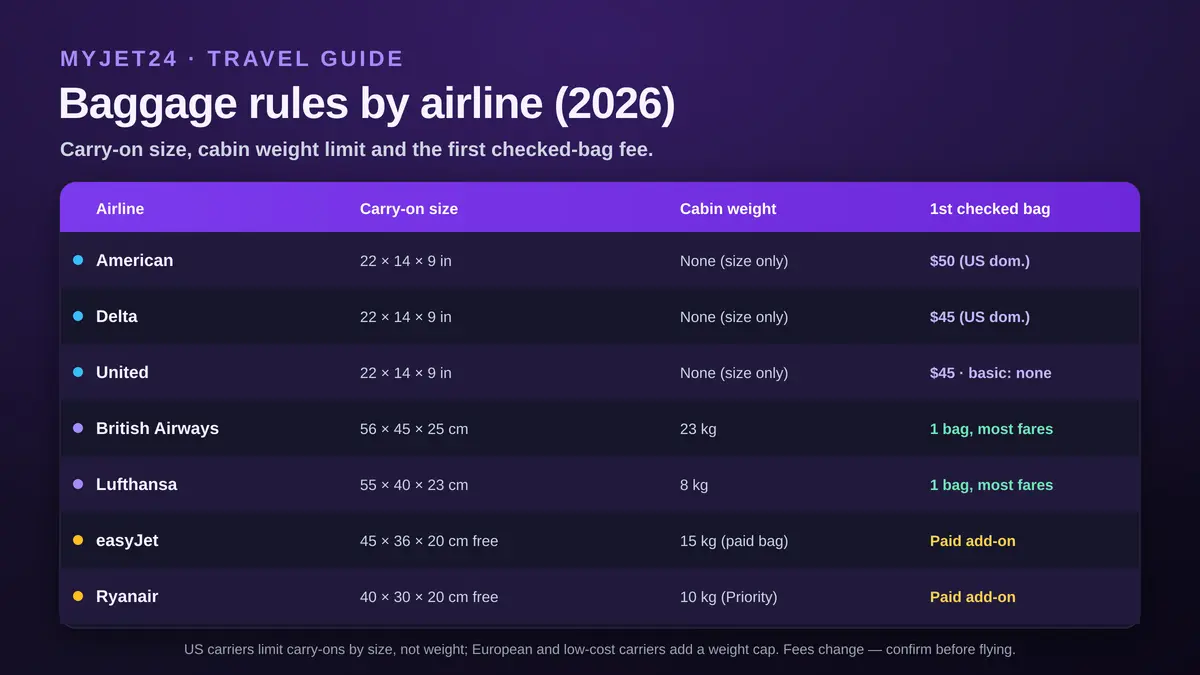
| Airline | Carry-on size | Cabin weight | 1st checked bag |
|---|---|---|---|
| American | 22 × 14 × 9 in | None (size only) | $50 (US dom.) |
| Delta | 22 × 14 × 9 in | None (size only) | $45 (US dom.) |
| United | 22 × 14 × 9 in | None (size only) | $45 · basic: none |
| British Airways | 56 × 45 × 25 cm | 23 kg | 1 bag on most fares |
| Lufthansa | 55 × 40 × 23 cm | 8 kg | 1 bag on most fares |
| easyJet | 45 × 36 × 20 cm free | 15 kg (paid bag) | Paid add-on |
| Ryanair | 40 × 30 × 20 cm free | 10 kg (Priority) | Paid add-on |
Fees change frequently and vary by route, so treat these as a guide and confirm on the airline's site before you fly. The pattern to remember: US legacy carriers are generous on carry-on weight but charge for checked bags domestically, while European budget carriers give you a tiny free bag and charge for almost everything else.
Liquids, batteries & what you can't pack
Security rules trip up even seasoned travellers. Liquids in your carry-on follow the 3-1-1 rule: containers of 3.4 oz (100 ml) or less, together in one clear resealable bag of about a quart (1 litre), one bag per passenger. Anything larger goes in checked luggage. A handful of airports with new CT scanners have relaxed the 100 ml limit, but it still applies almost everywhere, so pack to the 3-1-1 standard by default. Genuine exceptions exist for essential medication and for baby milk or food when you're travelling with an infant — these may exceed 100 ml but must be declared for separate screening. Duty-free liquids bought after security are allowed provided they stay sealed in the tamper-evident bag with the receipt inside, though a connecting flight in some countries can complicate that, so keep the receipt handy.
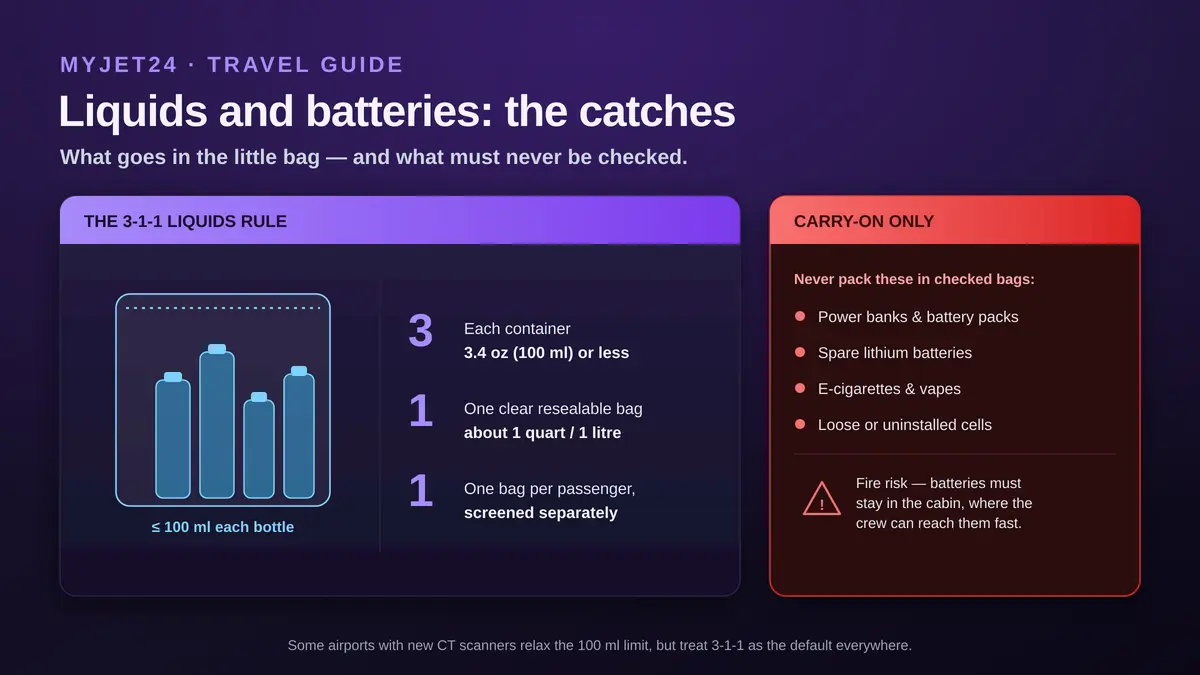
The counterintuitive rule that catches the most people concerns batteries. Because of fire risk, power banks, spare lithium batteries, e-cigarettes and loose cells must travel in the cabin — never in a checked bag — so that crew can respond immediately if one overheats.
"Never check a power bank. Spare lithium batteries belong in the cabin, where a crew member can act if one overheats."
Also stay in your carry-on: essential medication, valuables, travel documents and anything you can't bear to lose. For the definitive, item-by-item list, the TSA “What can I bring?” tool is the authority for US flights.
What you can't bring at all
Some things are barred from the cabin, the hold, or both — and the split isn't always intuitive. In your carry-on, security removes sharp objects (knives, blades, large scissors), most tools over about 7 inches, and any liquid over 100 ml; these can generally go in checked bags instead. In your checked bag, the ban runs the other way: power banks, spare lithium batteries, e-cigarettes and vapes are forbidden and must be in the cabin. A few things are banned from both: flammable gases and liquids, fireworks, strike-anywhere matches, bleach and most self-defence sprays. Firearms and ammunition are heavily restricted and must be declared and packed to strict rules. Because lists differ by country and airline, check the official source for your route before you pack — the TSA tool covers US departures, and your airline's dangerous-goods page covers the rest.
The basic-economy carry-on trap
The single most expensive mistake in 2026 is assuming your fare includes a carry-on. On basic economy, that's not always true. United basic economy allows a personal item only — no full carry-on — on most routes (transatlantic is an exception), and turning up with a cabin bag means paying a gate fee that's higher than pre-paying. Delta and American currently still include a carry-on on basic economy, and European budget carriers like Ryanair and easyJet give you only a small under-seat bag unless you pay up. The rule: read exactly what your specific fare includes before booking, because the cheapest headline price often isn't the cheapest once a bag is added. If you're weighing fare types, our guide on how airfares are structured helps you compare like for like.
How to avoid baggage fees
A few habits keep more money in your pocket:
- Travel carry-on only. On a full-service fare, one carry-on plus a personal item is free — enough for a week if you pack well.
- Weigh and measure at home. A cheap luggage scale and a tape measure beat a surprise overweight fee; remember the airline measures with wheels and handles.
- Pre-pay checked bags online. Airport and gate bag fees are almost always higher than paying during booking or check-in.
- Use a fare or card that includes a bag. Long-haul fares often include one; some airline credit cards give a free checked bag that pays for itself in a round trip.
- Wear your heaviest items. Coats and boots on your body don't count against your allowance.
- Share or split an allowance. Travelling with others? Pool into one well-packed checked bag where a shared allowance is offered, or move weight between bags so none tips into the overweight band.
Finally, do the maths on the whole trip, not the headline fare. A ticket that's $30 cheaper but adds $50 each way for a bag you need is $70 more expensive in reality. Add up the fare plus the bags you'll actually carry, in both directions, and compare that total across airlines — it's the only number that tells you which flight is genuinely the cheapest.
Booking a trip that needs travel proof?
If a visa application or border check needs a confirmed flight reservation or proof of onward travel, generate a verifiable reservation with a real PNR in under a minute — from just $7.90, with no non-refundable fare to commit to.
Create a flight reservation →If your bag is delayed or lost
Even a perfectly packed checked bag can go astray. If yours is delayed, damaged or lost, you have real rights: report it at the airport before you leave, keep your bag tag and receipts, and claim — on international journeys the airline's liability is set by the Montreal Convention. We cover exactly what you're owed, and how to claim it, in our guide to lost and delayed baggage compensation. It's also why anything irreplaceable belongs in your carry-on, and why bags are safest checked through to your final destination on a single ticket rather than re-handled on separate bookings. If a wider disruption hits, see your flight delay rights too.
Conclusion & next steps
Baggage rules reward the prepared. Remember the three bag types and the standard carry-on size, check whether your airline limits cabin bags by size or weight, budget $45–$60 for each checked bag and keep it under 23 kg, follow 3-1-1 for liquids, and never check your batteries. Above all, read exactly what your fare includes before you book — especially on basic economy — because the cheapest ticket plus a surprise bag fee is rarely the cheapest trip. Measure at home, pre-pay online, and you'll walk past the gate desk instead of reaching for your wallet.
Frequently asked questions
What is the standard carry-on size?
On most airlines the carry-on maximum is 22 × 14 × 9 inches (56 × 36 × 23 cm), including handles and wheels. Low-cost carriers are often smaller — Ryanair's free bag is only 40 × 30 × 20 cm — so always check your specific airline, because the measurement includes the parts of the bag manufacturers often leave out.
How much does a checked bag cost in 2026?
On US domestic flights, roughly $45–$50 for the first bag and $55–$60 for the second, usually a little cheaper if pre-paid online. Bags must stay under 50 lb (23 kg) and 62 linear inches to avoid overweight or oversize surcharges. Many long-haul international fares include at least one checked bag free.
Last updated: June 30, 2026. General travel information, not airline policy advice — sizes, weights and fees vary by airline, route and fare, and change often, so always confirm directly with the carrier. Authoritative sources: TSA What can I bring?, American Airlines carry-on and Delta baggage overview.
Marc Hoffmann
Travel-documents specialist at MyJet24. Covers baggage rules, fares, passenger rights and the practicalities that keep trips cheap and smooth.
