
Last updated: June 4, 2026
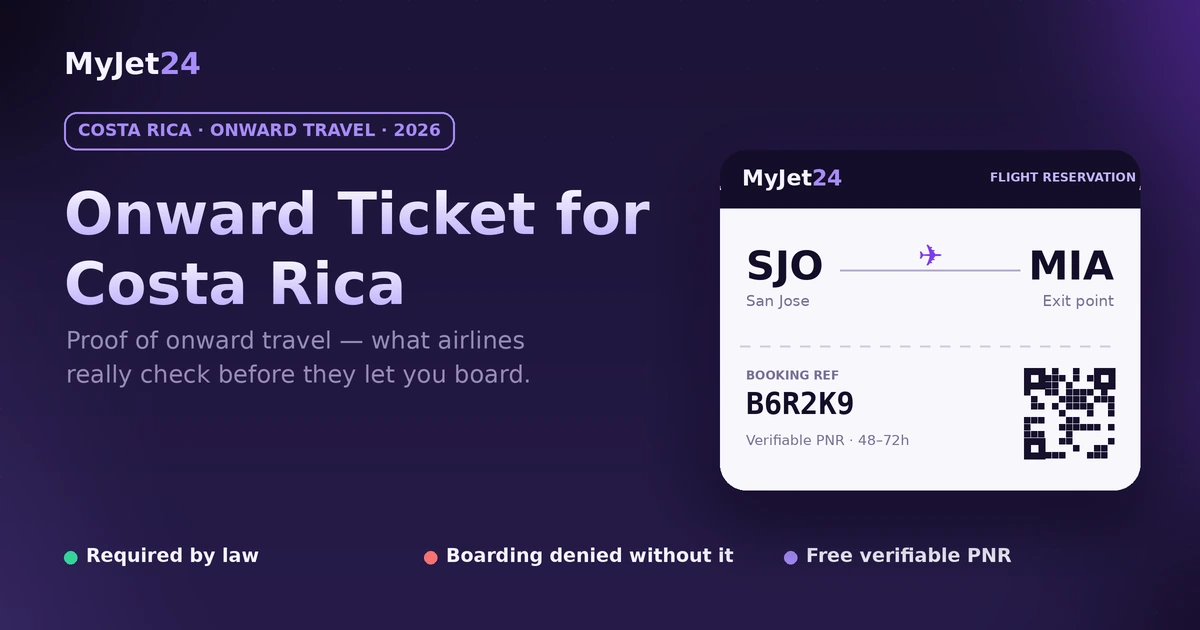
- Costa Rica legally requires proof of onward or return travel for visa-free visitors. It is an entry condition, not a suggestion.
- Airlines check it at the departure gate before you fly. Under IATA Timatic and carrier-liability rules, they can — and do — deny boarding without it.
- The rule is triggered if you hold a one-way ticket, a return dated more than your permitted stay, or you exit through a different country.
- Accepted proof: an onward flight, a return flight, a pre-purchased bus ticket (Tica Bus / TransNica), or a cruise booking.
- A dummy ticket satisfies check-in and immigration in 30 seconds — free with a booking reference, or verifiable with a real PNR via MyJet24 Premium ($7.90); no $300 refundable-flight gamble.
An onward ticket for Costa Rica is documented proof that you will leave the country before your permitted stay ends. Costa Rica admits most tourists visa-free, but both airlines and immigration officers require evidence of departure on entry. Without it, airline staff can refuse to board you and immigration can refuse entry. A confirmed onward flight, return flight, bus ticket, or verifiable flight reservation all qualify.
What an onward ticket means for Costa Rica
An onward ticket is a booking that shows your exit from Costa Rica on a specific date by an approved means of transport. Costa Rica's Dirección General de Migración y Extranjería (DGME) lists it among the documents a visa-exempt visitor must be able to present. The point is simple: Costa Rica grants you a tourist stay on the condition that you can prove you intend to leave within it.
This is different from a visa. Citizens of the United States, Canada, the UK, the EU, Australia, and dozens of other countries do not need a visa for tourism. What they do need is a passport valid for the duration of stay and credible proof of onward travel. The onward ticket is the document that closes the loop.
Proving you intend to leave is one of the most common stumbling blocks for travelers to Costa Rica — and it is enforced by both airlines and immigration, not one or the other.
Does Costa Rica actually require proof of onward travel?
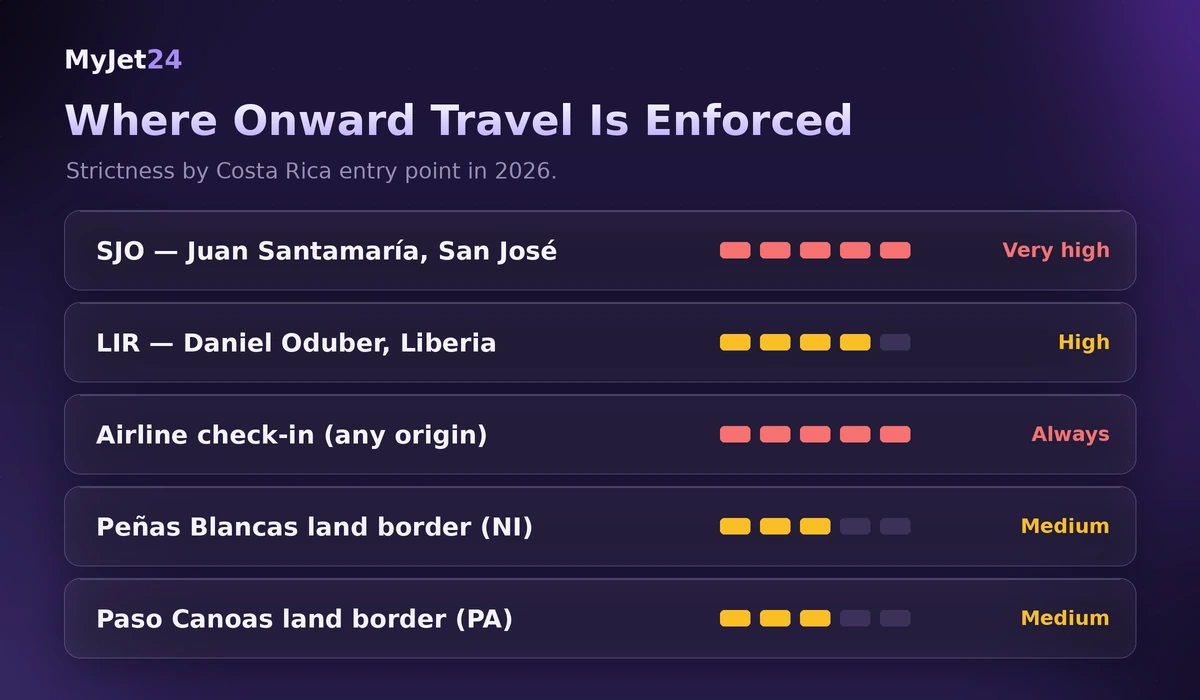
Yes. Proof of onward travel is a standing entry requirement for visa-free visitors to Costa Rica, published by the national tourism board and enforced under immigration law. It is not waived because you "look like a tourist." Officers at Juan Santamaría (SJO) and Daniel Oduber (LIR) airports routinely ask for it, and the absence of an exit booking is grounds to refuse entry.
Two separate bodies enforce the same rule at two different moments. The airline checks at check-in or the boarding gate in your departure country. Costa Rican immigration checks again on arrival. You can pass one and still be stopped by the other, so you need the document in hand for both.
When the onward ticket rule is triggered
The requirement bites in three common situations. If any one applies to you, expect to be asked for proof:
- You are flying on a one-way ticket. No return leg means no automatic proof of exit, so staff will ask for a separate onward booking.
- Your return is dated beyond your permitted stay. If your return flight is more than your stamped period after arrival, it does not prove a lawful exit and may be rejected.
- You enter and leave through different countries. Flying into San José but planning to bus into Panama or Nicaragua counts as one-way for the inbound airline.
Round-trip travelers on a normal two-week holiday usually sail through, because the return leg is the proof. The travelers who get caught are backpackers, digital nomads, and one-way flyers.
Why airlines enforce it harder than immigration
Airlines enforce proof of onward travel because they carry the financial risk, not you. Under IATA Timatic — the travel-document database every check-in agent queries — Costa Rica is flagged as requiring onward travel. If an airline boards a passenger who is then refused entry, the carrier is legally responsible for flying that person back at its own expense, and may face fines.
That liability is why gate agents can seem stricter than immigration officers. The agent is protecting the airline's balance sheet. This is the same mechanism we break down in our guide to whether airlines can deny boarding without proof of onward travel. Understand it and the "random" enforcement stops looking random.
The 90 vs 180-day stamp trap
Costa Rica raised the maximum tourist stay for many nationalities to 180 days in September 2023, but the length you actually receive is at the officer's discretion. In practice, US citizens are frequently stamped for 90 days rather than 180. This matters for your onward ticket: the exit date on your proof must fall inside the period you are actually granted.
If you assume 180 days, book an exit on day 150, and the officer stamps you for 90, your "proof" now shows an unlawful overstay — and can be rejected. The safe play is to keep your onward booking within 90 days of arrival unless you have confirmed a longer stay. You can always extend plans later; you cannot un-ring a refused entry.
Accepted forms of proof, compared
Costa Rica accepts several forms of onward proof, and they are not equal in cost, risk, or convenience. Approved options include an onward flight, a return flight, a pre-purchased bus ticket out of the country, and cruise-ship documentation.
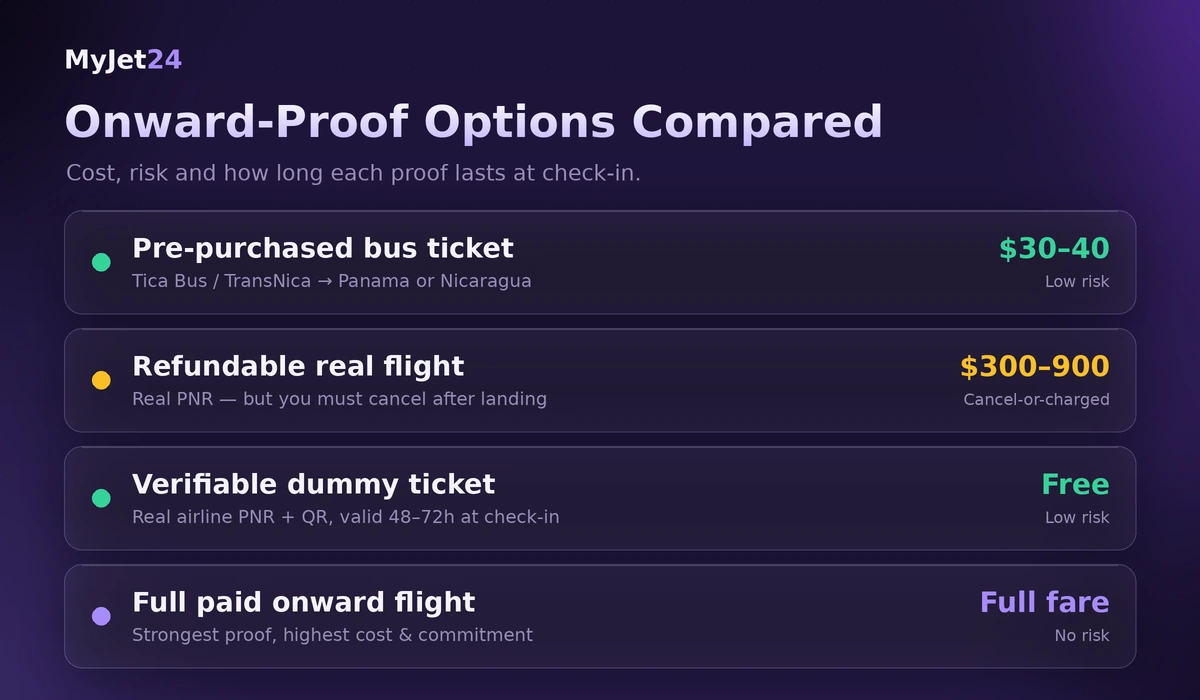
| Option | Cost | Risk | Best for |
|---|---|---|---|
| Pre-purchased bus ticket | $30–40 | Low | Backpackers exiting overland |
| Refundable real flight | $300–900 | Medium — must remember to cancel | Travelers who want a real seat held |
| Dummy ticket | Free (verifiable PNR: $7.90 Premium) | Low | One-way flyers, nomads, flexible plans |
| Full paid onward flight | Full fare | None | Fixed itineraries |
The bus-ticket workaround (and its limits)
A pre-purchased bus ticket out of Costa Rica is a legitimate, cheap form of onward proof. Cross-border operators such as Tica Bus and TransNica sell online tickets from San José to Granada or Managua in Nicaragua, and to Panama City or David in Panama, typically for under $40. The booking confirmation is accepted at check-in and immigration.
The limit is timing and flexibility. A bus ticket locks you to a route and date, refunds are awkward, and a printed bus confirmation occasionally draws more questions from an inbound airline agent than a flight PNR does. If your plans are fixed and overland, it is excellent value. If they are not, a verifiable flight reservation is faster and more flexible.
How to get a free or verifiable onward ticket in 30 seconds
A dummy ticket — also called a flight reservation or onward ticket — is, with MyJet24 Premium ($7.90), a real, verifiable booking with a genuine PNR that you can show as proof without buying a full fare. It is the cleanest answer to Costa Rica's requirement for travelers with flexible plans.
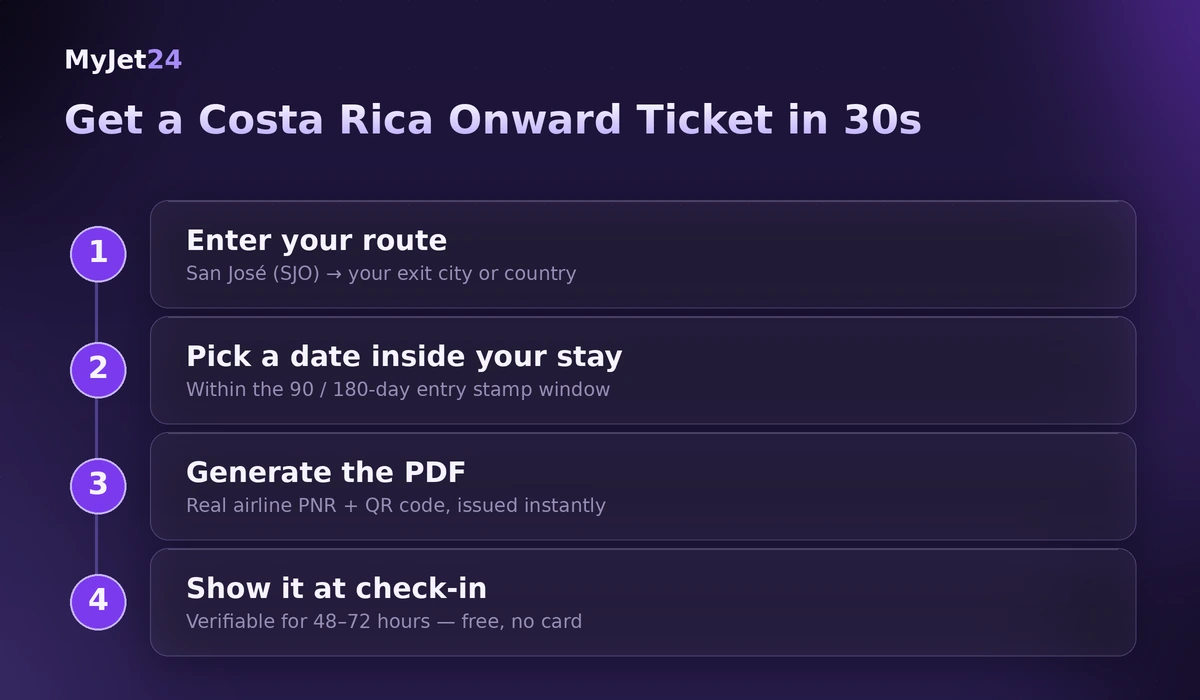
- Enter your route. Set San José (SJO) or Liberia (LIR) as the origin and your exit city or country as the destination.
- Pick a date inside your stay. Choose a departure that falls within the 90 (or 180) days you expect to be granted.
- Generate the PDF. You get a booking reference, flight numbers, and a scannable QR code, issued instantly — a real airline PNR with Premium ($7.90).
- Show it at check-in and immigration. With Premium, the reservation is verifiable for 24–72 hours — enough for both checks.
You can generate a free onward ticket here or use the full dummy ticket tool for round trips and extra documents. For the country-specific page, see onward ticket for Costa Rica.
A verifiable reservation answers the only question the gate agent is really asking: "If Costa Rica turns this passenger away, do we have proof they were leaving?"
Verify the PNR before you fly
A dummy ticket only works if the reservation is real and checkable. Before you travel, confirm the booking reference resolves in the airline's or a global distribution system, and that the passenger name matches your passport exactly. We walk through this in how to verify your dummy ticket PNR. A reservation that cannot be looked up is worse than none, because it invites scrutiny.
Is using a dummy ticket for Costa Rica legal?
Using a verifiable flight reservation as proof of onward travel is legal. You are showing a genuine booking that exists in an airline system; you are not altering a document. Embassies and immigration authorities worldwide accept flight reservations precisely because travelers should not have to buy non-refundable tickets they may never use. The line you must not cross is inventing a confirmation or altering a PDF — that is fraud. For the full picture, read what a dummy ticket is.
Common Costa Rica onward-ticket mistakes
- Assuming visa-free means check-free. No visa still means you must prove exit.
- Booking an exit beyond your stamped stay. Keep it within 90 days unless a longer stay is confirmed.
- Relying on a screenshot. Carry a clean PDF with a referenceable PNR; phone-only displays are slower and can fail at a busy counter.
- Letting the reservation expire before travel. Time your generation so the PNR is live when you check in.
- Name mismatches. The reservation name must match your passport exactly.
Where Costa Rica checks, by entry point
Enforcement is consistent at the international airports and at airline check-in worldwide; it is lighter, but not absent, at land borders. San José (SJO) and Liberia (LIR) check on arrival. The inbound airline checks before you board, regardless of origin. At the Peñas Blancas (Nicaragua) and Paso Canoas (Panama) land crossings, officers may ask for onward proof and funds, though scrutiny varies by day and officer. Treat the document as mandatory everywhere and you will never be caught out.
Which nationalities still need a visa (and still need onward proof)
Costa Rica sorts the world into four immigration groups. Group 1 nationalities — including the United States, Canada, the UK, the EU/Schengen states, Australia, New Zealand, Japan, and South Korea — enter visa-free for tourism. Groups 2, 3, and 4 face restricted or consular-visa requirements, and citizens of many African, South Asian, and Middle Eastern countries must obtain a visa in advance.
Here is the part travelers miss: the onward-travel requirement applies to every group, visa or no visa. Holding a Costa Rican consular visa proves you may enter; it does not prove you will leave. Visa-nationals are asked for the same exit evidence as the visa-free crowd, and airline check-in agents apply Timatic rules identically. If anything, visa-holders face more scrutiny, not less.
Proof of funds: the requirement people forget
Costa Rica can also ask visitors to show economic solvency — evidence you can support yourself during the stay. The informal benchmark officers reference is roughly US $100 for each month of intended stay, demonstrable by cash, a recent bank statement, or a credit card. It is requested far less often than the onward ticket, but it travels in the same conversation: an officer who is unsure about your exit plan is more likely to also probe your funds.
The practical takeaway is to arrive with both answers ready. A clean onward ticket plus a screenshot of a bank balance defuses almost every secondary-inspection scenario before it starts. Preparation, not improvisation, is what gets you the entry stamp.
Digital nomads and perpetual tourists
Costa Rica is a magnet for remote workers, and the country launched a formal Digital Nomad Visa (the Estancia) allowing stays of up to one year for applicants meeting an income threshold. That route has its own paperwork and does not rely on an onward ticket. But the large group still entering as tourists — the "perpetual tourists" who leave and re-enter to reset their stay — face the onward-ticket question on every single entry.
Each time you fly in, the inbound airline runs the same Timatic check, and immigration can ask again. Frequent border-hoppers therefore need a repeatable, low-cost source of onward proof. This is exactly the use case a reservation solves: generate a fresh one for each entry (free with a booking reference, or with a real PNR via Premium for $7.90) instead of buying — and wasting — real fares every few months.
Bus and overland exits in detail
If you are exiting overland, two corridors dominate. Northbound, buses run from San José to the Nicaragua border at Peñas Blancas and onward to Granada, Rivas, and Managua; Tica Bus and TransNica both sell these online. Southbound, services cross into Panama at Paso Canoas, continuing to David and Panama City. A confirmed seat on any of these is valid onward proof.
Cruise passengers are covered too: documentation showing your booked sailing out of a Costa Rican port (Puntarenas or Limón) functions as onward travel. Whatever the mode, the constant is the same — a dated, pre-purchased booking out of the country, presentable as a document.
What the officer actually asks
At immigration, the exchange is short. Expect: "How long are you staying?", "Where are you going next?", and "Can I see your ticket out?" Answer with a specific date and city, then present the booking. Vague answers — "I'm not sure yet," "maybe a month" — are what trigger secondary inspection. A confident, documented reply ends the conversation in seconds, which is the entire goal.
How Costa Rica compares to other strict countries
Costa Rica sits in the top tier of onward-travel enforcement, alongside the Philippines, Thailand, and several Caribbean and Central American states. What unites these destinations is dual enforcement: the airline screens you out before departure, and immigration screens you again on arrival. Countries with weaker enforcement often rely on only one of those checkpoints, which is why travelers sometimes "get away" without proof elsewhere and wrongly assume Costa Rica will be the same.
The difference is consistency. In Costa Rica the rule is applied to nearly every visa-free arrival at SJO and LIR, and airline gate agents flying into the country treat it as standard. That predictability is actually good news: because the requirement is known and stable, it is trivial to satisfy in advance. Travelers who plan ahead never see a problem; only the unprepared do. If you build your exit proof before you leave home — bus, flight, or verifiable reservation — Costa Rica becomes one of the easiest entries in the region rather than one of the hardest.
Conclusion and next steps
Costa Rica is one of the strictest onward-travel destinations in the Americas — not because the rule is unusual, but because airlines and immigration both enforce it. Carry credible proof of exit dated inside your stay and the entire issue disappears. If your plans are fixed, a real or bus ticket is fine. If they are flexible, a reservation is the lowest-risk, lowest-cost answer — free with a booking reference, or verifiable with a real PNR for $7.90 (MyJet24 Premium). Compare strict destinations in our pillar guide to which countries require proof of onward travel, or see how the same rule plays out in Thailand.
Ready to fly? Generate a free onward ticket for Costa Rica in 30 seconds — booking reference, QR code, accepted at check-in. No credit card, no account. A real, verifiable PNR comes with Premium ($7.90).
Last updated: June 4, 2026 · Sources: Visit Costa Rica — Entry Requirements · U.S. Department of State · DGME Costa Rica
