
Last updated: June 30, 2026 · 12 min read
TL;DR
- A round-trip goes out and back to the same airport. An open-jaw flies you home from a different city than you flew into — you cover the gap (the surface sector) yourself. A multi-city trip strings together three or more flights on one ticket.
- Open-jaw is really the simplest kind of multi-city. There are three flavours: destination, origin and double open-jaw.
- Open-jaws are usually cheaper than two one-way tickets, because airlines price each half at half a round-trip fare instead of charging a one-way premium.
- Keep connecting flights on one ticket: if you misconnect, the airline rebooks you free. On separate tickets, the risk is all yours.
- Book both via the “Multi-city” search on Google Flights, Skyscanner or the airline — for an open-jaw, just leave the ground leg out.
Most travellers only ever book two shapes of trip: one-way and round-trip. Yet the people who fly the cheapest and see the most use a third and fourth shape almost every time — the open-jaw and the multi-city itinerary. They are not loopholes or hacks; they are standard fare products that airlines have priced for decades. Once you can picture them, you stop backtracking, you stop overpaying for one-way tickets, and you can build a single trip that flies you into one city and out of another. This guide explains exactly what they are, how they differ, when each is cheaper, and how to book one in 2026.
Quick answer
An open-jaw ticket is a round-trip where one end is “open”: you fly into one city and home from another, covering the gap between them by train, car or a separate flight (the surface sector). A multi-city ticket is a single booking with three or more flight segments, letting you visit several cities by air in one trip. Open-jaw is the simplest form of multi-city. Both are booked through the multi-city search, both usually beat buying separate one-way tickets, and both keep you protected when they sit on a single ticket.
On this page
The three shapes of a trip
Every leisure or business itinerary is built from one of a few basic shapes. Get the shape right and the price and logistics fall into place; get it wrong and you either backtrack needlessly or pay a one-way premium. The three that matter beyond a simple one-way are the round-trip, the open-jaw and the multi-city.
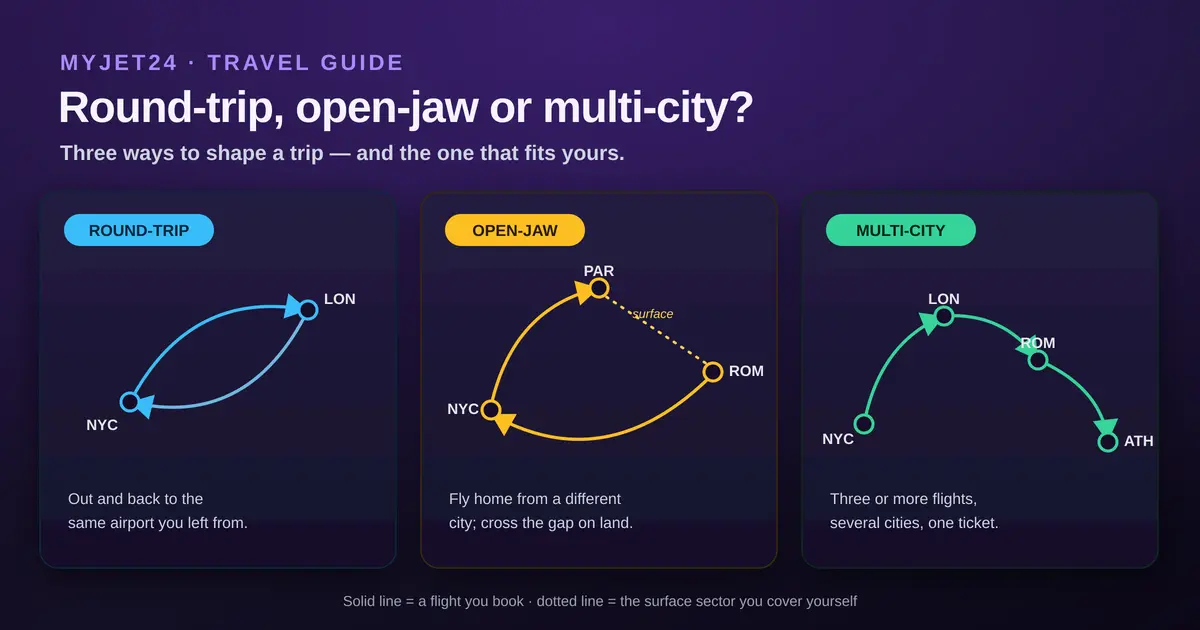
A round-trip (or “return”) is the default: you fly from A to B and later from B back to A, same two airports. An open-jaw keeps the round-trip structure but leaves one corner open — you fly into one city and out of another, and bridge the gap yourself. A multi-city trip is the most flexible: three or more flights booked together, so you can hop between several cities, or build in a long stopover, without ever returning to your start until the end.
What exactly is an open-jaw flight?
An open-jaw is a round-trip ticket where the outbound and return don't use the same pair of airports. The classic version: you fly from New York to Paris, spend a week travelling down through France and Italy by train, then fly home from Rome rather than backtracking to Paris. You took two flights — just like a round-trip — but the “jaw” of the trip is left open at the bottom. The leg you don't fly is called the surface sector: any part of the journey you cross by train, car, ferry or even a separate budget flight rather than on the booked ticket.
"An open-jaw is just a round-trip with one corner left open — you fly into one city and home from another, and walk, drive or train the bit in between."
Why bother? Because backtracking wastes time and money. If your trip naturally ends in a different city from where it started, an open-jaw lets the itinerary match reality instead of forcing an extra flight back to your arrival airport just to fly home. It is the single most useful “shape” for road trips, rail journeys and island-hopping, and it almost always prices better than the two one-way tickets most people reach for instead.
The three kinds of open-jaw
Open-jaw isn't one thing — the “jaw” can be open at the destination end, the home end, or both. Knowing the three types makes the booking screens far less confusing.
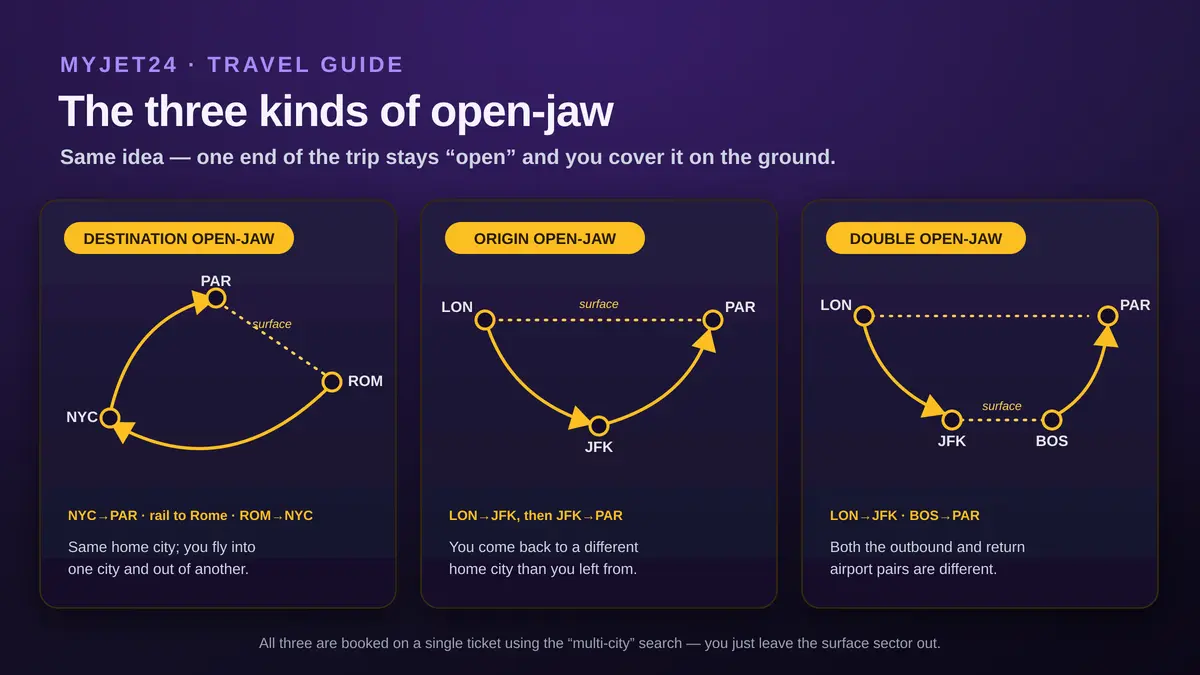
- Destination open-jaw — you keep the same home city but fly into one city and out of another. Example: New York → Paris, travel overland to Rome, then Rome → New York. This is by far the most common type.
- Origin open-jaw — you return to a different home city than you started from. Example: London → New York, then New York → Paris. Useful if you're relocating, or your outbound and return cities differ at the home end.
- Double open-jaw — both ends are open: the outbound and return airport pairs are all different. Example: London → New York, surface to Boston, then Boston → Paris. It looks complex but is still priced as a single open-jaw round-trip.
What is a multi-city flight?
A multi-city itinerary is a single ticket containing three or more flight segments. Instead of one outbound and one return, you list every leg you want: New York → London, London → Rome, Rome → Athens, and so on. It is the natural choice when you want to visit several cities by air in one trip, or to engineer a deliberately long stopover in a hub city (some airlines even market free stopover programmes for exactly this).
Strictly speaking, an open-jaw is just the simplest multi-city booking — two flights with a gap rather than three or more. That's why every airline and search engine tucks both behind the same “Multi-city” tab. The practical difference is how many cities you fly between, and whether you're crossing any gaps on the ground. If you're chaining several flights, you'll also want to understand how connections and minimum connection times work so your legs don't collide.
Open-jaw vs multi-city at a glance
The two overlap, but here is the clean comparison, with a plain round-trip as a baseline:
| Round-trip | Open-jaw | Multi-city | |
|---|---|---|---|
| Flights booked | 2 | 2 | 3+ |
| Same start & end airport | Yes | Not both | Usually no |
| Ground “gap” (surface sector) | No | Yes | Optional |
| Best for | There and back | No backtracking | 3+ cities by air |
| Booked on one ticket? | Yes | Yes | Yes |
In short: choose an open-jaw when your trip simply ends in a different city from where it began and you'll cover the middle on the ground; choose multi-city when you want to fly between three or more places. Both stay on one ticket, which is what keeps you protected.
Why open-jaws beat two one-ways
The instinct, when a trip ends somewhere different, is to book two separate one-way tickets. That is usually the most expensive option. Airlines price one-way tickets with a yield-management premium because they're disproportionately bought by last-minute and business travellers. An open-jaw, by contrast, is constructed under round-trip fare rules: each priced half is calculated as half of the applicable round-trip fare (the “half round-trip” method), so it inherits the cheaper advance-purchase pricing.
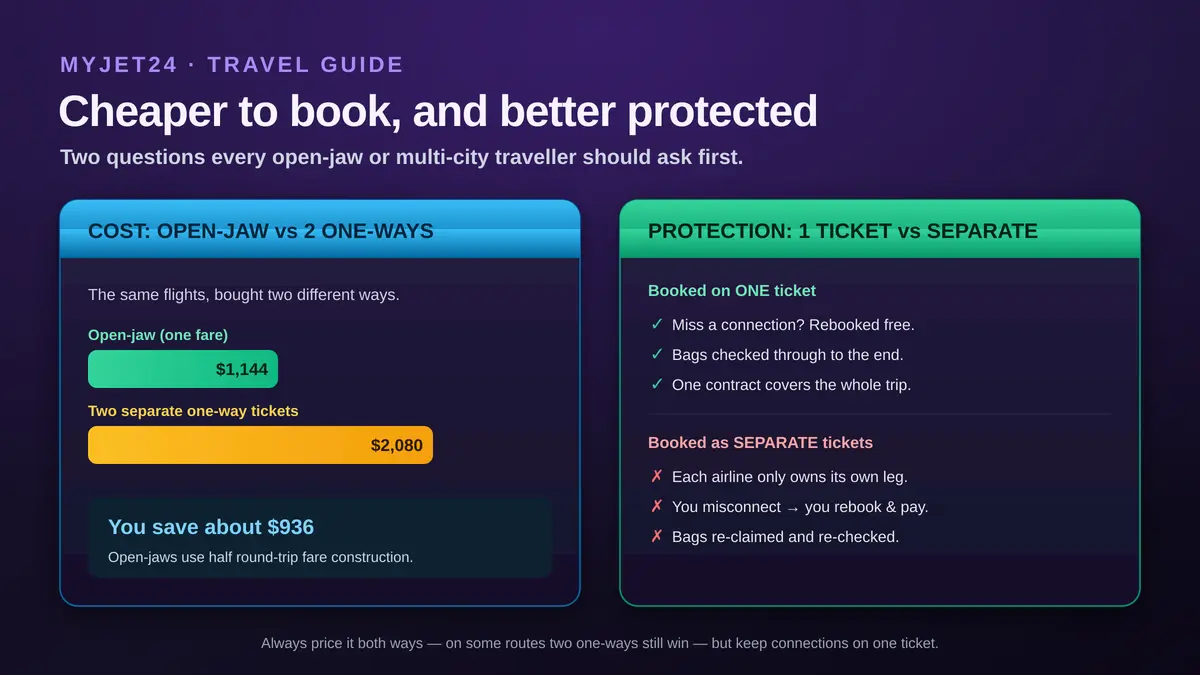
The numbers are not subtle. In one widely cited real example, the same flights cost $1,144 as an open-jaw versus $2,080 as two one-ways — a saving of about $936 for an identical journey. It won't always be that dramatic, and on some low-cost-carrier routes two one-ways genuinely win, so the golden rule is to price it both ways before you book. But start from the assumption that the open-jaw or multi-city fare is cheaper, because most of the time it is. For the document-side version of this “compare before you commit” logic, see our cost-and-risk comparison of ticket types.
One ticket vs separate tickets: the protection gap
Price isn't the only reason to keep a complex trip on a single booking. When all your flights are on one ticket, they form one contract of carriage: if a delay on an early leg makes you miss a later one, the airline must rebook you onto the next flight at no charge, and your bags are checked through to the final destination. That is connection protection, and it is worth a great deal when things go wrong.
Split the same journey across separate tickets — say a cheap long-haul plus an unrelated budget hop — and each airline is responsible only for its own segment. Miss the second flight because the first ran late and, legally, the second carrier owes you nothing; you re-book and pay again, and you re-claim and re-check your bags at every join. Separate tickets can be cheaper up front, but they shift all the risk onto you.
"The cardinal rule of complex itineraries: keep the flights that connect on one ticket, and the airline owns the risk instead of you."
How to book a multi-city or open-jaw flight
Booking either one is the same process and takes a couple of minutes on any major search engine or airline site.
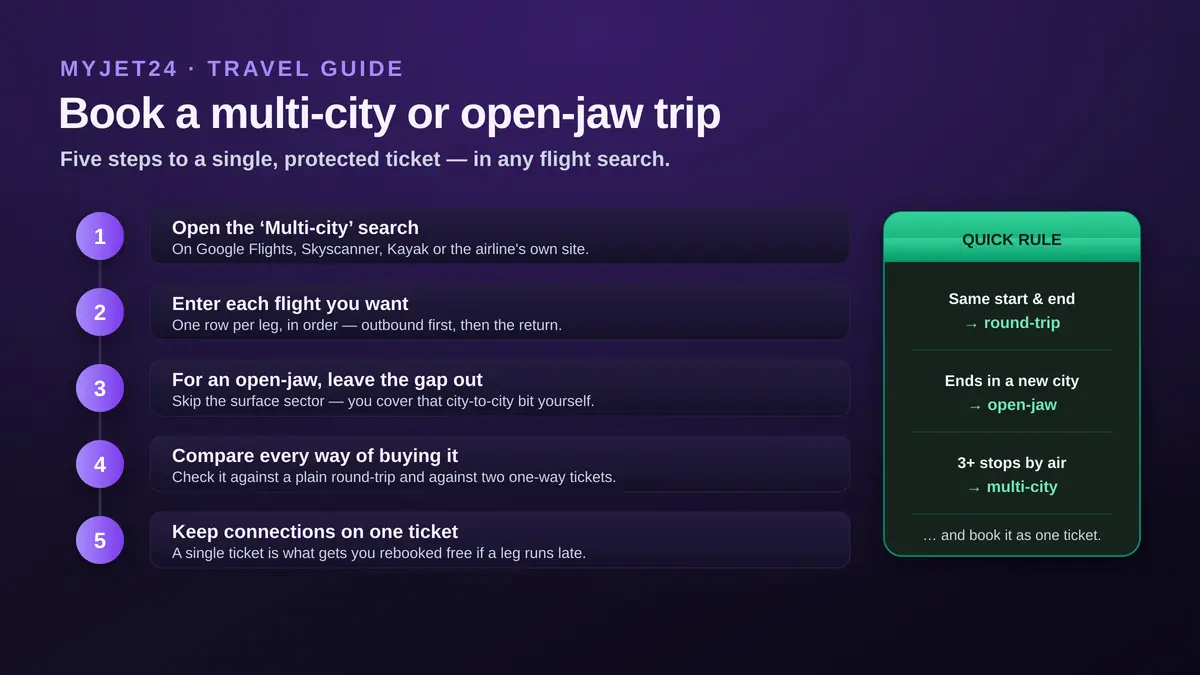
- Open the “Multi-city” search on Google Flights, Skyscanner, Kayak or the airline's own website — it sits beside the one-way and round-trip tabs.
- Enter each flight you want, one row per leg, in order: your outbound first, then any middle hops, then the flight home.
- For an open-jaw, simply leave the gap out — book the flight into your first city and the flight home from your last city, and don't add a row for the surface sector you'll cross on the ground.
- Compare every way of buying it — check the multi-city price against a plain round-trip and against two separate one-way tickets, and take the cheapest that keeps your connections protected.
- Keep connections on one ticket — if legs depend on each other, a single ticket is what gets you rebooked free when a flight runs late.
Which should you choose?
Use this quick decision rule. If your trip starts and ends at the same airport, book a round-trip. If it ends in a different city from where you flew in and you'll cover that gap on the ground, book an open-jaw. If you want to fly between three or more cities — or deliberately build in a long stopover — book a multi-city. Open-jaw shines for rail trips, road trips and island-hopping where backtracking would waste a day; multi-city shines for grand tours and complex business swings. In both cases, the goal is the same: one ticket, no wasted flights, and a price that beats buying the legs separately.
Common open-jaw and multi-city mistakes to avoid
These itineraries are simple once you understand them, but a few predictable mistakes can erase the savings or strand you mid-trip. Watch for these before you click buy:
- Forgetting to cost the surface sector. The ground leg between your two cities — the train, hire car or ferry — isn't free. Add it to the fare when you compare an open-jaw against a round-trip, or a cheap-looking open-jaw can end up dearer overall.
- Accidentally booking the gap as a flight. If you add a row for every leg, you've built a full multi-city, not an open-jaw. To keep the gap on the ground, simply leave that sector out of the search.
- Splitting onto separate tickets with no buffer. If you do choose separate tickets to save money, leave a generous buffer between flights and be ready to collect and re-check your own bags — the airlines won't do it for you, and a tight self-transfer is how people miss flights.
- Overlooking baggage rules across carriers. On one ticket your bags are usually checked through; across separate tickets you re-claim and re-check at every join, and may pay a second baggage fee. Budget for it.
- Ignoring transit and entry rules for the middle city. An overland stop or a long layover city can have its own visa, transit or onward-travel requirement. Check it the same way you would your final destination — for instance, whether airlines can deny boarding without proof of onward travel.
Open-jaw, multi-city and visa or onward-travel proof
There is one more place these itineraries matter: at the border and the visa desk. Many countries require proof of onward travel — evidence you intend to leave — and visa applications routinely demand a confirmed flight reservation showing your dates. An open-jaw is perfect proof of onward travel because, by definition, your booking already shows you leaving from a different city. A multi-city reservation does the same across several borders at once.
The catch is that you often don't want to buy expensive, non-refundable tickets just to satisfy a form before your plans are final. That's exactly what a verifiable flight itinerary for a visa application is for: a real, checkable reservation with a genuine PNR that documents your open-jaw or multi-city route, without locking in a fare you might change. It satisfies the embassy or airline check while you keep your flexibility.
Need proof for an open-jaw or multi-city trip?
Generate a verifiable flight reservation with a real PNR — including open-jaw and multi-city routes — in under a minute, from just $7.90. Perfect for visa applications and proof of onward travel, with no non-refundable fare to commit to.
Create a flight reservation →Conclusion & next steps
Open-jaw and multi-city tickets aren't advanced travel wizardry — they're just the trip shapes that match how people actually move. An open-jaw stops you backtracking when your journey ends somewhere new; a multi-city ticket lets you string several cities into one protected booking. Both usually undercut buying one-way tickets, and both keep the airline on the hook for your connections as long as you stay on a single ticket. Next time a trip doesn't fit a simple there-and-back, open the multi-city tab, leave the ground legs out, and price it against the alternatives. You'll often fly for less and see more.
Frequently asked questions
What is the difference between an open-jaw and a multi-city flight?
An open-jaw is a round-trip with two flights where you fly into one city and home from another, covering the gap on the ground. A multi-city ticket has three or more flight segments so you can fly between several cities. An open-jaw is simply the simplest form of multi-city, which is why both are booked through the same multi-city search.
Are open-jaw tickets cheaper than two one-way flights?
Usually, yes. Open-jaws are priced under round-trip fare rules, with each half costing about half a round-trip fare, while one-way tickets carry a yield premium. In one real example the open-jaw cost $1,144 versus $2,080 for two one-ways. It is not guaranteed on every route, so always price it both ways before booking.
Last updated: June 30, 2026. General travel information, not fare advice — prices and airline rules change, so always compare options at the time you book. Authoritative background: open-jaw ticket (overview), The Points Guy open-jaw guide and the Google Flights multi-city help.
Marc Hoffmann
Travel-documents specialist at MyJet24. Covers flight itineraries, fare construction, connections and entry requirements worldwide.
