
TL;DR
- What you need for New Zealand depends on your passport nationality, not your Gulf residence. All GCC citizens (UAE, Kuwait, Saudi, Qatar, Oman, Bahrain) are NZeTA visa-waiver eligible; expat residents on other passports need a Visitor Visa.
- The NZeTA is requested fully online, costs NZ$17 (app) or NZ$23 (web), and is valid 2 years for stays up to 90 days each.
- A separate IVL (tourism levy) of NZ$100 is charged with it — so budget about NZ$117–123 total.
- Everyone must be able to show proof of onward or return travel — airlines check it at the gate, and you don't need to buy a throwaway fare.
- Your passport should be valid for your whole stay; expat residents applying for a Visitor Visa also need funds, ties and an itinerary.
If you live in the Gulf and want to visit New Zealand in 2026, the first thing to settle is which document you actually need — and that is decided by the passport in your hand, not the Emirates ID or residence permit in your wallet. Gulf citizens travel on a fast online visa-waiver called the NZeTA; expat residents on most other passports apply for a Visitor Visa. Get that split right and the rest — cost, the IVL levy, and the onward-ticket rule everyone trips over — falls into place quickly.
Quick answer
GCC nationals (UAE, Kuwait, Saudi Arabia, Qatar, Oman, Bahrain) do not need a visa for New Zealand — they request an NZeTA online for NZ$17–23 plus a NZ$100 IVL (about NZ$117–123 total), valid 2 years for stays up to 90 days. Expat residents in the Gulf travelling on non-waiver passports (Indian, Pakistani, Filipino, Egyptian and most others) must apply for a New Zealand Visitor Visa with supporting documents. Both groups need proof of onward or return travel.
NZeTA or Visitor Visa? Your passport decides
This is the single most misunderstood point for travellers based in the Gulf: your eligibility is set by your nationality, not by where you live. Holding a UAE or Qatar residence visa lets you depart from Dubai, Doha or Riyadh — it does not change which New Zealand document you qualify for. There are two clear groups.
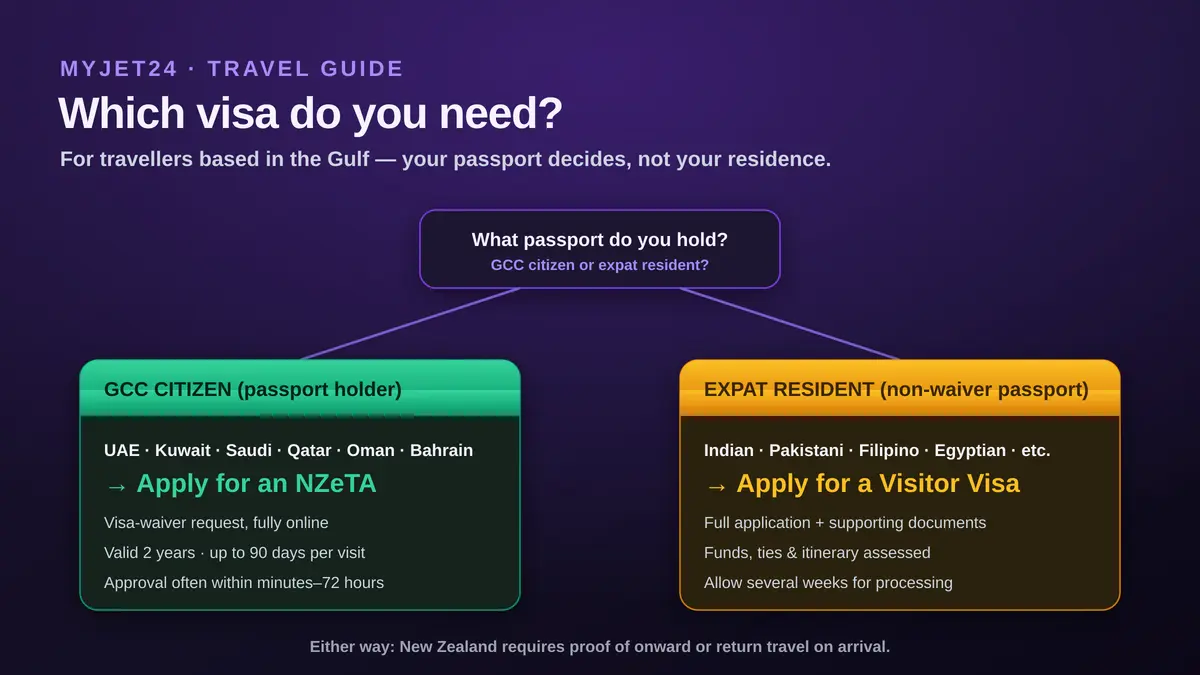
- GCC citizens (NZeTA route): passport holders of the UAE, Kuwait, Saudi Arabia, Qatar, Oman and Bahrain are visa-waiver eligible. You request an NZeTA online before you fly — no embassy, no interview.
- Expat residents (Visitor Visa route): Indian, Pakistani, Filipino, Egyptian, Jordanian, Lebanese and most other nationalities living in the Gulf are not visa-waiver and must apply for a New Zealand Visitor Visa with a full document set.
"Your residence permit gets you to the airport — your passport nationality decides whether you need an NZeTA or a full Visitor Visa."
If you want the mechanics of the waiver itself — how the request works, validity and the onward-travel angle — see our dedicated NZeTA 2026 guide. This article focuses on making the right choice as a Gulf-based traveller.
What the NZeTA is (and isn't)
The NZeTA (New Zealand Electronic Travel Authority) is not a visa — it is a visa-waiver authorisation linked electronically to your passport. For GCC citizens it replaces the old need to apply for a visitor visa for short trips. Once approved it is valid for up to two years and lets you enter repeatedly for stays of up to 90 days per visit (with a cap on total time in any 18-month period). There is no sticker and nothing to print for immigration: the authority is read from your passport chip when you check in and on arrival.
What the NZeTA does not do is guarantee entry or replace the documents a border officer can still ask for. It also does not cover work or long stays, and it does not exempt you from the proof-of-onward-travel rule. Crucially, it is only available to visa-waiver nationalities — which is why a Gulf resident on, say, an Indian passport cannot use it and must apply for a Visitor Visa instead.
How much does it cost in 2026?
For GCC citizens the cost is refreshingly simple, but it comes in two parts that are always charged together: the NZeTA fee and the International Visitor Conservation and Tourism Levy (IVL).
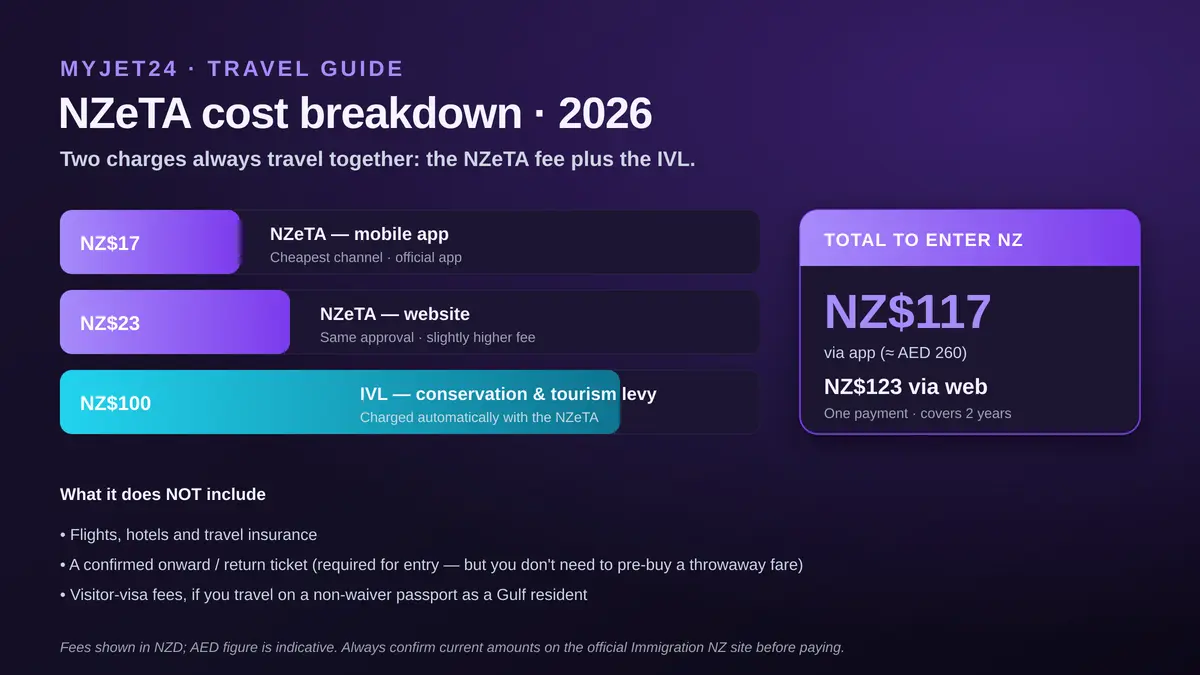
| Item | Cost (NZD) | Notes |
|---|---|---|
| NZeTA via official app | NZ$17 | cheapest channel |
| NZeTA via website | NZ$23 | same approval, higher fee |
| IVL (tourism levy) | NZ$100 | charged automatically |
| Total to enter (app) | ~NZ$117 | ≈ AED 260 · covers 2 years |
| Onward / return ticket proof | from NZ$0 | reservation, not a bought fare |
For expat residents on the Visitor Visa route, the cost structure is different: there is a Visitor Visa application fee plus a separate immigration levy, and processing takes longer. Always confirm the current amounts on the official Immigration New Zealand site before you pay, and never use a look-alike site that adds inflated "service" charges on top of the government fee.
The onward-ticket rule everyone forgets
Whether you travel on an NZeTA or a Visitor Visa, New Zealand expects you to be able to show proof of onward or return travel — evidence that you will leave the country within your permitted stay. This is enforced in two places: the airline at check-in (which is legally liable for carrying improperly documented passengers and can deny boarding) and the immigration officer on arrival. It is the single most common reason Gulf travellers get stopped at the gate even when their NZeTA is approved.
The trap is buying an expensive flexible or fully refundable fare just to satisfy the check, then dealing with cancellations. You don't need to. A confirmed flight reservation with a real PNR meets the requirement without locking you into a fare or forcing you to commit to exact return dates before your plans are final. For the full picture of where this rule bites, see our proof-of-onward-travel pillar and the explainer on when airlines can deny boarding.
"An approved NZeTA gets you booked; a confirmed onward ticket gets you boarded. Gulf travellers are stopped at the gate for the second, not the first."
How to get your NZeTA: 5 steps
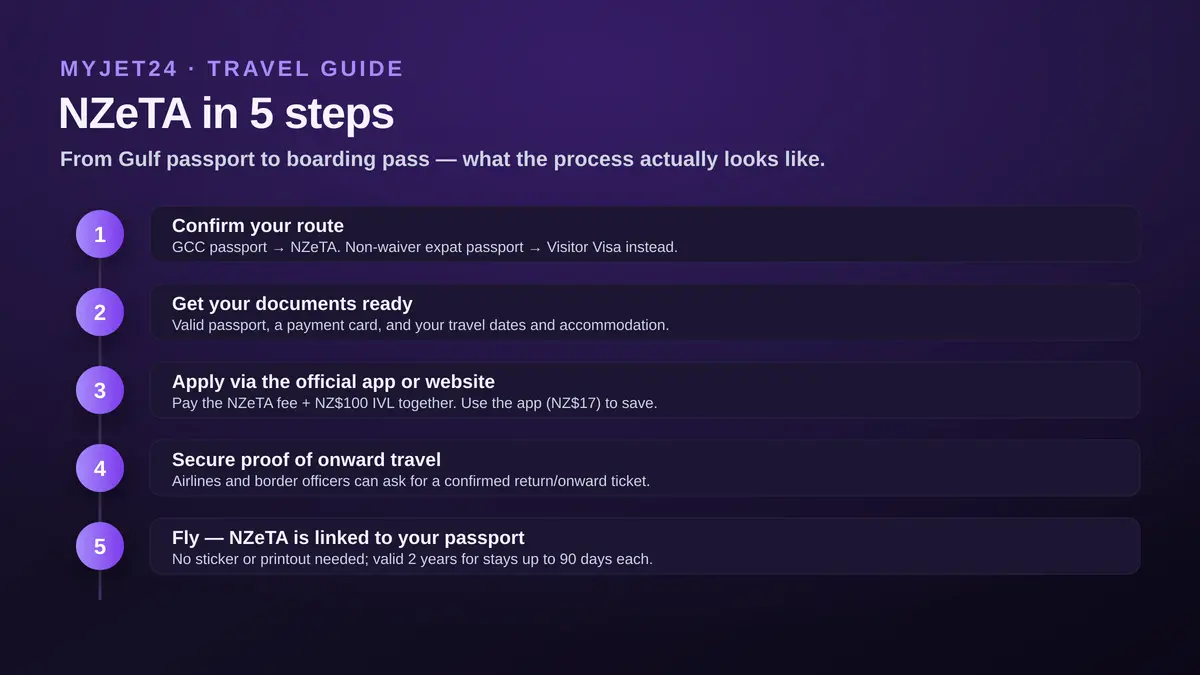
- Confirm your route — GCC passport means NZeTA; a non-waiver expat passport means Visitor Visa instead.
- Get your documents ready — a valid passport, a payment card, and your travel dates and accommodation details.
- Apply on the official app or website — use the app (NZ$17) to save; pay the NZeTA fee and the NZ$100 IVL together.
- Secure proof of onward travel — have a confirmed return or onward reservation ready for check-in and arrival.
- Fly — the NZeTA is linked to your passport; approval is often within minutes but can take up to 72 hours, so apply early.
The Visitor Visa route for expat residents
If you live in the Gulf on a non-waiver passport, your path is the New Zealand Visitor Visa. It is a full application assessed on the merits, so the file you build matters. Immigration New Zealand looks at whether you have genuine reasons to visit, sufficient funds to support yourself, and strong ties that show you will return. Expect to provide your passport, photographs, a travel itinerary, accommodation details, bank statements, and evidence of employment or business in the Gulf. Processing takes considerably longer than the near-instant NZeTA — plan on several weeks and apply well ahead.
Your Gulf residence actually helps here: a stable job, a salary credited to a local bank, a tenancy and a valid residence visa all signal ties and a clear reason to come home. The strongest applications are consistent — the itinerary matches the flights, the flights match the hotels, and the funds comfortably cover the trip. Build the day-by-day plan with our travel-itinerary guide, and remember the onward-ticket requirement applies to Visitor Visa holders too.
What the IVL is and why you pay it
The International Visitor Conservation and Tourism Levy (IVL) is a NZ$100 charge that funds conservation and tourism infrastructure across New Zealand. It is not optional and not separate from your application — it is collected automatically when you request your NZeTA or apply for most visitor visas, which is why your NZeTA "feels" like it costs over a hundred dollars rather than the headline NZ$17. A handful of travellers are exempt, but Gulf visitors on the NZeTA pay it as standard. Budget for it from the start so the total of roughly NZ$117–123 isn't a surprise at the payment screen.
Validity, multiple entries and the 90-day rule
An approved NZeTA is valid for up to two years and is multiple-entry: you can come and go for stays of up to 90 days each without reapplying, as long as you stay within the overall limit on time spent in New Zealand. That makes it ideal for Gulf travellers who combine New Zealand with Australia or Southeast Asia on the same long-haul trip, or who plan a second visit within the validity window. There is no on-arrival "visa run" culture as in some countries — respect the 90-day stay and the total cap, because overstaying damages future travel. If your travel plans need longer stays, study or work, the NZeTA is the wrong tool and you will need the appropriate visa category.
Passport, validity and common slip-ups
Your passport must be valid for your entire stay, and as a rule of thumb keep at least three months' validity beyond your planned departure to avoid problems with airlines and connecting countries. The NZeTA is tied to the specific passport you apply with, so if you renew your passport you must request a new NZeTA — the old one does not transfer. Gulf travellers with dual nationality should apply using the passport they will actually travel on, and use the same passport consistently at check-in and on arrival. Mismatched passports between the application and the boarding gate are a frequent, entirely avoidable cause of delay.
Top mistakes Gulf travellers make
- Assuming residence equals eligibility — an expat on a non-waiver passport cannot use the NZeTA, no matter how long they have lived in the Gulf.
- Forgetting the IVL — budgeting NZ$17 and being surprised by the NZ$100 levy at checkout.
- No proof of onward travel — the number-one reason for being stopped at the gate despite an approved NZeTA.
- Using look-alike websites — paying inflated "processing" fees to unofficial sites instead of the official channel.
- Applying last minute — most approvals are fast, but some take up to 72 hours; Visitor Visas take weeks.
- Renewing a passport but not the NZeTA — the authority is linked to the old passport and won't be read.
How New Zealand compares with other Gulf-resident trips
If you are a Gulf resident planning several long-haul trips in 2026, it helps to see how the rules differ by destination. New Zealand is one of the simpler ones for GCC citizens thanks to the NZeTA, but the underlying logic — nationality decides the document, and onward travel is checked — repeats everywhere. Compare it with applying for a Schengen visa from the UAE, which is a full visa application with biometrics, or a Japan visa from the UAE, where Emiratis are visa-free but expat residents apply for an eVisa. In each case the same four pillars decide success: a valid passport, a coherent itinerary, proof of funds where required, and a confirmed onward or return flight.
When you might see an "Invitation to Apply"
Some travellers researching New Zealand come across the term Invitation to Apply (ITA). This belongs to residence and skilled-migration pathways, not short tourist visits, and it is not something a Gulf holidaymaker needs for a two-week trip. If your goal is tourism, family visits or a stopover, the NZeTA (for GCC citizens) or the Visitor Visa (for expat residents) is your route. If you are exploring longer-term options, our NZ ITA 2026 guide explains how the invitation system works so you don't confuse the two.
Travelling with family or as a group
Each traveller needs their own NZeTA, including children — there is no single family authority — and each carries its own IVL. The good news is that the official app lets you submit several applications in one session, which is convenient for families departing together from the Gulf. Keep the practical details consistent across everyone: the same outbound and return flights, the same accommodation, and matching dates, so that nothing contradicts at check-in. For expat families on the Visitor Visa route, file one shared master itinerary and attach it to each person's application; inconsistent dates between family members are a common, multiplying cause of delay.
After approval: what to carry and what to expect
An approved NZeTA or Visitor Visa is permission to travel to the border — the immigration officer still makes the final call and can ask for your accommodation, return ticket and funds on arrival. Carry the same evidence you relied on: your onward or return reservation, accommodation details and, for Visitor Visa holders, your supporting documents. Keep them reachable offline, because airport connectivity is unreliable and you may need to show your onward ticket twice — once to the airline at check-in and again to immigration. Respect your permitted stay precisely; New Zealand takes overstaying seriously and it harms any future travel.
Frequently asked questions
Do Gulf citizens need a visa for New Zealand?
No. Citizens of the UAE, Kuwait, Saudi Arabia, Qatar, Oman and Bahrain are visa-waiver eligible and request an NZeTA online instead of a visa.
Can an expat resident in Dubai use the NZeTA?
Only if they hold a visa-waiver passport. An expat on a non-waiver passport (e.g. Indian or Filipino) must apply for a New Zealand Visitor Visa, regardless of UAE residence.
Need proof of onward travel for New Zealand?
Generate a confirmed return / onward reservation with a real PNR in under a minute — accepted at check-in worldwide, no non-refundable fare required.
Create your onward ticket →Marc Hoffmann
Travel-documents specialist at MyJet24. Covers visas, proof of onward travel and entry requirements for travellers across the Gulf and beyond.
