
Last updated: June 20, 2026 · 12 min read
TL;DR
- A visa overstay means remaining in a country after your permitted stay ends — even by one day, and even by accident.
- Consequences scale with length: fines, deportation, and entry bans from one year to a decade.
- The US applies automatic bars — 3 years for 180+ days, 10 years for a year or more.
- The Schengen ban covers all 27 countries at once; overstays are now logged digitally by the EES (manual stamping ended 10 April 2026).
- If you overstay, leave as soon as possible and voluntarily — it is treated far better than being caught.
One day past your permitted stay can cost you years of future travel. A visa overstay is one of the few travel mistakes that follows you across borders, because immigration systems increasingly share records and, since 2026, log every entry and exit automatically. This guide gives you the direct answers first — what the penalties and bans actually are by country — then exactly how to fix an overstay and how to make sure you never have one.
Quick answer
If you overstay a visa, you can face fines, deportation and an entry ban that scales with how long you stayed. The United States imposes a 3-year re-entry bar for overstays over 180 days and a 10-year bar for over a year. The Schengen Area issues fines and bans of 1–10 years valid across all 27 countries. The single best move is to leave voluntarily and as early as possible, keep proof you left, and document any genuine emergency.
On this page
What counts as a visa overstay
A visa overstay is remaining in a country beyond the date your entry permission expires. That date is not always the one on your visa sticker — it is the permitted stay granted at the border or by the entry rules. For visa-free or visa-on-arrival visitors it is the number of days stamped or allowed on entry; for visa holders it is the validity and duration printed on the visa. Overstaying by a single day still counts, and intent does not change the fact — a missed flight or a misread date is still an overstay. The difference intent makes is in how immigration treats it, which we cover below.
Overstay penalties by country (2026)
Penalties fall into three buckets: fines, removal/deportation, and entry bans. The mix and severity vary widely by country and by how long you overstayed. Here is a 2026 snapshot of the destinations travellers ask about most.
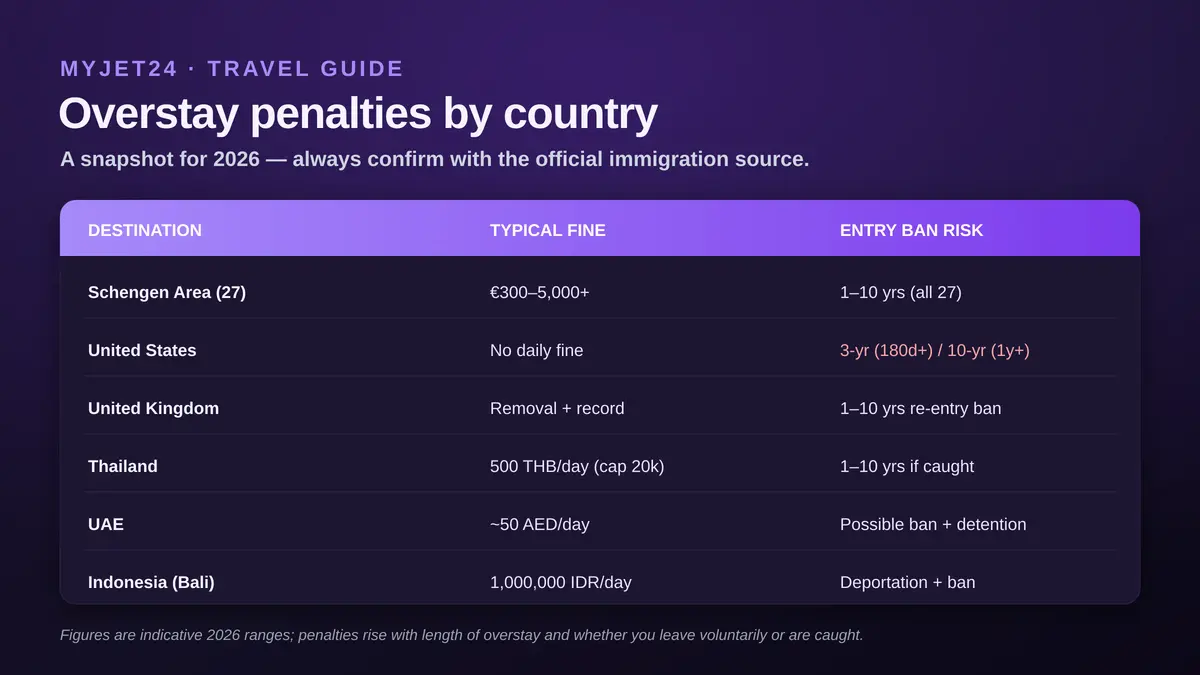
| Destination | Typical fine | Entry ban risk |
|---|---|---|
| Schengen Area (27) | €300–5,000+ | 1–10 yrs (all 27) |
| United States | No daily fine | 3-yr (180d+) / 10-yr (1y+) |
| United Kingdom | Removal + record | 1–10 yrs re-entry ban |
| Thailand | 500 THB/day (cap 20k) | 1–10 yrs if caught |
| UAE | ~50 AED/day | Possible ban + detention |
| Indonesia (Bali) | 1,000,000 IDR/day | Deportation + ban |
These are indicative ranges, not legal advice — the exact figure depends on the length of overstay and whether you leave voluntarily. Always confirm current penalties with the official immigration authority before you act.
"The fine is rarely the real cost of an overstay. The entry ban is — because it can lock you out of an entire region for years."
How entry bans work
An entry ban is a period during which you cannot legally return to a country or region, recorded against your passport and identity. Two features make bans more serious than fines. First, they are often regional: a Schengen ban applies to all 27 member states at once, so an overstay in one country closes the whole bloc. Second, the United States uses automatic statutory bars — under US immigration law, an overstay of more than 180 days triggers a 3-year bar on return and more than a year triggers a 10-year bar; the official explanation is published by the US Department of State at travel.state.gov. Bans can sometimes be waived or appealed, but the process is slow, uncertain and far harder than simply not overstaying.
The EES change: overstays are now tracked digitally
The biggest 2026 shift is that overstays in Europe are no longer a matter of whether an officer remembered to stamp your passport. The EU's Entry/Exit System (EES) records every non-EU traveller's entries and exits biometrically, and manual passport stamping ended on 10 April 2026. In practice that means your days are counted automatically and an overstay is flagged the moment it happens — there is no missed-stamp loophole. If you want the full mechanics, see our guide on how the EU Entry/Exit System changes your travel documentation, and to count your allowance correctly read the Schengen 90/180-day rule. The same digital direction is spreading worldwide, so assume your stay is being tracked precisely.
Accidental vs deliberate overstay
Legally, an overstay is an overstay — but how immigration treats it depends heavily on context. A traveller who overstayed by two days because of a cancelled flight, reported it, and left voluntarily is in a very different position from someone who vanished for six months and was caught in a raid. Officers and consulates weigh: the length of the overstay, whether you left voluntarily or were apprehended, whether there was a genuine emergency with documentation, and your overall travel history. A short, self-reported, well-documented overstay is often resolved with a fine and no ban. Hiding it is the worst choice, because the digital record will surface it later.
How to fix an overstay: step by step
If you have already overstayed, act on this order — speed and voluntary action are everything.
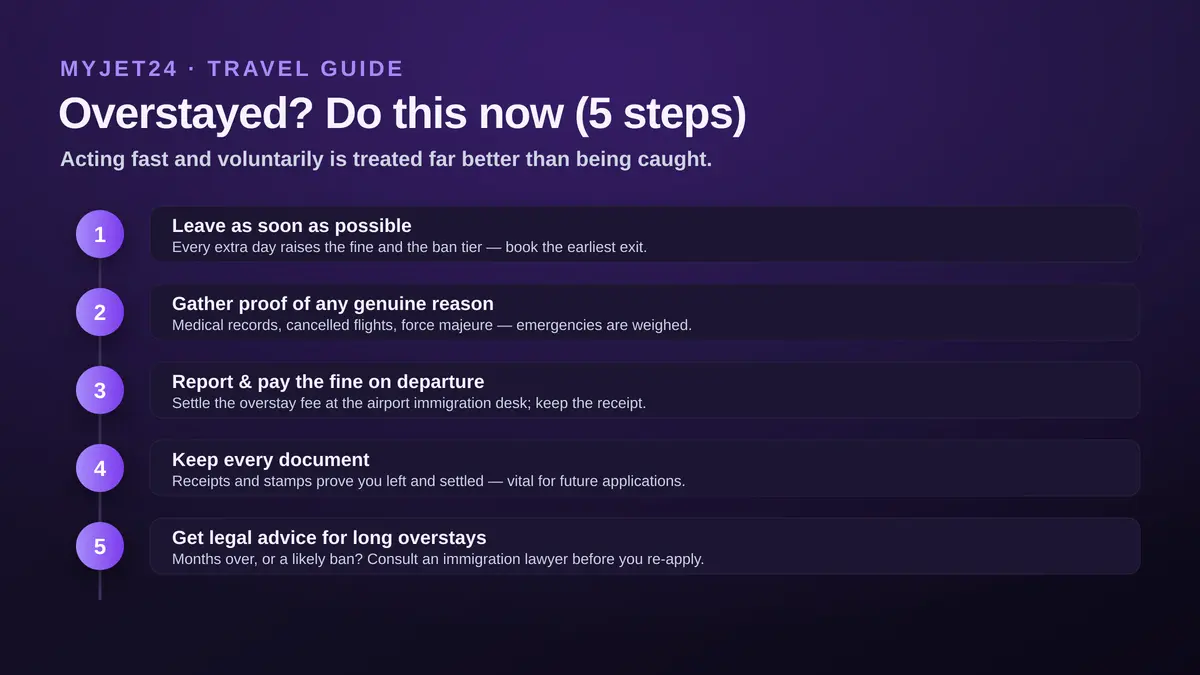
- Leave as soon as possible. Every extra day raises the fine and can push you into a worse ban tier. Book the earliest realistic exit.
- Gather proof of any genuine reason. Medical records, hospital notes, cancelled-flight evidence or other force-majeure documentation can materially soften the outcome.
- Report and pay the fine on departure. In most countries you settle the overstay fee at the airport immigration desk; declaring it yourself is voluntary departure.
- Keep every document. Receipts, stamps and your boarding pass prove you left and settled — these matter for your next application.
- Get legal advice for long overstays. If you are months over or facing a likely ban, consult an immigration lawyer before you re-apply or attempt to return.
"Voluntary departure is your strongest card. Walking up to the desk and paying the fine beats being found by enforcement every time."
Will an overstay affect future visa applications?
Yes — an overstay becomes part of your immigration history, and most visa forms ask directly whether you have ever overstayed or been refused entry. Answer honestly: a disclosed, resolved short overstay is recoverable, while a lie discovered later is treated as fraud and is far more damaging. A serious overstay can lead to future refusals, and if you are also dealing with a refusal you can combine this with our guidance on what happens after a visa refusal and how to recover and, for Schengen specifically, the Schengen appeal guide. Rebuilding trust means a clean record afterwards: strong ties, clear funds, and a coherent, time-limited trip plan.
How to never overstay
Prevention is far cheaper than any fix. The travellers who never overstay share a few simple habits.
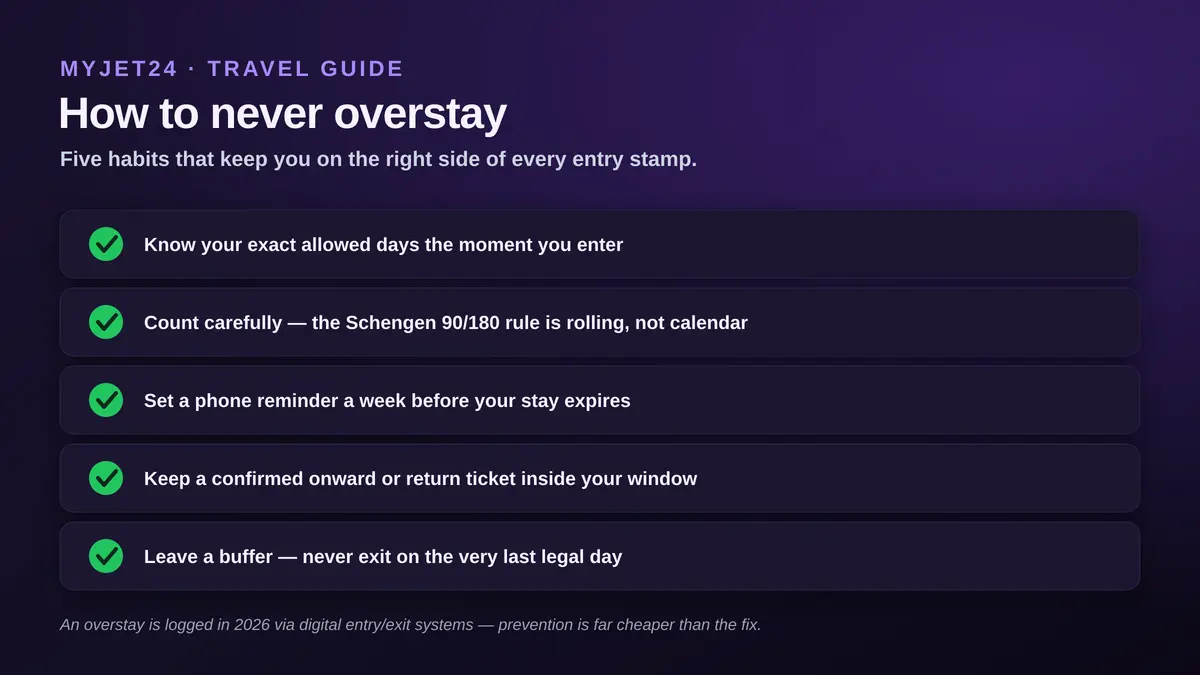
- Know your exact allowed days the moment you enter — confirm the stamp or e-record, not your assumption.
- Count carefully — the Schengen 90/180 rule is a rolling window, not a calendar reset.
- Set a reminder a week before your stay expires.
- Keep a confirmed onward or return ticket with a date inside your legal window — it both proves your exit plan and anchors your departure.
- Leave a buffer — never plan to exit on the very last legal day, when one delay tips you into an overstay.
That onward-ticket habit does double duty: it is the same proof of onward travel airlines and borders ask for on entry, which is why frequent travellers keep one on hand. For the wider picture see our proof of onward travel guide and, if you live the one-way life, the onward ticket for digital nomads playbook.
Frequently asked questions
What happens if you overstay a visa by one day?
A one-day overstay is still an overstay, but it is usually the mildest case — often a small fine on departure and, in many countries, no ban if you leave voluntarily. It is still recorded, so disclose it on future applications and do not assume it will be ignored.
Can I be banned for an accidental overstay?
Yes, bans can apply regardless of intent, but accidental, short, voluntarily-reported overstays with genuine documentation are far less likely to trigger one. Length and whether you left on your own are the biggest factors.
Stay on the right side of every entry stamp
Keep a verifiable onward or return ticket with a date inside your legal stay — proof of your exit plan and a built-in reminder to leave on time. Real PNR, no watermark, from $7.90.
Create your onward ticket →Conclusion & next steps
A visa overstay is serious but rarely catastrophic if you handle it correctly: leave quickly, leave voluntarily, document the reason, and never hide it. With entry/exit systems now digital, the old assumption that a short overstay goes unnoticed no longer holds — so the smartest play is prevention. Know your days, set a reminder, keep an onward ticket inside your window, and exit with a buffer. Do that and the ban tables above stay nothing more than reference reading.
Last updated: June 20, 2026. This article is general information, not legal advice — penalties change and vary by case, so confirm with the official immigration authority or a qualified immigration lawyer for your situation.
Marc Hoffmann
Travel-documents specialist at MyJet24. Covers visa rules, entry requirements, proof of onward travel and staying compliant for travellers worldwide.
