
Last updated: June 20, 2026 · 11 min read
TL;DR
- Digital nomads get stopped most often not at the border but at airline check-in — for arriving on a one-way ticket without proof of onward travel.
- A remote-work permit does not exempt you: officers still want evidence you will leave within your legal stay.
- For visa runs (Bali↔Singapore, Thailand↔Penang) you need onward proof for each crossing, not just the first.
- Cheapest reliable option: a verifiable flight reservation with a real PNR (~$7.90/hop) — no money tied up, repeatable in under a minute.
- Always verify the PNR yourself in the airline's “Manage Booking” tool before each departure.
If you live the one-way life, proof of onward travel is the document that decides whether you board. Nomads fly into a country, figure out the next move later, and then hit the wall everyone forgets: the airline at check-in wants to see you leaving before it will let you on. This guide is the nomad-specific playbook — when a one-way is fine, when it gets you flagged, how to run borders cleanly, and the cheapest way to always have valid proof.
Quick answer
An onward ticket for digital nomads is proof you will leave a country within your permitted stay — required by airlines at check-in and by border officers on arrival, even if you hold a remote-work visa. You do not need to buy a full fare: a verifiable flight reservation with a real, checkable PNR (around $7.90) satisfies the rule for each crossing without locking up money. Confirm it works by looking it up on the airline website before you fly.
On this page
What proof of onward travel means for nomads
Proof of onward travel is evidence that you will leave a country before your legal stay expires — a return flight, a ticket to a third country, or a verifiable reservation that shows a dated exit. For settled travellers it is a one-time formality. For nomads it is a recurring requirement, because you cross borders far more often and rarely hold a fixed return. The rule exists to protect two parties: the destination, which does not want overstayers, and the airline, which is fined and must fly you back if you are refused entry. That second point is why the check happens before you even take off. For the full country-by-country picture, see our proof of onward travel pillar guide.
Why nomads get flagged at check-in (not the border)
The surprise for most nomads is where the problem happens. It is rarely immigration at your destination — it is the check-in desk at your departure airport. Airlines screen passengers against entry rules (via systems like IATA's Timatic) and carry carrier liability: if they fly you somewhere you are then refused, they pay the penalty and the repatriation. So ground staff are cautious, and a one-way booking on a remote-worker profile is exactly the pattern they question. You can be turned away at a hub like Singapore or Dubai before your connecting flight, with a valid visa in hand. Our deep dive on when airlines can deny boarding explains the mechanics.
"Your visa gets you into the country; your onward ticket gets you onto the plane. Nomads are stopped by the second one, at home, before they ever reach the border."
When a one-way ticket is fine — and when it isn't
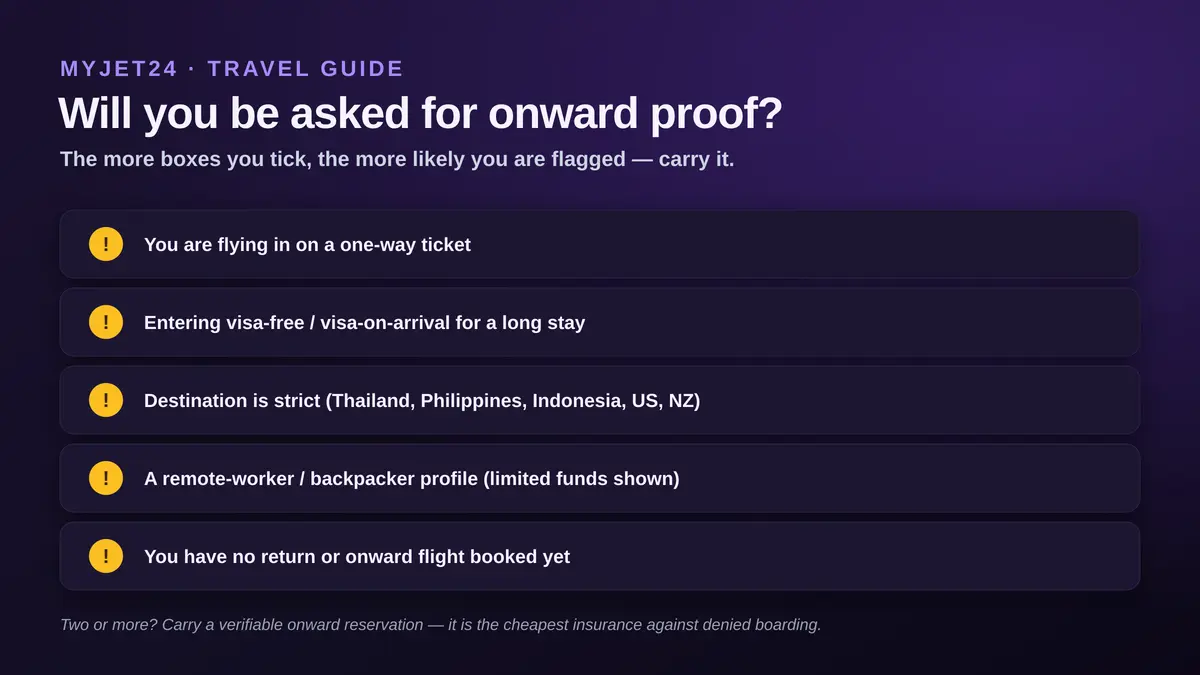
A one-way ticket is not illegal, and plenty of nomads fly on them daily. Whether it causes trouble depends on the route and the rule:
- Usually fine: entering a country where you hold a long-stay or nomad visa that explicitly permits open-ended departure, or a region with no onward-travel enforcement.
- Risky: arriving visa-free or visa-on-arrival in a strict country, where the airline must see a dated exit before boarding.
- Almost always flagged: a one-way into Thailand, the Philippines, Indonesia, the US (ESTA) or New Zealand without any onward booking.
The safe default for a nomad is simple: carry verifiable onward proof whenever the next country could ask, even if you plan to decide your real route later. It costs little and removes the single biggest boarding risk.
Does a digital-nomad visa exempt you? No
A common and expensive assumption: “I have a nomad visa, so onward travel does not apply to me.” In practice, a remote-work permit rarely removes the onward-travel question at the first entry, and never on the visa-run hops you take while holding it. Border agents use onward proof to confirm you are a genuine temporary visitor — not someone who will overstay or quietly take local work. If you are still choosing where to base yourself, our 2026 digital nomad visa guide compares the programs; just pair whichever you pick with onward proof for the journey itself.
Your three options, compared
Nomads have three realistic ways to satisfy the rule. The difference is cost, reliability and how often you can repeat it.
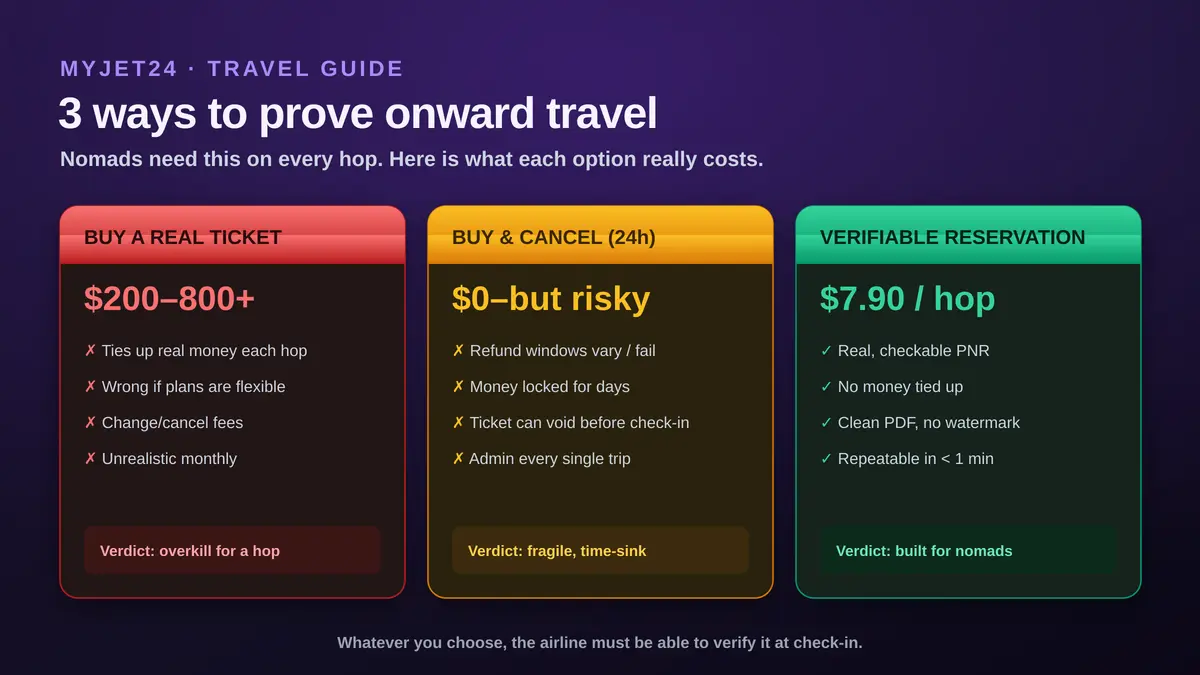
| Option | Real cost / hop | Reliability | Repeatable monthly? |
|---|---|---|---|
| Buy a real ticket | $200–800+ | High, but wasteful | Unrealistic |
| Buy & cancel (24h) | $0 if refunded | Fragile — can void early | Tedious, error-prone |
| Verifiable reservation | ~$7.90 | Real, checkable PNR | Yes, < 1 min |
For a deeper cost-versus-risk look at the first two rows, see dummy ticket vs refundable flight. The takeaway for a recurring traveller: the buy-and-cancel dance burns hours and occasionally fails at the worst moment, while a verifiable reservation is built to be repeated.
The visa-run playbook
A visa run is a short hop out and back to reset a visa-free stay — the backbone of long-term nomad life in Southeast Asia. The mistake is treating it as one trip. Each crossing is its own check.
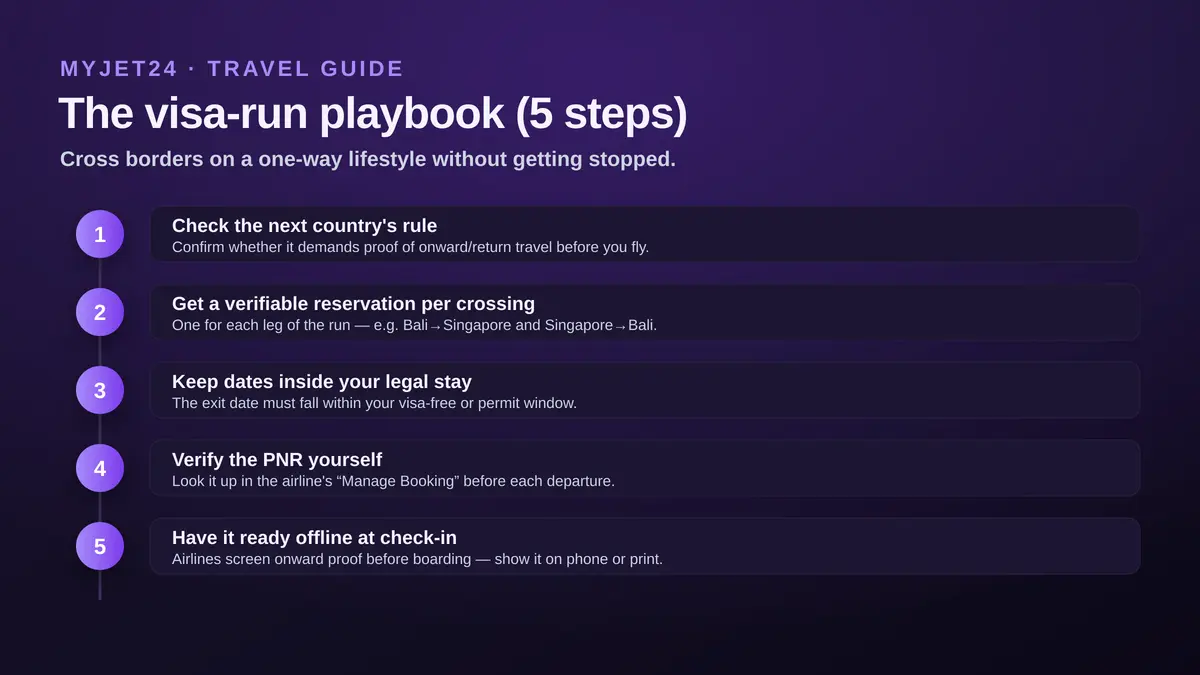
- Check the next country's rule — confirm whether it demands proof of onward or return travel before you fly.
- Get a verifiable reservation per crossing — one for the outbound (e.g. Bali→Singapore) and one for the return (Singapore→Bali).
- Keep dates inside your legal stay — the exit date must fall within your visa-free or permit window.
- Verify the PNR yourself — look it up in the airline's “Manage Booking” tool before each departure.
- Have it ready offline at check-in — airlines screen onward proof before boarding, so keep it on your phone and printed.
"On a visa run, two reservations cover the round trip. Treat each leg as its own boarding check, because that is exactly how the airline treats it."
Strict countries nomads hit most
A few destinations are famous for enforcing onward travel, and they happen to be nomad hotspots. Thailand regularly asks for onward proof at check-in and on arrival — details in our Thailand onward-travel guide. Indonesia (Bali) often requires an exit itinerary at Ngurah Rai airport; see the Bali dummy-ticket guide. The Philippines Bureau of Immigration is strict — its policy on onward tickets is published at immigration.gov.ph, and it expects proof of exit within your permitted period. The US (ESTA) and New Zealand round out the list nomads most often trip over.
Staying compliant long-term
Onward proof is not just a boarding hack — it is part of telling a consistent, honest story across months of travel. Officers are reassured by travellers whose dates line up: an entry, a planned exit inside the permitted window, and enough funds to support the stay. The fastest way to attract scrutiny is the opposite — repeated entries with no visible exit plan, which reads as undeclared work or overstay intent. Use onward reservations to keep every entry tidy, and never let a stay run past its limit, because an overstay is logged and follows you into future applications. A verifiable reservation supports the narrative precisely because it is real and checkable, not a fabricated PDF that collapses under inspection.
The repeat-buyer economics
Here is the original insight most guides miss: for a settled traveller the cost of onward proof is a rounding error, but for a nomad crossing borders every few weeks it is a line item. Buying and refunding real fares can mean hundreds of dollars floating in pending refunds at any time, plus the hours spent booking and cancelling. At roughly $7.90 per hop, a verifiable reservation turns an unpredictable, time-consuming chore into a fixed, trivial cost you can generate in under a minute — and re-verify on the spot. Over a year of monthly border runs, that is the difference between a recurring headache and a non-event.
Common mistakes nomads make
- Assuming a nomad visa removes the check — it usually does not, especially on visa-run hops.
- Showing a fabricated PDF — if the PNR cannot be looked up, it can be flagged at check-in.
- Booking only the outbound — a visa run needs proof for both legs.
- Letting the reservation expire — generate it close to travel and re-verify before each flight.
- An exit date past your legal stay — the onward date must sit inside your permitted window.
- No offline copy — airport connectivity fails; keep it on your phone and printed.
Frequently asked questions
Do digital nomads really need an onward ticket?
Often, yes. Airlines and strict countries ask for proof you will leave within your permitted stay, and a one-way booking on a nomad profile is exactly what gets flagged at check-in — even with a remote-work visa.
Is a verifiable reservation legal to use?
Yes. Showing a genuine flight reservation with a real, checkable PNR as proof of intended travel is standard practice. What is risky is a fabricated PDF whose booking reference cannot be verified.
Your next border hop, sorted in under a minute
Generate a verifiable onward reservation with a real PNR — clean PDF, no watermark, from just $7.90. Built for one-way travellers and visa runs.
Create your onward ticket →Conclusion & next steps
For a nomad, proof of onward travel is not red tape to dread — it is a thirty-second step that removes the single most common reason travellers are denied boarding. Know your next country's rule, carry a verifiable reservation for each crossing, keep your exit dates inside your legal stay, and check the PNR before you fly. Do that and the one-way life stays exactly as free as it should be.
Last updated: June 20, 2026. Entry rules change often — always confirm with the official immigration source for your destination before you travel.
Marc Hoffmann
Travel-documents specialist at MyJet24. Covers proof of onward travel, flight reservations and entry requirements for nomads and frequent travellers worldwide.
