
Last updated: June 28, 2026 · 12 min read
TL;DR
- Airlines oversell flights, so they sometimes bump passengers. If you're bumped involuntarily, you're usually owed cash.
- US (DOT): 200% of your one-way fare (max $1,075) for a 1–2 hour delay, or 400% (max $2,150) beyond that — paid by cash or cheque on the day, not a voucher.
- EU (EU261): a fixed €250–€600 by flight distance, plus care and re-routing or a refund.
- Airlines must ask for volunteers first; volunteering is a negotiation (often vouchers) with no legal minimum — don't accept a low offer if you'd qualify for higher involuntary cash.
- You keep your re-routing or refund and care on top of the compensation.
“We're looking for volunteers to take a later flight…” — that announcement is the start of a negotiation most passengers lose by accepting the first offer. Airlines routinely sell more seats than the plane holds, and when everyone shows up, someone gets bumped. Whether that costs you a day or pays you up to $2,150 depends on knowing the rules. This guide covers exactly what you're owed when you're denied boarding in 2026 — under both the US and EU systems — and how to claim it.
Quick answer
If you're involuntarily bumped from an overbooked flight, you're entitled to compensation. In the US, the DOT requires 200% of your one-way fare (up to $1,075) for a 1–2 hour delay and 400% (up to $2,150) beyond that, paid in cash or cheque on the day. In the EU, EU261 pays a fixed €250–€600 depending on distance, plus re-routing or a refund and care. Airlines must seek volunteers first; volunteering is negotiable with no minimum, so weigh the offer against the involuntary cash you'd otherwise be owed.
On this page
Why do airlines overbook flights?
Airlines oversell — deliberately selling more tickets than there are seats — because a predictable number of passengers no-show on every flight. Most of the time the maths works and everyone who turns up gets a seat. When it doesn't, the airline has to deny boarding to some passengers, known as “bumping.” This is legal, but it is also heavily regulated, because being involuntarily removed from a flight you paid for is a serious inconvenience. The protections differ sharply between the United States and Europe, which is why the first thing to establish is which rules cover your flight.
Voluntary vs involuntary: the distinction that pays
Before bumping anyone by force, an airline must ask for volunteers — and this split decides what you get.
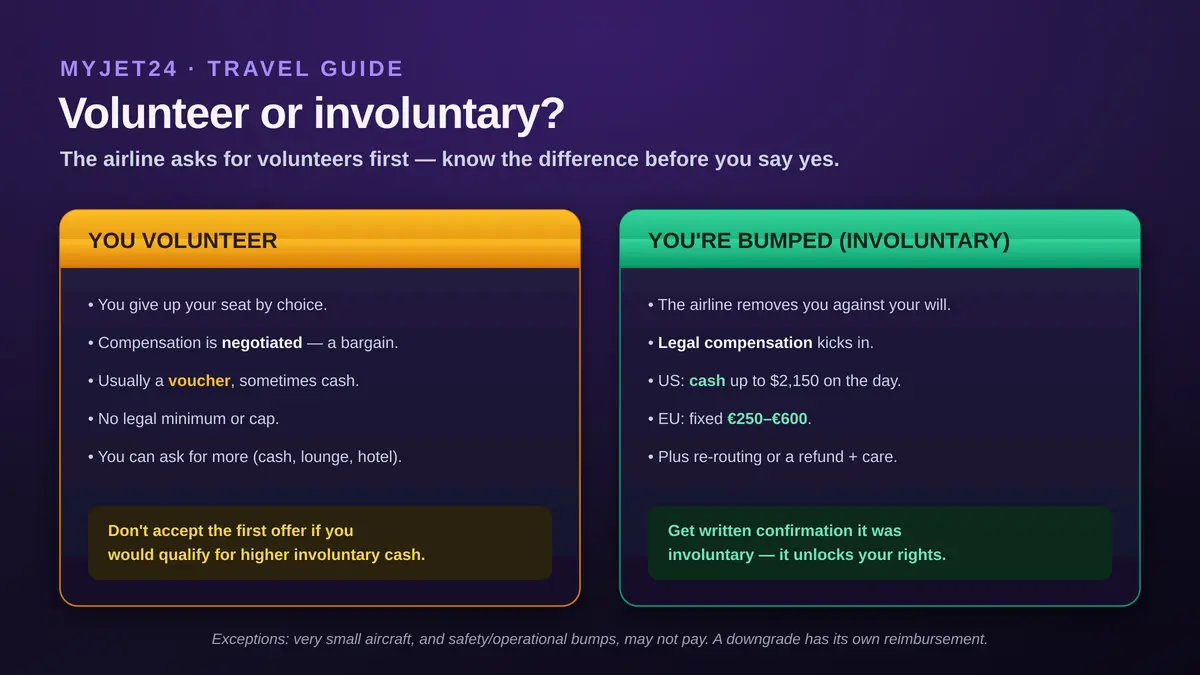
Voluntary: you choose to give up your seat in exchange for whatever the airline offers — typically a travel voucher, sometimes cash, plus perks. There is no legal minimum and no cap; it is a pure negotiation. Involuntary: the airline removes you against your will, which triggers statutory compensation (the US or EU amounts below). The practical trap: airlines open the bidding low, hoping you volunteer for a $200 voucher when an involuntary bump on the same flight would owe you many times that in cash.
"Never accept the first voucher reflexively. If they'll have to bump someone anyway, the involuntary cash you're owed may be worth far more than the offer on the table."
United States: DOT denied-boarding compensation
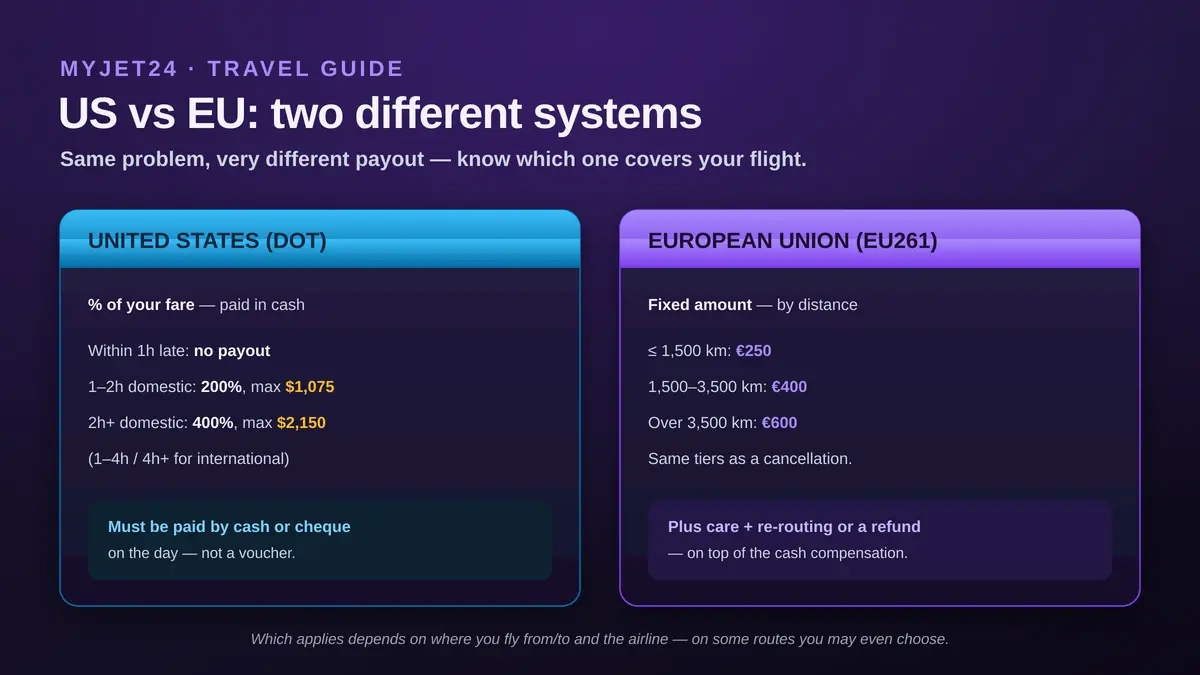
In the US, the Department of Transportation sets involuntary denied boarding compensation as a percentage of your one-way fare, with caps that were raised on 22 January 2025 and apply in 2026:
- Rebooked to arrive within 1 hour of your original time: no compensation.
- 1–2 hours late (domestic) / 1–4 hours (international): 200% of your one-way fare, up to $1,075.
- Over 2 hours (domestic) / over 4 hours (international): 400% of your one-way fare, up to $2,150.
This is on top of your original ticket — you keep the flight (rebooked) or a refund. The official rules are on the US DOT bumping & oversales page.
European Union: EU261 denied boarding
Under EU261, involuntary denied boarding pays the same fixed amounts as a cancellation, based on distance:
- €250 — flights up to 1,500 km.
- €400 — 1,500–3,500 km (and intra-EU over 1,500 km).
- €600 — flights over 3,500 km.
EU compensation is a flat sum regardless of your ticket price, and you also keep your right to re-routing or a refund plus care (meals, hotel). The denied-boarding rules sit inside the same regulation as delays and cancellations — see our EU261 flight compensation guide for the full framework and the official Your Europe page.
US vs EU at a glance
| US (DOT) | EU (EU261) | |
|---|---|---|
| Basis | % of one-way fare | Fixed by distance |
| Amount | up to $2,150 | €250–€600 |
| Form | Cash/cheque on the day | Cash/transfer |
| Plus | Re-route or refund | Re-route/refund + care |
Cash, not vouchers (US involuntary bumps)
A right most US travellers don't know: when you're bumped involuntarily, the airline must pay your compensation by cash or cheque, on the day, at the airport — or send it within 24 hours if it reroutes you before payment. It cannot fob you off with a travel voucher unless you agree to take one (sometimes worth it if the voucher value is much higher). So if a gate agent hands you a voucher after an involuntary bump, you can decline and ask for the cash you're legally owed. This is the single most valuable thing to remember at the gate.
When you're not owed compensation
Compensation doesn't apply in every case. You're generally not owed denied-boarding compensation if: you volunteered (you get the negotiated deal instead); you were rebooked to arrive within about an hour (US) of your original time; the aircraft was swapped for a smaller one for safety/operational reasons; or you were bumped for reasons that aren't overbooking, such as missing travel documents — that's a different situation we cover in when airlines can deny boarding. A downgrade (e.g. business to economy) isn't a bump either; it has its own separate reimbursement.
What to do if you're bumped
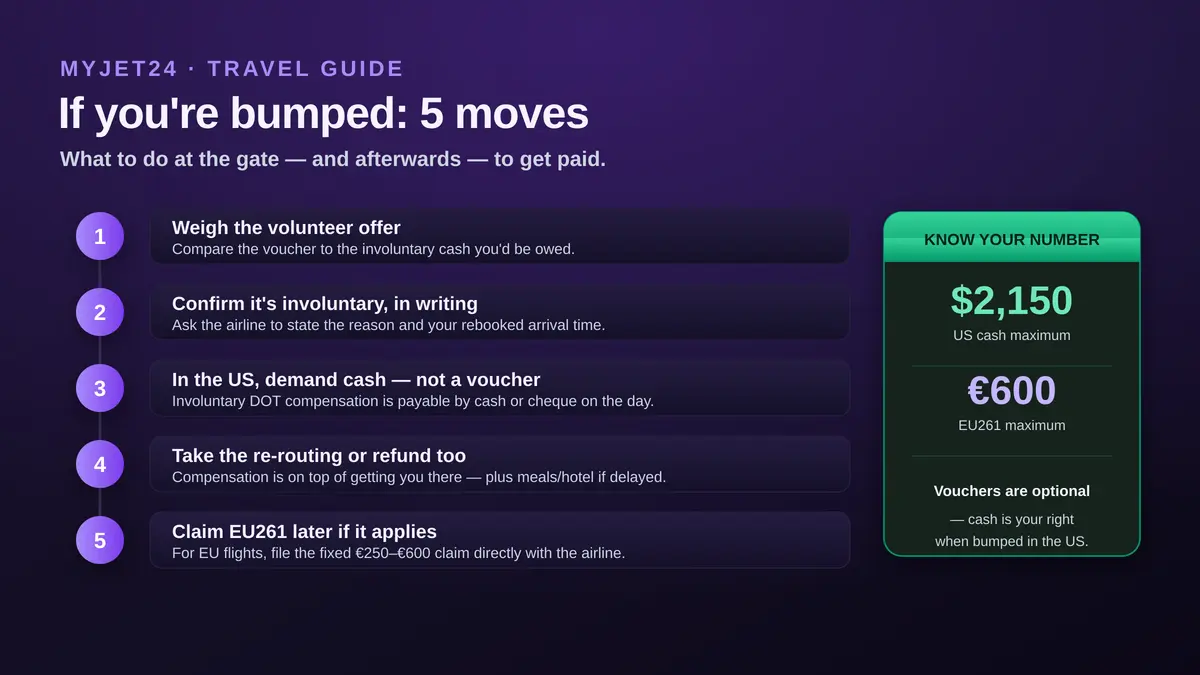
- Weigh the volunteer offer — compare the voucher to the involuntary cash you'd be owed before saying yes.
- Confirm it's involuntary, in writing — ask the airline to state the reason and your rebooked arrival time.
- In the US, demand cash — involuntary DOT compensation is payable by cash or cheque, not a voucher.
- Take the re-routing or refund too — compensation is on top of getting you there, plus meals/hotel if you're delayed.
- Claim EU261 later if it applies — for EU flights, file the fixed €250–€600 claim directly with the airline.
Conclusion & next steps
Overbooking turns the gate into a negotiation, and the informed passenger wins it. Know whether US or EU rules cover your flight, understand that volunteering is optional and negotiable while an involuntary bump is paid by formula, insist on cash where it's your right, and remember the compensation comes on top of a refund or re-routing. Keep your boarding pass and any written notice, and a bump becomes a payday rather than a write-off.
Frequently asked questions
How much do you get for being bumped from a flight?
If bumped involuntarily in the US, 200% of your one-way fare (up to $1,075) for a 1–2 hour delay, or 400% (up to $2,150) beyond that, in cash. In the EU, a fixed €250–€600 by distance, plus re-routing or a refund and care.
Can I refuse a voucher and get cash?
Yes, for an involuntary bump in the US. The airline must pay by cash or cheque on the day unless you agree to a voucher. So you can decline the voucher and request the cash you are legally owed.
Rebooked onto a new route after a bump?
If your new itinerary needs proof of onward travel for a visa or border check, generate a verifiable flight reservation with a real PNR in under a minute — from just $7.90, no non-refundable fare.
Create a flight reservation →Last updated: June 28, 2026. This is general information, not legal advice — rules and amounts change, so confirm with the US DOT or EU (Your Europe) sources and the airline before you claim.
Marc Hoffmann
Travel-documents specialist at MyJet24. Covers air passenger rights, denied boarding, proof of onward travel and entry requirements worldwide.
