
Last updated: 9 August 2026 · Reading time: 14 min · Author: James Mitchell, Travel Documentation Writer at MyJet24 · Reviewed by: Joshua White
TL;DR — Key Facts
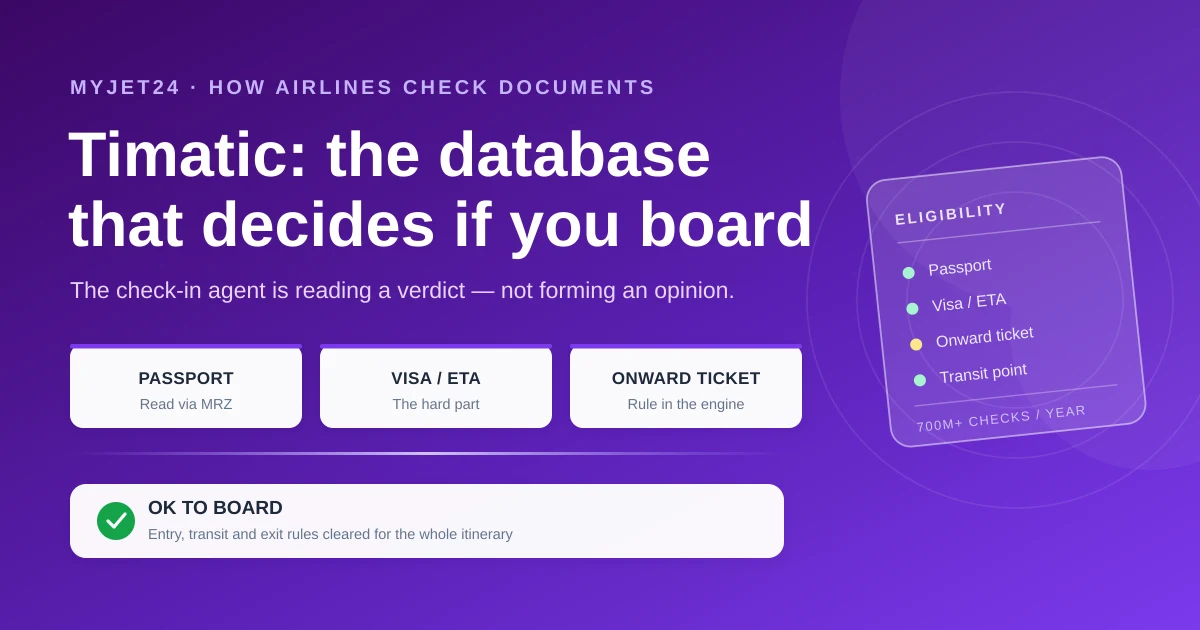
- Timatic is the IATA database airlines query to decide whether to let you board. It holds the entry, transit and exit rules for destinations worldwide, and the check-in agent is reading its verdict, not their own opinion.
- IATA says over 700 million passengers' documents are checked with Timatic every year, maintained with input from more than 2,000 government and airline officials.
- The rules change constantly — IATA reports around 70 updates a day, with up to 200 daily rule changes possible. That churn is the main reason the same passport gets different answers on different days.
- The eligibility engine explicitly applies onward-ticket requirements, which is why you get asked for proof of onward travel at check-in even when nothing changed about you.
- Most failed boardings aren't about the passport. IATA is blunt: the difficulty lies in "handling the documents that sit behind it" — visas, residence permits and e-visas.
- The engine assesses your whole itinerary, not one flight, so a transit point you never planned to leave can be the thing that stops you.
Timatic is the travel-document rules database run by IATA that airlines use at check-in to decide whether you can legally be carried to your destination. When an agent scans your passport, the system reads your document, checks it against the entry, transit and exit requirements for your whole itinerary, and returns a pass or fail. Airlines rely on it because they pay the cost of carrying a passenger who is refused entry. If the check fails, the document is flagged and the airline is alerted — and you are not boarded.
The eligibility check applies onward-ticket rules. Have one ready before you reach the desk.
In this guide
- What Timatic actually is
- The six steps between your passport and your boarding pass
- Where boardings actually fail
- What the eligibility engine checks
- Why the same passport gets different answers
- Whole trip, not one flight
- What happens when the check fails
- Can you see or challenge the verdict?
- Pre-clear your own documents in five steps
- Frequently asked questions
- The bottom line
What Timatic actually is
Timatic is a database of international travel-document requirements, operated by IATA, that airlines and ground handlers query to establish whether a passenger can lawfully be carried. It is the reference behind almost every document decision made at a check-in desk, and it is the reason two agents at the same airport give you the same answer.
The scale explains the reliance. IATA reports that more than 700 million passengers' travel documents are checked using Timatic each year, drawing on input from over 2,000 government and airline officials worldwide. The content covers passport, visa and health requirements, and extends into airport tax, customs and currency rules. IATA sells it in several forms — Timatic AutoCheck as an API wired into airline systems, Timatic Web for desk staff, Timatic Doc Scan for passenger self-service, and a Widget for airline websites — but they all resolve to the same underlying rule set.
Key takeaway: when a check-in agent says "the system won't let me board you," they are describing a Timatic verdict. Understanding it turns an arbitrary-feeling refusal into something you can anticipate and prevent — which is the entire purpose of this guide.
The six steps between your passport and your boarding pass
The document check is a six-stage pipeline, not a single lookup. IATA has published the sequence, and knowing it tells you exactly where things go wrong — because failures cluster heavily in one stage rather than being spread evenly.
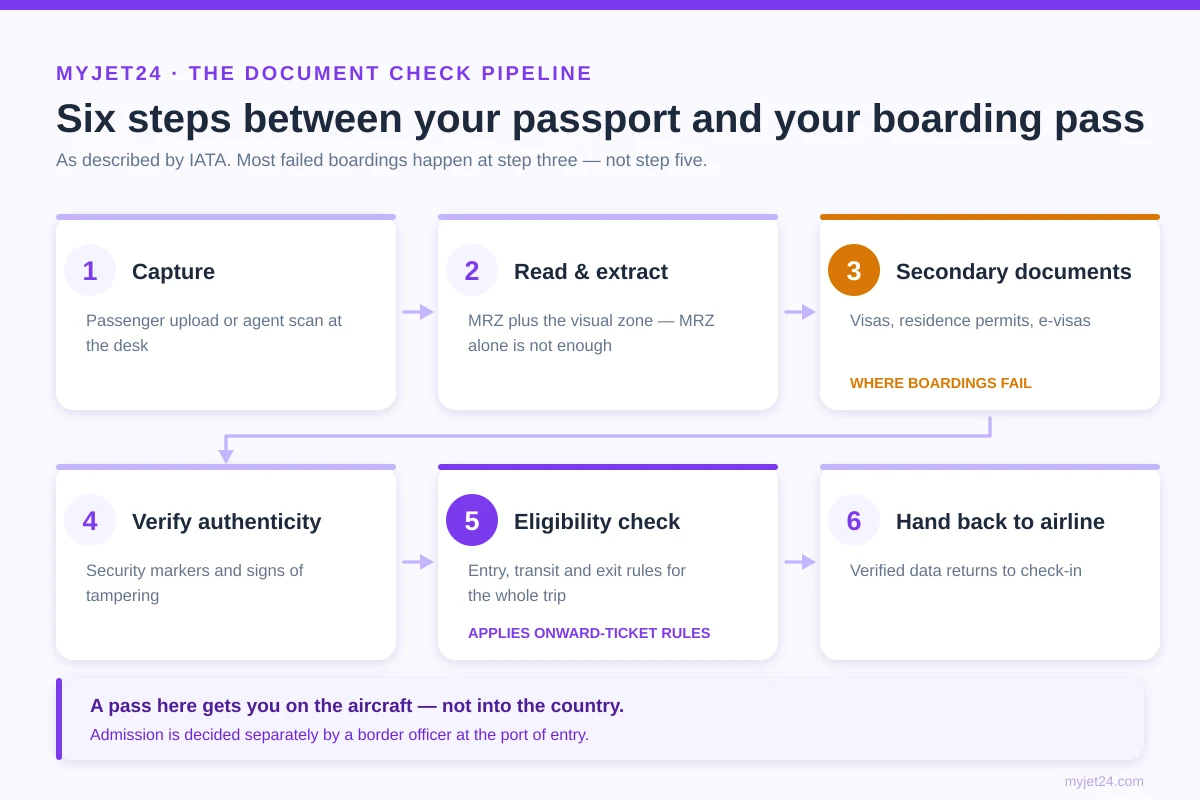
In order: the system captures the document, either from a passenger upload or an agent at the desk. It reads and extracts the data, scanning the machine-readable zone — the two lines of characters at the bottom of the passport page — plus the visual zone above it, because, as IATA notes, the MRZ alone is not enough. It then handles secondary documents: visas, residence permits, e-visas. It verifies authenticity, looking for the markers of a genuine document and signs of tampering. It runs the eligibility determination through Timatic against your entry, transit and exit requirements. Finally it hands the verified data back to the airline's booking and check-in systems.
Key takeaway: only stage five is the famous "Timatic check." Stages one to four are about reading your documents correctly in the first place — and a misread at stage two or three produces a wrong answer at stage five, which is why a perfectly valid traveller occasionally gets stopped.
Where boardings actually fail
Boarding errors concentrate in the documents behind the passport, not the passport itself. Passports are standardised, machine-readable and easy to process; visas, residence permits and e-visas are none of those things, and they are where the system and the agent both struggle.
"The value is not in scanning the passport well. It is in handling the documents that sit behind it."
— IATA Knowledge Hub, on what actually happens when travel documents are checked
Consider the practical difference. A passport arrives in a known format with a machine-readable zone the scanner is built for. An e-visa arrives as a PDF on a phone, in one of thousands of national formats, sometimes with a QR code the reader has never seen, sometimes as a reference number that has to be typed in by hand. A residence permit may be the thing that makes you visa-exempt for a destination, yet be issued by a third country entirely. Each of these is a place where a correct entitlement fails to reach the eligibility engine in a form it recognises.
Key takeaway: carry your secondary documents in the cleanest form you can — the original, not a screenshot of a screenshot — and know their reference numbers. If the entitlement that makes your trip legal is a residence permit or an e-visa, assume it will need explaining, not just showing. Which category of permission you hold changes what the agent is looking for, as our guide to visa-free, ETA, eVisa and visa-on-arrival status sets out.
What the eligibility engine checks
The eligibility engine is the component that turns your extracted document data into a boarding decision, by testing it against the destination's rules. It goes considerably further than "is this passport in date."
According to IATA's own description, the engine distinguishes a document's validity from its age, measures expiry against your arrival date rather than your departure date, flags visas that have not yet expired but do not cover the trip, and applies exemptions and requirements — including onward-ticket requirements. That last item is the one travellers feel most often and understand least. The reason a check-in agent asks for proof of onward travel is not personal judgement about how you look; it is a rule in the database being applied to your itinerary.
| The engine does check | The engine does not decide |
|---|---|
| Passport validity measured against your arrival date | Whether you are admitted — that is the border officer's call |
| Visa, ETA or permit coverage for the trip you booked | Whether your reason for travel is credible |
| Entry, transit and exit rules across the itinerary | How long you will actually be granted on arrival |
| Onward-ticket requirements where they apply | Whether your funds are sufficient in the officer's view |
| Health and vaccination documents where required | Anything after you leave the aircraft |
Key takeaway: a Timatic pass gets you on the plane; it does not get you into the country. The two decisions are made by different parties against different standards, and clearing the first tells you nothing definitive about the second.
Why the same passport gets different answers
The most common complaint about airline document checks is inconsistency — asked for an onward ticket on one trip, waved through on the next. That inconsistency is real, and it has four identifiable sources rather than one.
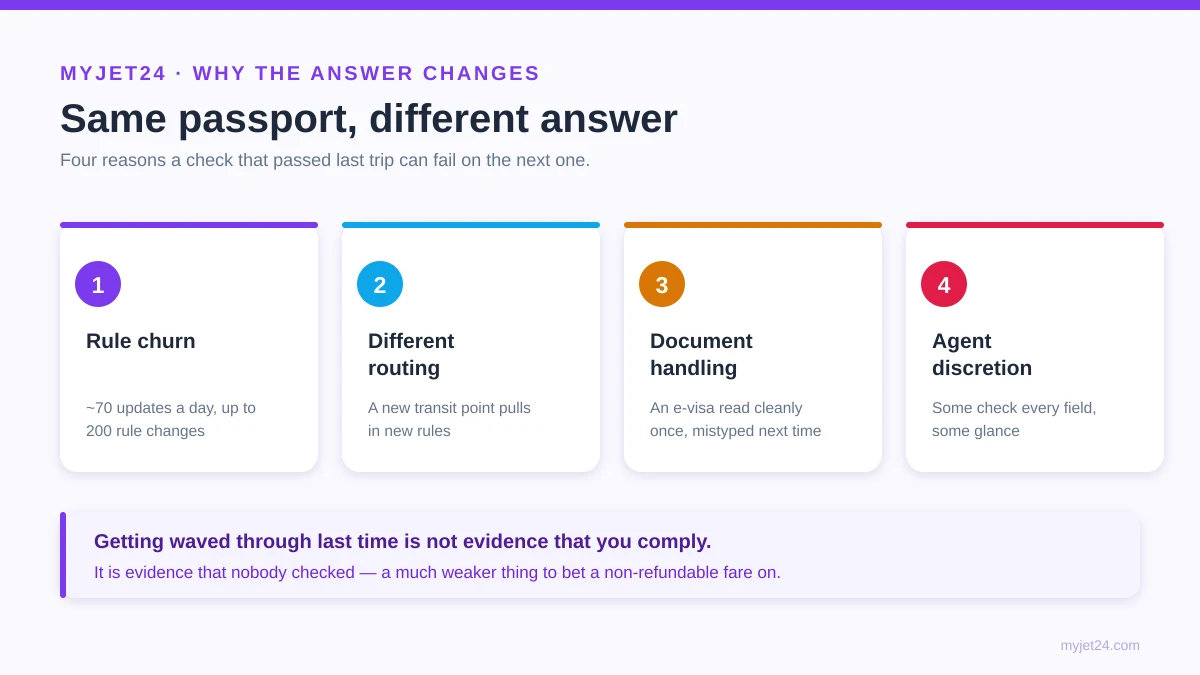
Rule churn comes first: IATA reports around 70 updates a day to the database, with up to 200 daily rule changes possible. A requirement that did not apply to your nationality in March can apply in August. Itinerary differences come second — a different routing through a different transit point pulls in a different rule set, even with the same origin and destination. Document handling is third: an e-visa read cleanly on one trip and mistyped on another produces two different verdicts from identical entitlements. Agent discretion is fourth, and it cuts both ways; some agents check every field, others accept a glance, and airlines vary in how strictly they enforce marginal cases.
Getting waved through last time is not evidence that you comply. It is evidence that nobody checked — which is a different thing, and a much weaker one to bet a non-refundable fare on.
Key takeaway: plan for the strict version of the check rather than the version you got last time. The cheapest way to remove the most common variable is to carry proof of onward travel as standard, since that is the requirement most likely to be applied unevenly. Our guide to the six ways to show it compares the options by cost and risk.
A verifiable reservation with a live PNR, ready in about 30 seconds.
Whole trip, not one flight
The eligibility engine evaluates your entire itinerary — entry, transit and exit for every point on it — not just the flight you are currently boarding. This is the single most misunderstood part of the system, and it produces the most surprising refusals.
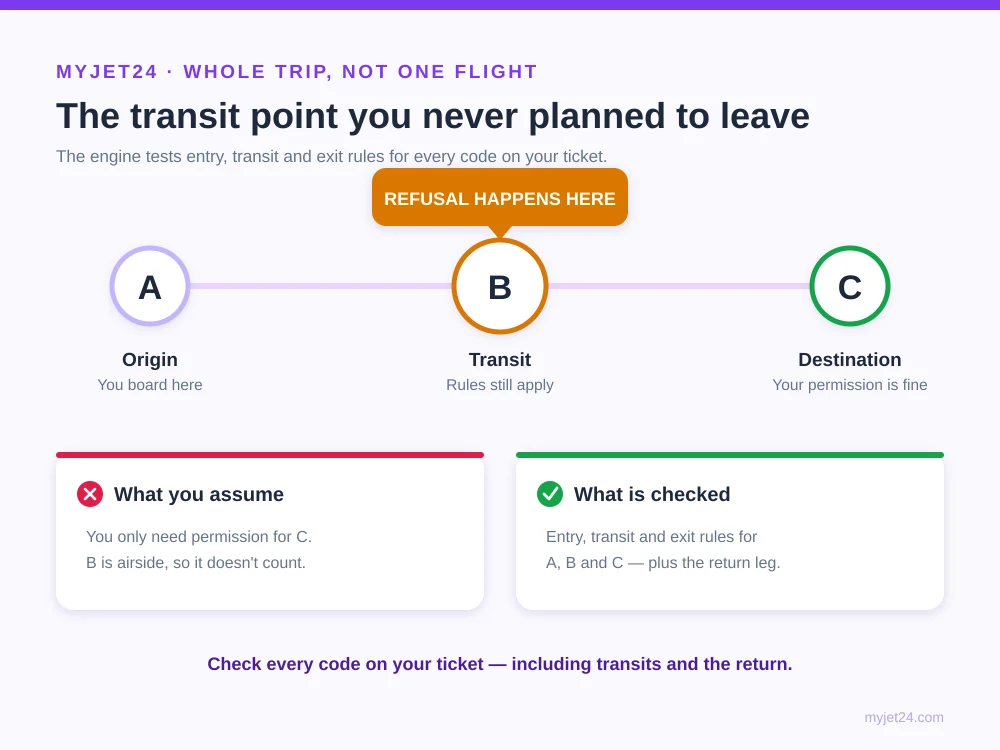
Here is the shape of it. You book A to C via B. You have the right permission for C and never intend to leave the airport at B. The engine still tests B's transit rules against your documents, and some countries require a transit visa or authorisation even for passengers who never clear immigration. The refusal that follows feels absurd — you were stopped over a country you were not visiting — but it is the system working exactly as designed, because the airline would be liable at B as much as at C. The same logic applies to exit rules and to the return leg: a requirement attached to how you leave your destination can be assessed before you have even departed.
Key takeaway: check the rules for every code on your ticket, including transit points and the return. A cheaper routing through an unfamiliar hub can carry document requirements the direct flight would not, and our country-by-country onward-travel guide is a useful starting point for the destinations most likely to bite.
What happens when the check fails
When the eligibility check fails, IATA's description is short: the document is flagged and the airline is alerted. In practice that means you are not issued a boarding pass until the problem is resolved, and the clock is the ticket's departure time.
What follows depends on which stage failed, and that is worth diagnosing quickly rather than arguing in general terms. A capture or extraction problem is often fixable on the spot with the original document. A missing entitlement — no visa, no ETA — usually is not fixable at the desk at all. A missing onward ticket is the one category that is almost always solvable in minutes, because a verifiable reservation can be produced while you stand there. The table below maps failure to response.
| What failed | Fixable at the desk? | What to do |
|---|---|---|
| Document misread or mistyped | Usually yes | Offer the original document and ask for a re-scan |
| Secondary document not recognised | Often | Provide the reference number and issuing authority; ask for a supervisor |
| No proof of onward travel | Yes — in minutes | Produce a verifiable onward reservation there and then |
| Passport validity short for arrival date | No | Renew before travel; check the rule in advance |
| Missing visa, ETA or transit authorisation | Rarely | Apply if instant issuance exists; otherwise rebook |
Key takeaway: triage before you argue. Establish whether the problem is a misread, a missing document or a rule you genuinely do not meet — the first two have remedies at the desk, and the third does not improve with persistence. Post 60 covers the aftermath in depth: what happens when an airline denies boarding.
Can you see or challenge the verdict?
You cannot query Timatic as a passenger in the way an airline can, and there is no personal record to request — the database holds country rules, not a file about you. What you can do is check the same rules the engine applies, and escalate a decision you believe is wrong.
IATA licenses consumer-facing versions of the data to airlines, which is why some carrier websites include a document-requirements checker; that widget is drawing on the same rule set the desk will use, so it is worth running before you leave home. Beyond that, the practical escalation path at the airport is a supervisor or the airline's duty manager, not the agent — and the argument that works is evidential rather than rhetorical: here is the document, here is its reference number, here is the official page stating the requirement I meet. Because the underlying rules come from governments, the ultimate authority is the destination's own immigration or foreign-ministry site, not the airline.
Key takeaway: you cannot see the verdict, but you can pre-empt it by checking the airline's own document tool and the destination's official guidance before travel. Bring evidence rather than opinion if you need to escalate, and accept that agents cannot override a hard rule even when they want to.
The numbers worth remembering. IATA reports that over 700 million passengers' travel documents are checked with Timatic each year, informed by more than 2,000 government and airline officials, with around 70 updates a day and up to 200 daily rule changes possible. On the other side of the flight, Eurostat recorded 132,600 refusals of entry at EU external borders in 2025 — the largest single reason, 40,185 cases or 30.3%, being "purpose and conditions of stay not justified," which rose to 40.0% of refusals at air borders. The airline check and the border check are separate hurdles, and both turn on the same evidence: a documented, time-bound plan.
Pre-clear your own documents in five steps
You can run a version of the same check before you leave home, using the pipeline as a checklist. Work through these in order the day before you fly — it takes about fifteen minutes and removes almost every avoidable failure.
- Check passport validity against your arrival date, not today. The engine measures expiry at arrival, and many destinations add a six-month buffer on top. Our passport validity guide covers the blank-page rules too.
- List every code on your ticket, including transit points and the return. Look up entry and transit requirements for each one on the destination's official immigration site.
- Assemble your secondary documents in original form. Have the e-visa PDF, residence permit or ETA confirmation to hand with its reference number — not buried in an email thread on airport wi-fi.
- Arrange proof of onward travel. This is the requirement the engine applies most inconsistently and the one you can fix most cheaply. Time it close to check-in so the booking is live when it is checked — see our note on how long a reservation stays valid.
- Run the airline's own document checker if it has one, then screenshot the result. It is the same rule set, and a saved result is a useful thing to show a supervisor.
Key takeaway: the pre-clear takes fifteen minutes and converts the most expensive category of travel failure — a denied boarding on a non-refundable ticket — into a solved problem at your kitchen table. Money questions follow the same principle, as our Schengen proof-of-funds guide shows.
Frequently asked questions
What does Timatic stand for?
Timatic is a contraction of "Travel Information Manual Automatic," the automated successor to the printed Travel Information Manual that airlines once used. The name is industry shorthand rather than a consumer brand, which is why most travellers only hear it when something has gone wrong at a check-in desk.
Can I check Timatic myself before I fly?
Not directly as a passenger, but many airlines embed a document-requirements checker on their own site that draws on the same IATA rule set. Running that before you travel, and screenshotting the result, is the closest equivalent. For anything critical, confirm against the destination's official immigration or foreign-ministry page, which is where the rules originate.
Does Timatic decide whether I'm allowed into the country?
No. It decides whether the airline can carry you. Admission is decided separately by a border officer at the port of entry, against a broader standard that includes your purpose of travel and your circumstances. Passing the airline check is necessary to board but is not a guarantee of entry.
Why did the airline ask for an onward ticket when the country doesn't require one?
Usually because a rule in the database applies to your nationality, your permission type or your routing rather than to all travellers to that destination. Airlines also enforce conservatively, since they carry the cost if you are refused entry. Producing a verifiable onward reservation resolves it faster than debating whether the rule should apply.
How often do the rules actually change?
Constantly. IATA reports around 70 updates a day, with as many as 200 daily rule changes possible across the database. That pace is why a requirement can appear between two trips on the same route, and why "it was fine last time" is a weak basis for planning.
Can a check-in agent override the system?
Not on a hard rule. Agents and supervisors have discretion over how documents are read and whether to seek clarification, but they cannot board a passenger the system has failed on a genuine requirement, because the airline carries the liability. Escalating to a supervisor helps most when the issue is a misread document rather than a missing entitlement.
Does it check my transit country as well as my destination?
Yes. The eligibility check covers entry, transit and exit requirements across your whole itinerary, so a transit point can trigger a refusal even if you never planned to clear immigration there. Some countries require a transit visa or authorisation for airside connections, which catches travellers who chose a cheaper routing.
Is a screenshot of my e-visa good enough?
Sometimes, but it is the weakest form. Secondary documents are where checks most often fail, and a degraded screenshot can defeat both the scanner and the agent. Carry the original PDF or printout, know the reference number and the issuing authority, and keep it accessible without needing airport wi-fi.
Do low-cost airlines use the same system?
The major carriers and their ground handlers overwhelmingly rely on the same IATA rule set, so the underlying requirements do not change by airline. What varies is enforcement culture and how much time an agent spends on marginal cases. Budget carriers are frequently stricter about onward travel because they operate on thinner margins against the same liability.
If I'm denied boarding over documents, do I get compensation?
Generally no. Passenger-rights regimes such as EU261 cover denied boarding for reasons within the airline's control, like overbooking, not refusals for inadequate travel documents. That makes the document check one of the few travel failures with no financial backstop, which is precisely why pre-clearing is worth the fifteen minutes.
The bottom line
The check-in desk is not making a judgement about you. It is reading a verdict from a rules database that IATA updates dozens of times a day, applied to every point on your ticket, using whatever it managed to extract from your documents. Once you see it that way, the two things that feel most arbitrary — the inconsistency between trips and the sudden demand for an onward ticket — turn out to be the two most predictable, because both are properties of the system rather than of the agent.
That makes the fix procedural. Check validity against your arrival date, look up every code on your ticket including transits, carry secondary documents in their original form, and hold proof of onward travel as a default rather than an afterthought. The last one is the requirement most likely to be applied unevenly and the cheapest to satisfy. Create a verifiable onward ticket before you leave for the airport, and let the system's verdict be a formality.
A real reservation with a live PNR — the document the eligibility check is looking for.
James Mitchell — Travel Documentation Writer, MyJet24
James has spent years explaining travel-document requirements — visa itineraries, onward-travel proof and airline boarding rules — for travellers across 60+ countries. Methodology note: the figures and the six-step check sequence in this guide are taken from IATA's own published material on Timatic rather than from secondary summaries; widely repeated claims about Timatic's founding date and country count come from third-party sources and are deliberately not presented here as IATA figures. Reviewed on 9 August 2026 by Joshua White, Immigration Policy Writer at MyJet24.
Sources
- IATA — Timatic Solutions (700M+ passengers checked per year; 2,000+ government and airline officials; ~70 updates per day)
- IATA Knowledge Hub — What actually happens when a passenger's travel documents get checked (six-step sequence; secondary documents; failed-check handling)
- Regulation (EU) 2016/399 (Schengen Borders Code), Annex I — supporting documents incl. "a return or round-trip ticket"
- Eurostat — Refusals of entry at EU external borders, 2025 (132,600 refusals; 40,185 for unjustified purpose)
This guide explains airline travel-document checking as of 9 August 2026, drawing on IATA's published material on Timatic, the Schengen Borders Code and Eurostat border statistics. Timatic is an IATA product; MyJet24 is not affiliated with IATA. Rules change many times a day and requirements depend on the exact pairing of nationality, routing and destination. Verify with the relevant airline, embassy and official immigration authority before you travel. This article is informational and not legal or immigration advice.
