
Last updated: 7 August 2026 · Reading time: 13 min · Author: Marc Hoffmann, Entry-Requirements Writer at MyJet24 · Reviewed by: James Mitchell
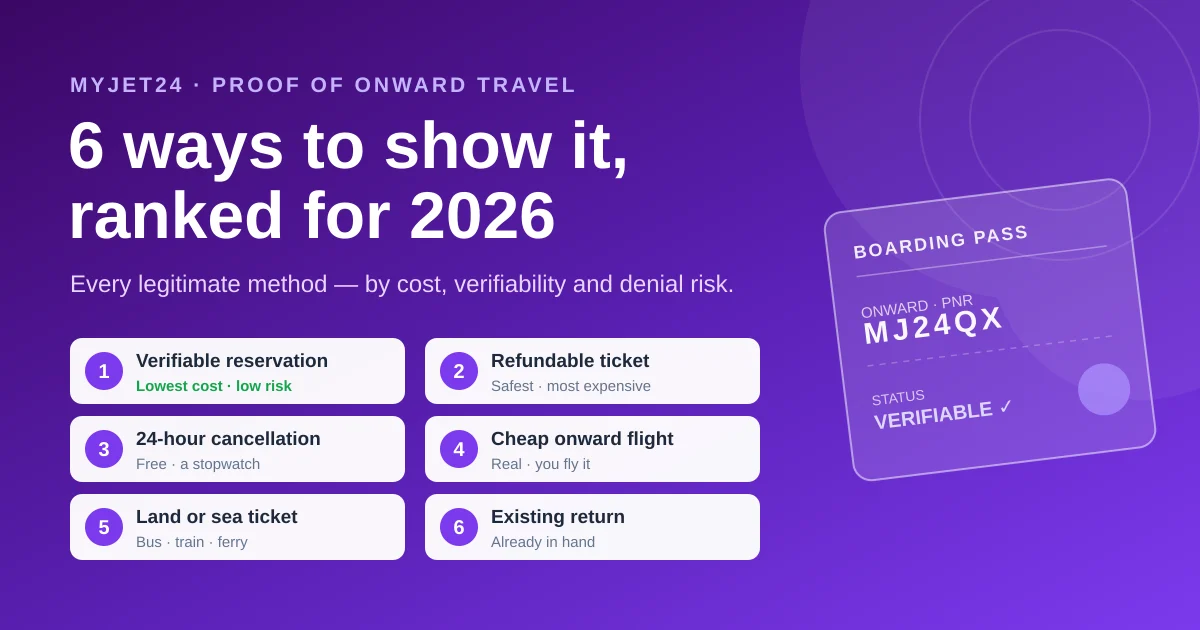
TL;DR — Key Facts
- There are six legitimate ways to show proof of onward travel, and they trade off on four things: cost, whether you get your money back, how verifiable the proof is, and your risk of being turned away.
- The single axis that decides whether proof works is verifiability — a real booking with a live PNR passes an airline or consular lookup; an edited PDF does not.
- The cheapest low-risk option for most travellers is a verifiable flight reservation — a genuine held booking you don't pay to fly — because it clears the check without the cost of a fare you may never use.
- A refundable ticket and a 24-hour-cancellation booking both work, but tie up real money and depend on you remembering to cancel; the US DOT 24-hour rule only covers bookings made seven or more days before departure.
- A land or sea ticket (bus, train, ferry) counts in many places — but not everywhere, and some airlines only accept a flight, so confirm the specific rule before you rely on it.
- Never use a fake PDF. Weak or missing onward proof falls under "purpose and conditions of stay not justified" — the single biggest reason for EU entry refusals in 2025, at 40,185 cases.
To show proof of onward travel, present a genuine, verifiable booking that you will leave the country: a held flight reservation with a live PNR, a fully refundable ticket, a booking made under an airline's 24-hour free-cancellation window, a cheap real onward flight, a land or sea ticket (bus, train or ferry) to a neighbouring country, or an existing return or open-jaw ticket. Any of these works if it is real and can be looked up. The only thing that reliably fails is a fake or edited PDF with no booking behind it. For most travellers, a verifiable flight reservation is the cheapest option that still passes the check.
A real reservation with a live PNR, ready in about 30 seconds.
In this guide
- What proof of onward travel actually has to prove
- The six methods, ranked at a glance
- Method 1 — A verifiable flight reservation
- Method 2 — A fully refundable ticket
- Method 3 — A 24-hour free-cancellation booking
- Method 4 — A cheap real onward flight
- Method 5 — A land or sea ticket
- Method 6 — Your existing return or open-jaw ticket
- The one to avoid: fake PDFs
- The verifiability spectrum
- Which method should you use?
- Frequently asked questions
- The bottom line
What proof of onward travel actually has to prove
Proof of onward travel is evidence that you will leave a country before your permitted stay runs out. It answers one question an airline or a border officer needs settled before they let you through: how and when are you getting out? Every valid method below is just a different way of answering that question with something real.
Two separate parties can ask for it, and they ask for different reasons. The airline checks at the departure gate because of carrier liability: if it flies you somewhere you're refused entry, it has to fly you back at its own cost and may face a fine, so agents screen onward travel through the industry database Timatic before boarding. The immigration officer at arrival checks because entry rules — such as the Schengen Borders Code, whose Annex I lists "a return or round-trip ticket" among supporting documents — give them the power to ask. In our experience helping travellers, the airline check is the one that actually stops people, because it happens first and budget carriers apply it most strictly.
Proof of onward travel isn't about owning a specific document. It's about being able to give a real, checkable answer to one question — when are you leaving? — at the moment you're asked.
Key takeaway: the goal is a booking that survives a lookup, not a particular file format. That reframes the whole decision: you're not choosing "the right document," you're choosing the cheapest, lowest-risk way to hold a real one. Which countries force the issue is a separate question — our guide to which countries require proof of onward travel maps that out, and whether airlines can actually deny boarding covers the gate mechanics.
The six methods, ranked at a glance
Every method proves the same thing; they differ only in what they cost you and how likely they are to fail. The matrix below scores the six legitimate options across the axes that matter, so you can see the trade-offs before reading the detail. There is no single "best" — there's a best for your situation, which the last section turns into a decision.
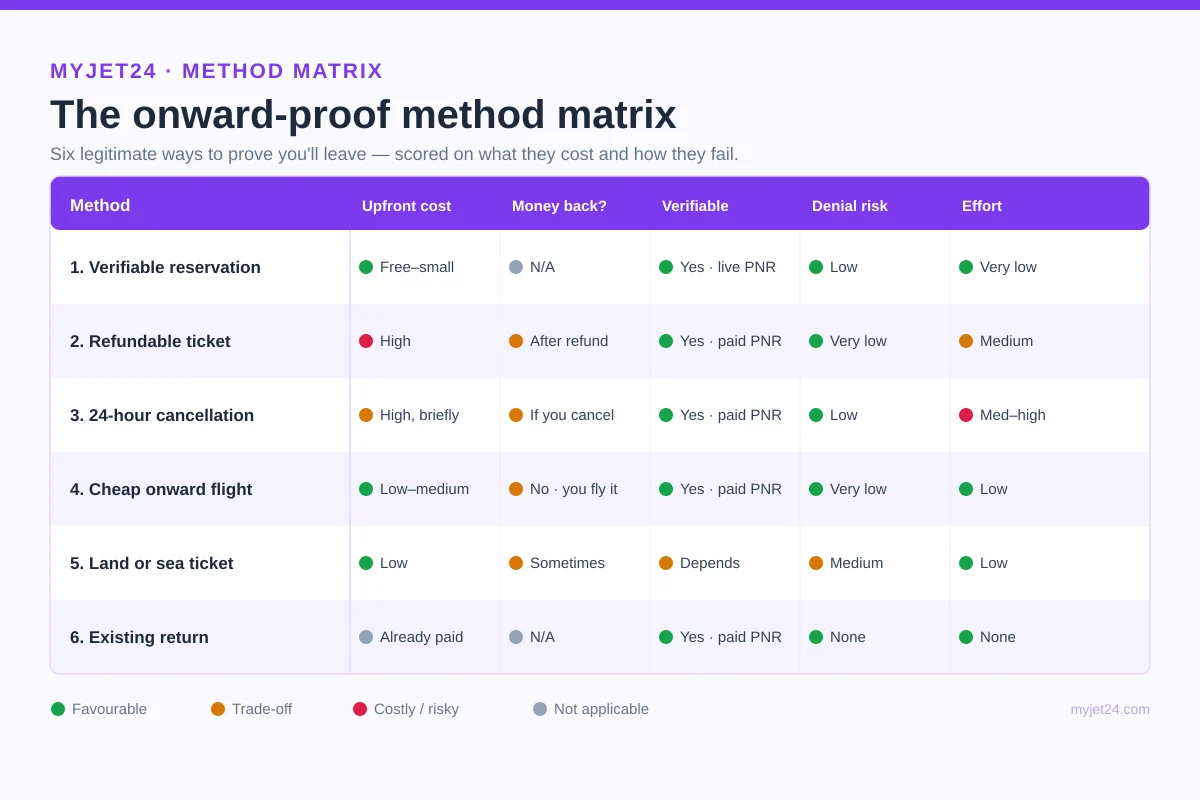
| Method | Upfront cost | Money back? | Verifiable | Denial risk | Effort |
|---|---|---|---|---|---|
| 1. Verifiable reservation | Free–small fee | N/A (never paid) | Yes — live PNR | Low | Very low |
| 2. Refundable ticket | High | Yes, after refund | Yes — paid PNR | Very low | Medium |
| 3. 24-hour cancellation | High, briefly | Yes, if you cancel | Yes — paid PNR | Low | Medium–high |
| 4. Cheap onward flight | Low–medium | No (you fly it) | Yes — paid PNR | Very low | Low |
| 5. Land or sea ticket | Low | Sometimes | Yes — depends on issuer | Medium | Low |
| 6. Existing return / open-jaw | Already paid | N/A | Yes — paid PNR | None | None |
Method 1 — A verifiable flight reservation
A verifiable flight reservation is a genuine airline booking, held on a live PNR in a global distribution system such as Amadeus or Sabre, that you have not paid to fly. It is the cheapest method that still passes a real check, which is why it is the default for visa applicants and one-way travellers alike.
Here is how it works. A travel agency or a service like MyJet24 creates a real reservation; the airline holds the seat for a set window and issues a genuine record locator. During that window an airline agent or consular officer who looks up the PNR sees a real, ticketed-looking itinerary. Because you never pay the fare, the booking lapses on its own rather than flying — so there's nothing to refund and nothing to cancel. The trade-off is validity: the hold is temporary, so you generate it close to when it will be checked. Our walk-through of getting a flight itinerary without buying a ticket covers the mechanics; the terminology behind "reservation," "dummy ticket" and "onward ticket" is untangled in this comparison.
Key takeaway: a verifiable reservation is the lowest-cost, lowest-lock-up way to hold real onward proof. For example, a visa applicant who needs an itinerary for the application but can't buy a real ticket until the visa is approved gets exactly what the consulate wants — a checkable plan — with no money tied up and nothing to fly.
Method 2 — A fully refundable ticket
A fully refundable ticket is a real, paid fare that you can cancel for a full refund, giving you the strongest possible proof at the highest upfront cost. It is the belt-and-braces option: nothing looks more convincing to an agent than a paid, ticketed onward flight, because it carries a live e-ticket number, not just a hold.
The catch is money and discipline. Refundable fares cost far more than the equivalent non-refundable ticket — often several times as much — and you front that entire amount until the refund clears, which can take days or weeks. You also have to actually request the cancellation; forget, and you've bought an expensive flight you won't take. Compared with a reservation, it buys marginally more certainty at a much higher cost and effort, which is why we usually reserve it for travellers facing famously strict carriers or borders. The full cost-and-risk trade-off is broken down in our dummy ticket vs refundable flight comparison.
Key takeaway: a refundable ticket is the safest proof and the most expensive path to it. Use it when the stakes are high and the carrier is strict; skip it when a reservation will do, which is most of the time.
Method 3 — A 24-hour free-cancellation booking
A 24-hour free-cancellation booking is a real ticket you buy and then cancel within a penalty-free window, relying on the airline's cancellation policy to get your money back. In the United States, this is backed by a federal rule: under the Department of Transportation's 24-hour reservation requirement (14 CFR 259.5), carriers must either hold a booking at the quoted fare for 24 hours without payment, or let you cancel within 24 hours without penalty — but only for reservations made seven or more days before departure.
To use it cleanly:
- Book directly with the airline — the DOT rule applies to carriers' own bookings, not always to third-party agencies, and booking direct avoids a middleman's separate fee.
- Confirm you're seven or more days out. Inside seven days, US carriers can decline the free 24-hour cancellation, and the method collapses.
- Screenshot the confirmation and PNR the moment it's issued — that's the proof you'll show at check-in or attach to a visa file.
- Set a timer and cancel well inside 24 hours. Miss the window and you own the ticket.
The 24-hour rule is a genuine, free way to hold real proof — but it's a stopwatch, not a safety net. It only works if you book direct, book early, and remember to cancel. Outside the US, "free cancellation" is a marketing promise, not a legal one.
Key takeaway: the DOT 24-hour rule turns a real ticket into short-lived free proof, but it's US-anchored and deadline-driven. It suits organised travellers booking a week ahead; it's a poor fit for a last-minute departure or anyone who'd rather not risk the clock.
No money fronted, nothing to cancel. A real PNR you can show at the gate.
Method 4 — A cheap real onward flight
A cheap real onward flight is exactly what it sounds like: a genuine budget ticket out of the country that you actually intend to use, or are willing to write off. On a low-cost regional route, a one-way fare to a nearby country can cost less than the fee some services charge for a reservation, and it is unimpeachable proof because you're really flying it.
This method shines when your onward plan is roughly real anyway. A traveller island-hopping through Southeast Asia, or a nomad who was going to move on within a month, loses nothing by booking the next hop early and showing it as onward proof. The downside is commitment: you're locked into a date and route, and if plans change the fare is usually gone. Buying a ticket purely to throw it away — the classic "throwaway" — works as proof but wastes the money, which is the exact inefficiency a reservation exists to avoid.
Key takeaway: if you were going to leave anyway, a cheap real onward flight is the most honest proof there is. If you're only buying it to satisfy a check, you're paying to fly a plane you don't want — at which point a reservation does the same job for less.
Method 5 — A land or sea ticket
Onward travel does not have to be a flight. A booked bus, train or ferry ticket to a neighbouring country is valid onward proof in many places, because the rule is about leaving — not about how you leave. The US Visa Waiver Program is explicit on this point: 8 CFR §217.2 defines the requirement as a "round trip transportation ticket," not an air ticket, which is why a cruise or an overland route can satisfy it.
The limits matter, though. Two things can trip you up. First, coverage is uneven: some countries and some airlines only accept an onward flight, especially when you're arriving by air, and a bus reservation to the next border won't reassure a strict check-in agent. Second, land and sea tickets are often less verifiable — a small ferry operator's confirmation may not resolve to a checkable record the way a GDS booking does. If you're flying in and hoping a land ticket covers you, confirm the specific airline and country accept it first. The nuances of non-flight proof, including where cruises count, are covered in our cruise onward-travel guide.
Key takeaway: a land or sea ticket is a cheap, legitimate answer where the rule allows any mode of exit — common for overland travellers and closed borders. It's a weaker bet when you arrive by air with a strict carrier, so verify acceptance before you count on it.
Method 6 — Your existing return or open-jaw ticket
If you already hold a real return or onward leg, you already have the strongest proof possible — and you should stop shopping for another. A round-trip ticket, or an open-jaw itinerary that flies you out of a different city, is a paid booking on a live PNR that answers the onward question completely.
The point of listing it is that many travellers overlook it. A person on a two-week trip with a booked return doesn't need a separate onward document; the return is the onward proof. The same goes for an open-jaw traveller who enters one country and departs from another — the outbound leg from the second country satisfies the first country's check. Where this gets misread is long, flexible trips: if your return is months away or undated, a border officer applying a short-stay rule may still want to see how you'll leave within the permitted window, which is when one of the earlier methods fills the gap. This is a frequent snag for the one-way and slow-travel crowd, covered in our onward-ticket guide for digital nomads.
Key takeaway: check what you already have before you book anything. An existing return or open-jaw ticket usually is your proof of onward travel — the only exception being stays too long or too open-ended for it to answer the "how will you leave in time?" question.
The one to avoid: fake PDFs
A fake ticket is an edited PDF with an invented booking code and no real reservation behind it — and it is the one method that reliably fails. It looks like the cheap shortcut and behaves like a landmine: the moment anyone looks up the code, it resolves to nothing or to someone else's booking, and a document meant to build trust instead destroys it.
The consequences aren't limited to an awkward gate conversation. A forged document submitted with a visa application can be treated as fraud, risking not just refusal but a longer-term bar. And it's an entirely unnecessary risk, because every legitimate method above costs about the same or less. The distinction is the whole game: a reservation is a real booking you simply haven't paid to fly; a fake is a fabricated one that never existed. If you've been offered a suspiciously cheap "guaranteed" PDF, our breakdown of whether free dummy-ticket generators actually work shows how to tell a real reservation from a worthless file.
Key takeaway: a fake PDF is cheaper than nothing and worth less than nothing. There is no scenario where it beats a verifiable reservation, and several where it turns a solvable problem into a serious one.
The verifiability spectrum
Line the methods up by the one thing that decides whether they work — verifiability — and the ranking becomes obvious. Verifiability is whether the proof resolves to a real, checkable booking when someone looks it up. Everything on the "pass" side of the line survives a lookup; everything on the "fail" side does not.
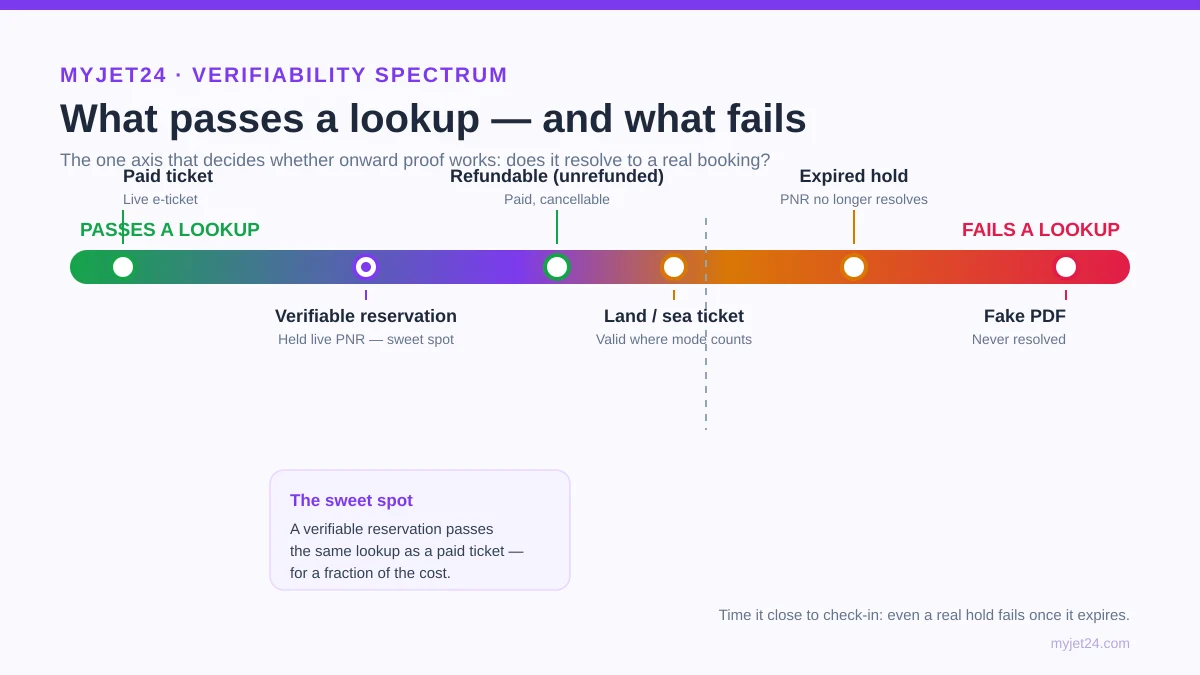
At the strong end sits a paid ticket (a live e-ticket number), then a verifiable reservation (a genuine held PNR) — the sweet spot, because it's nearly as convincing for a fraction of the cost. A refundable ticket sits alongside it while unrefunded. Further along, a land or sea ticket passes where the mode is accepted but is sometimes harder to check. Then comes the failure zone: an expired reservation, where the hold has lapsed and the PNR no longer resolves, and finally the fake PDF, which never resolved at all. The practical lesson is timing as much as choice — even a legitimate reservation slides into the fail zone if you generate it too early and let it expire before it's checked.
Almost every onward-travel problem is really a verifiability problem. Show a booking that passes a lookup at the moment you're asked, and the method you chose to create it barely matters.
Key takeaway: pick any method on the pass side and keep it current. A reservation timed to your check-in beats a refundable ticket bought a month early and forgotten, because verifiability is a property of the moment, not of the price you paid.
Which method should you use?
The right method depends on why you need the proof and how firm your plans are. Match your situation to the row below rather than hunting for a universal answer — the whole point of six methods is that different travellers face different trade-offs.
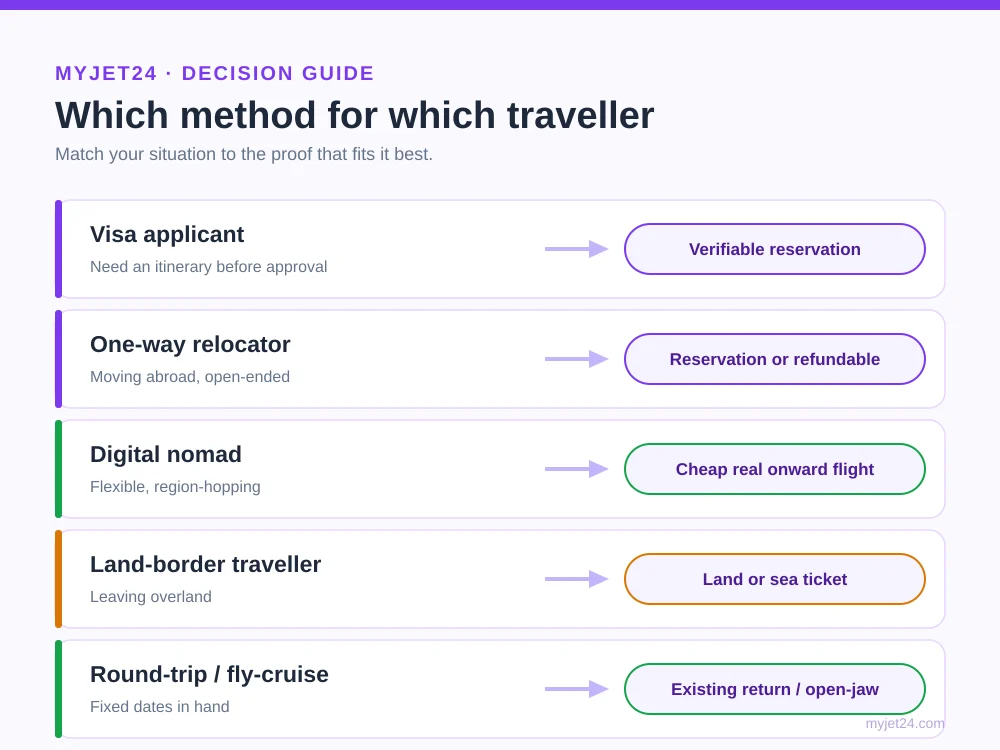
| Your situation | Best method | Why |
|---|---|---|
| Visa applicant (need an itinerary before approval) | Verifiable reservation | Consulates want a plan, not a paid fare; don't buy a ticket before the visa clears. |
| One-way relocator (moving, open-ended) | Verifiable reservation or refundable ticket | You need to clear the gate without committing to a return you won't use. |
| Digital nomad (flexible, region-hopping) | Cheap real onward flight | You were moving on anyway — a real next hop is honest, cheap proof. |
| Land-border traveller (overland exit) | Land or sea ticket | Where any mode counts, a bus, train or ferry booking is cheapest — confirm it's accepted. |
| Round-trip / fly-cruise (fixed dates) | Existing return or open-jaw ticket | You already hold the proof — don't buy a second document. |
The data point worth remembering. According to Eurostat, 132,600 travellers were refused entry at EU external borders in 2025, and the single largest reason — 40,185 cases, 30.3% of the total — was "purpose and conditions of stay not justified," the category a weak or missing onward-travel document falls into. At air borders that reason drove 40.0% of refusals, and a separate 10,330 people (7.8%) were turned away for insufficient means of subsistence. Whichever method you pick, the job it's doing is answering the exact question those refusals turn on: how and when are you leaving? The Schengen proof-of-funds rules cover the money half of the same check.
Frequently asked questions
What is the cheapest way to show proof of onward travel?
A verifiable flight reservation is usually the cheapest low-risk option, because it's a real held booking you never pay to fly, so no money is tied up and there's nothing to refund. A land or sea ticket can be cheaper still where any mode of exit is accepted. The genuinely free routes — a 24-hour-cancellation booking or an existing return — work too, but one is a deadline you have to manage and the other only helps if you already hold it.
Does proof of onward travel have to be a flight?
Not always. In many places a booked bus, train or ferry to a neighbouring country counts, and the US Visa Waiver Program specifically requires a "round trip transportation ticket," not an air ticket. But coverage is uneven: some countries and airlines only accept an onward flight, especially when you arrive by air. Confirm the specific carrier and destination accept non-flight proof before relying on it.
Can I just buy a refundable ticket and cancel it?
Yes, and it's strong proof, but it's the expensive path. A fully refundable fare costs far more than a normal ticket and you front the whole amount until the refund clears, which can take days or weeks. You also have to remember to cancel. It works well for strict carriers or high-stakes trips; for routine checks, a verifiable reservation does the same job without the cost.
How does the US 24-hour cancellation rule work for onward travel?
Under the Department of Transportation's 24-hour reservation requirement, US carriers must let you cancel a booking within 24 hours without penalty (or hold it unpaid for 24 hours), provided the booking was made seven or more days before departure. That lets you buy a real ticket, screenshot the confirmation as proof, and cancel for a full refund. It only applies to bookings made directly, at least a week ahead, and you must cancel inside the window.
Who actually checks proof of onward travel — the airline or immigration?
Both can, but the airline check at the departure gate is the one that usually stops people, because it happens first. Airlines screen onward travel through the Timatic database to avoid carrier-liability penalties — if they fly you somewhere you're refused entry, they pay to fly you back. Immigration officers at arrival can also ask, applying entry rules such as the Schengen Borders Code, but by then you've already boarded.
Will a flight reservation work instead of a paid ticket?
Generally yes, as long as it's verifiable. A genuine reservation on a live PNR resolves to a real booking when an airline agent or consular officer looks it up, which is what the check is really testing. The reservation just needs to be real and still active at the moment it's checked — an expired hold no longer resolves, so time it close to your visa interview or check-in rather than weeks ahead.
Is it legal to show proof of onward travel you don't intend to use?
Showing a genuine reservation you don't ultimately fly is legitimate and widely accepted, because the booking is real and verifiable — consulates themselves often advise against buying a paid ticket before a visa is approved. What's not legal is a fake or forged document with no booking behind it, which can be treated as fraud. The line is whether the booking actually exists, not whether you'll use it.
Do I still need onward proof if I already have a visa?
Often, yes. A visa is permission to seek entry; it doesn't remove the airline's onward-travel check or a border officer's right to ask how you'll leave. Travellers with valid visas — and especially those entering visa-free — are still asked at check-in, so carrying a verifiable onward booking is sensible regardless of visa status.
How far in advance should I arrange proof of onward travel?
Close to when it will be checked, not weeks ahead. Held reservations lapse after a short window and refundable tickets tie up money the longer you hold them, so the ideal is to have live, verifiable proof in hand for the moment of the visa interview or the check-in desk. Arranging it a day or two before is usually the safe sweet spot.
The bottom line
Six methods, one job. A verifiable reservation, a refundable ticket, a 24-hour-cancellation booking, a cheap real onward flight, a land or sea ticket, and an existing return each prove the same thing — that you'll leave — and differ only in what they cost and how they can fail. The fake PDF is the lone exception, and it fails on purpose. Sort the six by verifiability and the choice stops being about names or price and starts being about one question: will this booking pass a lookup at the moment I'm asked?
For most travellers the practical answer is the cheapest option that still passes that lookup: a real reservation with a live PNR, timed to your visa interview or check-in. It clears the gate and satisfies the application without tying up money in a fare you may never fly. When you need one, create a verifiable onward ticket, keep it current, and match the method to your trip — not the other way round.
A verifiable reservation with a live PNR, ready in about 30 seconds — no fare to pay, nothing to cancel.
Marc Hoffmann — Entry-Requirements Writer, MyJet24
Marc covers immigration and entry-requirement policy for MyJet24, tracking how airlines and border authorities apply onward-travel rules across 60+ countries. This guide draws on primary sources including the Schengen Borders Code, US DOT and immigration regulations, and Eurostat border-refusal data. Reviewed on 7 August 2026 by James Mitchell, Travel Documentation Writer at MyJet24.
Sources
- US Department of Transportation — 24-hour reservation requirement (14 CFR 259.5): https://www.transportation.gov/individuals/aviation-consumer-protection/24-hour-reservation-requirement
- US Code of Federal Regulations — 8 CFR §217.2, Visa Waiver Program "round trip transportation ticket": https://www.law.cornell.edu/cfr/text/8/217.2
- Regulation (EU) 2016/399 (Schengen Borders Code), Annex I — supporting documents incl. "a return or round-trip ticket": https://www.legislation.gov.uk/eur/2016/399/annex/I
- Eurostat — Refusals of entry at EU external borders, 2025 (news release, 12 May 2026): https://ec.europa.eu/eurostat/web/products-eurostat-news/w/ddn-20260512-1
This guide explains proof-of-onward-travel methods as of 7 August 2026, drawing on US DOT and immigration regulations, the Schengen Borders Code, Eurostat data and standard airline (IATA/Timatic) practice. Individual consulate, airline and country requirements vary and can change. Verify with the relevant embassy, airline and official border authority before you travel. This article is informational and not legal or immigration advice.
