
Last updated: 31 July 2026 · Reading time: 14 min · Author: James Mitchell, Travel Documentation Writer at MyJet24 · Reviewed by: Marc Hoffmann
TL;DR — Key Facts
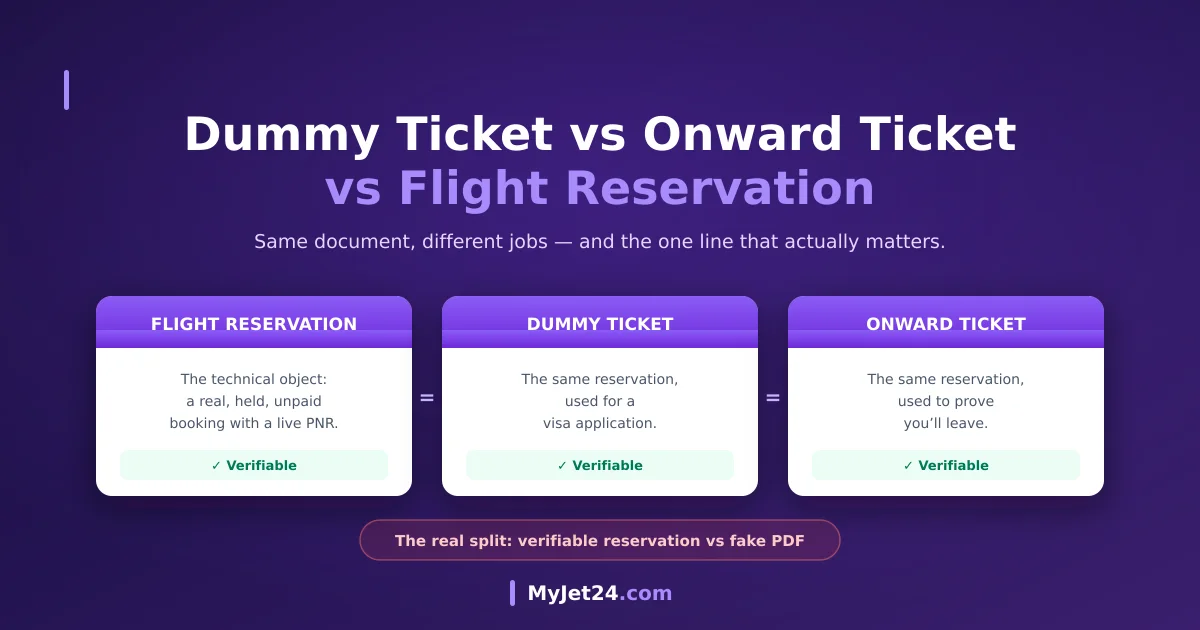
- They overlap, but they aren't the same. A "flight reservation" is the technical thing; "dummy ticket" and "onward ticket" are use-cases for it. The real dividing line is verifiability, not the name.
- A flight reservation is a real, unpaid booking with a live PNR — an airline actually holds the seat for a short window. It's the safe, checkable document behind a good dummy or onward ticket.
- A "dummy ticket" is a flight reservation used to satisfy a visa application. An "onward ticket" is the same kind of document used to prove you'll leave a country at check-in or the border.
- A "fake ticket" is none of these. An edited PDF with an invented booking code has no live PNR, fails verification, and can get a visa refused. Verifiability is what separates a legitimate document from a forgery.
- Which you need depends on the moment: a visa application wants a dummy ticket / itinerary; an airline gate wants an onward ticket; a one-way traveller wants proof of onward travel. One verifiable reservation can serve all three.
- The stakes are real: "purpose and conditions of stay not justified" — the category a missing onward document falls into — was the single biggest reason for EU entry refusals in 2025, at 40,185 cases.
A flight reservation is a real, temporarily held airline booking with a live PNR that you have not paid for. A "dummy ticket" and an "onward ticket" are the same type of document described by how it's used: a dummy ticket is a flight reservation submitted with a visa application, and an onward ticket is a flight reservation shown to an airline or border officer to prove you will leave a country. The critical difference is not between these three names but between a verifiable reservation (a genuine, checkable booking) and a fake ticket (an edited PDF with no real PNR). For most travellers, one verifiable onward ticket satisfies a visa application, airline check-in and immigration alike.
A real reservation with a live PNR, ready in about 30 seconds.
In this guide
The comparison at a glance
The three terms describe overlapping things, which is exactly why they get confused. The table below is the fastest way to see where they actually differ — and where they don't. In our experience helping travellers pick the right document, most confusion disappears the moment you separate the object (a reservation) from the job (visa vs departure proof).
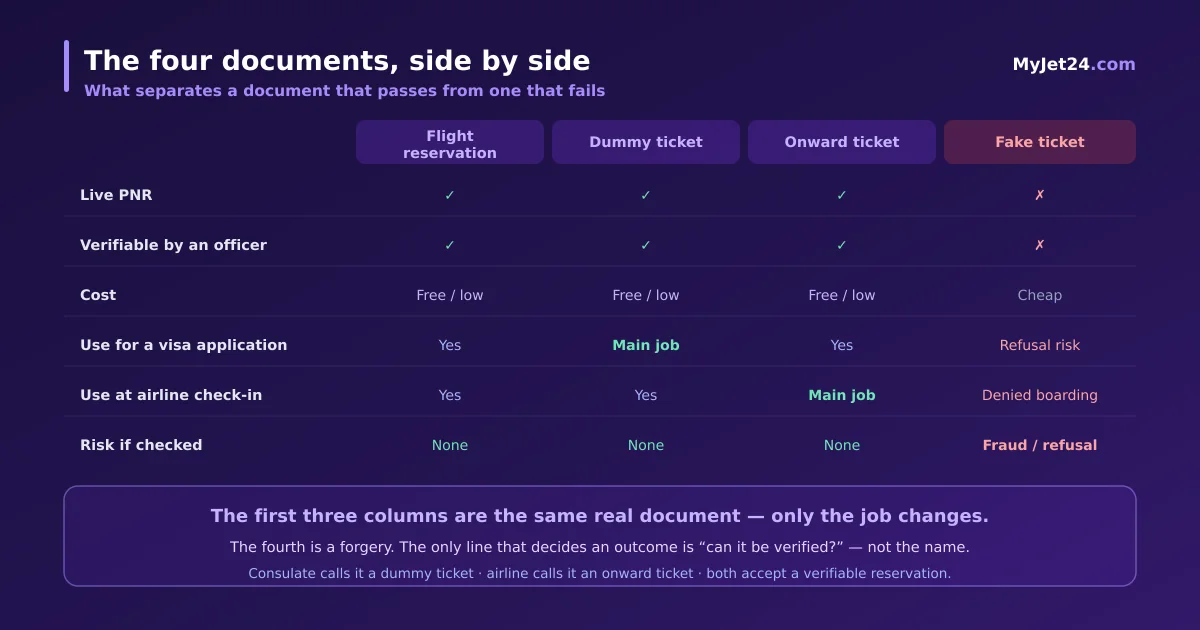
| Flight reservation | Dummy ticket | Onward ticket | Fake ticket | |
|---|---|---|---|---|
| What it is | The technical object: a held, unpaid booking | A reservation used for a visa application | A reservation used to prove departure | An edited PDF, no real booking |
| Live PNR | Yes | Yes (if legitimate) | Yes (if legitimate) | No |
| Verifiable | Yes | Yes | Yes | No — fails checks |
| Cost | Free or small fee | Free or small fee | Free or small fee | Cheap — and worthless |
| Use for a visa | Yes | Its main job | Yes | Risk of refusal |
| Use at check-in | Yes | Yes | Its main job | Risk of denied boarding |
The question is almost never "dummy ticket or onward ticket?" — they're the same document doing different jobs. The question that matters is "verifiable reservation or fake PDF?" One passes checks; the other fails them.
What a flight reservation is
A flight reservation is a genuine airline booking that holds a seat for you temporarily without payment, identified by a live record locator (PNR) in a global distribution system such as Amadeus or Sabre. It is the underlying object — the real, checkable thing — that the other terms describe by their purpose.
When a travel agency or a service like MyJet24 books a reservation, an airline actually creates a record and holds the seat for a set window (often 24–48 hours, sometimes longer) before it's cancelled if unpaid. During that window, anyone with the PNR — a consular officer, an airline agent — can look it up and see a real, ticketed-looking itinerary. That verifiability is the whole point. A flight reservation differs from a purchased ticket in one respect only: no money has changed hands and no e-ticket number has been issued, so it will lapse rather than fly.
Key takeaway: "flight reservation" is the technically accurate name for the document. "Dummy ticket" and "onward ticket" are just what you call that same reservation depending on who you're showing it to. Our guide to getting a flight itinerary without buying a ticket walks through how the booking is actually created.
What a dummy ticket is
A dummy ticket is a flight reservation used specifically to satisfy the flight-booking requirement of a visa application. It is not a lesser or fake version of a ticket — it's the same verifiable reservation described above, named for its job: proving a travel plan to a consulate without committing to a paid, non-refundable fare before your visa is even approved.
Consulates ask for a flight itinerary to see that your trip is real and time-bound. But buying a real ticket first is a bad bet: visa refusal rates are significant — the Schengen area alone refused about one in seven applications in 2025 — and the fee is gone whether or not you fly. A dummy ticket solves this by giving the consulate a genuine, verifiable booking to assess, while your money stays in your pocket until the visa is granted. For a worked example of the requirement, see our US B-1/B-2 dummy ticket guide, and for the legal picture, is a dummy ticket legal?
A dummy ticket is legitimate precisely because it's a real reservation. The word "dummy" describes the intent — a placeholder booking, not a purchase — not a forgery. The moment it stops being a real booking, it stops being a dummy ticket and becomes a fake one.
What an onward ticket is
An onward ticket is a flight reservation used to prove that you will leave a country — shown to an airline at check-in or to an immigration officer at the border, rather than to a consulate. It answers the single question that gatekeepers care about: how and when are you departing?
The reason it matters most at the airport is money — the airline's, not yours. Under international carrier-liability rules, an airline that boards a passenger who is then refused entry has to fly them back at its own cost, and can be fined. So airlines check for onward travel before boarding, screening it through the industry's Timatic database. This is why a one-way traveller can clear a visa but still be stopped at the departure gate. Immigration can ask too: the requirement to show "a return or round-trip ticket" is written into Annex I of the Schengen Borders Code, and dozens of countries apply a version of it. We cover exactly where in our roundup of which countries require proof of onward travel, and the boarding mechanics in can airlines deny boarding without it?
Key takeaway: a dummy ticket and an onward ticket are the same reservation, distinguished only by the checkpoint. The consulate calls it a dummy ticket; the airline calls it an onward ticket. Neither is more "real" than the other.
Why "fake ticket" is a different thing entirely
A fake ticket is a document that looks like a booking but has no real reservation behind it — typically an edited PDF or a screenshot with an invented booking code. It is not a cheaper kind of dummy ticket; it's a forgery, and it fails the one test that matters.
The difference is verifiability. A legitimate reservation has a live PNR that a consulate or airline can look up and confirm. A fake ticket has a code that resolves to nothing — or, worse, to someone else's booking. When an officer checks it and finds no matching record, the outcome isn't just a rejected document: it's a credibility problem that can sink the whole application or trip, and in some jurisdictions submitting a forged document is a criminal matter. In our testing of "verify your booking" flows, the gap is binary — a real reservation returns a matching itinerary in the airline's system; a fake returns an error. There's no middle ground. Our guides on PNR validity and what a dummy ticket actually is go deeper on how to tell the two apart before you submit.
The verifiability spectrum
The verifiability spectrum is a way to rank travel documents by whether an official can confirm them — and it's the only axis that actually predicts whether a document will pass. Forget the labels for a moment; sort by "can this be checked?" and the picture gets simple.
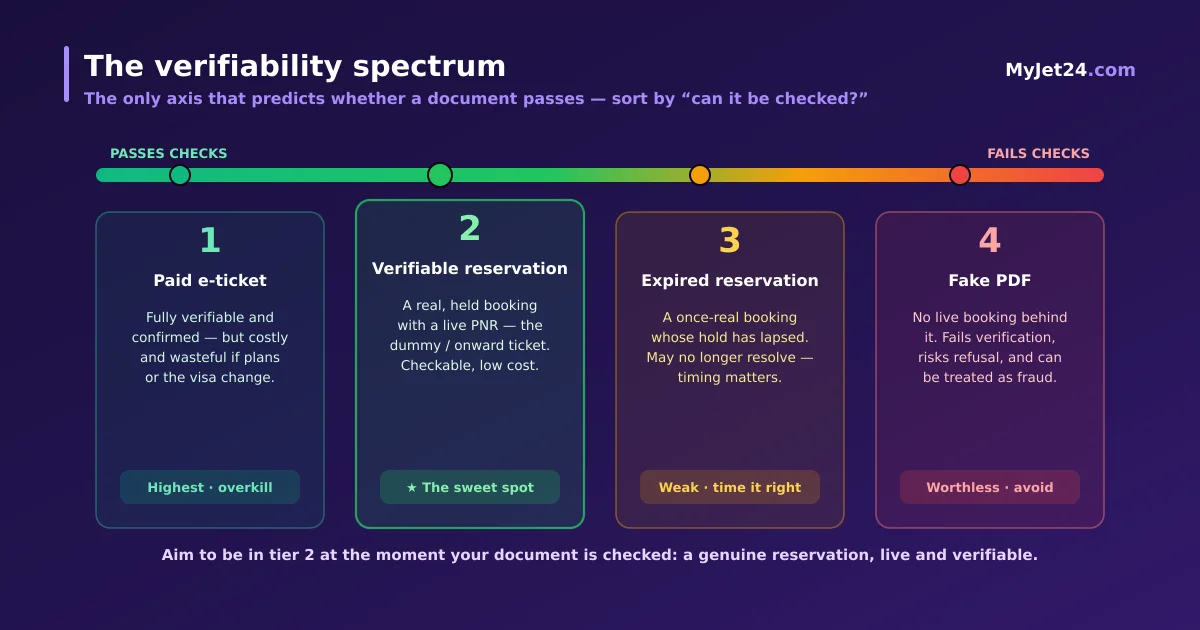
- Paid e-ticket (highest). A purchased, ticketed flight with an e-ticket number. Fully verifiable and confirmed — but expensive and wasteful if your plans might change or your visa might be refused.
- Verifiable reservation (the sweet spot). A real, held booking with a live PNR — the flight reservation behind a legitimate dummy or onward ticket. Checkable during its validity window, at little or no cost.
- Expired reservation (weak). A once-real booking whose hold has lapsed. The PNR may no longer resolve, so timing matters — generate it close to when it will be checked.
- Fake PDF (worthless). No live booking behind it. Fails verification, risks refusal, and can be treated as fraud.
Key takeaway: the practical goal is to sit in tier two at the moment your document is checked — a genuine reservation, live and verifiable, timed to the checkpoint. That's what a well-made onward ticket delivers.
Which one do you actually need?
The right document is determined by the checkpoint you're facing, not by the name in your search bar. Here's the decision framework we use with travellers — match your situation to the row.
| Your situation | What you need |
|---|---|
| Applying for a visa, don't want to buy a fare yet | A verifiable flight reservation (a "dummy ticket") plus a hotel booking |
| Flying somewhere visa-free on a one-way ticket | An onward ticket dated inside your permitted stay, for check-in |
| Touring overland, no fixed exit flight | A verifiable onward reservation to show intent to leave |
| Trip is fixed and paid for already | Your real e-ticket — no placeholder needed |
| Tempted by a cheap "fake ticket" site | Don't — use a verifiable reservation instead |
The simplifying truth: in nearly every one of these cases the answer is the same physical document — a real, verifiable flight reservation. A free verifiable onward ticket covers the visa application, the airline gate and the border in one booking, with a live PNR you can show anyone. You only need a paid ticket when your plans are genuinely locked in.
Who accepts what — visas, airlines, borders
Acceptance is really a question of verification: consulates, airlines and border officers all accept the same kind of document — a genuine, checkable reservation — because all three can confirm it. What none of them accept, once they look, is a document that fails a lookup.
Consulates want to see a coherent, time-bound plan and will take a verifiable reservation as evidence of it; many explicitly don't require a paid ticket at the application stage. Airlines want proof you can be admitted to your destination, and check onward travel through Timatic at the gate. Immigration officers, where they ask, are applying entry rules such as the Schengen Borders Code's return-ticket clause. The through-line: a real reservation satisfies all three, and the stakes for getting it wrong are not abstract.
The data point worth remembering. According to Eurostat, 132,600 travellers were refused entry at EU external borders in 2025, and the single largest reason — 40,185 cases, 30.3% of the total — was "purpose and conditions of stay not justified," the category that a weak or missing onward-travel document falls into. At air borders that reason accounted for 40.0% of refusals. A verifiable onward ticket is one of the cleanest ways to answer the exact question those refusals turn on: how and when are you leaving?
Frequently asked questions
Is a dummy ticket the same as an onward ticket?
Essentially yes — they're the same type of document (a real, unpaid flight reservation) named for different uses. A dummy ticket is a reservation submitted with a visa application; an onward ticket is a reservation shown to an airline or border officer to prove you'll leave a country. The document itself is identical; only the checkpoint differs.
Is a flight reservation the same as a dummy ticket?
A flight reservation is the technical object — a genuine airline booking with a live PNR that you haven't paid for. A dummy ticket is that reservation used for a visa application. So a dummy ticket is a flight reservation; "flight reservation" is just the accurate, neutral name for what's underneath.
Is a dummy ticket legal?
Yes, when it's a genuine reservation. Using a real, temporarily held booking to satisfy a visa or airline requirement is legitimate and widely accepted, because the booking actually exists and can be verified. What's not legitimate is a fake ticket — an edited document with no real booking — which can be treated as fraud. The legality hinges on the document being real, not on the word "dummy."
What's the difference between a dummy ticket and a fake ticket?
A dummy ticket is a real, verifiable reservation with a live PNR; a fake ticket is a forged PDF with no booking behind it. The first passes verification when an officer checks it; the second fails, resolving to no record or someone else's booking. That single difference — verifiable versus not — is what separates a legitimate document from one that can get you refused.
Do embassies accept flight reservations instead of paid tickets?
Most do at the application stage. Consulates generally ask to see a flight itinerary as evidence of a time-bound travel plan, and many explicitly advise against buying a non-refundable ticket before a visa is approved. A verifiable flight reservation provides the itinerary they need without the cost and risk of a purchased fare. Always check the specific consulate's guidance, as requirements vary.
Will an airline accept an onward ticket that's a reservation, not a paid flight?
Generally yes, provided it's verifiable. Airlines check onward travel to avoid carrier-liability penalties, and a genuine reservation with a live PNR satisfies that check when they look it up. A fake or expired booking can fail, so the reservation needs to be real and current at the moment of check-in. Timing it close to travel keeps the PNR live.
How long is a flight reservation valid?
Typically from 24–48 hours up to a couple of weeks, depending on the airline and how the booking is made, before the unpaid hold lapses. Because validity is limited, the practical rule is to generate the reservation close to when it will be checked — for a visa interview or a check-in — rather than weeks ahead. Our dedicated guide on PNR validity covers the specifics by scenario.
Can I use one document for both my visa and my flight?
Yes — a single verifiable flight reservation can serve as the dummy ticket for your visa application and, if timed right, the onward ticket at check-in, since it's the same document. If your plans are fixed and you've bought a real ticket, that paid e-ticket covers both too. The key is that whatever you show is a genuine, checkable booking.
Do I need an onward ticket if I already have a visa?
Often, yes. A visa grants permission to seek entry; it doesn't remove the airline's onward-travel check or the border officer's ability to ask how you'll leave. Travellers with valid visas — and especially those entering visa-free — are still asked for proof of onward travel at check-in, so carrying a verifiable reservation is wise regardless of visa status.
The bottom line
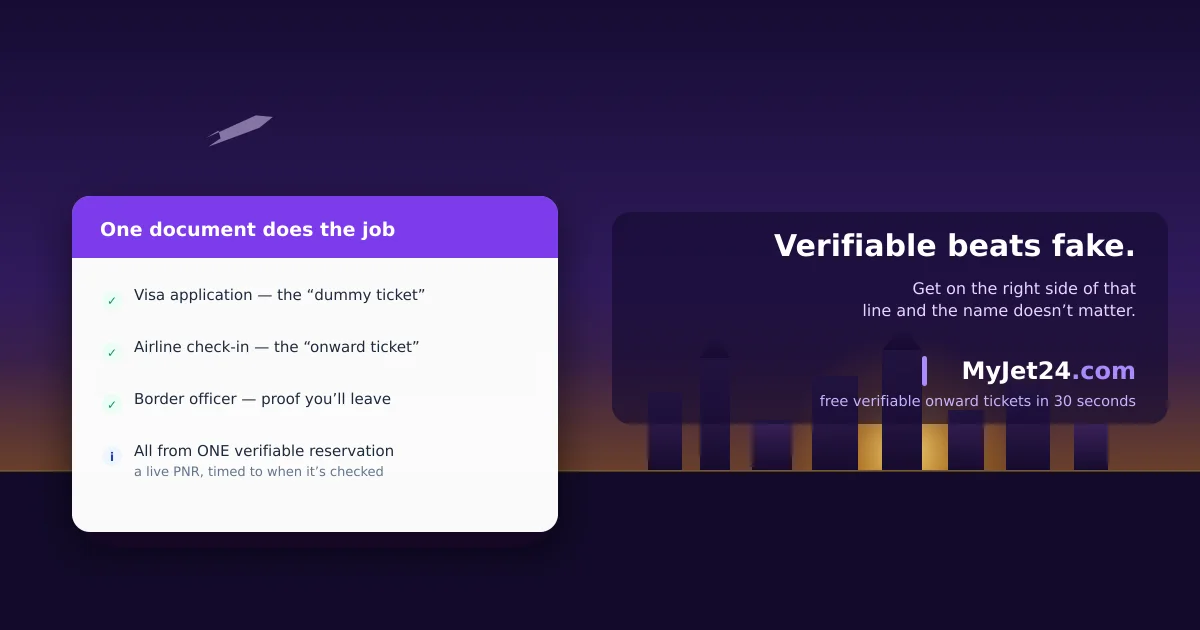
Strip away the vocabulary and the whole subject collapses into one distinction. "Flight reservation," "dummy ticket" and "onward ticket" are three names for the same real, verifiable booking, sorted only by who's looking at it — a consulate, an airline, a border officer. The line that actually matters runs elsewhere: between a genuine reservation that passes a lookup and a fake PDF that fails one. Get on the right side of that line and the name you use for it is irrelevant.
For almost every traveller, the practical answer is a single document: a real reservation with a live PNR, timed to the moment it will be checked. It satisfies the visa application, clears the airline gate, and answers the border's oldest question — how and when are you leaving? — without the cost or risk of buying a fare you might not fly. Create a free verifiable onward ticket when you need one, keep it current, and let the terminology sort itself out.
James Mitchell — Travel Documentation Writer, MyJet24
James has spent years explaining travel-document requirements — visa itineraries, onward-travel proof and airline boarding rules — for travellers across 60+ countries. This guide draws on primary sources including the Schengen Borders Code, Eurostat border-refusal data and IATA carrier-liability practice. Reviewed on 31 July 2026 by Marc Hoffmann, who covers immigration and entry-requirement policy for MyJet24.
Sources
- Eurostat — Refusals of entry at EU external borders, 2025 (news release, 12 May 2026): https://ec.europa.eu/eurostat/web/products-eurostat-news/w/ddn-20260512-1
- Regulation (EU) 2016/399 (Schengen Borders Code), Annex I — supporting documents incl. "a return or round-trip ticket": https://www.legislation.gov.uk/eur/2016/399/annex/I
- European Commission, DG HOME — Schengen short-stay visa statistics 2025 (refusal rate): https://home-affairs.ec.europa.eu/news/schengen-short-stay-visa-applications-rise-2025-remain-below-pre-pandemic-levels-2026-05-28_en
- UK Government (FCDO) — Foreign travel advice, entry requirements (onward travel): https://www.gov.uk/foreign-travel-advice
This guide explains travel-document terminology and requirements as of 31 July 2026, drawing on the Schengen Borders Code, Eurostat and European Commission data, and standard airline (IATA) practice. Individual consulate, airline and country requirements vary and can change. Verify with the relevant embassy, airline and official border authority before you travel. This article is informational and not legal or immigration advice.
