
Last updated: 5 July 2026 · Reading time: 14 min · Author: Joshua White, Travel Documentation Writer at MyJet24
TL;DR — Key Facts
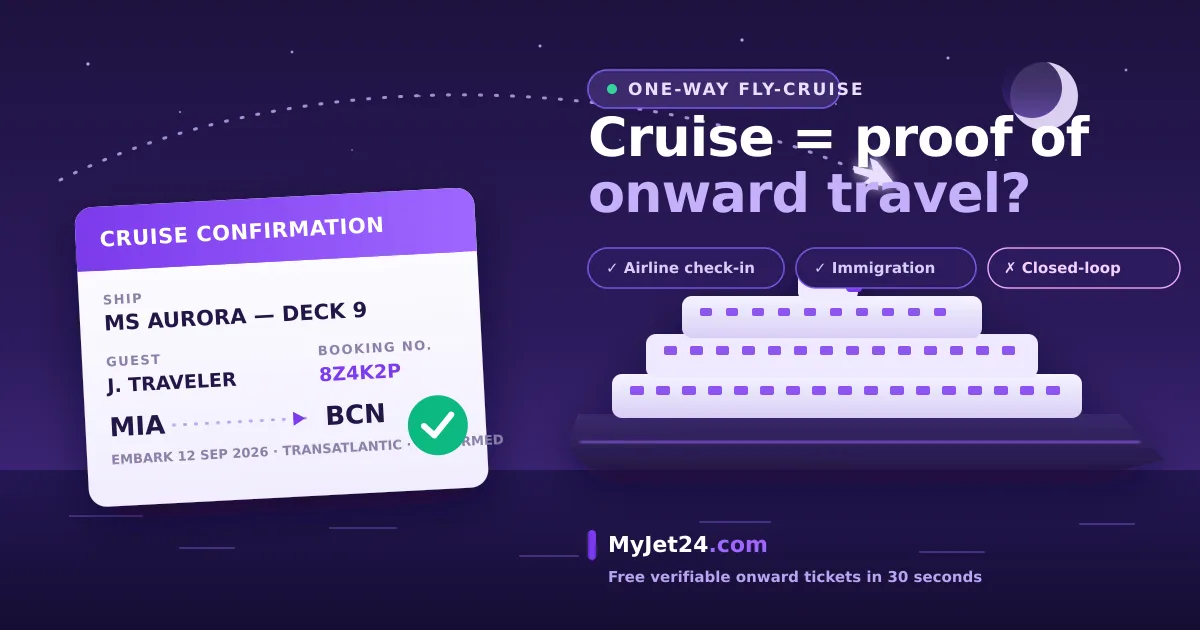
- Yes — a confirmed cruise booking counts as proof of onward travel at most borders. Immigration rules are written around leaving the country, not around airplanes: Taiwan's visa-exemption conditions literally say "return air/sea ticket," and the U.S. regulation defines the required document as a "transportation ticket," not a flight.
- The stricter gatekeeper is the airline check-in desk, not the border. Agents verify onward travel before boarding one-way passengers because the carrier pays the fine and the return flight if you are refused entry. A printed cruise confirmation with your name, ship, sail date and booking number passes; a screenshot of a shore-excursion app does not.
- The U.S. has the sharpest fine print. A cruise that ends in a foreign port satisfies the ESTA onward-ticket rule; a closed-loop Caribbean cruise that brings you back to Miami does not — you are back inside the United States, and the days at sea still count against your 90.
- Ferries, buses and trains work too — on paper. Costa Rica famously accepts a Tica Bus ticket to Panama, and Thailand recognizes land exits. In practice, low-cost-carrier desks reject land tickets more often than any other proof, so carry a stronger backup on those routes.
- When an agent insists on a flight, a verifiable flight reservation solves it in 30 seconds. A free MyJet24 onward ticket generates a real-PNR reservation that check-in staff can verify — the standard fallback when a cruise, ferry or bus booking is not enough.
A confirmed cruise booking counts as proof of onward travel for most countries, provided it shows your full name, the ship, the departure date and port, and a booking reference — and provided the cruise actually leaves the country you are entering. Airlines checking one-way passengers at check-in accept printed cruise confirmations under the same rule they apply to flights. The main exception is a closed-loop cruise for U.S. entry under ESTA: because the ship returns you to a U.S. port, it does not prove departure, and you still need separate onward transportation out of the United States.
Every week, thousands of travelers book the same perfectly sensible trip: a one-way flight to Miami, Barcelona or Singapore, a cruise out of that port, and no return flight yet — because the cruise ends somewhere else, or because the plan after disembarking is still open. Then, somewhere between booking and boarding, the doubt arrives: the airline wants proof of onward travel. Is a cruise ticket even valid? Do I need a flight? Search that question and you land in a swamp of decade-old forum threads, one-line FAQ answers and contradictory anecdotes from cruise message boards.
This guide replaces the anecdotes with the actual rules: what immigration regulations say about sea travel (several are more cruise-friendly than travelers assume), what airline check-in agents are trained to look for, the exact U.S. regulation that decides the ESTA question, where ferries, buses and trains stand — and the one fallback document that resolves every "computer says no" moment at the desk. It is the cruise-specific companion to our master guide on proof of onward travel, which covers the requirement country by country.
The Short Answer: When a Cruise Counts — and When It Doesn't
Proof of onward travel has one purpose: convincing a country (and the airline delivering you to it) that you will leave within your permitted stay. Nothing in that purpose requires an airplane. Immigration law in most of the world is written in transport-neutral language — "onward or return ticket," "proof of departure," "evidence of onward travel." A ship that carries you out of the country is departure, full stop.
A cruise booking counts as valid proof of onward travel when all four of these are true:
- The ship leaves the country you are entering. A cruise from Barcelona to Civitavecchia proves you will leave Spain. A cruise from Miami that loops the Caribbean and returns to Miami proves nothing about leaving the United States — you are on it and off it inside the same country.
- It departs within your permitted stay. The sail date must sit inside your visa-free window or visa validity — a ship on day 95 of a 90-day allowance works against you.
- It is confirmed and paid, with a booking reference. A quote, a hold or a screenshot of a fare search is not a booking. Agents look for the confirmation number.
- Your name is on it — exactly as in your passport, on the guest list of that booking, not just on the credit-card receipt of whoever paid.
And it fails in four recognizable situations: closed-loop itineraries used as "onward" proof for the country they return to; app screenshots with no booking number; group bookings that never list your name; and the rarer case of a destination whose airline-facing rules are phrased around air tickets — where a check-in agent may hesitate even though the border itself would accept the ship. The rest of this guide is about spotting which situation you are in before the airport does.
Two Different Gatekeepers: the Airline Desk and the Border Booth
Understanding who checks what — and why — dissolves most of the confusion in the cruise forums. There are two checkpoints between you and your ship, and they run on different incentives.
Checkpoint 1: the airline that flies you to the port
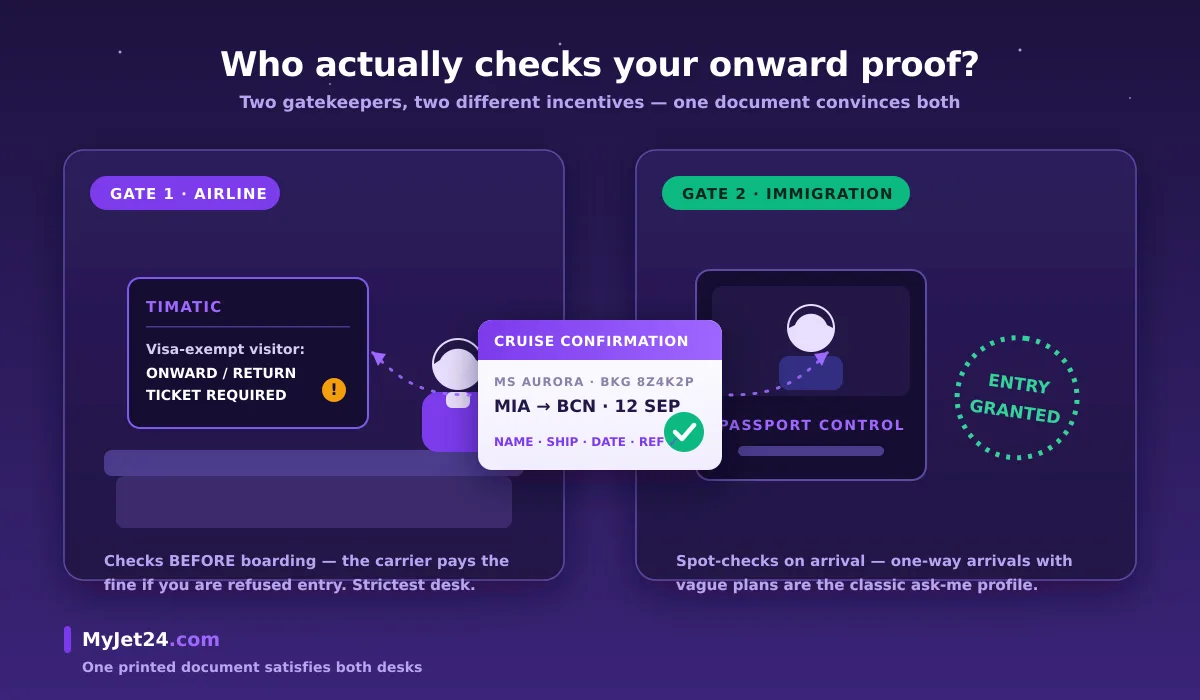
Under international carrier-liability rules, an airline that boards a passenger who is then refused entry pays the fine — routinely several thousand dollars — and carries you back at its own expense. So airlines verify entry conditions before departure, using Timatic, the IATA database that condenses every country's entry rules into instructions a check-in agent can apply in under a minute. When Timatic says a visa-exempt visitor needs an onward or return ticket, the agent asks the one-way passenger to show one. This is the checkpoint that actually bites: it happens hours before any immigration officer could see your documents, as we documented in our guide to denied boarding over onward travel.
The good news for cruise passengers: Timatic entries overwhelmingly use the neutral "onward/return ticket" phrasing, and airline document manuals treat confirmed sea passage as a ticket. A legible cruise confirmation — name, ship, date, ports, booking number — satisfies the instruction the agent is reading off the screen. Where it goes wrong is presentation (a phone app open to a countdown widget instead of a document) or geography (the loop itinerary that never actually leaves the country).
Checkpoint 2: the immigration officer — and the cruise terminal
Border officers ask for onward proof selectively — the classic trigger profile is a one-way arrival, a near-maximum intended stay and vague plans. Arrive with a cruise confirmation that matches your story and the conversation is over in seconds; officers process fly-cruise passengers every day at gateway airports like Miami, Fort Lauderdale, Barcelona and Singapore.
There is also a third desk travelers forget: the cruise line's own check-in at the terminal. On one-way (open-jaw) itineraries that end in a different country, the line verifies that you meet the entry rules of the final country — including, for some destinations, its onward-travel requirement. A passenger sailing Sydney to Singapore can be asked at the Sydney terminal how they will leave Singapore. Cruise lines apply this for exactly the same reason airlines do: the carrier that delivers you is responsible for you.
What Your Cruise Confirmation Must Show
Agents do not have a special cruise checklist — they map your document onto the same fields a flight itinerary has. Before you fly, export or print a confirmation that shows all six:
- Full passenger name, matching your passport — on the booking itself. If a partner or group leader booked, make sure the guest manifest page with your name is part of what you print.
- Booking or reservation number — the cruise line's reference the agent could look up. This single field separates "document" from "screenshot."
- Ship name and cruise line — "Explorer of the Seas, Royal Caribbean" reads as real transportation; "7-night Caribbean dream" does not.
- Embarkation port and date — this is the "departure" the onward-travel rule cares about, and the date must sit inside your permitted stay.
- Itinerary or disembarkation port — the line that shows the ship leaves the country. For open-jaw cruises, the final port is what the next country's rules apply to.
- Paid / confirmed status — "booking confirmed" or an invoice total. A courtesy hold with a payment deadline in the past invites questions.
Format matters more than travelers expect. A printed PDF — or at minimum the cruise line's confirmation email opened full-screen — hands the agent something they can read and photocopy. The cruise line's app, with its countdown tiles and deck plans, is designed for excitement, not for document checks; agents at busy desks have refused perfectly valid bookings simply because nothing on the screen looked like a transport document. Print it. Every experienced one-way cruiser eventually learns this the hard way, usually at 5 a.m. behind a rope barrier.
The U.S. Case: ESTA, the "Round Trip Ticket" Definition and the Closed-Loop Trap
No destination generates more cruise-and-onward-travel confusion than the United States, because it is the world's biggest cruise market and a country whose Visa Waiver Program has a codified ticket requirement. Here is the actual law, not the forum version.
Travelers entering by air under the Visa Waiver Program (with an approved ESTA) must hold what the regulation calls a round trip ticket. The definition, in 8 CFR § 217.2, is broader than most travelers — and some check-in agents — realize:
"Round trip ticket means any return trip transportation ticket in the name of an arriving Visa Waiver Program applicant on a participating carrier …" — 8 CFR § 217.2, definitions
Three consequences follow directly from that wording:
- "Transportation ticket," not "air ticket." Sea passage qualifies. The major cruise lines operating from U.S. ports participate in the Visa Waiver Program under the same carrier agreement airlines sign (Form I-775, referenced in the same definition) — which is why a cruise that ends in a foreign port is accepted as the onward leg for an ESTA arrival. Fly one-way into Barcelona? Different country, same logic works in reverse: a transatlantic cruise out of the U.S. satisfies the U.S. rule.
- The closed-loop trap. A Caribbean loop from Miami back to Miami is not "return trip transportation" out of the United States — it delivers you back inside the country. For the ESTA requirement it does not exist: you still need onward or return transportation out of the U.S. after the cruise, and that is the document the airline will ask for when you check in for your one-way flight to Florida.
- The 90-day clock keeps running at sea. Under the VWP rules for short side trips, departures to Canada, Mexico and the adjacent islands do not reset your admission — you are readmitted for the remainder of your original 90 days. A two-week Caribbean cruise costs you two weeks of your allowance; plan the post-cruise exit date accordingly.
Practical translation: flying one-way from Europe to Miami for a closed-loop cruise, you should expect the airline to ask how you leave the U.S. — and the correct answer is a flight or other transportation dated after the cruise, not the cruise itself. Travelers who have not booked their post-cruise plans yet use a verifiable onward reservation for exactly this moment.
Country Rules for Cruise Passengers: Where Ships Are Accepted
The pattern worldwide: written rules are transport-neutral or explicitly include sea travel; enforcement strictness varies by country and by airline route. The snapshot for 2026's most-sailed destinations:
| Destination | Cruise accepted as onward proof? | What actually matters |
|---|---|---|
| United States (ESTA) | Yes — if the ship ends in a foreign port | Closed-loop cruises do not count; days at sea count against your 90. See the section above. |
| Schengen Area | Yes | Border code asks you to justify stay and means; a cruise confirmation does both. Watch the 90/180 window on repositioning itineraries with many EU ports. |
| Taiwan | Yes — explicitly | Visa-exemption conditions require "a confirmed return air/sea ticket" — sea named in the rule itself. Airlines to Taipei check consistently; see our Taiwan TWAC guide. |
| New Zealand | Yes — with a cruise carve-out | Immigration New Zealand's cruise guidance treats passengers arriving and departing on the same ship as holding onward travel; NZeTA still required before boarding. Flying in to join a ship: bring the confirmation. |
| Australia | Yes | No blanket onward-ticket condition for ETA/eVisitor holders — the visa is the check. Cruise lines on one-way Australia–Asia routes verify the next country's rules at embarkation. |
| Indonesia (Bali) | Yes, but strictly checked | Enforcement tightened since 2023 at Ngurah Rai; AirAsia and Lion Air check before boarding. A confirmed cruise departing Benoa works — printed, with booking number. |
| Philippines | In principle — airlines want a flight | The rule says return or onward ticket; check-in practice for Manila and Cebu treats it as a flight requirement. One of the routes where a flight-reservation backup earns its keep. |
| Colombia (Cartagena) | Yes | Onward proof required by law and enforced at Bogotá and land borders; Cartagena is a major cruise call and officers know ship documents. Confirmation with dates settles it. |
Two universal footnotes to that table. First, island and ED-card destinations — Aruba and its Caribbean neighbors, the Maldives, French Polynesia — build departure details into their online embarkation or arrival cards; the form itself has a field for your outbound flight or ship, which is as official as acceptance gets. Second, whatever the country, the airline flying you there applies its own desk-level judgment — which is the subject of the next two sections.
Ferries, Buses and Trains as Onward Proof
The same transport-neutral logic extends below deck height. Our country-by-country guide lists the accepted document types, and confirmed ferry, coach and rail bookings are on the list for most destinations. Where they shine — and where they wobble:
Where land and sea exits are routine
- Central America. Costa Rica is the canonical example: a Tica Bus ticket to Panama City or Managua is an accepted exit proof, asked about by airlines at U.S. departure gates daily. Panama applies the same logic in reverse.
- Southeast Asia overland. Thailand's spot-checks recognize land departures — a train to Penang or a bus to Vientiane — as covered in our Thailand onward-travel guide. Carry the booking, not just the plan.
- Ferry corridors. Algeciras–Tanger Med (Spain–Morocco), Helsinki–Tallinn, Penang–Langkawi–Satun: scheduled international ferries issue named tickets with references that read exactly like transport documents, because they are. Morocco's practice is covered in our Morocco guide.
Where they get refused
Land tickets fail at the desk for two repeatable reasons. Reason one: verification. A check-in agent can query a flight PNR and often a cruise booking; they cannot verify a regional bus operator's PDF from another continent, and at strict low-cost-carrier desks "cannot verify" drifts into "cannot accept." Reason two: Timatic phrasing on a handful of routes where the entry is written as an air requirement — agents on those routes are instructed to see a flight. Neither reason means your bus ticket is invalid at the border; both mean the desk, not the border, is where you need a stronger document. Backpackers doing visa runs have known this asymmetry for years — it is the single most common reason digital nomads carry a flight reservation even when they genuinely plan to leave by bus.
When the Agent Says "I Need a Flight": the Fallback That Works
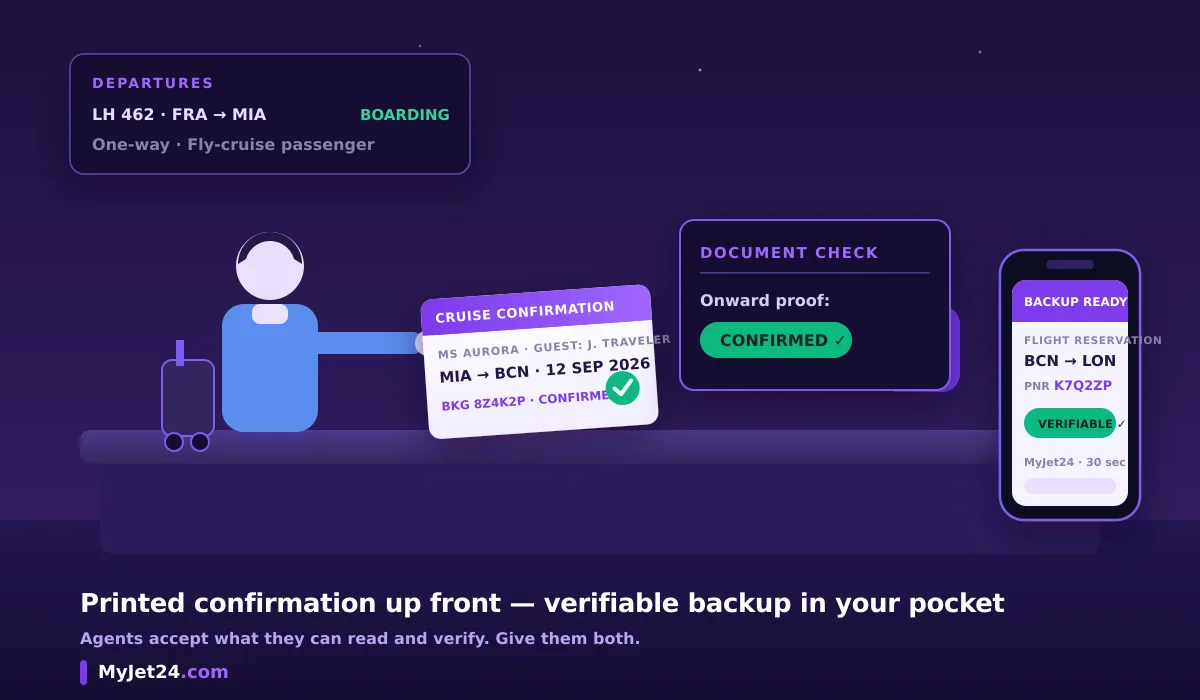
Even a flawless cruise confirmation meets an immovable object occasionally: an outsourced handling agent working a checklist, a trainee on a strict route, a Timatic entry phrased around air travel, a supervisor already summoned for the passenger ahead of you. Arguing regulation at a check-in desk at 5:40 a.m. is a losing game — the winning move is producing the document the desk expects and boarding.
The standard solution is a verifiable flight reservation — a real itinerary with a live PNR that the agent can check, dated inside your permitted stay:
- Open the MyJet24 onward ticket generator.
- Enter a departure from the country in question to any sensible next stop, dated after your cruise or within your allowance.
- Enter your name exactly as in your passport, and generate.
- Download the PDF — a flight reservation with a verifiable booking reference, ready in about 30 seconds, free.
Keep it alongside the cruise confirmation, not instead of it. The cruise papers tell your true story; the flight reservation answers the desk that will not read it. Together they cover every version of the check — and neither costs you the hundreds of dollars a refundable "just in case" flight ties up. For the difference between a verifiable reservation and a fake PDF (one survives an agent typing the PNR into the system; the other is a boarding denial for fraud), see our dummy ticket guide.
The Fly-Cruise Playbook: Documents by Scenario
Four itineraries cover nearly every one-way cruiser. Find yours:
1. One-way flight to Miami, closed-loop Caribbean cruise
The airline will ask how you leave the United States — the loop cruise is not the answer. Carry: cruise confirmation (explains the trip) plus onward transportation out of the U.S. dated after the cruise. Remember the cruise days count against your 90-day ESTA allowance, and the ship's calls at Cozumel or Nassau do not reset anything.
2. One-way flight to Barcelona, transatlantic cruise to Miami
For Spain, the cruise is textbook onward proof — it leaves the Schengen Area. The airline to Barcelona sees a confirmed departure; pack the printed confirmation and your hotel nights before sailing. The U.S. side is handled by the cruise line itself, which submits manifests and checks your ESTA before boarding. Your only open flank is what happens after Miami — have post-arrival plans ready to describe, and onward transportation if you are staying on in the U.S. toward the 90-day edge.
3. Repositioning cruise ending abroad (Sydney → Singapore, Vancouver → Tokyo)
Two countries to satisfy: the embarkation country (your flight in + ship out — clean) and the disembarkation country, whose rules the cruise line enforces at the terminal. Singapore and Japan both expect visitors to show onward travel; a flight home booked from the arrival port, or a verifiable reservation if plans are open, keeps both the terminal desk and the arrival officer satisfied.
4. Arriving by ship, flying home later
Disembarking passengers clear immigration at the port like any traveler — with the advantage that officers at cruise terminals process this exact profile all day. If your flight home is weeks away and unbooked, be ready for the onward question at the terminal in stricter countries; the same 30-second reservation answers it. New Zealand's carve-out is the model other countries informally follow: same-ship round-trippers are fine, but leave the ship for good and you are a normal visitor with normal rules.
Six Mistakes Cruise Passengers Make with Onward Proof
- Treating a closed-loop cruise as onward travel for the country it returns to. The single most expensive misunderstanding in this niche — it surfaces at check-in for the flight to the embarkation country, when rebooking is priciest.
- Showing the cruise app instead of a document. Countdown screens and deck plans are not transport documents. Print the confirmation with the booking number, or save the PDF full-screen.
- A booking that never mentions you. Family and group bookings often confirm to one email address and one name. Print the page listing every guest — your passport name must appear.
- Solving the first country and forgetting the last. Open-jaw cruisers satisfy the embarkation country and blank on the disembarkation country's onward rule — the one the cruise line checks at the terminal.
- Relying on a regional bus PDF at a low-cost-carrier desk. Valid at the border, unverifiable at the desk. On strict routes, carry a document the agent can check in the system.
- Dates outside the allowance. A ship departing on day 95 of a 90-day window is evidence of intent to overstay, not of onward travel. Keep every exit date — sea or air — inside the window, a trap we detail in our documentation mistakes guide.
Frequently Asked Questions
Does a cruise count as proof of onward travel?
Yes, at most borders — a confirmed cruise booking that departs the country within your permitted stay, showing your name, the ship, dates and a booking reference, is accepted as proof of onward travel by immigration authorities and airline check-in desks alike. The main exception is a closed-loop cruise, which returns you to the same country and therefore proves no departure.
Do airlines accept cruise bookings at check-in for one-way flights?
Routinely, yes. Agents verify onward travel against Timatic, which phrases most entries as "onward/return ticket" without specifying air. A printed confirmation with a booking number reads as a transport document; an app screenshot without a reference often does not.
Does a closed-loop cruise count as onward travel for the US under ESTA?
No. A cruise from a U.S. port that returns to a U.S. port leaves you inside the United States, so it does not satisfy the Visa Waiver Program's ticket requirement. You need separate onward or return transportation out of the U.S. — and the cruise days count against your 90-day allowance.
Can I enter the US on ESTA with a one-way flight if I leave on a cruise?
Yes — if the cruise ends in a foreign port. The regulation (8 CFR 217.2) requires a "return trip transportation ticket," not specifically a flight, and major cruise lines are Visa Waiver Program signatory carriers. A transatlantic or Panama-position cruise ending abroad satisfies the rule; carry the confirmation for the airline.
Do I need an onward ticket if I arrive by cruise ship?
If you arrive and depart on the same ship, the itinerary itself is your onward travel — New Zealand's immigration guidance makes this explicit, and most cruise destinations apply the same logic. If you disembark for good and fly home later, you are a normal visitor: stricter countries may ask how and when you leave.
Does a ferry ticket count as proof of onward travel?
Yes — a named, confirmed ticket on a scheduled international ferry (Spain–Morocco, Finland–Estonia, Malaysia–Thailand) is accepted like any transport document. Print it with the booking reference; hand-written or open tickets carry less weight at airline desks.
Do bus tickets work as proof of onward travel?
At many land-border destinations, yes — Costa Rica accepting a Tica Bus ticket to Panama is the classic case. The risk is the airline desk, not the border: agents cannot verify small bus operators' PDFs, and strict low-cost carriers refuse what they cannot check. Carry a verifiable flight reservation as backup on those routes.
Does a train ticket count as proof of onward travel?
Yes, where international rail exists — a booked Eurostar, a Thailand–Malaysia sleeper or a Vienna–Budapest railjet all show a confirmed departure. The same desk-verification caveat as buses applies: bookable, referenced tickets outperform open regional fares.
What must my cruise confirmation show to be accepted?
Six fields: your full passport name on the guest list, a booking reference, the ship and cruise line, embarkation port and date within your permitted stay, the itinerary or final port showing the ship leaves the country, and confirmed/paid status. Printed beats app screens every time.
Do cruise lines themselves check proof of onward travel?
On one-way itineraries, yes — the line verifies you meet the entry rules of the country where the cruise ends, which can include its onward-travel requirement, before letting you board. Carriers bear the cost of passengers refused entry, so terminal desks apply the same checks airlines do.
What if the check-in agent refuses my cruise confirmation?
Do not argue regulation at the desk — produce a document the agent can verify instead. A free MyJet24 onward ticket generates a flight reservation with a live PNR in about 30 seconds on your phone; agents accept it because they can check it. Keep the cruise papers for immigration, where your real story wins.
Does Taiwan accept sea tickets as proof of onward travel?
Explicitly — Taiwan's visa-exemption conditions require "a confirmed return air/sea ticket or an air/sea ticket and a visa for the next destination." A cruise or ferry departing Keelung or Kaohsiung qualifies by the letter of the rule, and airlines flying to Taiwan check onward documents consistently.
Do I need proof of onward travel for a repositioning cruise that ends abroad?
The cruise itself is onward proof for the country where you board. The country where you disembark applies its own rules — Singapore or Japan will expect you to show how you leave, and the cruise line may ask for that evidence at embarkation. A booked flight home or a verifiable reservation covers it.
Is it legal to use a dummy ticket alongside a cruise booking?
A verifiable flight reservation with a real PNR — what MyJet24 generates — is a legitimate, widely used document for satisfying onward-travel checks, the same instrument travel agencies issue during visa processing. A forged PDF with an invented reference is the opposite: it fails the moment an agent queries it and risks denial for fraud. The difference is verifiability, not the label.
Sources & further reading
- 8 CFR § 217.2 — Visa Waiver Program definitions ("round trip ticket")
- Taiwan Bureau of Consular Affairs — visa-exempt entry conditions ("return air/sea ticket")
- Immigration New Zealand — cruise ship traveler guidance and NZeTA
- IATA Timatic — the entry-requirements database used at airline check-in
Entry rules and airline enforcement practice change; verify critical details with official sources before travel. This guide reflects conditions documented as of July 2026.
