
Last updated: 3 July 2026 · Reading time: 12 min · Author: James Mitchell, CEO & Founder of MyJet24
TL;DR — Key Facts
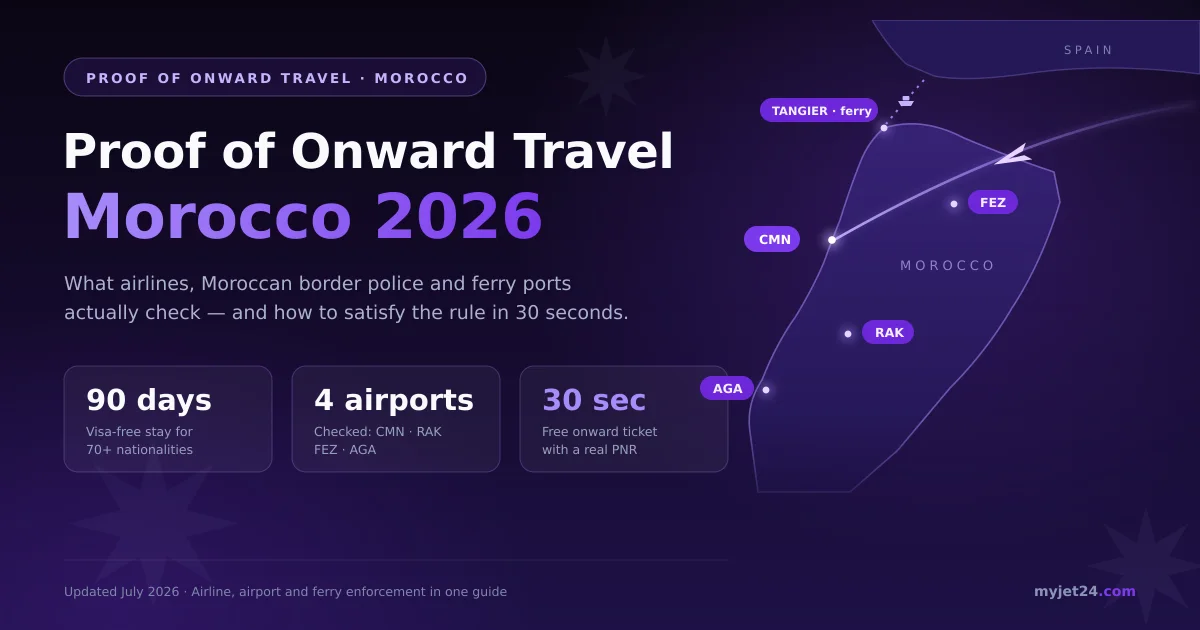
- Morocco is visa-free for roughly 70 nationalities (EU, UK, US, Canada, Australia and more) for up to 90 days — but border officers can still ask for a return or onward ticket under Morocco's entry rules for foreigners (Law 02-03).
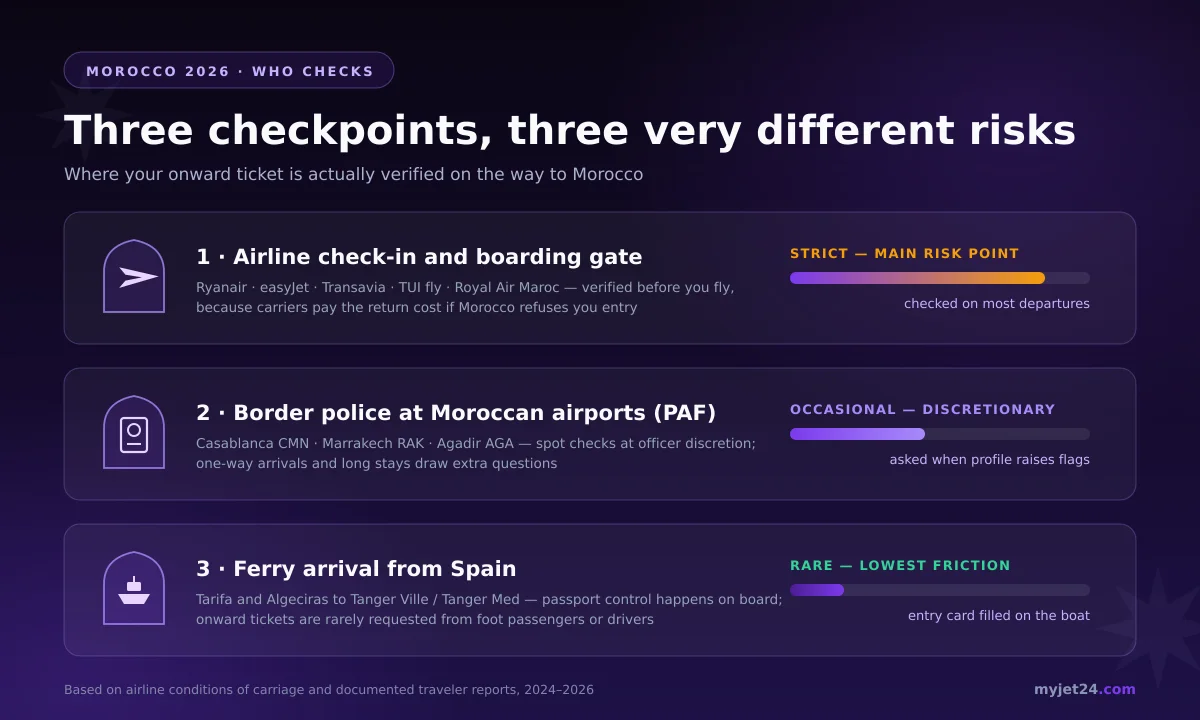
- The real checkpoint is your departure airport, not Morocco. Ryanair, easyJet, Transavia, TUI fly and Royal Air Maroc verify onward travel at check-in and the gate, because they pay the repatriation bill if you are refused entry.
- Travelers have been denied boarding on one-way tickets to Morocco even when they live there — documented cases include long-term residents flying home without a booked exit.
- Ferry arrivals from Spain are the exception: Moroccan passport control happens on board between Tarifa or Algeciras and Tangier, and onward tickets are rarely requested from foot passengers or drivers.
- A free onward ticket from MyJet24 generates a verifiable flight-reservation PDF with a real PNR in 30 seconds — enough to satisfy airline desks and Moroccan border police.
Morocco technically requires visa-free visitors to hold a return or onward ticket, but enforcement is uneven: Moroccan border police at Casablanca and Marrakech only spot-check, while airlines flying to Morocco check far more often and can deny boarding without one. Travelers arriving by ferry from Spain are almost never asked. A verifiable onward flight reservation dated within your 90-day stay satisfies every version of the check.
Morocco welcomed more than 17 million visitors in 2024 — a record that made it Africa's most-visited country — and the numbers have kept climbing ahead of the 2030 FIFA World Cup, which Morocco co-hosts with Spain and Portugal. Yet almost none of those visitors could tell you what the country's onward-ticket rule actually says. That gap in knowledge is exactly where travelers get burned: not at the border in Casablanca, but at a check-in desk in London, Paris or Amsterdam, where an airline agent asks a question they didn't prepare for — "Can I see your ticket out of Morocco?"
This guide covers what Moroccan law requires, which airlines enforce it and how strictly, what actually happens at each Moroccan airport, why ferry passengers play by different rules, and how to satisfy the requirement in half a minute without buying a flight you may never take.
Does Morocco Actually Require Proof of Onward Travel?
Yes — as a condition of entry that officers may enforce, not as a document that is systematically collected. Morocco's framework for the entry and stay of foreigners (Law 02-03, in force since 2003) requires arriving visitors to justify the purpose and conditions of their stay, including the means to support themselves and, where requested, evidence of their onward journey. In practice, the Direction Générale de la Sûreté Nationale (DGSN) — whose border police staff passport control at every Moroccan airport and port — applies this selectively.
Three facts frame everything else in this guide:
- Around 70 nationalities enter visa-free for up to 90 days — including all EU member states, the UK, the United States, Canada, Australia, New Zealand and Japan. No visa does not mean no conditions: the onward-ticket and sufficient-funds requirements apply precisely to these visa-exempt entries.
- Enforcement at Moroccan borders is discretionary. Most tourists with an ordinary profile — round-trip booking, hotel reservation, short stay — are stamped through in seconds and never asked. Questions concentrate on one-way arrivals, very long intended stays, frequent repeat entries and travelers who cannot name where they are staying.
- Airlines enforce the rule far more consistently than Morocco does. The carrier that flies you in is legally responsible for flying you back if Morocco refuses you entry — so the strictest document check happens before you ever leave Europe or North America.
The UK Foreign Office entry-requirements page for Morocco reflects the same reality: visa-free entry for 90 days, passport valid at least three months beyond arrival, and the standing possibility of being asked to show onward travel, accommodation details and sufficient funds. If you want the one-page version for every country, our overview of which countries require proof of onward travel in 2026 puts Morocco in context.
Why Airlines Check Harder Than Morocco Itself
Under international carrier-liability rules, an airline that delivers an inadmissible passenger must remove them at its own expense and can face fines from the destination state. For a €39 Ryanair fare to Marrakech, one refused passenger wipes out the margin on the entire row of seats. The economics explain the behavior: the gate agent is not being difficult — they are the airline's insurance policy.
Documented traveler reports from 2024–2026 show a consistent pattern on Morocco routes, and it has one striking feature: enforcement lands hardest on people who least expect it. In one widely discussed case, a business-class passenger flying London–Casablanca was refused boarding despite living in Morocco — the airline wanted a booked exit within the visa-free window, and residence documents alone did not satisfy the check-in system. One-way travelers, digital nomads and returning long-stayers report the same experience across carriers.
| Airline | Typical Morocco routes | How strictly onward travel is checked |
|---|---|---|
| Ryanair | UK/EU → RAK, AGA, FEZ, TNG, ESU | Strict — document checks before boarding; one-way passengers regularly questioned |
| easyJet | LGW, MAN → RAK, AGA | Strict to moderate — check-in desk asks on one-way bookings |
| Transavia | ORY, AMS → most Moroccan airports | Moderate to strict — automated document checks flag one-way itineraries |
| Royal Air Maroc | JFK, LHR, CDG → CMN hub | Moderate — long-haul one-way passengers asked at check-in, especially non-Moroccan passports |
| TUI fly / Vueling / Air Arabia Maroc | BRU, BCN, European seasonal routes | Moderate — spot checks, stricter in peak season and on late-night departures |
Enforcement tiers summarize airline conditions of carriage and documented traveler reports from 2024–2026; individual experiences vary by station, agent and passenger profile.
If you are weighing your options after a refusal — or want to understand the legal footing airlines stand on — our deep dive into whether airlines can deny boarding without proof of onward travel walks through the conditions of carriage clause by clause.
What Happens at CMN, RAK, AGA and FEZ
Once you land, the tone changes. Moroccan border police work fast — the queue at Casablanca Mohammed V (CMN) is usually longer than the interview. Officers scan your passport, ask where you are staying, stamp you in and write the entry number. For most travelers that is the entire encounter.
Casablanca Mohammed V (CMN)
Morocco's main hub and Royal Air Maroc's home base. Because CMN receives the long-haul traffic — New York, Montreal, Dubai, São Paulo — it also sees the most one-way arrivals, and that is where questions about onward plans surface. Officers may ask to see the ticket named on your arrival card; a printed reservation with a PNR ends the conversation quickly.
Marrakech Menara (RAK)
Overwhelmingly tourist traffic on European low-cost routes. Checks are rare because the passenger mix is short-stay by default — but RAK is precisely where the airlines upstream check hardest, since Ryanair and easyJet carry the bulk of arrivals.
Agadir Al Massira (AGA) and Fes Saïss (FEZ)
Seasonal and regional gateways. Agadir sees winter long-stayers (surfers, retirees renting for months) — the profile most likely to be asked how and when they intend to leave. Fes officers occasionally ask for accommodation details; a riad booking confirmation alongside your onward reservation covers both questions. If you still need the second document, a verifiable Morocco hotel booking takes another minute.
Who gets pulled aside? The honest answer: profiles, not passports. One-way arrivals with no accommodation booked, travelers on their third entry of the year, and anyone whose stated plans ("maybe three or four months?") exceed the visa-free window invite follow-up questions. The officer's job is to establish that you will leave within 90 days — hand them a dated reservation and you have answered it.
Entering Morocco by Ferry from Spain
The Strait of Gibraltar crossing is one of the world's great short ferry rides — Tarifa to Tanger Ville in about an hour, Algeciras to Tanger Med in about ninety minutes — and it comes with a quirk that surprises first-timers: Moroccan passport control happens on the boat. An officer sets up at a desk mid-crossing, you fill in the entry card you picked up at the gangway, and you walk off the ferry in Africa already stamped in.
Onward-ticket checks in this channel are rare to the point of anecdote. Three structural reasons:
- No carrier-liability pressure. Ferry operators like FRS, Baleària and Intershipping do not run the airline-style document screening — a refused passenger sails back in ninety minutes, not on a €400 repatriation flight.
- The traffic is inherently round-trip. Day-trippers from Andalusia, Moroccan residents driving home, overlanders with vehicles — the profile that raises flags at CMN barely exists on the strait.
- Open return tickets are the norm. Most ferry fares sell as flexible returns anyway, so the "proof" exists by default.
The practical takeaway cuts both ways. If you are overlanding into Morocco with a vehicle, the ferry is the lowest-friction entry — but do not generalize the experience. The traveler who enters by ferry, stays ten weeks, and then tries to fly out and back in on a one-way from Málaga meets the airline checkpoint for the first time, usually unprepared. The rule did not change; the enforcer did.
Ceuta, Melilla and the 90-Day Border Run
Morocco shares its only land borders with two Spanish enclaves — Ceuta (crossing at Fnideq) and Melilla (crossing at Beni Ensar). Because both are EU territory, stepping across and back has long been the classic "border run" to restart the 90-day clock without flying anywhere.
Treat that strategy with caution in 2026. Re-entry after a same-day exit is granted at officer discretion, not by right, and travelers report uneven outcomes: many are stamped straight back in, some are questioned about what they are really doing in Morocco, and repeat runners have been refused re-entry or told to apply for a proper extension instead. The pattern is familiar from every country that tolerates border runs informally — it works until the day it doesn't, and that day tends to come without warning. If your plans genuinely exceed 90 days, the extension route (next section) or a fresh entry after a real absence is the defensible play. For location-independent travelers structuring longer stints around visa windows, our onward-ticket guide for digital nomads covers the multi-country playbook.
What Counts as Valid Proof in 2026
Neither Moroccan border police nor airline agents demand a specific document type — they demand a credible, checkable exit. Here is how the common options hold up at each checkpoint:
| Document | Airline check-in | Moroccan border police | Notes |
|---|---|---|---|
| Return flight (paid) | Accepted | Accepted | Gold standard, but inflexible and expensive if plans change |
| Onward flight to a third country | Accepted | Accepted | Lisbon, Madrid, Paris, the Canaries — any exit from Morocco counts |
| Verifiable held reservation (dummy ticket with real PNR) | Accepted | Accepted | Must show a live PNR an agent can look up — this is what MyJet24 issues |
| Ferry ticket out (e.g. Tanger–Tarifa) | Usually accepted | Accepted | Carry it printed; some airline systems only recognize flights |
| Bus itinerary / unbooked "plans" | Risky | Officer discretion | No international bus routes exit Morocco except via Ceuta/Melilla foot crossings |
| Photoshopped or fake PDF | Denied if verified | Serious consequences | Agents can query any PNR in seconds — never present a fabricated document |
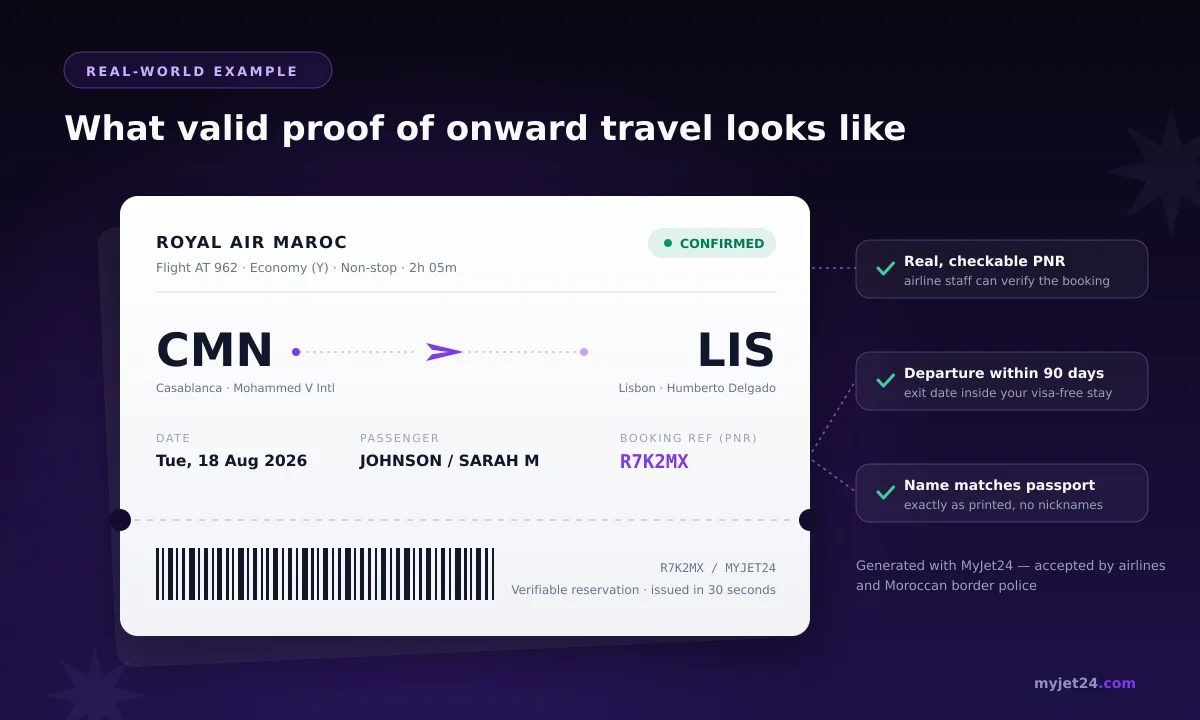
Three attributes separate a reservation that works from one that gets you a second interview: a real booking reference the agent can pull up, a departure date inside your 90-day window, and a passenger name that matches your passport exactly. Whether the underlying fare is a flexible refundable ticket or a held reservation matters far less than those three checks — we compared the economics of both approaches in dummy ticket vs. refundable flight: cost and risk.
The 90-Day Clock: Extensions, Overstays and Exit Rules
Your onward ticket's date only makes sense relative to the stay you are allowed, so here is the 90-day rule in operational terms:
- The clock starts at your entry stamp. Check the date the officer writes — that stamp is also what you will be asked for on exit, so guard the page. Passport validity must extend at least three months past arrival (UK guidance); six months clears every airline's own rule of thumb.
- Extensions exist but demand paperwork. To stay past 90 days legally, apply at the local police station's foreigners' bureau (Bureau des Étrangers) before your window expires — expect to show a rental contract or hotel record, funds and a reason. Approval is discretionary and processing is famously local: Agadir and Marrakech process winter long-stayers routinely; small towns may see one application a year.
- Overstays are handled as violations, not paperwork errors. Reported outcomes range from fines and a court summons to problems on your next entry. A cheap onward reservation dated inside the window costs nothing next to that risk.
- Funds can be asked about too. There is no published minimum, but guidance circulating among carriers suggests being able to show roughly €70 per day of stay — a bank card and a statement screenshot settle it.
One Morocco-specific exit rule worth knowing before you leave: print your boarding pass for departures out of Morocco. Moroccan airports still require a physical, stamped boarding document at security on many services — Ryanair explicitly tells passengers departing Morocco to carry a printed pass, and airport kiosks charge for reprints. It is the mirror image of the onward-ticket rule: paper still rules Moroccan airport formalities in 2026.
How to Get a Free Onward Ticket for Morocco in 30 Seconds
A dummy ticket for Morocco is a genuine flight reservation held in an airline system — it carries a real PNR that check-in staff can verify, without you paying for a flight you may never take. Here is the whole process:
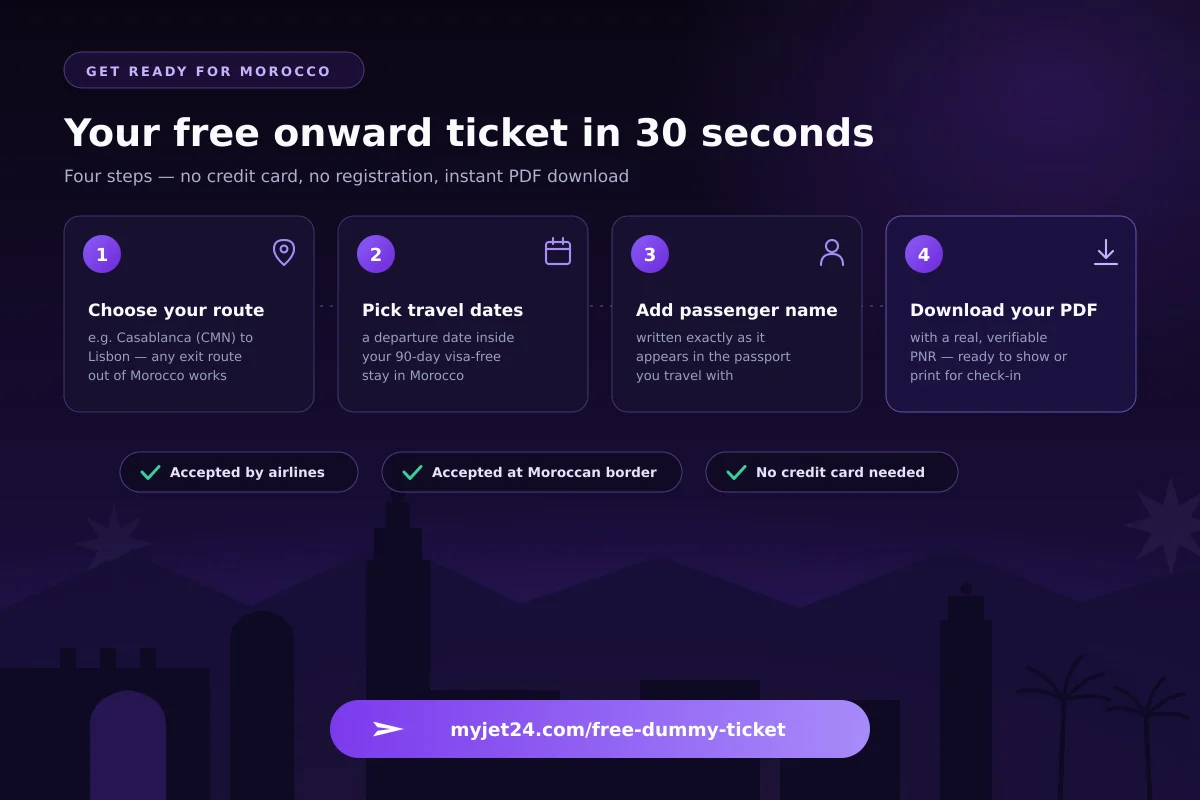
- Choose your route out of Morocco. Casablanca (CMN) to Lisbon, Marrakech (RAK) to Madrid, Agadir (AGA) to Las Palmas — any exit works. Match the departure city to where you will actually be.
- Pick a date inside your 90-day window. If you are landing on 10 August, an exit dated late October reads as a normal long holiday; one dated past early November contradicts your visa-free stay.
- Enter your name exactly as your passport prints it. Agents compare character by character.
- Download the PDF and print it. You get a reservation with a live booking reference and QR code. Keep the paper copy with your passport — Moroccan formalities love paper, and airport Wi-Fi will let you down at the exact wrong moment.
Get yours now: the free dummy ticket generator issues your Morocco onward reservation in about 30 seconds — no credit card, no registration. For route-specific details, entry notes and airport information, see the full onward ticket for Morocco page.
Generate my free onward ticketSeven Mistakes That Get Travelers Flagged
- Presenting a PDF with a dead PNR. Free "ticket generators" that fabricate a code fail the moment an agent queries the airline system. Only use reservations that are actually held.
- Dating the exit outside the 90 days. An onward flight four months out is evidence against you, not for you.
- A name that doesn't match the passport. "Mike" on the reservation, "Michael" in the passport — enough for a jobsworth refusal at a budget-carrier desk.
- Relying on a phone screenshot. Between dead batteries, no roaming and agents who want to scroll the actual email, paper wins. Print everything for Morocco — including, on departure, your boarding pass.
- Generalizing the ferry experience to flights. "Nobody checked when I came in via Tanger Med" is true and irrelevant at an easyJet desk in Gatwick.
- Citing a Ceuta walk-out as your exit plan. Telling an officer your onward travel is "walking to Spain at Fnideq" invites exactly the discretionary scrutiny you were trying to avoid.
- Preparing at the check-in queue. The travelers who get refused are almost always improvising at the desk. Thirty seconds of preparation the night before removes the entire failure mode.
Frequently Asked Questions
Does Morocco require a return ticket for all visa-free nationalities?
The requirement to justify your stay — including onward travel when asked — applies to all visa-exempt entries under Morocco's entry rules for foreigners. In practice Moroccan officers check selectively, while airlines flying you in check consistently. No nationality is formally exempt from being asked.
Do border officers at Casablanca airport actually check onward tickets?
Occasionally. CMN sees the most one-way long-haul arrivals, so it also sees the most follow-up questions. Ordinary tourists are rarely asked; one-way arrivals, repeat entries and travelers without booked accommodation are the profiles that trigger a request.
Will Ryanair or easyJet deny me boarding to Morocco without an onward ticket?
They can, and documented cases show they do — including passengers who reside in Morocco. Both carriers' conditions of carriage require you to hold the documents your destination demands, and their agents verify one-way bookings to Moroccan airports at check-in or the gate.
Do I need an onward ticket if I arrive in Morocco by ferry from Spain?
Rarely. Moroccan passport control happens on board the Tarifa and Algeciras ferries, and officers almost never request onward proof from foot passengers or drivers. Keep the rule in mind anyway if you later fly out and back in — air routes enforce what ferry routes ignore.
Does the proof have to be a flight, or does a ferry ticket count?
Any bookable exit from Morocco can satisfy the rule: a return flight, an onward flight to a third country, or a ferry to Spain. Airline check-in systems handle flights most smoothly, so if your real exit is a ferry, carry it printed and be ready to explain the itinerary.
Is a dummy ticket legal for Morocco?
Yes. A dummy ticket from MyJet24 is a real reservation held in an airline system with a verifiable PNR — presenting it is presenting a genuine booking. What is never acceptable is a forged or edited document with an invented reference; agents can query any PNR in seconds.
What date should my onward ticket show?
Any date inside your 90-day visa-free window that matches your story. A four-to-ten-week gap reads as normal tourism. Avoid same-week exits that contradict what you tell the officer, and never date the exit beyond day 90.
Can I extend my stay beyond 90 days inside Morocco?
Yes — apply at the foreigners' bureau (Bureau des Étrangers) of the local police before your 90 days expire, with proof of accommodation, funds and a reason for staying. Approval is discretionary. The informal alternative, a border run via Ceuta or Melilla, works for many but is refused often enough that it should not be a plan.
What happens if I overstay my 90 days in Morocco?
Expect a fine and possibly a court appearance before you are allowed to depart, plus harder questions on any future entry. Overstays are treated as legal violations, not administrative slips — if you are close to the limit, extend or leave.
Do children need their own proof of onward travel for Morocco?
Yes — every traveler, including minors, should appear on a reservation covering the exit. Families are questioned far less often, but airline document checks apply per passenger, so generate the reservation with all names on it.
Does Morocco also check hotel bookings and money?
Officers may ask where you are staying and whether you can support yourself; guidance used by carriers suggests roughly €70 per day. A hotel confirmation for at least your first nights plus a bank card answers both. If you need a verifiable accommodation document, MyJet24 issues those for Morocco as well.
Is Morocco visa-free for US, UK and EU citizens in 2026?
Yes — citizens of the US, UK, all EU states, Canada, Australia, New Zealand, Japan and roughly 60 other countries enter visa-free for up to 90 days. Your passport must be valid at least three months beyond arrival; nationalities outside the exemption list apply through Morocco's consular or e-visa channels.
Will the 2030 World Cup change Morocco's entry requirements?
No changes have been announced as of July 2026. Morocco is investing heavily in airport capacity ahead of co-hosting the 2030 FIFA World Cup with Spain and Portugal, and border processing is being modernized — which generally means more systematic document verification, not less. The onward-ticket rule is safest treated as permanent.
Sources & further reading
- UK Foreign Office — Morocco entry requirements
- Moroccan Consular Services — visa procedures
- Ryanair Help Centre — check-in & travel documents
Entry rules and enforcement practice change; verify critical details with official sources before travel. This guide reflects conditions documented as of July 2026.
