
Last updated: 17 July 2026 · Reading time: 15 min · Author: Joshua White, Travel Documentation Writer at MyJet24
TL;DR — Key Facts
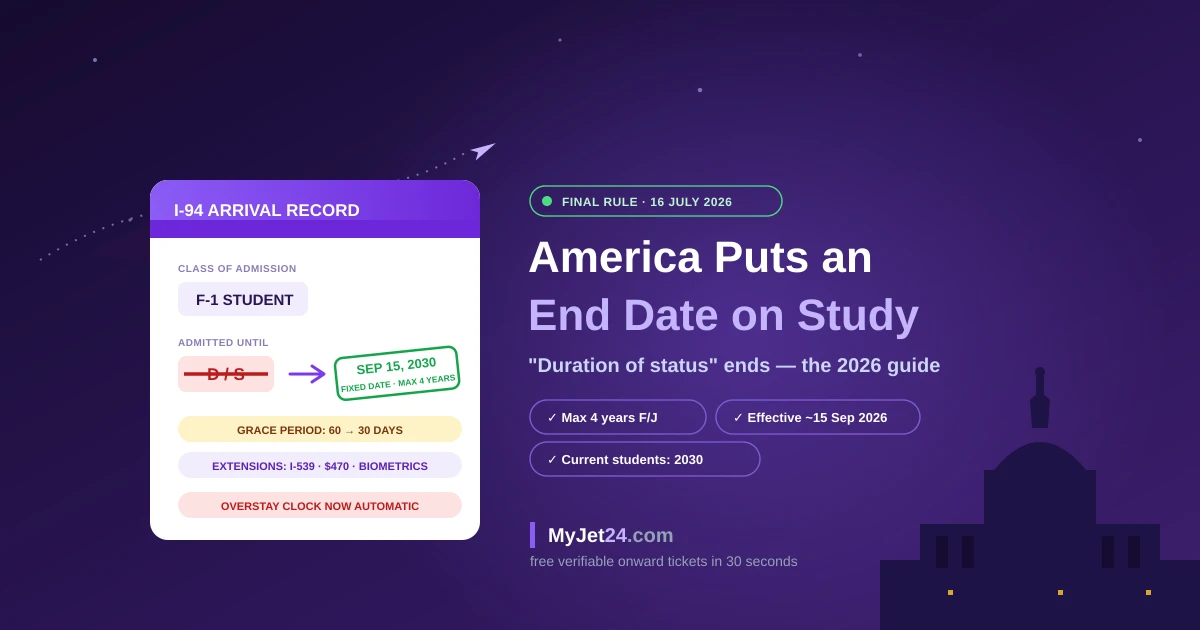
- A 48-year-old cornerstone of US student immigration is gone. On 16 July 2026, DHS announced a final rule ending "duration of status" (D/S) — the system that let F-1 students and J-1 exchange visitors stay as long as their program lasted, with no fixed end date. The rule publishes in the Federal Register on 17 July and takes effect 60 days later, around 15 September 2026.
- The replacement: fixed admission periods, capped at four years for F and J visa holders (program length if shorter), plus a grace period cut from 60 to 30 days for F-1s. Journalists on I visas get a 240-day cap — just 90 days for PRC passport holders.
- Need more time? You apply for it. Extensions of stay go through USCIS on Form I-539 with a $470 base fee, biometrics and fraud screening — for a five-year PhD, that's now a built-in mid-program checkpoint.
- The sharpest change is invisible: unlawful presence. Under D/S, overstay penalties only started after a formal government finding. With fixed dates, unlawful presence accrues automatically the day your admission expires — putting the 3- and 10-year re-entry bars within reach of a missed deadline.
- Current students aren't grandfathered forever. Anyone in F or J status on the effective date may stay until their I-20/DS-2019 end date (or OPT card expiry, if later) — but never more than four years past the effective date. The clock is now real for everyone.
The United States is ending "duration of status" for F-1 students, J-1 exchange visitors and I media representatives. Under the DHS final rule announced 16 July 2026 (Federal Register 17 July, effective about 15 September 2026), these travelers receive fixed admission periods — the length of their program up to a maximum of four years for F and J, 240 days for I (90 for PRC passports) — instead of open-ended stays. The F-1 post-completion grace period drops from 60 to 30 days, extensions require Form I-539 with a $470 fee and biometrics through USCIS, and unlawful presence begins accruing automatically once the fixed date passes. People already in the US transition based on their current I-20, DS-2019 or OPT card, capped at four years from the effective date.
In this guide
- What just happened — and what "duration of status" was
- The new fixed periods at a glance
- Key dates: from announcement to enforcement
- Already in the US? The transition rules
- The new extension gauntlet: I-539, $470, biometrics
- The sharpest edge: unlawful presence and re-entry bars
- The mobility restrictions nobody is talking about
- Who is affected — and how we got here
- What F-1 and J-1 travelers should do now
- Frequently asked questions
What just happened — and what "duration of status" was
Since 1978, international students in the United States have lived under an unusual arrangement: instead of being admitted until a date stamped in their passport, F-1 students (and later J-1 exchange visitors and I media representatives) were admitted for "duration of status" — noted as "D/S" on the I-94 record. As long as you remained enrolled and followed the rules, your permission to stay simply continued: through a bachelor's, into a master's, on to a PhD, through OPT work authorization — no fixed end date, no renewal filings with immigration authorities.
On 16 July 2026, the Department of Homeland Security announced the final rule that ends this system. In DHS's framing, D/S allowed foreign students to remain "indefinitely without routine government oversight" — the fix is to admit F, J and I nonimmigrants the way tourists and workers are admitted: until a specific date, after which they must leave, change status, or formally apply to extend.
Three structural changes follow, and each deserves its own attention:
- Fixed admission periods — generally the length of your program, hard-capped at four years for F and J;
- A formal extension process through USCIS for anyone whose studies outlast their admission;
- Automatic unlawful-presence accrual after the fixed date — the change with the most severe long-term consequences.
The new fixed periods at a glance
| Category | Old rule (D/S) | New admission period | Grace period |
|---|---|---|---|
| F-1 students | Length of studies, open-ended | Program length, max 4 years | 30 days (was 60) |
| J-1 exchange visitors | Length of program, open-ended | Program length, max 4 years | 30 days (unchanged) |
| I media representatives | Duration of assignment | Max 240 days · 90 days for PRC passport holders (HK/Macau excluded from the reduction) | — |
| Language-school & public-school students | D/S like other F-1s | Shorter caps than the standard four years | 30 days |
| F-2 / J-2 dependents | Tied to principal | Tied to principal's fixed period | Follows principal |
The four-year cap is the headline, but notice what it actually means in practice: a standard US bachelor's degree runs four years if nothing slips. A PhD averages five to six. Any program with a co-op year, a medical leave, a research delay or a part-time stretch now has a built-in immigration deadline in the middle of it.
Key dates: from announcement to enforcement
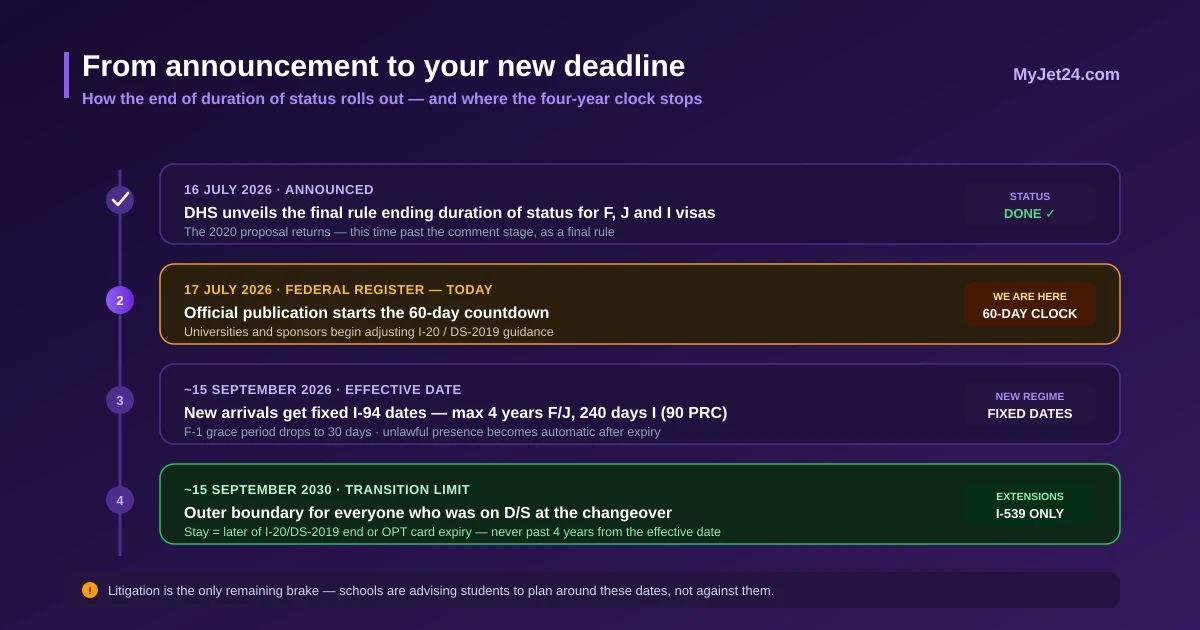
- 16 July 2026 — DHS announces the final rule ending duration of status.
- 17 July 2026 — Publication in the Federal Register (today, as this guide goes live).
- ~15 September 2026 — The rule takes effect, 60 days after publication. New arrivals from this date are admitted to fixed dates; everyone already in the US enters the transition framework below.
- ~15 September 2030 — The outer limit: the last day anyone who was on D/S at the changeover can remain under transition rules (four years from the effective date), barring an approved extension.
History note: this is not the first attempt. DHS proposed nearly the same rule in September 2020; it was withdrawn in 2021 before taking effect. The 2026 version is a final rule — the comment stage is over, and only litigation could now delay the September start. Universities and exchange sponsors are treating the dates as real.
Already in the US? The transition rules
If you're in F or J status when the rule takes effect, you are not instantly switched to a four-year clock from your original entry. The transition works like this:
- Your authorized stay runs to the later of: the end date on your current I-20 (F) or DS-2019 (J), or the expiration date of your OPT employment authorization card, if you have one;
- But never beyond four years from the rule's effective date — roughly 15 September 2030, whatever your documents say;
- Transition grace periods: 60 days for F nonimmigrants who were on D/S at the changeover, 30 days for Js — the reduced 30-day F grace applies to people admitted under the new framework;
- I media representatives in the US on the effective date may stay for the time needed to complete their activity, capped at 240 days from the effective date (90 days on PRC passports).
| Your situation on ~15 Sep 2026 | Your authorized stay ends | Grace period |
|---|---|---|
| In the US on F/J with D/S | Later of I-20/DS-2019 end date or OPT EAD expiry — never past ~15 Sep 2030 | F: 60 days · J: 30 days |
| Entering the US after the effective date | Fixed I-94 date: program length, max 4 years | F: 30 days · J: 30 days |
| In the US on an I media visa | End of activity, max 240 days from effective date (90 for PRC passports) | — |
| Program runs past your fixed date | Only with a timely-filed I-539 extension ($470 + biometrics) | Per approval |
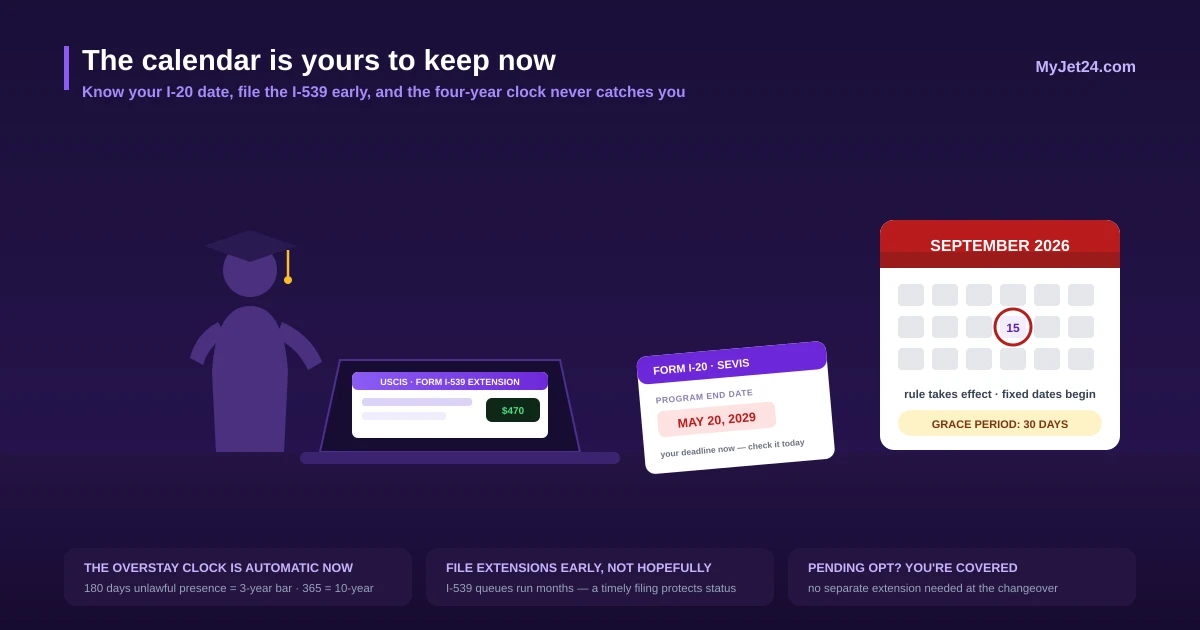
Practically, that makes two documents suddenly very important: the end date on your I-20/DS-2019 (many students have never looked at it, because under D/S it barely mattered) and your OPT card expiry. One of them is now your immigration deadline.
The new extension gauntlet: I-539, $470, biometrics
Under D/S, a student whose PhD ran a year long simply had the school extend the I-20 — an administrative step inside SEVIS. Under the new rule, more time means a formal Extension of Stay (EOS) application to USCIS:
- Form I-539, with a base filing fee of $470;
- Biometrics — fingerprints and photo — plus background and fraud screening;
- Evidence that the additional time is justified (program requirements, academic progress);
- Processing time risk — USCIS I-539 queues are measured in months, and a denial after your fixed date has passed leaves you out of status with unlawful presence already accruing (see next section).
Two softeners made it into the final rule: F-1 students with a pending OPT application on the effective date won't need to file a separate extension, and certain F-1 categories get automatic employment-authorization extensions of up to 240 days while an extension is pending. Neither changes the core reality: staying past your fixed date without a timely filing is now a hard violation, not a paperwork footnote.
The sharpest edge: unlawful presence and re-entry bars
This is the change immigration lawyers flagged within hours, and it deserves plain language.
Before: because D/S had no end date, an F-1 who fell out of status didn't automatically start accruing "unlawful presence" — the clock only started if USCIS or an immigration judge formally found a violation. That buffer protected students from the harshest penalties in US immigration law.
After: with a fixed date on the I-94, unlawful presence begins automatically the day after your admission expires, exactly as it does for tourists. And unlawful presence feeds two of the most unforgiving provisions on the books:
- 180+ days of unlawful presence → a 3-year bar on re-entering the US;
- 365+ days → a 10-year bar.
Combine a missed I-20 date, a slow extension decision and a semester of inattention, and a 22-year-old can acquire a decade-long ban without ever intending to overstay. Under the old system that outcome required a formal adjudication; from September it requires only a calendar.
The mobility restrictions nobody is talking about
The four-year cap gets the headlines, but the final rule also rewrites what F-1 students may do with their status:
- Graduate students lose transfer flexibility. Master's and doctoral students generally may no longer change their educational objective or transfer schools mid-program — decisions that were routine under D/S;
- No more sideways or downward moves. A student who completes a program must generally progress to a higher level to remain in F-1 status — finishing a master's and starting a second master's, or dropping to a certificate program, no longer keeps you in status;
- The shortened grace period compounds everything. Thirty days after program completion is not much time to pack up a life, decide between OPT, a new program or departure — and the old habit of using the 60-day window to weigh options is gone.
For students planning multi-step academic paths — language school, then bachelor's, then master's — the combination of level-progression rules, shorter caps for language programs and the four-year ceiling makes the sequence itself something to plan around immigration dates, not just admissions letters.
Who is affected — and how we got here
The population is enormous: the US has hosted over a million international students in recent academic years, plus hundreds of thousands of J-1 exchange visitors — au pairs, research scholars, camp counselors, physicians — and working foreign journalists on I visas. Every one of them touches this rule, either at their next entry or through the transition framework.
The policy history matters for judging what happens next. A nearly identical rule was proposed in September 2020, drew tens of thousands of comments, and was withdrawn in 2021 after the administration changed. The 2026 version arrives as a final rule — meaning DHS has already processed the comment record and litigation is the only remaining brake. Universities are advising students to plan around the September effective date rather than bet on a courtroom rescue.
It also fits a visible 2026 pattern on this blog: the US layered a $250 Visa Integrity Fee onto most nonimmigrant visas — F and J included — and began selling $750 fast-track interview slots for B1/B2 applicants. Fixed student admissions complete the picture: more fees, more checkpoints, more dates on the calendar.
What F-1 and J-1 travelers should do now
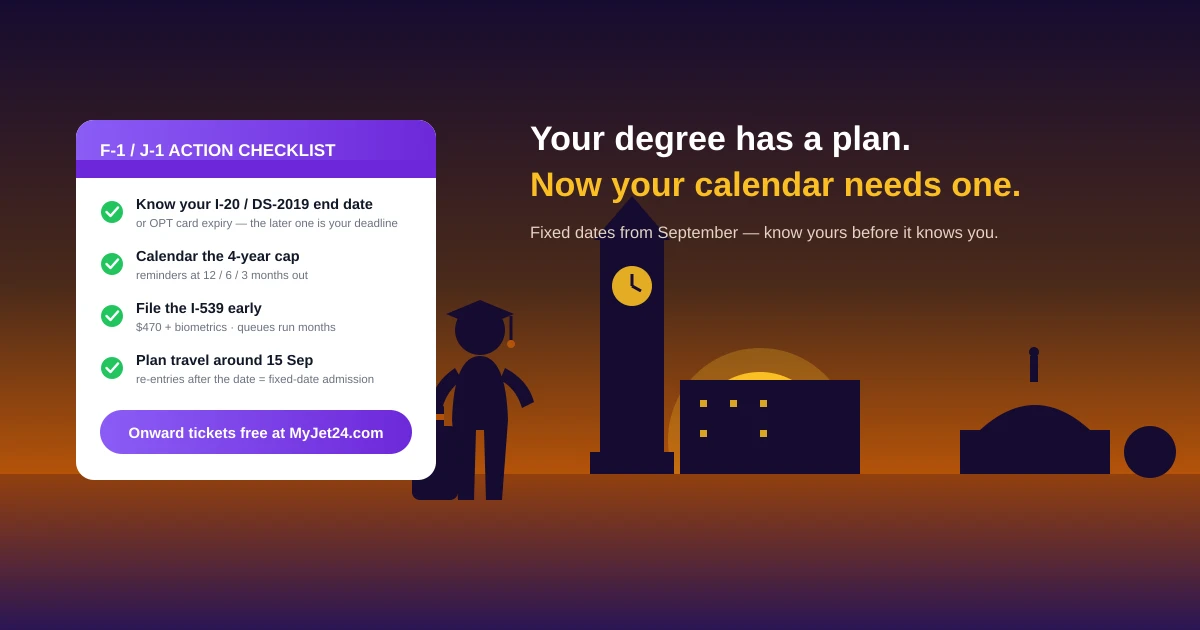
- Find your real end date today. Pull up your I-20 or DS-2019 and your OPT card if you have one. The later of those dates — capped at ~15 September 2030 — is your authorized stay under the transition. Put it in your phone with reminders at 12, 6 and 3 months.
- Map your program length against four years. PhD students, co-op participants, part-time finishers: identify now whether you'll need an I-539 extension, and budget the $470 fee plus months of processing into the plan.
- Time any international travel around the changeover. Re-entering the US after ~15 September means being admitted under the new fixed-date framework. That's not a reason to cancel trips — it's a reason to check your documents and your I-94 printout after every entry.
- Treat the 30-day grace period as an exit runway, not a decision window. Book departure or have the next status filed before program end — and note that a one-way departure flight can trigger onward-ticket questions in your next destination; a verifiable onward ticket (MyJet24 Premium, $7.90) settles those in 30 seconds.
- Visa interview coming up? Consular officers will expect you to know your program dates cold. Our guide to US visa interview documents covers the paperwork logic, and the flight itinerary for visa applications tool handles the travel-plan evidence embassies ask for without buying refundable tickets.
- Family visiting for graduation? Parents on B1/B2 or ESTA face the classic tourist checks — return tickets included; the US B1/B2 dummy ticket guide explains what airlines and officers actually verify.
Frequently asked questions
What is "duration of status" (D/S)?
Duration of status is the admission framework, used since 1978, under which F-1 students, J-1 exchange visitors and I media representatives were allowed to stay in the US for as long as their program or assignment continued — with "D/S" instead of a date on their I-94 record. The DHS final rule of 16 July 2026 replaces it with fixed admission dates.
What exactly did DHS change?
Three things: F, J and I nonimmigrants now receive fixed admission periods (program length up to four years for F/J; 240 days for I, 90 for PRC passports); staying longer requires a formal I-539 extension through USCIS with a $470 fee and biometrics; and unlawful presence accrues automatically once the fixed date passes, instead of only after a formal finding.
When does the rule take effect?
Sixty days after its Federal Register publication of 17 July 2026 — approximately 15 September 2026. Admissions from that date are made to fixed end dates, and people already in the US enter the transition framework.
Does the rule apply to students already in the US?
Yes, through transition rules: current F and J holders may stay until the end date on their I-20 or DS-2019 — or their OPT card expiry, if later — but no more than four years from the effective date (roughly September 2030). Fs in transition get a 60-day grace period, Js 30 days.
What is the maximum stay for an F-1 student now?
The length of the academic program as stated on the I-20, up to a hard cap of four years, plus a 30-day grace period. Language-school and public-school students face shorter caps. Longer programs require filing for an extension of stay before the admission period ends.
What happens if my degree takes longer than four years?
You must apply for an Extension of Stay on Form I-539 before your admission expires — with the $470 base fee, biometrics and evidence that the extra time is academically justified. Filing on time protects your status while the application is pending; missing the date means unlawful presence starts accruing immediately.
How much does the extension cost?
The I-539 base filing fee is $470, plus the practical costs of biometrics appointments and, for many applicants, legal help. For a five-to-six-year PhD, at least one mid-program extension is now part of the standard budget.
What is the new grace period after finishing my program?
Thirty days for F-1 students admitted under the new framework — halved from the previous 60. J-1 grace remains 30 days. Students who were on D/S when the rule took effect get a one-time 60-day transition grace period.
How does the rule affect J-1 exchange visitors?
J-1s receive fixed admissions of program length up to four years, with their existing 30-day grace period unchanged. Longer exchange programs — some research-scholar and physician categories run five years or more — will require USCIS extensions to complete.
What about journalists on I visas?
I media representatives are capped at 240 days per admission — reduced to 90 days for holders of PRC passports (Hong Kong and Macau SAR passports excluded from the reduction). Those in the US on the effective date may finish their activity within 240 days (or 90) from that date.
Why does the unlawful presence change matter so much?
Because it automates the harshest penalties. Accruing 180+ days of unlawful presence triggers a 3-year re-entry bar; 365+ days triggers a 10-year bar. Under D/S those clocks needed a formal violation finding to start; under fixed dates they start by themselves the day your admission ends.
Can I still transfer schools or change programs?
Undergraduates retain more flexibility, but graduate students generally may no longer transfer schools or change educational objectives mid-program, and completed students must move to a higher degree level to stay in F-1 status — a second master's or a step down to a certificate no longer qualifies.
Does the rule change OPT?
OPT itself continues, and the transition honors OPT cards: your authorized stay runs to your EAD expiry if that's later than your I-20 date (within the four-year outer limit). Students with OPT applications pending on the effective date don't need a separate extension, and certain categories get automatic work-authorization extensions of up to 240 days during EOS processing.
Does this affect B1/B2 tourists or ESTA travelers?
No — tourists were always admitted to fixed dates, so nothing changes for them here. The 2026 changes tourists actually face are the $250 Visa Integrity Fee on issued visas and the optional $750 fast-track interview pilot — plus the usual return-ticket expectations at check-in, which a verifiable onward reservation satisfies.
The bottom line
For 48 years, the end of an American education was an academic question. From mid-September 2026 it's also an immigration date — printed, fixed, and enforced by an unlawful-presence clock that runs on its own. The rule doesn't shrink how long you can study in the US; it changes who keeps the calendar. That job used to belong to your university's international office. Now it belongs to you.
The playbook is short: know the end date on your I-20 or DS-2019, treat four years as a hard planning horizon, file extensions early rather than optimistically, and time your travel with the September changeover in mind. And when your journey continues beyond the US — next semester abroad, next visa application, next one-way hop — the paperwork questions get simpler: a verifiable onward ticket from MyJet24 Premium ($7.90) answers the return-ticket question anywhere in the world, in about 30 seconds.
Sources
- DHS — Trump Administration Issues Final Rule to End Foreign Student Visa Abuse (16 July 2026): https://www.dhs.gov/news/2026/07/16/trump-administration-issues-final-rule-end-foreign-student-visa-abuse
- Fragomen — DHS Issues Final Rule Replacing Admission for Duration of Status with Fixed Periods of Stay for F, J, and I Nonimmigrants: https://www.fragomen.com/insights/united-states-dhs-issues-final-rule-replacing-admission-for-duration-of-status-with-fixed-periods-of-stay-for-f-j-and-i-nonimmigrants.html
- Envoy Global — DHS Finalizes Fixed Admission Periods for F, J and I Visa Holders: https://www.envoyglobal.com/news-alert/dhs-finalizes-fixed-admission-periods-for-f-j-and-i-visa-holders/
- Murthy Law Firm — NewsFlash! DHS Finalizes Major Changes to F, J, and I Admissions (16 July 2026): https://www.murthy.com/2026/07/16/newsflash-dhs-finalizes-major-changes-to-f-j-and-i-admissions/
- Erickson Immigration Group — DHS Finalizes Fixed-Term Stay Rule for Foreign Students, Exchange Visitors, and Media Representatives: https://eiglaw.com/dhs-finalizes-rule-limiting-f-1-students-to-four-year-stays/
- NAFSA — DHS Proposal to Replace Duration of Status (regulatory history): https://www.nafsa.org/regulatory-information/dhs-proposal-replace-duration-status
This guide reflects the DHS final rule as announced on 16 July 2026 and analyzed by immigration counsel at publication time; the Federal Register text governs. Details — including the precise effective date and any litigation outcomes — can change. This article is informational and not legal advice; consult your designated school official (DSO) or an immigration attorney for your specific case.
