
Last updated: 8 August 2026 · Reading time: 14 min · Author: Joshua White, Immigration Policy Writer at MyJet24 · Reviewed by: Marc Hoffmann
TL;DR — Key Facts
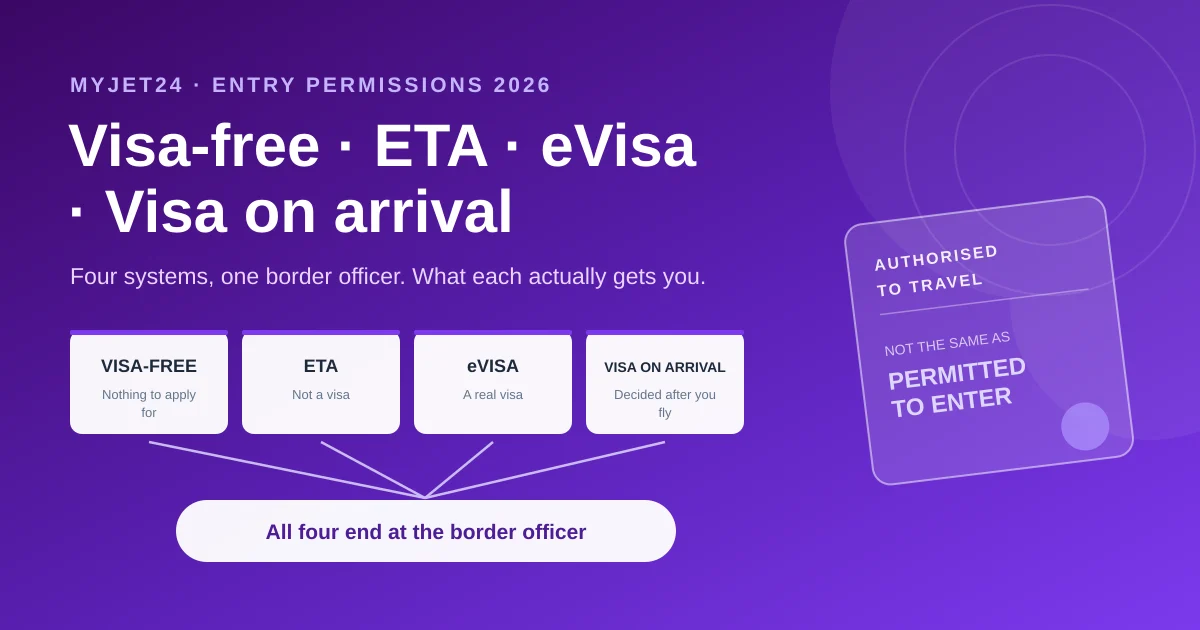
- An ETA is not a visa. The UK Home Office puts it plainly: an ETA "is not a visa or a tax" and "does not permit entry into the UK – it authorises a person to travel to the UK."
- An eVisa is a real visa, just issued electronically. It's for nationalities that genuinely need a visa, costs more, takes longer, and usually wants supporting documents.
- Visa on arrival is the riskiest category, because approval happens after you have already flown. A refusal strands you at a foreign border rather than at home.
- None of the four grants you entry. Every system ends with an officer at the port of entry deciding admissibility — CBP says ESTA approval "does not guarantee that you are admissible."
- The lighter the pre-vetting, the heavier the checks at the airport. Visa-free, ETA and visa-on-arrival travellers get asked for onward tickets and funds far more often than eVisa holders, because nobody has screened them yet.
- Work out which one applies by nationality and destination — the same traveller can be visa-free in one country, an ETA case next door and an eVisa applicant a border further on.
Visa-free travel means you need no advance permission at all. An ETA (Electronic Travel Authorisation) is a light pre-registration for travellers who don't need a visa — it authorises you to travel, not to enter. An eVisa is a genuine visa applied for and issued online, for nationalities that do need one. A visa on arrival is a visa issued at the border after you land. The difference that matters is when you are checked and who decides: all four still end with a border officer granting or refusing entry.
Every one of these systems still leaves the airline free to ask how you're leaving.
In this guide
- The distinction that explains all four
- The four systems at a glance
- Visa-free travel
- ETA — Electronic Travel Authorisation
- eVisa — a real visa, issued online
- Visa on arrival
- Which system does your destination use?
- The pre-vetting rule: lighter permission, heavier checks
- How to work out which one you need
- Frequently asked questions
- The bottom line
The distinction that explains all four
Every entry-permission system separates two things that travellers routinely merge: permission to travel and permission to enter. An ETA, an eVisa, a visa on arrival and visa-free status all deal with the first. Only an officer at the port of entry decides the second.
Two governments say this in almost identical words. The UK Home Office's ETA factsheet states that an ETA "is a digital permission to travel – it is not a visa or a tax" and that it "does not permit entry into the UK – it authorises a person to travel to the UK." US Customs and Border Protection says the same about ESTA: approval establishes that you are eligible to travel under the Visa Waiver Program but "does not guarantee that you are admissible," because a CBP officer determines admissibility on arrival. Read those together and the whole vocabulary snaps into focus — these documents get you to the border, not through it.
"An ETA is a digital permission to travel – it is not a visa or a tax… [it] does not permit entry into the UK – it authorises a person to travel to the UK."
— UK Home Office, Electronic Travel Authorisation factsheet, April 2026
Key takeaway: stop asking "which document lets me in?" — none of them do. Ask instead when you're screened, how thoroughly, and what you'll still be asked for at the gate. That single reframing predicts almost everything else in this guide.
The four systems at a glance
The four categories differ on four practical axes: when you apply, how hard the check is, where a refusal can hit you, and how exposed you are to document questions at the airport. The matrix below sets them side by side; the sections after it take each in turn.
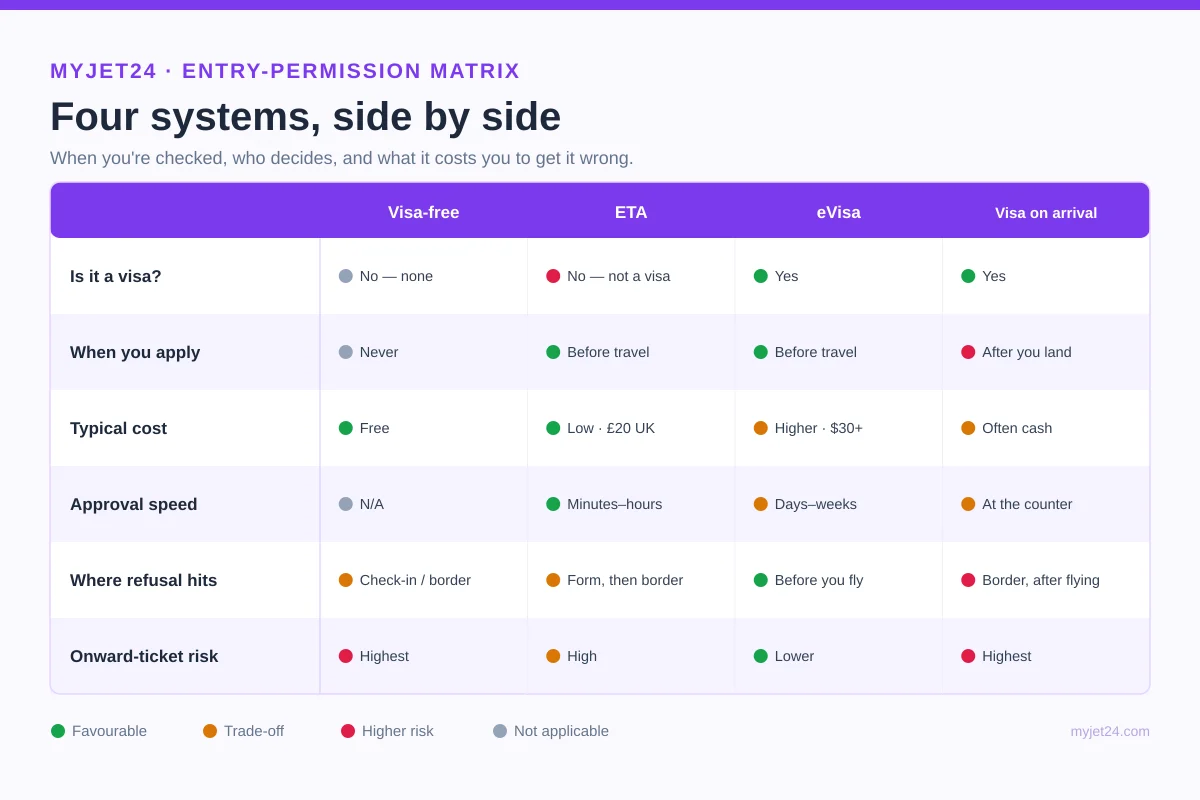
| Visa-free | ETA | eVisa | Visa on arrival | |
|---|---|---|---|---|
| Is it a visa? | No — nothing required | No — explicitly not a visa | Yes — a real visa | Yes — a real visa |
| When you apply | Never | Before travel, online | Before travel, online | After you land |
| Typical cost | Free | Low (UK ETA £20) | Higher (e.g. Egypt $30) | Moderate, often cash |
| Approval speed | N/A | Minutes to hours | Days to weeks | At the counter |
| Supporting docs | None in advance | Rarely | Usually | Sometimes, at the desk |
| Where refusal hits | Check-in or border | Application, then border | Application (before you fly) | At the border, after flying |
| Onward-ticket exposure | Highest | High | Lower | Highest |
Visa-free travel
Visa-free travel is entry permission granted by your nationality alone, with no application, no fee and no advance registration. You book a flight, turn up with a valid passport, and an officer decides at the border.
It is the lightest arrangement and the most commonly misunderstood, because "no paperwork" gets heard as "no conditions." The conditions are simply enforced later: a stay limit (often 30 or 90 days), a permitted purpose (tourism or business, rarely work), and a passport-validity rule. China's unilateral 30-day scheme is a good current example — no form, no fee, no pre-registration, and a hard 30-day ceiling, as our guide to China's visa-free entry sets out. In Europe the equivalent limit is the 90-days-in-180 rolling count, explained in our Schengen 90/180 rule guide.
Key takeaway: visa-free means nobody has vetted you before departure — so the vetting lands entirely on the airline agent and the border officer. That is precisely why visa-free travellers field the most questions about onward tickets and funds.
ETA — Electronic Travel Authorisation
An ETA is a quick online pre-registration required of travellers who do not need a visa, checked against security and immigration databases before you board. It is explicitly not a visa, and it is linked electronically to your passport rather than stamped in it.
The practical profile is consistent across systems: a short form, a small fee, approval usually in minutes or hours, multi-year validity, and multiple entries. The UK's version costs £20 and permits multiple entries for stays of up to six months at a time over two years, or until the passport expires. The family is now large — the US ESTA, the UK's ETA, Canada's eTA, South Korea's K-ETA, New Zealand's NZeTA and the EU's forthcoming ETIAS all sit in this category. We cover each individually: the UK ETA, Canada's eTA, K-ETA and the NZeTA. ETIAS is the one still pending: officially targeted for late 2026 but widely reported as slipping, which our ETIAS delay explainer tracks, and it is a different thing again from the EES border system — a pairing untangled in ETIAS vs EES.
Key takeaway: an ETA is a boarding pass for the immigration system, not an entry permit. It replaces nothing about the border interview — and because holders were visa-free to begin with, it adds almost no reassurance about how you plan to leave.
eVisa — a real visa, issued online
An eVisa is a genuine visa that you apply for and receive electronically, rather than as a sticker collected from a consulate. Unlike an ETA, it is for nationalities that actually require a visa, and it carries the full weight of one.
That difference shows up in every practical detail. eVisa applications ask for supporting documents — an itinerary, accommodation, proof of funds, sometimes an invitation — charge more, and take days or weeks rather than minutes. Egypt's tourist eVisa runs $30 for a single entry, and Japan and Vietnam both operate their own systems, covered in our Japan eVisa guide and Vietnam eVisa guide. The upside of all that friction is certainty: an eVisa is decided before you fly, so a refusal costs you a fee and a change of plan rather than a stranded arrival.
The clearest test: if the system exists because your nationality needs a visa, it's an eVisa. If it exists because your nationality doesn't, it's an ETA. The online form looks the same; the legal status is not.
Key takeaway: an eVisa buys certainty with effort. Because a consulate has already reviewed your plan, eVisa holders are questioned about onward travel less often than visa-free or ETA arrivals — though the airline can still check.
Visa on arrival
A visa on arrival is a visa issued at the border after you land, at a desk before immigration control. It is the only category in which you commit to the flight before anyone approves you — which makes it the highest-risk option of the four.
The mechanics are straightforward and the exposure is real. You queue, present a passport and often a photo, pay a fee that is frequently cash-only in a specific currency, and receive a sticker or stamp. If something is missing — an unmet document requirement, an unacceptable banknote, an unconvincing answer about your departure — you are already thousands of kilometres from home. Egypt's move to a digital QR-based visa on arrival, covered in our Egypt visa-on-arrival guide, is a good illustration of how these systems are modernising without changing that basic asymmetry. Note too that airlines apply their own filter first: a check-in agent who doubts you'll be granted the visa on arrival can decline to board you.
Key takeaway: visa on arrival front-loads convenience and back-loads risk. Where a country offers both a visa on arrival and an eVisa for the same trip, applying online in advance converts a border gamble into a settled decision.
Which system does your destination use?
Category membership depends on the pairing of your nationality and your destination, not on the country alone. The same destination runs several systems at once: visa-free for some passports, an ETA for others, an eVisa or visa on arrival for the rest.
| Category | Systems you'll meet in 2026 |
|---|---|
| ETA (not a visa) | ESTA (US), UK ETA, eTA (Canada), K-ETA (South Korea), NZeTA (New Zealand), ETIAS (EU, pending) |
| eVisa (a real visa) | India, Vietnam, Egypt, Türkiye, Kenya, Japan, Sri Lanka and many more |
| Visa on arrival | Indonesia, Egypt, Thailand (limited nationalities), parts of the Gulf and Africa |
| Visa-free | China's 30-day scheme, Schengen 90/180 for many passports, most ASEAN short stays |
| Traditional visa | Consulate appointment, biometrics, interview — still the default for long stays, study and work |
One more layer trips people up: a country can require an entry registration on top of your permission — a digital arrival card is not a visa, an ETA or a substitute for either. It's a customs and health declaration wearing a QR code.
Key takeaway: check the pairing, not the country, and check whether a separate arrival card applies. A traveller flying London–Cairo–Nairobi can pass through all three of ETA-land, visa-on-arrival-land and eVisa-land on one itinerary.
The pre-vetting rule: lighter permission, heavier checks
Here is the pattern that ties the four systems to what actually happens at the airport: the less a country screens you before departure, the more the airline and the border officer screen you on the day. Scrutiny is conserved — it moves, it doesn't disappear.
The logic is the airline's. Under IATA carrier-liability practice, a carrier that flies someone who is then refused entry pays to fly them back and may be fined, so check-in agents screen against the Timatic database. When a consulate has already examined your itinerary for an eVisa, the agent has something to lean on. When you're visa-free or hold an ETA — which vetted your security record, not your travel plan — nobody has looked at how you intend to leave. That gap is what the agent fills by asking for a return or onward booking. Visa on arrival is the extreme case: not only has nobody assessed your plan, your visa itself is still undecided, so the airline is carrying the entire risk.
The data point worth remembering. According to Eurostat, 132,600 travellers were refused entry at EU external borders in 2025. The single largest reason — 40,185 cases, 30.3% of the total — was "purpose and conditions of stay not justified," and at air borders that reason drove 40.0% of refusals. Those are people who already held whatever permission their nationality required. The permission was never the question; the plan was. The Schengen Borders Code lists "a return or round-trip ticket" among the supporting documents an officer may ask to see, which is exactly the gap a light-touch system leaves open.
Key takeaway: your entry-permission category predicts how hard your airport day will be. If you're travelling visa-free, on an ETA, or to a visa-on-arrival counter, carry proof of onward travel as a matter of course — our guides to which countries require it and the six ways to show it cover the practicalities.
A verifiable reservation with a live PNR — the document that answers "how are you leaving?"
How to work out which one you need
Identifying your category takes four checks, in this order. Work through them for each country on your itinerary, including places you only transit.
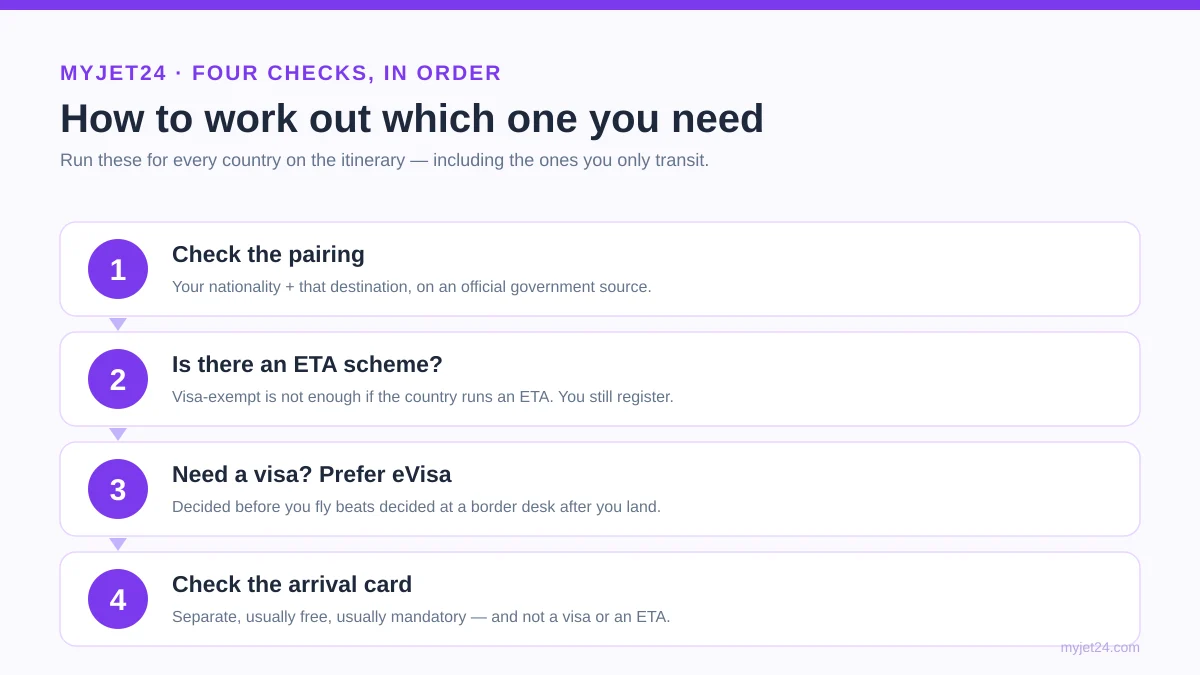
- Start from the pairing, on an official source. Look up your exact nationality on the destination's own immigration or foreign-ministry site. Third-party "visa checker" tools are frequently out of date and sometimes commercial fronts.
- Ask whether the destination runs an ETA scheme. If your passport is visa-exempt but the country operates an ETA, being visa-exempt is not enough — you still need the authorisation before you board.
- If you do need a visa, check whether an eVisa exists and prefer it to a visa on arrival. Deciding before you fly converts a border risk into a desk decision. Where only a visa on arrival exists, confirm the exact fee, accepted currency and cash requirement.
- Check for a separate arrival card or declaration. Many countries now require a digital arrival card within a fixed window before landing — free, mandatory, and entirely separate from your visa or ETA.
Key takeaway: the order matters. Travellers who skip step two are the ones turned away at check-in holding a valid passport and a firm belief that they didn't need anything — technically true about visas, and irrelevant to an ETA.
Frequently asked questions
Is an ETA the same as a visa?
No. The UK Home Office states that an ETA "is not a visa or a tax" and "does not permit entry" — it authorises travel to the border. An ETA is required of people who are already visa-exempt, whereas a visa is required of people who are not. They are different legal instruments that happen to share an online application form.
Can I be refused entry even with an approved ETA or eVisa?
Yes. Every system reserves the final decision for an officer at the port of entry. US Customs and Border Protection says ESTA approval "does not guarantee that you are admissible," and UK Border Force retains full discretion despite a valid ETA. Approval gets you to the border in good standing; admissibility is decided there.
Which is better, an eVisa or a visa on arrival?
An eVisa, in almost every case where you have the choice. It is decided before you fly, so a refusal costs a fee rather than a stranded arrival, and it removes the queue, the cash requirement and the currency problem at the border. A visa on arrival is only preferable when you cannot apply in time or no online route exists for your nationality.
Do I need an onward ticket if I'm travelling visa-free?
Often yes, and visa-free travellers are asked more than most. Because nobody has reviewed your travel plan in advance, the airline check-in agent and the border officer are the first people to look at it, and proof of onward travel is the standard way they satisfy themselves you'll leave on time. Carrying a verifiable booking avoids the problem entirely.
How much does an ETA cost compared with an eVisa?
ETAs are consistently cheaper because they are lighter checks. The UK ETA costs £20 and covers multiple entries over two years. eVisas cost more and are usually issued per trip or per short validity window — Egypt's tourist eVisa, for example, is $30 for a single entry. Exact fees change, so confirm on the official portal before applying.
Is a digital arrival card a visa or an ETA?
Neither. A digital arrival card is an immigration, customs and sometimes health declaration filed shortly before you land, usually free and usually mandatory regardless of which permission you hold. It does not authorise travel and does not grant entry — you can hold a valid eVisa and still be stopped for failing to file one.
How long does each type take to get approved?
ETAs are typically approved within minutes to hours, though official guidance advises allowing longer in case of manual review. eVisas take days to weeks depending on the country and season, and may require supporting documents. Visa-free travel involves no wait at all, and a visa on arrival is decided at the counter in the time it takes to queue.
Does an ETA let me work or study?
No. ETAs cover short visits for tourism, business meetings and transit, mirroring the visa-exempt terms they sit on top of. Work and study almost always require a traditional visa with a consular application, biometrics and supporting documents. Using a light-touch permission for a purpose it does not cover is a common and serious mistake.
If I have an eVisa, do I still need an ETA for the same country?
No — the two are alternatives, not layers. ETAs exist specifically for travellers who do not need a visa, so holding a valid visa for that country makes the ETA inapplicable. You may still need a separate arrival card or declaration, which is a different requirement again.
Do these rules apply if I'm only transiting?
Sometimes, and it catches people out. Some countries require an ETA or transit visa even when you never clear immigration, while others allow sterile international transit with nothing at all. Check the transit rule for your specific airport and nationality separately from the entry rule, because the two often differ.
The bottom line
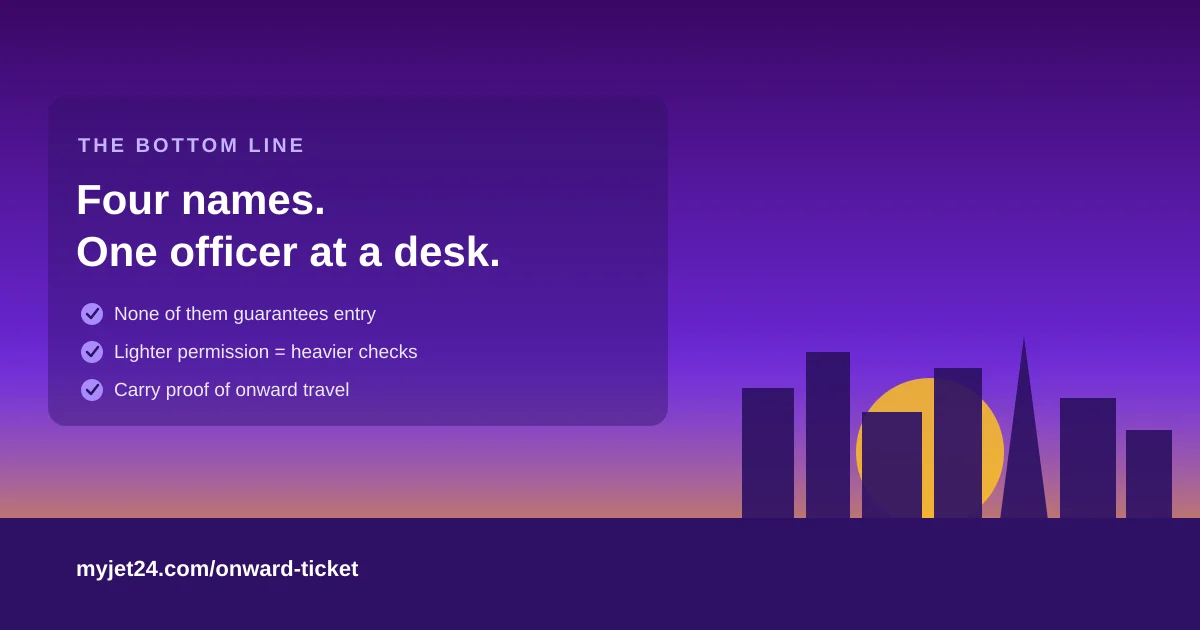
Four names, one destination: an officer at a desk. Visa-free status, an ETA, an eVisa and a visa on arrival differ in when you're checked, how hard, and what a refusal costs you — but not one of them is a guarantee of entry, and two governments say so in their own words. Sorting them out is less about vocabulary than about knowing which stage of scrutiny you've already cleared and which is still ahead.
The practical consequence is the part worth carrying with you. Light permission means heavy questions later, so if you're flying visa-free, on an ETA, or towards a visa-on-arrival counter, arrive with the document that answers the question those systems left open. Create a verifiable onward ticket before you check in, keep it current, and let the border officer's job be a formality rather than a negotiation.
A real reservation with a live PNR, ready in about 30 seconds.
Joshua White — Immigration Policy Writer, MyJet24
Joshua tracks entry-authorisation systems across 60+ countries for MyJet24, from ETA rollouts to arrival-card mandates. Every claim in this guide was checked against primary government text rather than secondary summaries — the UK Home Office ETA factsheet, US Customs and Border Protection guidance, the Schengen Borders Code and Eurostat border statistics. Reviewed on 8 August 2026 by Marc Hoffmann, who covers immigration and entry-requirement policy for MyJet24.
Sources
- UK Home Office — Electronic Travel Authorisation (ETA) factsheet, April 2026 (ETA is not a visa; £20; two-year validity)
- US Customs and Border Protection — Official ESTA site (approval does not guarantee admissibility; officer decides at the port of entry)
- Regulation (EU) 2016/399 (Schengen Borders Code), Annex I — supporting documents incl. "a return or round-trip ticket"
- Eurostat — Refusals of entry at EU external borders, 2025 (132,600 refusals; 40,185 for unjustified purpose)
This guide explains entry-permission categories as of 8 August 2026, drawing on UK Home Office and US Customs and Border Protection guidance, the Schengen Borders Code, Eurostat data and standard airline (IATA/Timatic) practice. Fees, validity periods and eligibility lists change, and requirements depend on the exact pairing of nationality and destination. Verify with the relevant embassy, airline and official immigration authority before you travel. This article is informational and not legal or immigration advice.
