
Last updated: 31 July 2026 · Reading time: 16 min · Author: Joshua White, Travel Documentation Writer at MyJet24
TL;DR — Key Facts
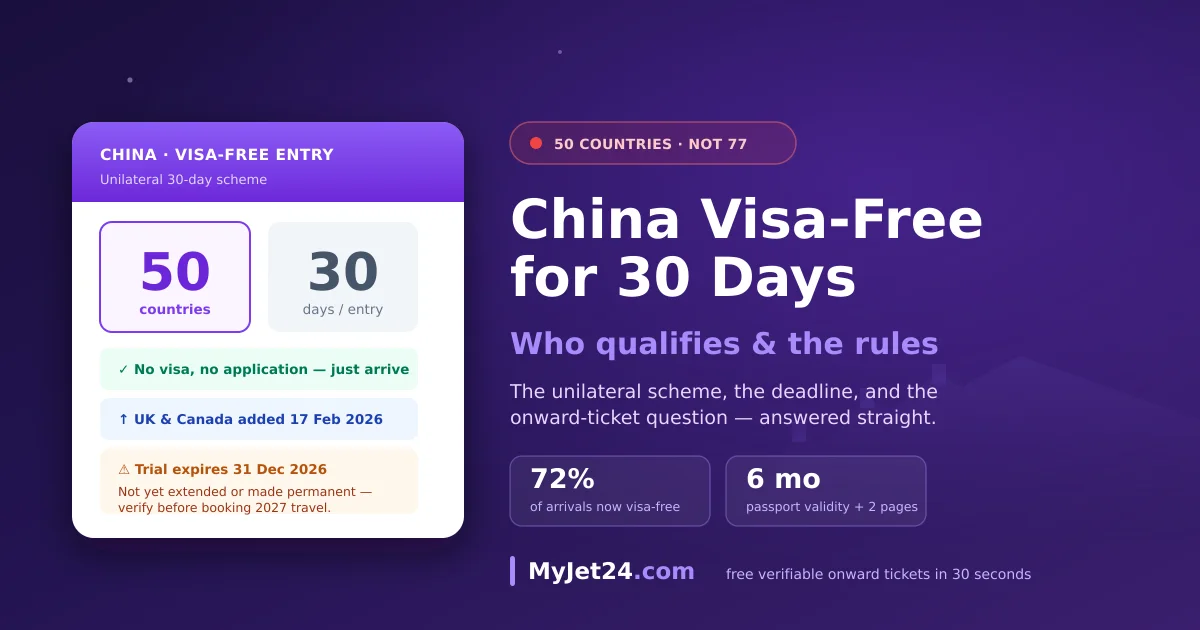
- China lets nationals of 50 countries visit visa-free for 30 days — for tourism, business, family visits, exchanges or transit. No visa, no application; you simply arrive.
- It's 50, not 77. The higher numbers you'll see everywhere lump in a separate set of mutual visa-exemption agreements. The unilateral 30-day scheme this article covers is 50 countries.
- The UK and Canada joined on 17 February 2026, alongside most of the EU, Japan, South Korea, Australia and others. The stay was doubled from 15 to 30 days back in late 2024.
- It's a trial with a deadline: the scheme is currently scheduled to expire on 31 December 2026. As of mid-2026 it had not been extended or made permanent, though Beijing has signalled it wants to expand visa-free access.
- You don't legally need an onward ticket at the border — but airlines check for one at check-in, so in practice you should carry proof of onward travel to be sure of boarding.
- Don't confuse it with the 240-hour transit scheme. That's a different policy for passing through China to a third country, and it does require a confirmed onward ticket.
China's unilateral visa-free scheme lets ordinary-passport holders from 50 countries enter China without a visa for up to 30 days per visit, for tourism, business, visiting family or friends, exchanges or transit. No advance application is needed — you arrive at a port of entry, show a passport valid for at least six months, and are admitted for 30 days. The scheme is a trial currently scheduled to expire on 31 December 2026, and as of mid-2026 had not been extended or made permanent. The 50-country figure refers only to the unilateral policy; higher counts around 77 mistakenly add China's separate mutual visa-exemption agreements. There is no border rule requiring an onward ticket, but airlines enforce proof of onward travel at check-in.
In this guide
- What China's 30-day visa-free scheme is
- Why it's 50 countries, not 77
- Who's covered, and who joined recently
- The rules: 30 days, purposes, passport
- The 31 December 2026 deadline
- Do you need an onward ticket?
- Visa-free vs 240-hour transit: don't mix them up
- Seven mistakes to avoid
- Frequently asked questions
- The bottom line
What China's 30-day visa-free scheme is
For most of the last decade, a trip to China meant a visa application: forms, a consulate appointment, fees, and a wait. Since late 2023, China has been dismantling that barrier for a growing list of countries through a unilateral visa-free policy — and by early 2026 it reached the milestone that put it on every traveller's radar, adding the UK and Canada. If your country is on the list, you can now fly to China and walk in without a visa for up to 30 days.
The word that matters is unilateral. China is choosing, on its own, to waive the visa requirement for these nationals — it is not a mutual deal, and the countries involved don't necessarily offer Chinese citizens the same in return. It's a deliberate policy to revive inbound tourism and business travel after the pandemic, and the numbers show it working: visa-free entries made up over 72% of all foreign arrivals in one recent quarter, up nearly 50% year on year.
For the traveller, the practical experience is simple: no visa, no online authorisation, no application at all. You book your flights, turn up at a Chinese airport with a valid passport, fill in an arrival card, and you're admitted for 30 days.
Why it's 50 countries, not 77
Search this topic and you'll see wildly different country counts — 50, 75, 77, even higher. Most of them are wrong, or at least misleading, and the confusion is worth clearing up because it changes whether you qualify.
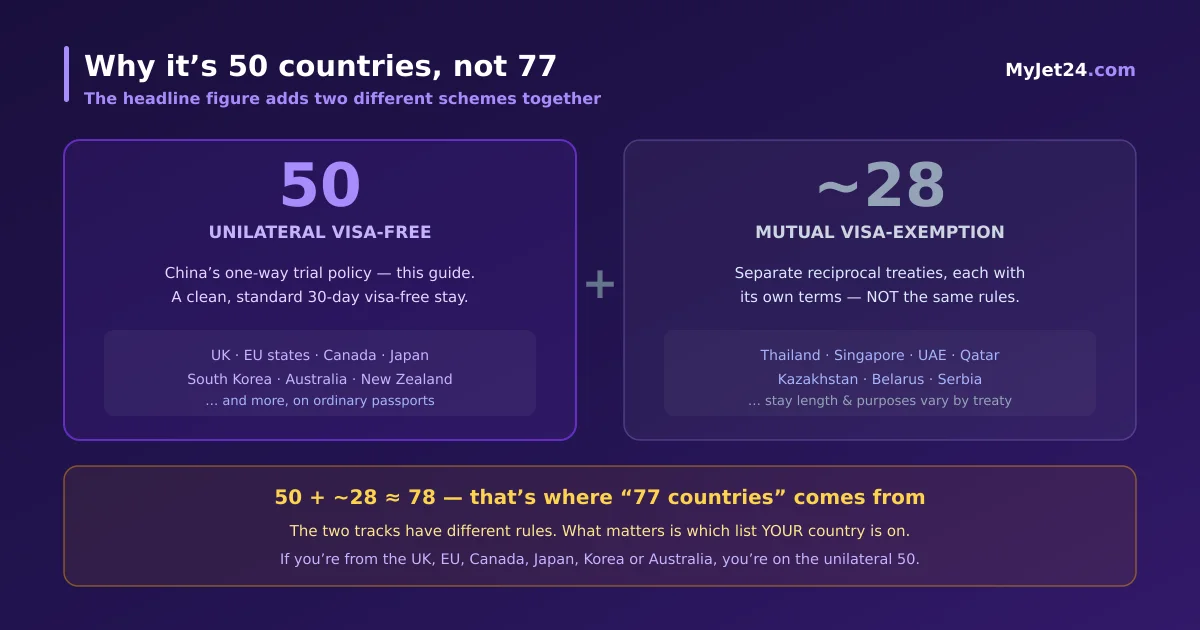
China actually runs two separate visa-free tracks, and the big headline numbers come from adding them together:
| Track | Roughly how many | What it is |
|---|---|---|
| Unilateral visa-free | 50 countries | China's one-way trial policy — the subject of this guide. 30-day stay. Includes the UK, EU, Canada, Japan, South Korea, Australia. |
| Mutual visa-exemption | ~28 countries | Long-standing reciprocal agreements (e.g. Thailand, Singapore, UAE, Qatar, Kazakhstan, Belarus, Serbia). Terms vary by treaty. |
| Reported "total" | ~78 | 50 + ~28. This is where the "77" figure comes from — but the two tracks have different rules. |
Why does the distinction matter in practice? Because the rules differ. The unilateral 50 get a clean, standard 30-day visa-free stay on the terms below. The mutual agreements each have their own conditions — some cap the stay at 30 days, some less, and the permitted purposes vary by treaty. If you're from the UK, the EU, Canada, Japan, South Korea or Australia, you're on the unilateral list, and this guide is for you.
Who's covered, and who joined recently
The unilateral scheme grew in tranches, and the trajectory tells you how fast it's moving. The headline dates:
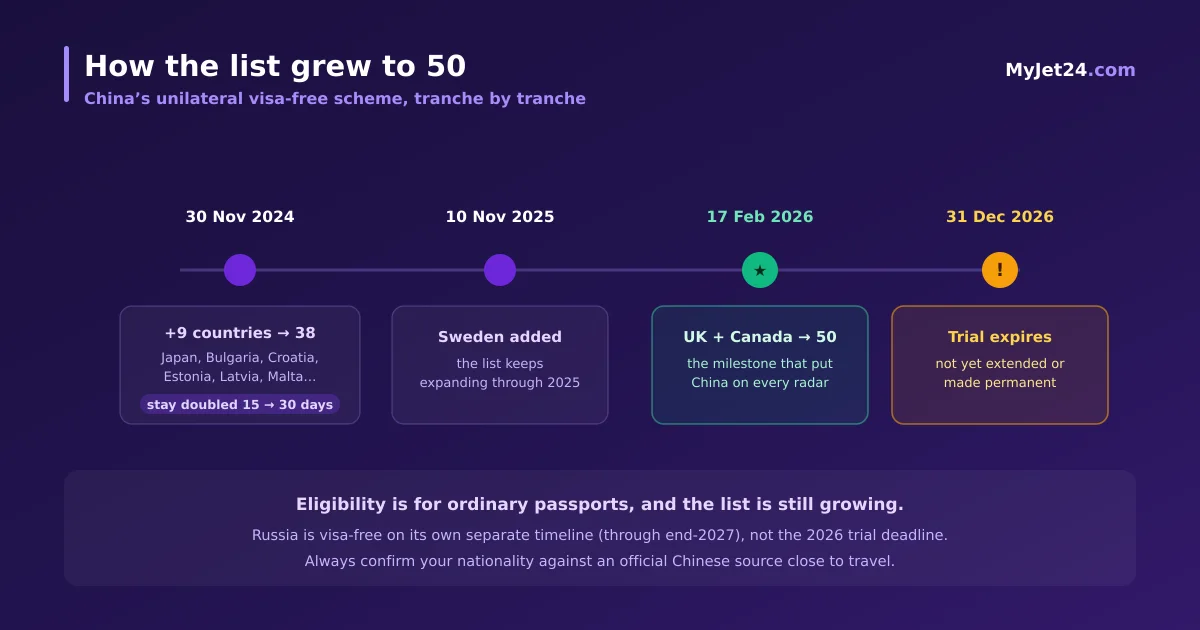
- 30 November 2024: nine countries added (including Japan, Bulgaria, Croatia, Estonia, Latvia, Malta, Montenegro, North Macedonia and Romania) — and, crucially, the stay was doubled from 15 days to 30.
- 10 November 2025: Sweden added.
- 17 February 2026: the United Kingdom and Canada added, taking the unilateral list to 50.
The list now covers most of Europe, the UK, Canada, Japan, South Korea, Australia, New Zealand and a range of others. A couple of nuances are worth knowing. Russia is on a visa-free footing too, but on its own separate timeline running to the end of 2027, not the 2026 trial deadline. And eligibility applies to ordinary passports — diplomatic and some official passports follow different rules. Because the list is still being added to, the golden rule is to confirm your specific nationality against an official source (your Chinese embassy or the National Immigration Administration) close to travel.
The rules: 30 days, purposes, passport
The mechanics are refreshingly light, but the limits are firm.
| Rule | Detail |
|---|---|
| Length of stay | Up to 30 days per entry. It cannot be extended and cannot be converted into another visa type inside China — you must leave and re-enter. |
| Purposes | Business, tourism, visiting family or friends, exchanges, and transit. Not work, study or journalism, which still need a visa. |
| Entries | Multiple entries are allowed, with no published cap on how many times you can use it — each stay just has to be 30 days or fewer. |
| Application | None. There's no online authorisation or pre-registration — you present yourself at a port of entry. |
| Passport | Valid for at least six months with two blank pages. A brief health/medical screening on arrival is possible. |
The 30-day, non-extendable limit is the one that catches people. If you're planning a longer stay — a semester, a work stint, an extended family visit — the visa-free route won't stretch, and there's no converting it once you're in the country. For those trips you still need the appropriate visa, and our China visa flight-reservation guide and China flight-reservation page cover what a visa application needs.
The 31 December 2026 deadline
Here's the detail most excited coverage skips: this is a trial, and it has an expiry date. The unilateral visa-free policy for the core group of countries is currently scheduled to run only until 23:59 on 31 December 2026.
What we can and can't say about what happens next. As of mid-2026, the scheme had not been extended beyond 31 December 2026 or made permanent. In March 2026, China's commerce ministry and eight other departments published measures pledging to "orderly expand" the list of visa-free countries and to enhance related policies — a clear signal of intent to keep going. But intent is not an extension. The honest position is: the policy is scheduled to end on 31 December 2026, a renewal is widely expected but not confirmed, and anyone planning a 2027 trip should verify the status before booking.
For a 2026 trip, none of this is a problem — the scheme is fully in force. The uncertainty only bites if you're planning into 2027, or relying on multiple visa-free entries across the year boundary. Keep an eye on announcements from China's Ministry of Foreign Affairs and National Immigration Administration as the date approaches.
Do you need an onward ticket?
This is the question that trips up more visa-free travellers to China than any other, because the answer has two layers — and most guides only tell you one of them.
At the Chinese border: there is no published rule requiring you to show an onward or return ticket to enter under the 30-day visa-free scheme. Official guidance, including the UK government's, lists passport validity and blank pages but no onward-ticket condition. Chinese immigration officers are, in practice, fairly relaxed — a first-night hotel address on your arrival card is usually enough, and travellers have entered on one-way tickets after explaining their plans.
At airline check-in: it's a different story. Airlines routinely check for proof of onward travel before they let you board a flight to China, and they screen it through the industry's Timatic system. The reason is money: under international carrier-liability rules, if you're refused entry at the destination, the airline has to fly you back and can be fined. So the check-in agent, not the border officer, is the one most likely to ask — and "the rule is soft" is cold comfort if you're standing at the gate without a ticket that gets you back out.
The practical answer: carry proof of onward travel even though China's border rules don't strictly demand it. If your plans are open or you're travelling one-way to your next country, a verifiable onward ticket — a real, checkable reservation dated inside your 30 days — satisfies the airline's check without locking you into a fare. It's the cheapest way to make sure a soft rule never becomes a hard problem at the gate. Our guide on whether airlines can deny boarding explains exactly why the carrier holds the power here, and our roundup of which countries require proof of onward travel puts China in context.
Visa-free vs 240-hour transit: don't mix them up
China has a second visa-free scheme that's constantly confused with this one, and getting them mixed up can genuinely cost you entry. The 240-hour (10-day) visa-free transit is for a completely different kind of trip.
| 30-day unilateral visa-free | 240-hour visa-free transit | |
|---|---|---|
| For | Direct visits to China | Passing through China to a third country |
| Stay | 30 days | Up to 10 days (240 hours) |
| Onward ticket | Not a border rule (airline-checked) | Mandatory — confirmed ticket to a third country within 10 days |
| Where | Any port of entry | 65 designated ports only |
| Eligible | 50 countries | 55 countries |
The simple rule of thumb: if China is your destination and you're from one of the 50 countries, use the 30-day visa-free scheme. If China is a stopover on the way somewhere else, the 240-hour transit scheme may fit — and there, an onward ticket to your third country is non-negotiable. We cover that scheme in full in our 240-hour transit guide, and layovers more broadly in the transit visa and layover guide.
Seven mistakes to avoid
- Believing the "77 countries" figure applies to you. The unilateral 30-day scheme is 50 countries; the rest are separate mutual agreements with their own terms.
- Planning a stay longer than 30 days. It's non-extendable and can't be converted in China. For longer trips, get the right visa.
- Assuming it's permanent. It's a trial scheduled to end on 31 December 2026, not yet extended. Verify before booking 2027 travel.
- Flying in one-way with nothing to show. The border may not demand an onward ticket, but the airline can refuse to board you without proof of onward travel.
- Confusing it with the 240-hour transit. Different scheme, different rules — and transit genuinely requires an onward ticket to a third country.
- Using it for work or study. Visa-free covers tourism, business, family visits, exchanges and transit — not employment, study or journalism.
- Travelling on a passport under six months' validity. You need six months and two blank pages, or you can be refused regardless of eligibility.
Frequently asked questions
How long can I stay in China visa-free in 2026?
Up to 30 days per entry under the unilateral visa-free scheme, for nationals of the 50 eligible countries. The stay is not extendable and cannot be converted into another visa type inside China — to return you must leave and re-enter. This 30-day limit has applied since late 2024, when China doubled it from the original 15 days.
How many countries have visa-free access to China?
Fifty countries have unilateral 30-day visa-free access — the scheme covered in this guide. You'll often see figures like 77, but those add China's roughly 28 separate mutual visa-exemption agreements to the 50 unilateral countries. The two tracks have different rules, so the number that matters is whether your specific country is on the unilateral list.
Is the UK on China's visa-free list?
Yes. The United Kingdom was added to China's unilateral 30-day visa-free scheme on 17 February 2026, alongside Canada. UK ordinary-passport holders can now enter China without a visa for up to 30 days for tourism, business, family visits or transit, provided their passport is valid for at least six months with two blank pages.
Do I need to apply for anything before flying to China visa-free?
No. Unlike an ETA or e-visa, China's visa-free scheme requires no advance application or online authorisation. You simply arrive at a port of entry with a valid passport, complete an arrival card, and are admitted for 30 days. China is, however, rolling out an online arrival card, so the arrival formality may move online in future.
Does China's visa-free entry require a return or onward ticket?
Not as a border rule. Official Chinese entry guidance for the 30-day visa-free scheme does not require you to show an onward ticket, and immigration officers are generally lenient. However, airlines check for proof of onward travel at check-in under carrier-liability rules and can deny boarding without it, so you should carry a confirmed onward or return booking even though the border doesn't strictly demand one.
When does China's visa-free scheme expire?
The unilateral visa-free policy is a trial currently scheduled to expire at the end of 31 December 2026. As of mid-2026 it had not been extended or made permanent, though China's government has signalled an intention to expand visa-free access. If you're planning travel in 2027, check the current status with China's Ministry of Foreign Affairs or National Immigration Administration before booking.
Can I work or study in China on visa-free entry?
No. The visa-free scheme covers tourism, business, visiting family or friends, exchanges and transit. Employment, study and journalism are not permitted purposes and still require the appropriate visa. Using visa-free entry to work is a serious violation and can lead to detention, fines and deportation.
Can I enter China visa-free multiple times?
Yes. The scheme allows multiple entries with no published cap on how many times you can use it, as long as each individual stay is 30 days or fewer. That said, repeatedly using visa-free entry to live in China long-term can draw scrutiny; for an extended stay, the correct visa is the safer route.
What's the difference between China's visa-free entry and the 240-hour transit?
The 30-day visa-free scheme is for direct visits to China by nationals of 50 countries, with no third-country requirement. The 240-hour (10-day) transit scheme is for travellers passing through China to a third country within 10 days, is available at 65 designated ports to nationals of 55 countries, and firmly requires a confirmed onward ticket to that third country. Use visa-free if China is your destination, transit if it's a stopover.
What passport validity do I need for visa-free entry to China?
Your passport must be valid for at least six months beyond your date of entry and have at least two blank pages for stamps. A brief health or medical screening on arrival is possible. Only ordinary passports are covered by the unilateral scheme; diplomatic and some official passports follow separate rules.
Is China's visa-free scheme the same as a mutual visa exemption?
No. The unilateral scheme is China choosing, one-way, to waive its visa requirement for 50 countries — the partner country doesn't have to reciprocate for Chinese citizens. Mutual visa-exemption agreements are reciprocal treaties with around 28 other countries (such as Thailand, Singapore and the UAE), each with its own terms. This guide covers the unilateral 30-day scheme.
Can I extend my 30-day visa-free stay in China?
No. The 30-day visa-free stay cannot be extended and cannot be converted into another visa type from inside China. If you need longer, you must leave the country and re-enter for a fresh 30 days, or obtain the appropriate visa in advance. Overstaying carries fines and possible detention, so plan your exit inside the window.
The bottom line

China's visa-free opening is one of the most significant travel changes of the decade, and for the 50 countries on the unilateral list it makes a trip genuinely easy: no visa, no application, 30 days on arrival. The two things worth holding in your head are the ones the breathless coverage tends to drop — that "50" is the real number for the unilateral scheme, not 77, and that the whole policy is a trial pencilled to end on 31 December 2026 unless Beijing renews it.
The rest is a short checklist. Confirm your nationality is on the unilateral list, carry a passport with six months and two blank pages, keep your stay inside 30 days, and — because the airline will ask even when the border won't — travel with a verifiable proof of onward travel dated inside your window. Get those right and the hardest part of visiting China in 2026 is deciding where to go. The paperwork, for once, is the easy part.
Sources
- The State Council of the People's Republic of China (gov.cn) — China widens visa-free access: https://english.www.gov.cn/news/202511/04/content_WS69094ae0c6d00ca5f9a07472.html
- Visa for China Service Center (visaforchina.cn) — visa-free policy FAQ: https://www.visaforchina.cn/
- UK Government (FCDO) — China travel advice, entry requirements: https://www.gov.uk/foreign-travel-advice/china/entry-requirements
- KPMG GMS Flash Alert 2026-092 — China's 20 March 2026 travel-services measures: https://kpmg.com/xx/en/our-insights/gms-flash-alert/2026/flash-alert-2026-092.html
- China Briefing — China visa-free travel policies complete guide (country tracker): https://www.china-briefing.com/news/china-visa-free-travel-policies-complete-guide/
This guide reflects China's unilateral visa-free entry policy as reported by Chinese government sources, the UK FCDO and specialist trackers as of 31 July 2026. The scheme is a trial scheduled to expire on 31 December 2026, and the eligible-country list and terms can change. Only ordinary passports are covered, and mutual visa-exemption agreements follow separate rules. Verify your nationality's status with an official Chinese source before you travel. This article is informational and not legal or immigration advice.
