
Last updated: 2 October 2026 · Reading time: 17 min · Author: Joshua White, Travel Documentation Writer at MyJet24 · Reviewed by: Marc Hoffmann, Senior Visa Consultant

TL;DR — Key Facts
- A sponsorship letter is a private promise to pay someone's travel costs. It is signed by the sponsor, addressed to the consulate, and carries no legal force on its own.
- In several Schengen countries a private letter is not accepted at all. Germany, France and the Netherlands each require a formal undertaking issued by a public authority — a different document with a different name, a fee, and an office visit.
- Germany's version makes the sponsor liable for five years. Section 68 of the Residence Act obliges the signatory to repay public funds spent on the visitor's living costs, housing, illness and long-term care for five years from entry.
- France's version must be validated before you apply. The attestation d'accueil costs €30 in tax stamps, is issued by the host's town hall, and must be stamped and posted to the applicant before the visa appointment.
- A sponsor does not remove your own financial proof. Consulates read sponsorship as an addition to your file, not a replacement for it.
A visa sponsorship letter is a signed statement in which a named person or company undertakes to cover an applicant's travel, accommodation and living costs during a short stay. It names both parties, states the relationship, gives the exact dates, lists which costs are covered, and comes with the sponsor's own proof of income. For most non-Schengen destinations a well-drafted private letter is enough. For Germany, France and the Netherlands it is not: those states require their own official undertaking instead.
What a sponsorship letter actually is
A sponsorship letter is a private written undertaking in which one party accepts financial responsibility for another party's trip. It is not a government form, it is not notarised by default, and no authority issues it. The sponsor writes it, signs it, and the applicant files it with the rest of the application.
That distinction matters more than most templates admit. A consulate reads the letter as a statement of intent backed by evidence. The letter itself proves nothing; the bank statements, payslips and residence documents attached to it do the proving. A beautifully worded letter from someone with no demonstrable income is worth less than three plain sentences from someone whose account history shows the money is there.
Key takeaway: the letter is the cover sheet for a financial argument. The argument lives in the attachments.
Sponsorship letter, invitation letter, official undertaking
An invitation letter establishes who is hosting you. A sponsorship letter establishes who is paying for you. An official undertaking is a state-issued form that does both and adds legal liability. Competing guides routinely treat the first two as synonyms, and applicants file the wrong one.
The three documents answer different questions, and a consulate may ask for one, two or all three. If your cousin in Lisbon is hosting you but you are paying your own way, you need an invitation letter and no sponsorship letter at all. If your employer is funding a trade fair visit and you are in a hotel, you need sponsorship and no invitation. Our separate guide on writing an invitation letter that gets approved covers the hosting side in full.
| Invitation letter | Sponsorship letter | Official undertaking | |
|---|---|---|---|
| Answers | Who hosts you | Who pays for you | Both, with liability |
| Issued by | The host, privately | The sponsor, privately | A public authority |
| Costs money | No | No | Yes, a state fee |
| Legally binding | No | Weakly, as a declaration | Yes, enforceable |
| Needs an office visit | No | No | Usually, by the host |
Key takeaway: ask the consulate's checklist which of the three it wants. Filing a private letter where a state form is required is a formal defect, not a weak point you can argue around.
Where a private letter is not accepted
Several Schengen states replaced the private sponsorship letter with their own statutory instrument years ago. In those countries the host does not write a letter — the host goes to an office, fills in a government form, pays a fee, and the authority issues the document. A private letter submitted instead is simply the wrong paper.
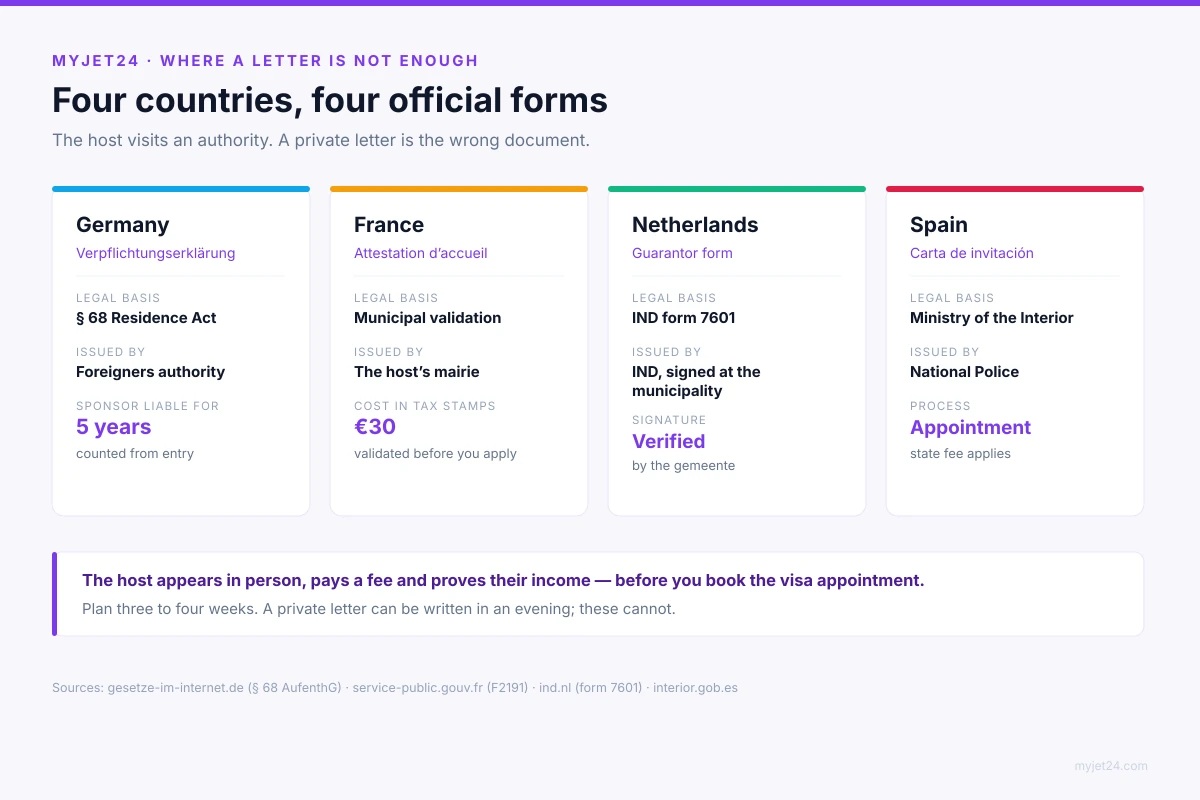
| Country | What is required | Issued by | Notable condition |
|---|---|---|---|
| Germany | Verpflichtungserklärung, § 68 Residence Act | Foreigners authority, or a German mission abroad | Liability runs five years from entry |
| France | Attestation d'accueil | The host's mairie (town hall) | €30 in tax stamps; must be validated before you apply |
| Netherlands | Official guarantor form (IND form 7601) | Downloaded from the IND, signed before the municipality | Signature verified by the gemeente |
| Spain | Carta de invitación | National Police, via the Ministry of the Interior | Appointment required; a state fee applies |
| Most other destinations | Private sponsorship letter | The sponsor | Strength comes from the attachments |
In our reading of the four national checklists, the pattern is consistent: the countries that issue their own instrument all attach a cost and an identity check to it, and all of them want the host, not the traveller, to appear in person. That is the practical difference. A private letter can be written on a Sunday evening and emailed. An attestation d'accueil needs a town hall appointment, a tax stamp bought at a tabac, and postal delivery to the applicant — plan three to four weeks, not three days.
"L'attestation doit obligatoirement être validée par la mairie avant la demande de visa."
— service-public.gouv.fr, French public service portal, sheet F2191
Key takeaway: check the destination before anyone starts writing. For four major Schengen destinations, the right answer is a state form, not a letter — and the lead time is measured in weeks.
What the sponsor is signing up for
An official undertaking transfers real financial risk to the person who signs it. German law states the scope plainly, and the period surprises most hosts: the obligation does not end when the visitor flies home.
"Wer sich der Ausländerbehörde oder einer Auslandsvertretung gegenüber verpflichtet hat, die Kosten für den Lebensunterhalt eines Ausländers zu tragen, hat für einen Zeitraum von fünf Jahren sämtliche öffentlichen Mittel zu erstatten, die für den Lebensunterhalt des Ausländers einschließlich der Versorgung mit Wohnraum sowie der Versorgung im Krankheitsfalle und bei Pflegebedürftigkeit aufgewendet werden."
— § 68 (1) Aufenthaltsgesetz, German Residence Act
Read in plain terms: if the visitor falls ill, needs housing, or ends up on public support, the state can bill the sponsor — for five years counted from the day of entry, not from the day the visa expires. The same paragraph confirms the clock starts with the entry that the undertaking made possible.
That is why a German Verpflichtungserklärung is never handed out casually: the foreigners authority first checks that the signatory can actually carry the obligation. A host with irregular income will be turned away at that counter, long before the consulate sees anything.
Before anyone signs. Ask the sponsor whether they would still sign knowing the liability can outlive the trip by years. A host who hesitates at that question is a host whose documents will not survive the authority's own income check either. Finding that out now costs nothing; finding it out at the counter costs the appointment.
Who is allowed to sponsor you
A sponsor is any person or legal entity with lawful status in the destination country and provable means to cover the stated costs. Consulates generally accept three categories: close family, a resident friend or acquaintance, and an employer or inviting organisation.
Relationship matters less than capacity, with one exception: the closer the family tie, the less the consulate questions the motive. A parent sponsoring a student is ordinary. A distant acquaintance sponsoring a stranger invites questions about why. Where the tie is loose, the financial evidence has to be correspondingly stronger, and the letter should explain the connection in one honest sentence rather than leaving it blank.
Corporate sponsorship follows different conventions. A company letter goes on letterhead, is signed by someone with authority to bind the company, states the business purpose, and references the registration number. Consulates treat a well-formed company undertaking as strong evidence, because the entity behind it is verifiable in a public register.
Key takeaway: the sponsor must be lawfully resident, financially provable, and able to explain the relationship in one sentence. Any of the three missing weakens the file.
What the letter must contain
A sponsorship letter is complete when a stranger reading it can answer five questions without guessing: who pays, who travels, what relationship connects them, which dates apply, and which costs are covered. Anything beyond that is decoration; anything missing is a gap an officer has to fill with assumptions.
The required elements, in the order consulates expect to find them:
- Sponsor's full identity — legal name, full residential address, nationality, passport or national ID number, and immigration status in the destination country.
- Applicant's full identity — name exactly as printed in the passport, date of birth, nationality, passport number.
- The relationship — stated plainly: "my daughter", "my employee since 2019", "a friend I met during my studies in Dhaka".
- Exact travel dates — arrival and departure, matching the flight reservation and the accommodation booking to the day.
- The costs covered — itemised, not summarised: international flights, accommodation, daily living expenses, local transport, medical insurance if the sponsor is paying it.
- A statement of means — one sentence on the source of the money: salary, business income, pension.
- Contact details — phone and email the consulate can actually reach.
- Date, place and handwritten signature — an unsigned letter is a draft.
Names must match the passport exactly. A sponsorship letter naming "Mohammed Rahman" against a passport reading "Md Rahman" creates a mismatch, and mismatches between documents are among the quietest causes of refusal — the same trap we documented for flight bookings that disagree with the application form.
Documents the sponsor attaches
The attachments carry the evidential weight. A sponsorship letter without them is an unsupported promise, and consulates treat it as such.
The standard bundle from a private sponsor is a copy of the identity page of the passport or national ID, proof of lawful residence where the sponsor is not a citizen, bank statements covering the last three to six months, recent payslips or a tax assessment, and an employment confirmation stating position and salary. Where the sponsor is also hosting, a property deed or tenancy agreement is added.
Bank statements do more work than any other attachment, and they are read for pattern rather than balance. A consistent salary arriving monthly across six months is stronger than a single large deposit landing a week before the appointment. A sudden injection of funds reads as a staged balance and invites exactly the scrutiny the file was supposed to avoid. Our guide to proof of funds for Schengen applications sets out the per-country thresholds in detail.
Key takeaway: six months of ordinary statements beat one impressive balance. Officers read the shape of the account, not the final line.
Writing it, step by step
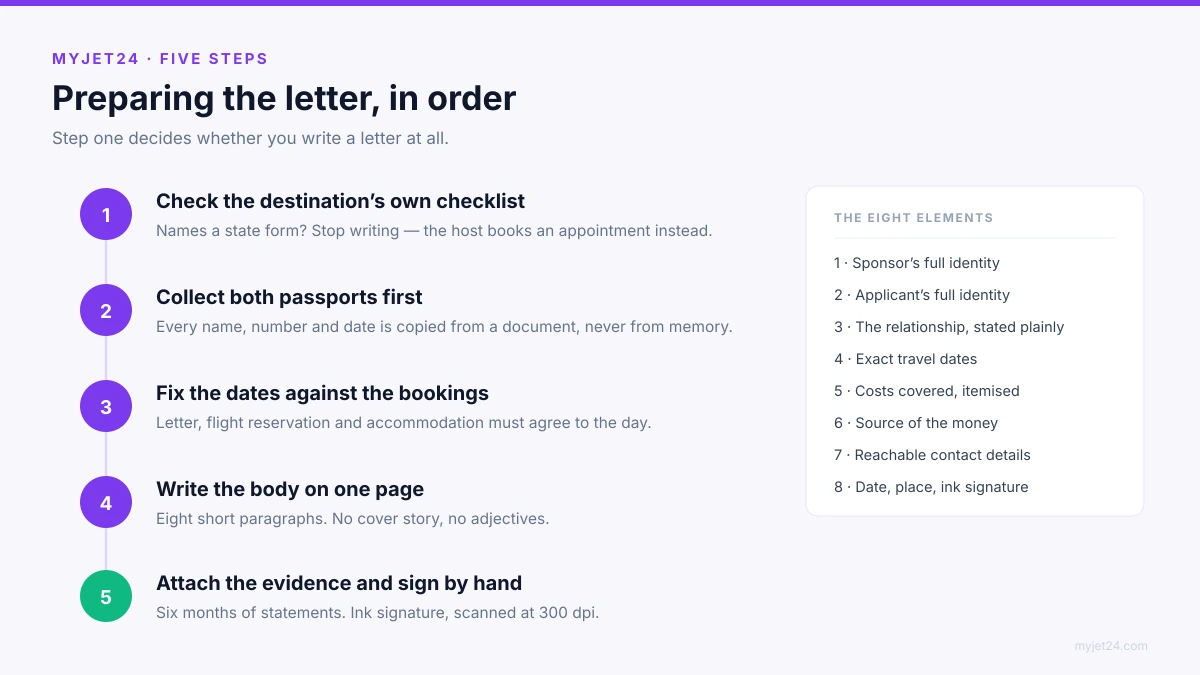
- Check which document the destination wants. Open the consulate's own checklist. If it names a state instrument, stop writing and book the host's appointment instead.
- Collect both passports first. Every name, number and date in the letter is copied from a document, never from memory.
- Fix the dates against the bookings. The letter, the flight reservation and the accommodation must agree to the day.
- Write the body in one page. Eight short paragraphs covering the eight elements above. No cover story, no adjectives, no promises about the trip's purpose — that belongs in the applicant's own cover letter.
- Assemble the evidence pack and sign by hand. Print, sign in ink, scan at 300 dpi. A typed signature on a PDF is refused at some consulates as a matter of routine.
Need the supporting letter formatted the way consulates expect?
The MyJet24 Visa Support Letter Generator builds the document from your details in about two minutes, with the structure above already in place.
Create a visa support letter — $7Does a sponsor replace your own funds?
No. A sponsorship letter supplements an applicant's financial profile; it does not substitute for it. The Schengen framework asks whether the applicant has sufficient means of subsistence, and a third party's promise is one way of demonstrating that — not a waiver of the question.
In practice, consulates look for coherence between the two files. An applicant with no income at all, fully funded by a distant acquaintance, presents a weaker case than the same applicant with a modest salary and a relative covering the flights. The sponsor answers "can this trip be paid for"; the applicant's own documents answer "will this person return", and the second question is the one that decides most tourist applications. Ties to home — employment, property, family — carry that weight, which is why we treat them separately in our guide to proving ties to your home country.
Key takeaway: sponsorship answers affordability. It does not answer intent to return, and intent is what refusals usually turn on.
When the sponsor lives somewhere else
A sponsor residing outside the destination country can still fund a trip, but the document loses most of its institutional weight. A cousin in Toronto sponsoring a visit to Italy cannot sign an Italian declaration of hospitality, and the Italian consulate has no way to verify a Canadian bank statement against a Canadian employer.
Where this applies, two adjustments help. Have the sponsor's bank issue a stamped letter confirming the account and the average balance, rather than relying on printed statements alone; an institution's confirmation travels across borders better than a PDF. And route the money before the appointment: a transfer that arrives in the applicant's own account four to six weeks ahead turns third-party support into first-party funds, which no officer needs to interpret.
The weakest version of this file is the one where a foreign sponsor promises support that never moves. Officers see the promise, see an empty applicant account, and refuse on means — a refusal that is painful precisely because the money existed the whole time. If that outcome has already happened, our guide on what to do after a refusal sets out the appeal and reapplication routes.
Mistakes that cost approvals
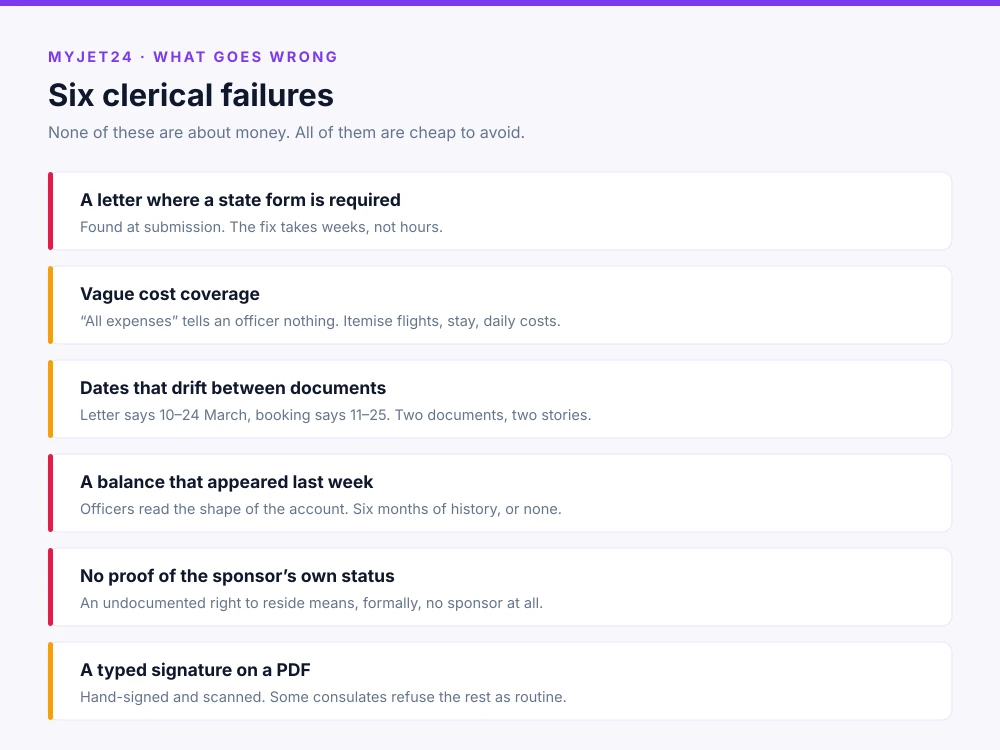
The failures we see repeated are clerical, not substantive. They are also cheap to avoid, which is what makes them worth listing.
- Filing a letter where a state form is required. The single most expensive error, because it is only discovered at submission and the fix takes weeks.
- Vague cost coverage. "I will take care of all expenses" tells an officer nothing. Itemise.
- Dates that drift. The letter says 10–24 March, the booking says 11–25 March. Two documents, two stories.
- A balance that appeared last week. Six months of history or none at all.
- No proof of the sponsor's own status. A sponsor whose right to reside is undocumented is, for the consulate's purposes, not a sponsor.
- An unsigned or digitally typed signature. Hand-signed and scanned, every time.
One pattern deserves its own line: sponsors who over-promise. A letter undertaking to cover "any and all costs including medical emergencies" from someone earning a modest salary reads as unserious. State what can actually be carried, attach the evidence, and let the modesty of the claim do the persuading.
Frequently asked questions
Does a sponsorship letter need to be notarised?
Usually not. Most consulates accept a hand-signed letter with supporting documents. Notarisation becomes relevant where the destination requires a verified signature — the Dutch guarantor form, for example, is signed in front of the municipality, which performs that check itself.
Can a friend sponsor my visa, or does it have to be family?
A friend can sponsor you in most cases. The relationship affects how closely the file is read rather than whether it is accepted. Where the tie is not a family one, state honestly how you know each other and attach stronger financial evidence to compensate.
How much money does the sponsor need to show?
There is no universal figure, because the benchmark is the destination's daily subsistence rate multiplied by the length of stay, plus the cost of travel. Schengen states publish their own rates and they differ widely. Treat the published minimum as a floor, not a target.
Is a sponsorship letter the same as an affidavit of support?
They serve the same purpose under different legal systems. "Affidavit of support" is the term used in United States immigration practice, where it is a sworn statement on an official form. In short-stay European practice the equivalent is either a private sponsorship letter or a state undertaking, depending on the country.
Can one sponsor cover several travellers?
Yes, and families frequently do it. Name every traveller individually with passport numbers rather than writing "and family", and show that the declared means cover the whole group rather than one person.
How long is a sponsorship letter valid?
A private letter has no formal expiry, but consulates expect it to be recent — dated within about three months of the appointment and tied to specific travel dates. Official undertakings carry their own validity: the French attestation d'accueil, for instance, is issued for a defined visit, not open-ended.
What happens to the sponsor if I overstay?
Under a private letter, generally nothing enforceable. Under a state undertaking the position is different: the signatory remains liable for public costs connected to the stay, and in Germany that liability runs for five years from entry regardless of when the visitor actually leaves.
Do I still need travel insurance if someone sponsors me?
Yes. Sponsorship covers costs; insurance covers risk, and Schengen applications require medical cover of at least €30,000 as a separate condition. A sponsor may pay for the policy, but the policy itself still has to exist and be filed.
Does a sponsorship letter guarantee approval?
No document guarantees approval. Sponsorship removes one objection — affordability — and leaves the others untouched. Purpose of travel, intent to return and the completeness of the file all remain open questions the consulate decides on its own assessment.
Can I write the sponsorship letter myself and have the sponsor sign it?
Practically, this is how most letters are produced, and nothing prohibits it. The sponsor must read and understand what they are signing, because the obligations attach to them and not to you — particularly where the document is a state undertaking with multi-year liability.
What to do next
Start with the destination's own checklist, because that single step decides whether you are writing a letter at all. If it names a state instrument — the German Verpflichtungserklärung, the French attestation d'accueil, the Dutch guarantor form, the Spanish carta de invitación — the host books an appointment and the private letter never gets written. If it does not, draft the letter around the eight elements above, attach six months of ordinary financial history, and keep the dates identical across every document in the file.
The supporting documents sit alongside it: a confirmed itinerary, accommodation for the full stay, and insurance that meets the threshold. We cover accommodation proof without prepaying and what embassies require from an insurance policy in separate guides.
Put the paperwork together in one sitting.
Generate the supporting letter, then add a confirmed flight itinerary and hotel reservation for the same dates — formatted the way consulates expect to receive them.
Visa support letter — $7 Free flight itinerary
Joshua White — Travel Documentation Writer, MyJet24
Joshua writes MyJet24's documentation guides, working from consulate checklists and the underlying national legislation rather than secondary summaries. For this article he read the German Residence Act, the French public service guidance on the attestation d'accueil and the Dutch IND guarantor form directly, and compared them against the four consulate checklists cited above.
Last reviewed: 2 October 2026 by Marc Hoffmann, Senior Visa Consultant.
This guide explains documentation practice and is not legal advice. Requirements change and only the competent consulate decides an application. Verify against the official checklist for your destination before filing.
