
Last updated: 4 October 2026 · Reading time: 24 min · Author: Marc Hoffmann, Senior Visa Consultant at MyJet24 · Reviewed by: James Mitchell, Travel Documentation Specialist
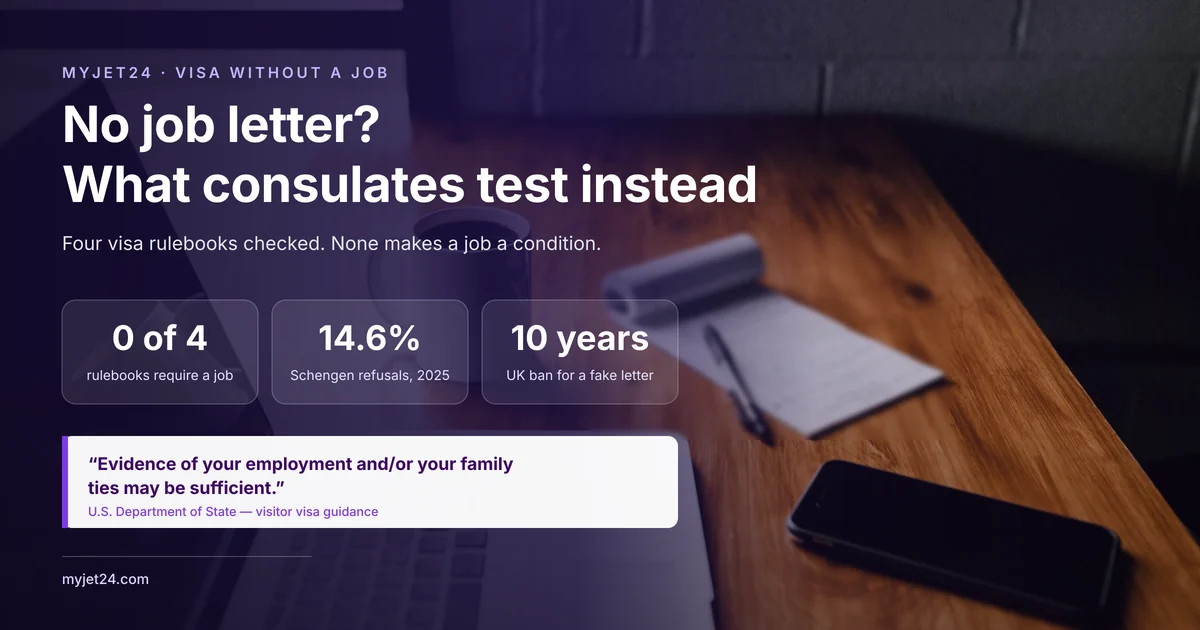
TL;DR — Key Facts
- Yes, you can get a tourist visa without a job. None of the four rulebooks we checked — Schengen, the UK, the US and Canada — makes employment a legal condition for a visitor visa.
- The officer tests two things, not your job title: that you can pay for the trip, and that you have reasons to go home. A job is simply the most common way of proving both at once.
- Without an employer letter you replace it, you do not skip it. Self-employed applicants file business registration, tax returns and invoices; retirees file pension statements; students file enrolment letters; people between jobs file savings history and a written explanation.
- Consistency decides more files than income. The occupation you enter on the form, the documents you attach and the money moving through your bank account must tell the same story.
- Never invent an employer. A fabricated job letter triggers a 10-year ban in the UK and permanent inadmissibility in the US. An honest "not employed" with good evidence is a far smaller risk.
You can get a tourist visa without a job. Consulates do not require employment; they require proof that you can fund the trip and will return home. Unemployed, self-employed, retired and student applicants are approved every day when their file replaces the employer letter with other evidence: savings history, business records, pension statements or a sponsor, plus a clear travel plan.
Building your file now? A dated flight reservation is the one document every applicant files, with or without a job. Create a free flight reservation for your visa dates — it takes about a minute and matches the itinerary you describe in your cover letter.
Can you get a tourist visa if you are unemployed?
A tourist visa is a permission to visit, and the legal test for it is whether you are a genuine visitor — not whether you are employed. Unemployment is a fact the officer weighs, never an automatic refusal ground. We checked the rulebooks of the four systems that receive the most visitor applications from our readers, and none of them lists a job as a requirement.
What the rules do require is evidence. The Schengen Visa Code asks for documents showing your intention to leave. The UK asks whether you are a genuine visitor. US law presumes every applicant is an intending immigrant until they show otherwise. Canada's regulations require that the visitor will leave Canada by the end of the period authorized. A job is one way of meeting each test. It is not the only way.
The difference between an approved unemployed applicant and a refused one is rarely the unemployment itself. It is whether the file explains it. An application that leaves the employment field blank, attaches no income evidence and offers no reason to return reads as a gap. The same applicant with eight months of savings history, a lease at home and a two-line explanation reads as a person between chapters.
Key takeaway: the question on the officer's mind is not "does this person have a job?" but "why would this person come back?" Answer that one directly.
What do the rules actually say about employment?
The legal texts are more relaxed about employment than most checklists suggest. Visa checklists published by consulates and agencies are practical lists of what usually works. The underlying law is the standard the officer must apply, and it is written around return and funds, not employment status.
| System | Legal test | What the text says about work | Job required? |
|---|---|---|---|
| Schengen | Intention to leave before the visa expires (Visa Code, Annex II B) | Lists "proof of employment: bank statements" and "professional status" as examples of evidence | No — examples, not conditions |
| United Kingdom | Genuine visitor, balance of probabilities (Appendix V, V 4.2) | Officers weigh "financial circumstances as well as their family, social and economic background" | No — missing recommended documents are "not of itself a ground for refusal" |
| United States | Overcome the presumption of immigrant intent (INA § 214(b)) | "Evidence of your employment and/or your family ties may be sufficient" | No — "and/or" makes family ties a valid alternative |
| Canada | Will leave by the end of the authorised stay (IRPR s. 179(b)) | Officer guidance asks "Is the person employed?" as one question among many | No — a factor, not a gate |
The Schengen wording deserves a second look. Annex II of the Visa Code (Regulation 810/2009) names five kinds of evidence for the intention to leave: a return or round-trip reservation, financial means in the country of residence, proof of employment in the form of bank statements, real estate, and integration through family ties or professional status. Employment is one item on a list of five, and the law itself suggests bank statements as the way to show it.
"If an applicant does not send one of the recommended documents this failure is not of itself a ground for refusal."
— UK Home Office, Visit guidance, version 17.0 (published 25 February 2026)
Key takeaway: employment is evidence, not eligibility. You are free to prove the same two things — funds and return — with different documents.
Why does a job letter carry so much weight?
An employer letter is a third-party confirmation that answers three questions in one page: where your money comes from, how much of it arrives each month, and who expects you back on a fixed date. That is why it dominates checklists. It is efficient, not mandatory.
Think about what the officer reads in a standard salaried file. The letter says the applicant earns a fixed salary, has worked there for four years and has approved leave from 3 to 17 May. The bank statement shows that salary arriving monthly. The leave dates match the flight reservation. Three documents, one coherent story. The officer can decide in minutes.
Remove the employer, and the officer has to build that picture from other pieces. The work you do as an applicant without a job is to hand over those pieces already assembled. Each function of the job letter needs its own replacement:
- Source of funds → business accounts, tax returns, pension statements, a sponsor's documents or a savings history that shows where the money came from.
- Stability over time → six to twelve months of statements, a business registered for years, a pension paid for years.
- A reason to return on a date → client contracts with deadlines, a course start date, a job offer, a lease, dependants, a return booking.
Key takeaway: list the three things a job letter proves, then file one document for each. That turns a "missing" document into a complete argument.
Who counts as "without a job", and what replaces the employer letter?
"Without a job" covers six very different applicant profiles, and each one has a different natural substitute for the employer letter. A freelance designer with five years of invoices and a recent graduate with a student loan are both "not employed" on paper, yet their strongest evidence has nothing in common. Matching the evidence to the profile is the single most useful step you can take.
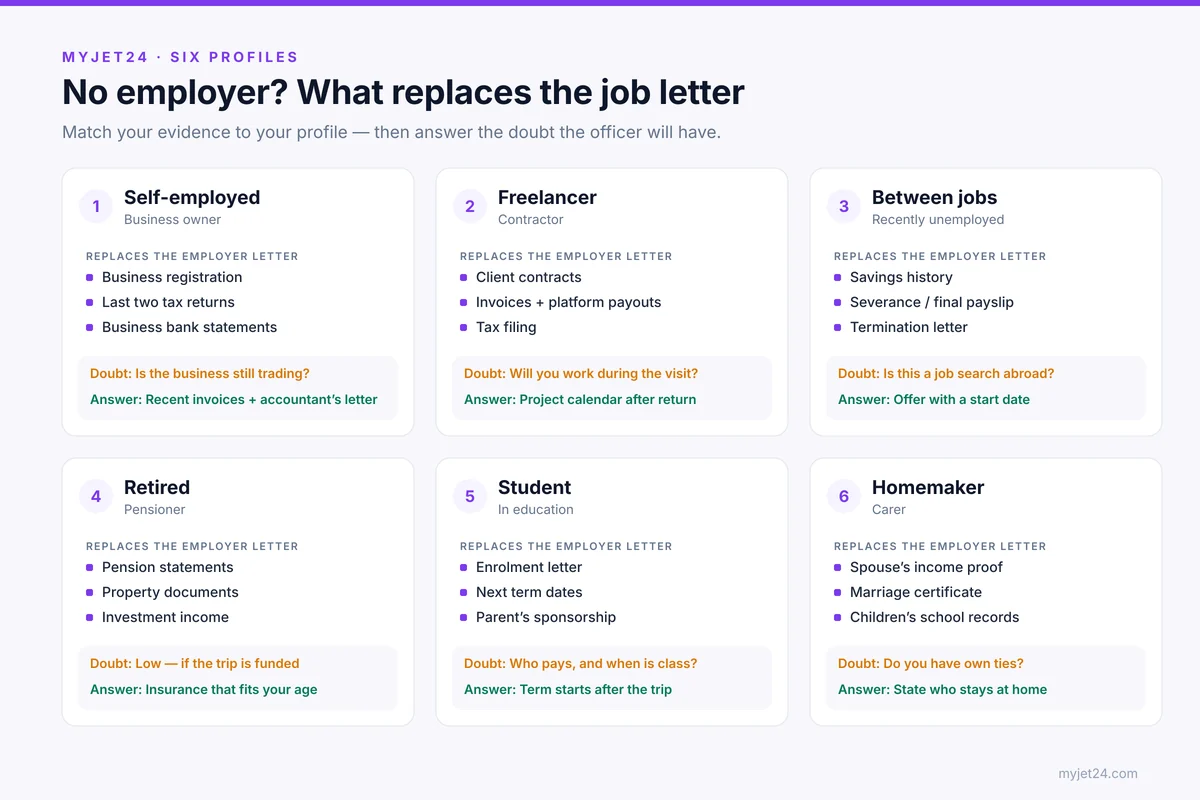
| Profile | Replaces the employer letter | Officer's likely doubt | How to answer it |
|---|---|---|---|
| Self-employed / business owner | Business registration, last two tax returns, business bank statements | Is the business real and still trading? | Recent invoices, an accountant's letter, premises lease |
| Freelancer / contractor | Client contracts, invoices, platform payout records, tax filing | Will you work during the visit? | A project calendar showing work resumes after return |
| Between jobs | Savings history, final payslip or severance, termination letter | Is this trip a job search abroad? | A signed offer with a start date, or a short honest explanation |
| Retired | Pension statements, proof of property, investment income | Little — retirees are a low-risk group if funded | Show the pension arriving monthly; travel insurance matters more |
| Student | Enrolment letter confirming the next term, parental sponsorship | Who pays, and will you return for classes? | Term dates that start after the trip ends; the sponsor's statements |
| Homemaker / carer | Spouse's employment and income documents, marriage certificate | Do you have independent ties? | Children's school records, a spouse staying home, joint property |
This matrix reflects the employment questions our support team answers week after week. The "likely doubt" column is the important one: it tells you which question your strongest document must answer. A retiree who files four pages of bank statements but no pension letter answers a question nobody asked and leaves the real one open.
Key takeaway: pick your profile, read its doubt column, and make sure the first document in your file answers it.
How do self-employed people and freelancers prove their work?
A self-employed applicant proves employment by proving that the business exists, earns money and will still be there next month. Registration shows existence; tax returns show earnings over time; recent invoices show the business is trading now. The UK's official guide for visitors names this directly: "business registration documents or recent invoices that confirm on-going self-employment".
The self-employed file in order of strength
- Business registration certificate or trade licence, showing the registration date. Older is better.
- The last two filed tax returns, with the tax office's receipt or assessment notice. Returns filed only last week carry less weight than returns filed on time.
- Six months of business bank statements, plus your personal account if you pay yourself into it.
- Three to five recent invoices to different clients, and matching payments on the statement.
- An accountant's letter confirming your role, the business turnover and how long they have kept your books.
- Evidence of commitments after the trip: a signed contract with a delivery date, a booked client meeting, a premises lease.
Freelancers: the remote-work question
Freelancers face one doubt that business owners rarely do: an officer may suspect you plan to keep working from your laptop during the visit. Most visitor rules restrict work for local clients, and the details differ by country. Do not volunteer that you will "work from the beach". State your trip dates as time off, and show the project calendar that resumes after your return. If you genuinely plan to work abroad for months, a tourist visa is the wrong instrument — see our overview of countries that offer digital nomad visas.
A self-employed problem we see regularly in support conversations is not low income but income that cannot be traced: client payments received through a personal wallet app, cash, or a relative's account. If that describes you, attach the platform's payout history alongside the bank statement so the money has a visible path.
Key takeaway: registration proves the business exists, tax returns prove it earns, invoices prove it is trading today. File all three.
What if you are between jobs right now?
Being between jobs is the profile officers scrutinise most, because a trip taken during unemployment can look like a job search abroad. The fix is to make the gap explainable and the return date credible. Applicants who address the gap directly do far better than those who hope the officer will not notice it.
Start with the strongest fact you have. If you have accepted a new position, a signed offer letter with a start date after your return is better evidence than many employer letters, because it fixes a date by which you must be home. If you do not, show how the trip is funded — savings built up over months, a severance payment, a final salary — and say in one sentence why you are travelling now.
An officer cannot weigh what you leave out. A two-line explanation of a career gap costs you nothing; silence invites the officer to fill the gap with the least favourable reading.
Two patterns cause trouble. First, a large deposit just before applying. The UK guidance tells officers that where funds "have not been held in their account for long", they may make further checks on where the money came from. Savings that grew gradually look nothing like a sudden transfer. Second, a long trip with no fixed return. A two-week holiday after a redundancy is easy to understand; a three-month open-ended stay is not.
Key takeaway: name the gap, show where the money came from, and keep the trip short and dated.
How do retirees, students and homemakers show they will return?
Retirees, students and homemakers prove their ties through their status itself: a pension paid at home, a course that resumes, a household that depends on them. These profiles are often treated as lower risk than the unemployed, provided the money side is documented.
Retirees and pensioners
A pension is a strong tie because it is paid where you live and continues regardless of the trip. File the pension award letter or a recent statement, show the pension arriving on your bank statement, and add property documents if you own your home. Health and age make insurance more important, not less: Schengen applications require medical cover of at least €30,000, and an officer will check that the policy actually covers someone your age.
Students
A student's tie is the next term. An enrolment letter that confirms your status and the date classes resume after your return is the core document. Most students are funded by a parent, so the parent's income evidence and a short sponsorship letter fill the funds side. The UK guide lists "a letter from your education provider, on headed paper, confirming your enrolment and leave of absence" as standard evidence.
Homemakers and carers
A homemaker usually travels on a spouse's income. File the spouse's employment and income documents, the marriage certificate, and evidence of the household you are returning to — children's school enrolment is one of the clearest. If the spouse is not travelling with you, that fact itself is a tie, and it is worth stating in your cover letter.
Key takeaway: your status is your tie. Document the status, then document who pays.
Where does a sponsor fit in, and when does it backfire?
A sponsor is a person or company that formally undertakes to pay some or all of your trip costs. For applicants without income, a sponsor is often the cleanest answer to the funds question. The US State Department says so plainly: if you cannot cover all costs, "you may show evidence that another person will cover some or all costs for your trip".
Sponsorship solves funds; it does not solve ties. A parent paying for an unemployed adult's holiday answers "who pays?" and leaves "why return?" untouched. The file still needs your own anchor: a lease, a course, a job offer, dependants. Officers also check that the sponsor is real and able to pay — the sponsor's bank statements, proof of residence and relationship to you go in alongside the letter.
Some Schengen countries do not accept a private sponsorship letter at all and require an official state form from the host instead. We cover the four main ones in our guide to what consulates accept as a sponsorship letter.
Key takeaway: a sponsor replaces your income, never your reasons to go home.
Why must your form, documents and bank account match?
The three-way match is the principle that the occupation you declare on the form, the documents you attach and the money flowing through your bank account must describe the same person. For applicants without a job it decides more files than income does, because every inconsistency reads as a possible invention.
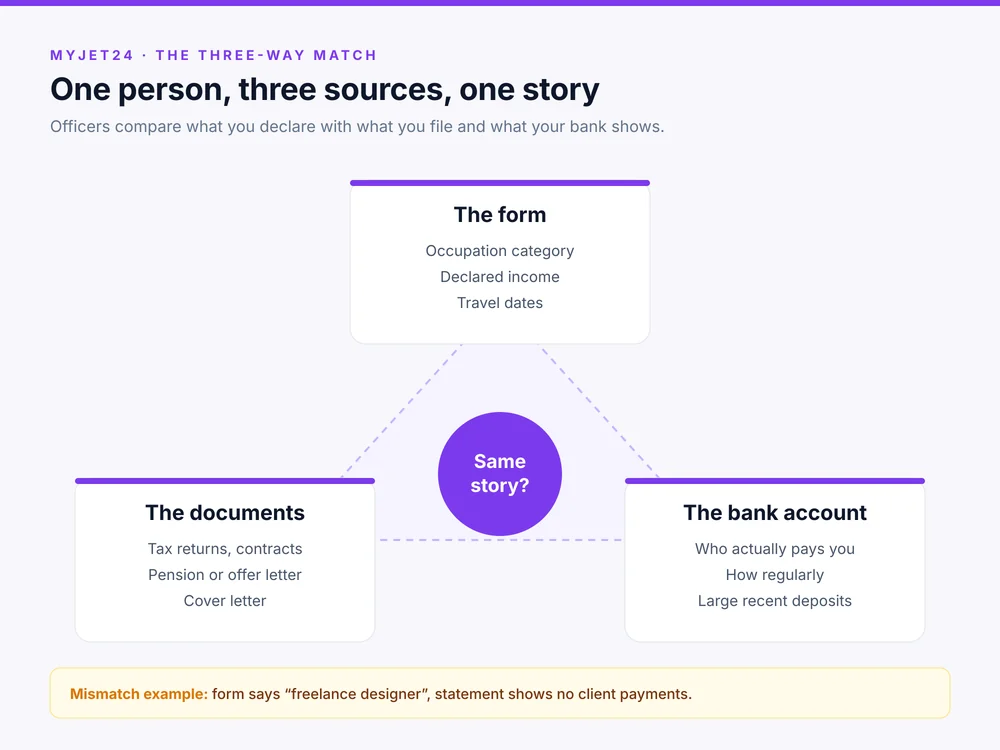
The UK guidance spells this out for its officers: there should be "a correlation between the information applicants have declared on their application form (such as income, large account deposits and / or support received by family / friends), and the actual evidence provided". Schengen and US officers work the same way in practice. Here is how a mismatch looks from the other side of the desk:
- The form says "freelance designer", but the bank statement shows no client payments — only a monthly transfer from a relative.
- The form says "unemployed", yet the cover letter mentions "my company" and the itinerary includes business meetings.
- The form declares a monthly income of 3,000, and the statement shows deposits of 900.
None of these applicants lied on purpose. Each one simply filled in the form from memory and the documents from the drawer. Before submitting, read your form and your statement side by side. The same discipline applies to dates — our guide on why the visa form and flight booking have to match covers that half of the check.
Key takeaway: choose the honest occupation category, then make every attachment confirm it.
When does having no job lead to a refusal?
A refusal linked to employment status is almost always a refusal for weak ties or insufficient funds, recorded under a general ground. Officers rarely write "refused because unemployed". They write that you have not shown your intention to leave, or that the purpose and conditions of the stay were not justified. Employment status is one input into that judgement.
Refusal data: the baseline you start from
- 14.6% of Schengen short-stay applications were refused in 2025, out of more than 12 million filed (European Commission, 28 May 2026).
- US B-visa adjusted refusal rates, FY2025: Brazil 14.87%, Mexico 21.36%, India 22.04%, Indonesia 26.69%, Philippines 30.76%, Nigeria 57.00%, Kenya 68.23% (US Department of State).
- 4.6× — the spread between Kenya and Brazil under the very same US law. Your nationality sets the starting risk; your documents move you from there.
Read those figures as context, not prediction. An unemployed applicant from a low-refusal country is not safe, and a well-documented freelancer from a high-refusal country is not doomed. The figures do explain why identical advice produces different outcomes for different readers: the same thin file is a small risk in one consulate and a large one in another.
If you have been refused before, you must normally declare it, and you should address the stated reason in the new file. Our guide on what happens after a visa refusal walks through reapplying.
Key takeaway: a refusal says your evidence did not carry the argument. Fix the evidence, not your job title.
Why is a fake employment letter the worst option?
A fabricated employment letter converts a weak application into a fraud finding, and fraud findings outlast any single trip. Unemployment can be refused once and approved the next time with better evidence. Deception follows you into every future application.
The consequences are written into law. In the UK, Home Office guidance states that "when an application is refused because of deception, future applications must be refused for a 10-year period". In the US, INA § 212(a)(6)(C)(i) makes inadmissible any person who "by fraud or willfully misrepresenting a material fact" seeks a visa — a bar with no expiry date that only a waiver can lift. Consulates verify employer letters by telephone more often than applicants expect, particularly for small companies.
| Honest "not employed" + evidence | Invented employer letter | |
|---|---|---|
| Worst realistic outcome | One refusal; reapply with stronger evidence | Deception finding on record |
| UK | Refusal, no ban | 10-year mandatory refusal period |
| US | 214(b) refusal, reapply any time | Permanent inadmissibility unless waived |
| Effect on other countries | A refusal you declare and explain | A deception refusal you must declare everywhere |
The same logic applies to every document in the file. A flight reservation, for instance, should be a real booking held in an airline system, not an edited PDF — our explainer on why fake flight tickets are risky covers the difference.
Key takeaway: "not employed" is a fact officers handle every day. A forged letter is the one choice that can close a country to you for a decade.
How do you build the application, step by step?
An application without an employer letter is built around the officer's two questions — funds and return — answered in the order the officer reads them. The sequence below is the one we recommend in our support conversations; it turns scattered paperwork into a single argument.
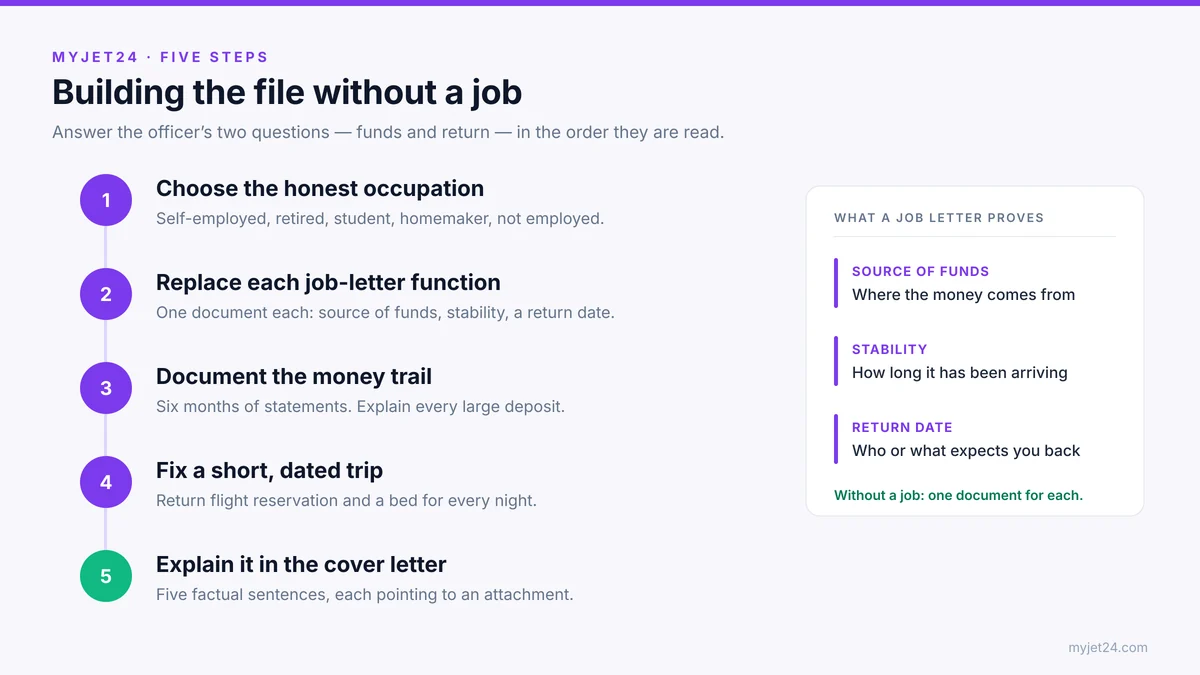
- Choose the honest occupation category. Use the form's own options — "self-employed", "retired", "student", "homemaker", "not employed". Do not pick the category that sounds best; pick the one your documents prove.
- Replace each function of the job letter. One document for the source of funds, one for stability over time, one for a reason to return on a date. Use the profile matrix above.
- Document the money trail. Six months of statements minimum. Annotate any large deposit with its source and attach the proof — a sale contract, a severance letter, a gift letter from a parent.
- Fix a short, dated trip. A defined itinerary with a confirmed flight reservation and accommodation for every night. Short and specific beats long and open.
- Explain your situation in the cover letter. One paragraph, factual, no apology. State your status, how the trip is funded and what brings you home.
A cover-letter paragraph that works
"I have worked as a self-employed graphic designer since March 2021, registered under number [number]. My last two tax returns and six months of business statements are enclosed. I will travel from 3 to 17 May 2027 and pay all costs from my savings shown in the attached statements. On 20 May I begin a contracted project for [client], confirmed in the enclosed agreement."
Five sentences, each pointing to an attachment. Adapt the structure to your profile: a retiree names the pension, a student names the term start date, an applicant between jobs names the offer or the savings. Our longer guide to writing a visa cover letter that gets read has templates for each case.
Key takeaway: every sentence in the cover letter should point to a document in the file.
Which travel bookings make the plan look credible?
A credible travel plan is a defined trip with fixed dates, a return flight and accommodation for every night. For an applicant without a job it carries extra weight, because it is the one piece of evidence that directly shows when you intend to leave — and the Schengen Visa Code lists a "reservation of or return or round ticket" first among the documents for the intention to leave.
Most consulates advise against buying non-refundable tickets before the visa is decided. A flight reservation solves that: a real booking with a PNR that shows your outbound and return dates without the full fare. We explain the timing question in our guide to whether you need a flight before applying. The return date on that reservation should match the cover letter, the form and, where you have one, the date your next contract or term begins.
Compare two files. In the first, the applicant states "around two weeks in Europe" with no bookings. In the second, the applicant files a reservation from Mumbai to Paris on 3 May and back on 17 May, three hotel confirmations covering 14 nights, and a cover letter giving the same dates. Both are unemployed. Only the second has shown the officer a date of return.
Show the officer your return date.
Create a flight reservation with confirmed outbound and return dates — free, in about a minute, ready to attach to your application.
Create my free flight reservationKey takeaway: a return booking is the most direct evidence of departure you can file — and the cheapest.
Frequently asked questions
Can I get a US tourist visa if I am unemployed?
Yes. US law presumes every visitor applicant intends to immigrate until they show otherwise, and the State Department says evidence of employment and/or family ties may be sufficient to overcome that. Without a job, the interview has to establish your funds and your reasons to return through other evidence, such as savings history, property, dependants or a confirmed job offer.
What should I enter as my occupation on the visa form if I have no job?
Enter the truthful category that your documents can prove, such as not employed, self-employed, retired, student or homemaker. Do not enter your previous job title as if it were current. A form that says one thing while the bank statement shows another is a bigger problem than the unemployment itself.
Can a freelancer without a registered business get a tourist visa?
Yes, if the income is visible and taxed. Where registration is not required in your country, file your tax returns, client contracts, invoices and the payout history from the platforms you work through. The aim is to show a trackable path from client to bank account.
How much money do I need in my bank account if I have no job?
There is no single figure. Several Schengen countries publish a daily amount per visitor, and other countries assess whether your savings minus your commitments reasonably cover the trip. A steady balance built up over months carries more weight than a larger sum deposited shortly before applying.
Do I need to explain a gap in my employment?
You are not obliged to, but it almost always helps. One or two factual sentences in the cover letter, for example that your contract ended in March and you start a new role in June, prevent the officer from guessing. Attach proof where you can, such as the termination letter or the new offer.
Can my parents sponsor my tourist visa if I am unemployed?
Yes. A parent can cover the costs, and their bank statements, proof of income and a short signed sponsorship letter go into your file. Sponsorship answers the question of who pays, but you still need your own ties to home, such as studies, a lease or a job offer.
Is it easier to get a visa as a retiree than as an unemployed person?
Usually, yes. A pension is a regular income paid at home that continues regardless of the trip, which answers both the funds and the return question. Retirees should pay closer attention to travel insurance, because the cover must apply to their age and medical situation.
Should I wait until I start a new job before applying?
If the start date is close and the trip is flexible, a signed offer letter is often enough and you do not need to wait. If you have no offer yet, applying with clear savings history and a short dated trip is reasonable. Applying with a vague plan just before a job search is the weakest combination.
Will the consulate contact my clients or former employer?
It can. Officers are instructed to verify documents at source when they doubt them, and small businesses and freelancers are checked by phone or email more often than applicants expect. Only file contracts and invoices whose senders will confirm them.
Can I get a Schengen visa as a housewife or homemaker?
Yes. Homemakers are approved regularly on the basis of the spouse's income and employment documents, the marriage certificate and evidence of the household they return to, such as children's school enrolment. If the spouse stays home during the trip, say so in the cover letter, because it is a tie in itself.
What to do next
Start by identifying your profile in the matrix above and writing down the officer's likely doubt. Then gather one document for each function of the missing job letter, check that your form, documents and bank statement agree, and fix a short trip with exact dates. Finish with a five-sentence cover-letter paragraph that points to each attachment.
If money is the weak spot, read our guide to presenting bank statements embassies trust. If ties are the weak spot, our guide on how to prove ties to your home country compares what four legal systems accept.
Complete the travel side of your file today.
A confirmed flight reservation with your exact dates, matching your cover letter and application form.
Get a free flight reservationSources and method
Every legal statement in this guide was checked against the primary text on 4 October 2026: the Schengen Visa Code, Annex II; the UK Home Office Visit guidance v17.0 and the guide to supporting documents; the Home Office suitability guidance on deception; the US State Department visitor visa page; 8 U.S.C. § 1184(b) and § 1182(a)(6)(C)(i); Canada's IRPR section 179 and IRCC officer guidance on visitor eligibility.
The six-profile matrix and the three-way match are MyJet24's own framework, drawn from the application questions our support team handles. They describe practice, not law.

Marc Hoffmann — Senior Visa Consultant, MyJet24
Marc founded MyJet24 in 2021 and has worked on visa documentation for applicants travelling to more than 195 countries. For this guide he read the Schengen Visa Code, the UK Home Office's visit and suitability guidance, the relevant sections of US immigration law and Canada's visitor regulations directly, and built the profile matrix from the employment questions that reach MyJet24's support team most often.
Last reviewed: 4 October 2026 by James Mitchell, Travel Documentation Specialist.
This guide explains documentation practice and is not legal advice. Requirements change and only the competent consulate decides an application. Verify against the official checklist for your destination before filing.
