
TL;DR
- UAE residents (not only Emiratis) can apply for a Schengen visa from Dubai or Abu Dhabi if their residence visa is valid 3+ months beyond return.
- Official fee: EUR 90 adult, EUR 45 child (6-12), free under 6, plus a VFS/BLS service charge and EUR 30,000 travel insurance. All-in: ~EUR 120-135 (~AED 520-590).
- Apply to the consulate of the country where you spend the most nights (or first entry if equal).
- You must show a round-trip flight reservation and a hotel booking for every night — but you should not buy non-refundable tickets before approval.
- Processing is 15 calendar days (up to 45). Apply 6-8 weeks ahead; you can lodge up to 6 months before travel.
Yes — any UAE resident can apply for a Schengen visa from inside the UAE. You book an appointment at the VFS Global, BLS or TLScontact centre in Dubai or Abu Dhabi that serves your main destination, pay the EUR 90 consulate fee plus service and insurance costs, and submit a document set that includes a round-trip flight reservation and hotel booking. The single most common UAE mistake is buying non-refundable flights and hotels before the visa is approved — consulates only require a reservation, not a paid ticket.
Quick answer
A Schengen tourist visa from the UAE costs about AED 520-590 all-in, takes 15-45 days, and requires proof of onward travel (a flight reservation), accommodation for every night, EUR 30,000 insurance, UAE bank statements and a residence visa valid 3+ months past your return.
Can UAE residents apply for a Schengen visa?
You do not need to be an Emirati national. UAE residents of any nationality can apply for a Schengen short-stay (Type C) visa from within the Emirates, which is exactly why "visit visa from Dubai" and "visit visa from Kuwait" are such common searches across the Gulf. The core conditions are simple:
- A valid UAE residence visa and Emirates ID, valid at least 3 months beyond your planned departure from the Schengen Area.
- A passport valid 3+ months beyond return, issued within the last 10 years, with at least 2 blank pages.
- Proof of ties to the UAE — a job, salary, tenancy or business — that show you will return.
Tourists, business visitors and people visiting family all use the same Type C visa. It allows stays of up to 90 days in any 180-day period across the whole Schengen Area.
How much does a Schengen visa cost from the UAE in 2026?
The consulate fee is fixed by the EU and is the same whether you apply from Dubai, Abu Dhabi or anywhere else. Everything beyond it — service charges, insurance, optional courier and SMS — is what makes the real total higher.
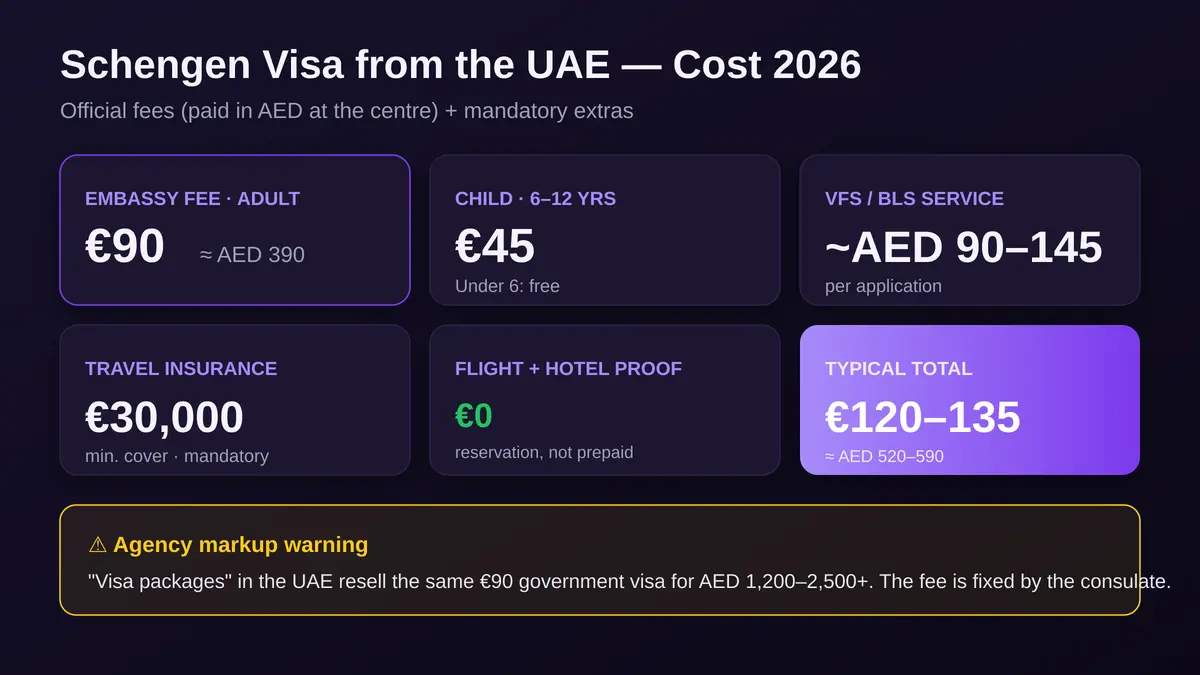
| Item | Cost | Notes |
|---|---|---|
| Consulate fee (adult) | EUR 90 (~AED 390) | Fixed; non-refundable even if refused |
| Consulate fee (child 6-12) | EUR 45 | Under 6 free |
| VFS / BLS / TLS service fee | ~AED 90-145 | Per applicant, varies by consulate |
| Travel insurance | ~AED 60-150 | Min EUR 30,000 medical cover, mandatory |
| Flight reservation + hotel proof | From AED 0 | Reservation, not a prepaid ticket |
| Typical all-in total | EUR 120-135 (~AED 520-590) | Excluding optional courier/SMS |
Watch the markup. Many UAE "visa packages" resell the same EUR 90 government visa for AED 1,200-2,500+. The consulate fee cannot be discounted or inflated — you are only ever paying for someone else's paperwork. Doing it yourself is entirely feasible.
Which embassy or consulate should you apply to?
This trips up more UAE applicants than anything else. You apply to one country's consulate, decided by the main-destination rule:
- Most nights wins. Apply to the country where you will spend the most nights.
- Equal nights? Apply to the country of first entry.
- Single country? Apply to that country, even for a 2-day trip.
"A 7-night trip with 4 nights in Spain and 3 in France is a Spanish application — even if you land in Paris first."
In the UAE, applications are handled through outsourced centres — VFS Global, BLS International and TLScontact — with offices in both Dubai and Abu Dhabi. Each consulate uses one provider, so confirm the correct centre for your destination before booking biometrics.
Documents required for UAE residents
Bring originals plus one photocopy of each. The checklist below is the baseline every Dubai and Abu Dhabi applicant needs; some consulates ask for extras such as a marriage certificate or older bank history.
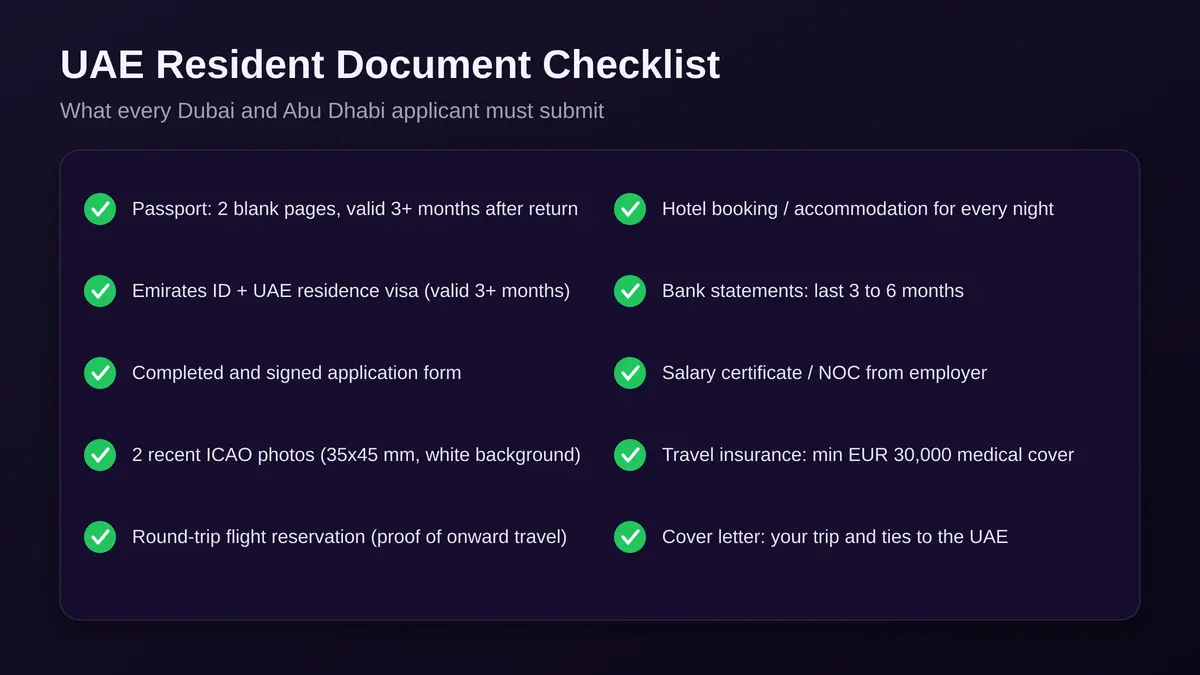
- Passport — 2 blank pages, valid 3+ months after return, under 10 years old.
- Emirates ID + UAE residence visa copy — residence valid 3+ months beyond return.
- Completed, signed application form.
- 2 ICAO photos — 35x45 mm, white background, recent.
- Round-trip flight reservation — proof of onward travel with a real PNR.
- Hotel booking / accommodation — covering every night of the stay.
- Bank statements — last 3 to 6 months, stamped.
- Salary certificate / NOC from your UAE employer (or trade licence if self-employed).
- Travel insurance — min EUR 30,000 medical cover for the whole Schengen Area.
- Cover letter — your itinerary, who pays, and your ties to the UAE.
Proof of onward travel and accommodation — without prepaying
Two requirements quietly cause the most wasted money: the flight reservation and the hotel booking. Consulates want to see a coherent, dated round-trip and accommodation for every night — but they explicitly do not expect you to buy non-refundable tickets before a decision. Buying first and getting refused (or delayed past your dates) is how applicants lose thousands of dirhams.
The safe approach is a confirmed flight reservation with a verifiable PNR for your visa file, and a cancellable hotel booking matching the same dates and main destination. This satisfies the Schengen flight reservation requirement and the accommodation requirement without locking in fares. You can generate both in minutes — see the CTA below — and only book real flights once your passport comes back with the visa inside.
"A flight reservation for a visa is legal and expected. A forged or edited ticket is not. Use a real, verifiable reservation."
How to apply step by step from the UAE
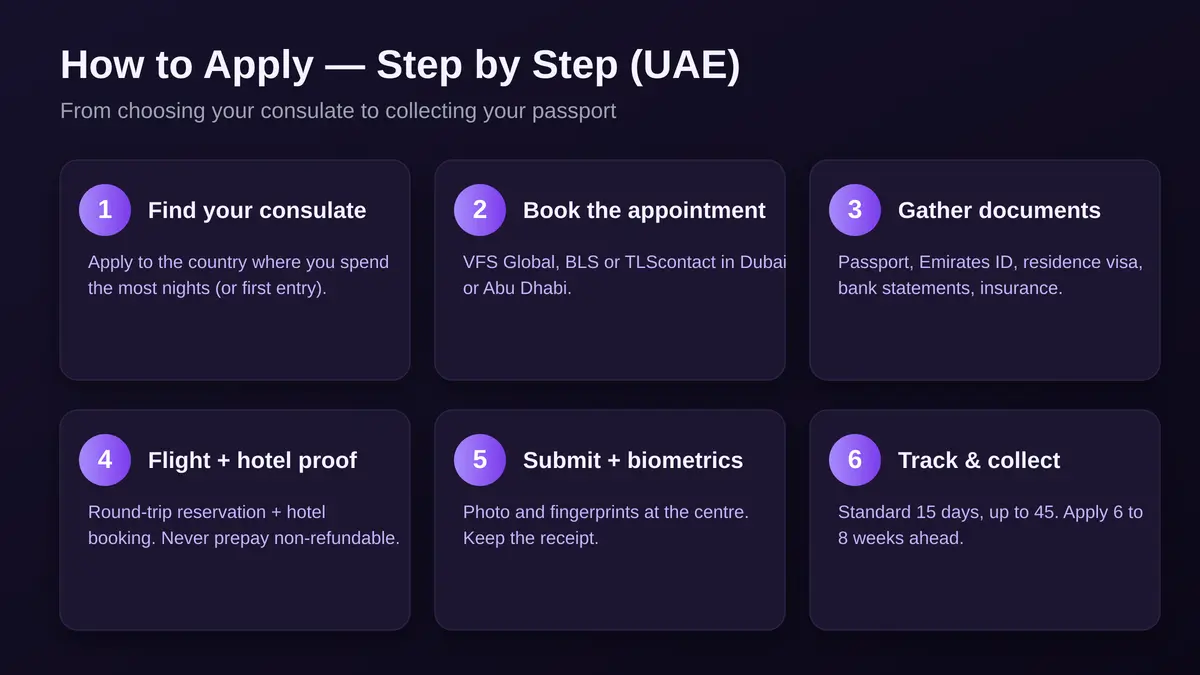
- Find your consulate using the main-destination rule above.
- Book the appointment at the right VFS/BLS/TLS centre in Dubai or Abu Dhabi. Slots fill fast in summer.
- Gather documents from the checklist; check the validity of your passport and residence visa first.
- Add flight reservation and hotel booking for the exact dates — reservations, not prepaid bookings.
- Attend the appointment for fingerprints and photo, and submit the file. Keep the reference receipt.
- Track and collect — standard 15 days; collect your passport or use courier return.
Processing times and when to apply
Standard processing is 15 calendar days from your appointment date. Consulates may extend this to 30 or 45 days if they need extra checks, and decisions slow during the Gulf's two big outbound waves: June-August (European summer) and December. You can submit up to 6 months before travel; the sweet spot is 6 to 8 weeks ahead — late enough that your dates are firm, early enough to absorb delays.
Top reasons UAE applications get refused
- Insufficient or unexplained funds — a large deposit dropped in days before applying looks staged. Show 3-6 months of steady balances.
- Weak ties to the UAE — short residence validity, no salary certificate, or a residence visa expiring soon after the trip.
- Wrong consulate — applying somewhere other than your main destination.
- Mismatched dates — flights and hotels that do not line up with each other or the form.
- Insurance gaps — under EUR 30,000 cover or not valid Schengen-wide.
If you are refused, you receive a reason code and a right to appeal — covered in our guide on Schengen visa rejection appeals.
Funds and bank statements: how much do you need?
There is no single published minimum, because each consulate sets its own "sufficient means of subsistence" expectation. As a working rule, plan to demonstrate roughly EUR 50-100 per day of your trip, on top of already-paid costs. For a 10-day trip that is broadly EUR 500-1,000 of visible, available money — though a healthy buffer always reads better than the bare minimum.
What matters more than the headline balance is how the money behaves. Consulates are looking for stability, not a screenshot. Submit three to six months of stamped UAE bank statements showing regular salary credits and an ending balance that comfortably covers the trip. A single large deposit that lands a few days before you apply is the classic red flag: it suggests borrowed funds and routinely triggers a "justification for the purpose and conditions of the stay was not provided" refusal. If a relative or employer is sponsoring you, add a sponsorship letter plus their bank statements and ID, and explain the relationship in your cover letter.
Travel insurance for the Schengen visa
Travel medical insurance is mandatory and non-negotiable. The policy must provide a minimum of EUR 30,000 in medical cover, be valid across the entire Schengen Area, and cover the full duration of your stay including repatriation. Buy it from a recognised UAE insurer or a Schengen-compliant provider, and make sure the certificate names you, shows the coverage amount in euros, and matches your exact travel dates. A policy that stops a day before your return flight, or covers only one country, is a common avoidable rejection. If you apply for a multiple-entry visa, you can show single-trip cover for the first journey plus a signed declaration to insure each subsequent trip. Our guide on travel insurance for visa applications breaks down what actually protects you versus what just ticks the box.
The 90/180-day rule and multiple-entry visas
A Schengen Type C visa lets you stay up to 90 days within any rolling 180-day period across all Schengen countries combined — not 90 days per country. The 180-day window moves with you: on any given day, look back 180 days and your total presence must not exceed 90. UAE residents who travel to Europe frequently for work or family should track this carefully, because overstaying — even by accident — damages future applications.
First-time applicants are usually issued a single-entry or short multiple-entry visa aligned to their itinerary. With a clean travel history, consulates increasingly grant multi-year multiple-entry visas (1, 3 or 5 years), which let you come and go within the 90/180 limit without reapplying. For those, see our explainer on multiple-entry visa flight reservation requirements — the onward-travel proof rules differ slightly.
Applying with family or children from the UAE
Each traveller files their own application and biometrics, including children (fingerprints are required from age 12). For minors you also need their birth certificate, copies of both parents' passports and residence visas, and — if a child travels with one parent or alone — a parental consent / no-objection letter, often attested. Children aged 6-12 pay the reduced EUR 45 fee and under-6s are free. Families should book appointments together where the centre allows it, and keep one consistent itinerary, hotel booking and return flight reservation across every family member's file so the dates never contradict each other.
After approval: entry, EES and the 90/180 clock
A granted visa is permission to travel to the border, not a guaranteed entry — border officers can still ask for your hotel booking, return ticket and funds on arrival, so carry the same documents you submitted. From 2026 the EU's Entry/Exit System (EES) replaces passport stamps with a digital record of every entry and exit, automatically counting your days against the 90/180 limit. That makes accurate travel dates and a clean return reservation more important than ever, because the system, not a human stamping a page, now tracks your compliance. You can read how this changes documentation in our guide on how the EES changes your travel documents.
Schengen Area countries (2026 quick reference)
One Schengen visa covers all member states, so your single application from the UAE is valid across the whole zone. As of 2026 the Schengen Area includes 29 countries: Austria, Belgium, Bulgaria, Croatia, Czechia, Denmark, Estonia, Finland, France, Germany, Greece, Hungary, Iceland, Italy, Latvia, Liechtenstein, Lithuania, Luxembourg, Malta, the Netherlands, Norway, Poland, Portugal, Romania, Slovakia, Slovenia, Spain, Sweden and Switzerland. Popular UAE-resident destinations such as France, Spain, Italy, Germany, Greece and the Netherlands are all inside the zone, which is why getting the main-destination consulate right matters: you apply once, but you apply to the correct country.
Schengen vs other popular visas from the UAE
| Destination | Type | Fee | Onward ticket? |
|---|---|---|---|
| Schengen (Europe) | Sticker visa (consulate) | EUR 90 | Yes — reservation |
| United Kingdom | Online + biometrics | ~GBP 127 | Recommended |
| USA (B1/B2) | Interview | ~USD 185 | Helpful |
| Japan | Consulate / eVisa | ~AED 100 | Yes — itinerary |
Every one of these wants proof of onward travel and accommodation — see which countries enforce it in our pillar guide on proof of onward travel and whether you need a flight before applying.
Appointment tips for Dubai and Abu Dhabi
The appointment itself is often the real bottleneck, not the decision. Slots at the busiest consulates — France, Italy, Spain, Germany, Greece and the Netherlands — disappear quickly from May onwards as Gulf residents plan summer trips. A few habits save the most stress:
- Book the appointment first, perfect the file second. You can refine documents up to the day; you cannot conjure a slot that does not exist.
- Check both emirates. If your destination's centre operates in both Dubai and Abu Dhabi, an Abu Dhabi slot is often available days earlier than Dubai.
- Avoid premium-lounge upsells unless you need them. Fast-track, prime-time and courier add-ons are optional convenience fees, not application requirements.
- Apply in the 6-8 week window. Earlier than that and your flight reservation and hotel booking dates may not be firm; later and you risk a peak-season extension eating your departure date.
Is it worth paying an agency? For a straightforward tourist trip with a clean profile, no — the process is self-serviceable and the consulate fee is identical either way. An agency can be useful only if your case is genuinely complex (recent refusals, irregular income, complicated sponsorship). What an agency cannot do is make the EUR 90 government fee cheaper or the 15-day clock faster, so treat any "guaranteed approval" or "express visa" promise as a warning sign rather than a feature.
Frequently asked questions
Can UAE residents apply for a Schengen visa from Dubai?
Yes — any UAE resident can apply, regardless of home nationality, if their residence visa and Emirates ID are valid 3+ months beyond return.
Do I need to book flights before getting the visa?
No. You show a round-trip flight reservation, not a paid ticket. Buy real flights only after approval.
How long does it take from Dubai?
Standard 15 calendar days, up to 45 in peak season. Apply 6-8 weeks ahead.
Is a flight reservation / dummy ticket legal?
Yes, a genuine verifiable reservation is legal and expected. A forged ticket is not.
Need proof of onward travel for your Schengen file?
Generate a confirmed flight reservation with a real PNR and a matching hotel booking in minutes — no non-refundable tickets, no markup.
Create your flight reservation →Marc Hoffmann
Travel-documents specialist at MyJet24. Writes about visas, proof of onward travel and entry requirements for travellers across the Gulf and beyond.
