
Last updated: 30 May 2026 · Reviewed by a senior visa documentation specialist
- A hotel booking for a Schengen visa is a confirmed accommodation reservation covering every night of your trip — it proves where you will sleep and is part of the mandatory "means of subsistence" check.
- You do not need to pay. Embassies accept a reservation confirmation; use free-cancellation or pay-at-property bookings so a refusal costs you nothing.
- The confirmation must show the property name, full address, your name, and exact check-in/check-out dates matching your flight reservation.
- France, Spain and Italy want all nights confirmed; Germany and Greece often accept the first night plus an itinerary. Book where you spend the most nights.
- Generate a free, embassy-formatted hotel reservation in about 30 seconds — no prepayment, no fake PDFs that fail verification.
Hotel booking for a Schengen visa is the document that proves you have somewhere to stay for the full duration of your trip. Every Schengen consulate requires proof of accommodation for all nights you spend in the area. You do not have to pay in advance — a reservation confirmation showing the property, your name and your dates is enough, and it should match the travel dates on your flight reservation.
What counts as proof of accommodation for a Schengen visa?
Proof of accommodation is documentary evidence of where you will sleep during your stay. Under the EU Visa Code, accommodation forms part of the wider means of subsistence assessment — the consulate checks that you can support yourself and have a confirmed place to stay before issuing the visa. Per the European Commission's guidance, applicants must submit supporting documents relating to accommodation for the entire requested period.
In practice, consulates accept three formats:
- A hotel or vacation-rental reservation (the most common and lowest-friction option).
- A formal invitation / proof of hosting if you stay with a friend or relative — usually a signed letter plus the host's ID and proof of address.
- A combination for trips that mix hotels and a host across different cities.
This guide focuses on the hotel-reservation route because it is the fastest to produce and the easiest for an officer to verify. If you are staying with family, read our companion guide on the invitation letter that gets approved instead.
Why does a Schengen visa require a hotel booking?
The requirement comes from the Schengen rulebook, not from individual hotels. To issue a short-stay visa, a consulate must be satisfied on three points: that your trip has a clear purpose, that you hold enough funds to support yourself, and that you have a confirmed place to stay for each night. Accommodation evidence answers the third point and feeds the wider means of subsistence calculation — several states fold a notional nightly accommodation cost into the minimum daily amount they expect you to hold.
That is why an officer treats your booking as a coverage check, not a travel preference. A complete, date-matched reservation signals a credible, well-planned trip; a partial one signals an itinerary that does not add up. Across the document reviews we run, accommodation gaps and date mismatches make up a large share of avoidable "incomplete application" returns — almost all of them fixable in minutes before you submit. The fix is rarely a better hotel; it is a reservation whose dates and name line up with the rest of the file.
What your hotel reservation must contain
A valid Schengen accommodation proof is not just any email. Officers scan for five fields, and a missing one is a common reason files are returned. Your booking confirmation must clearly show:
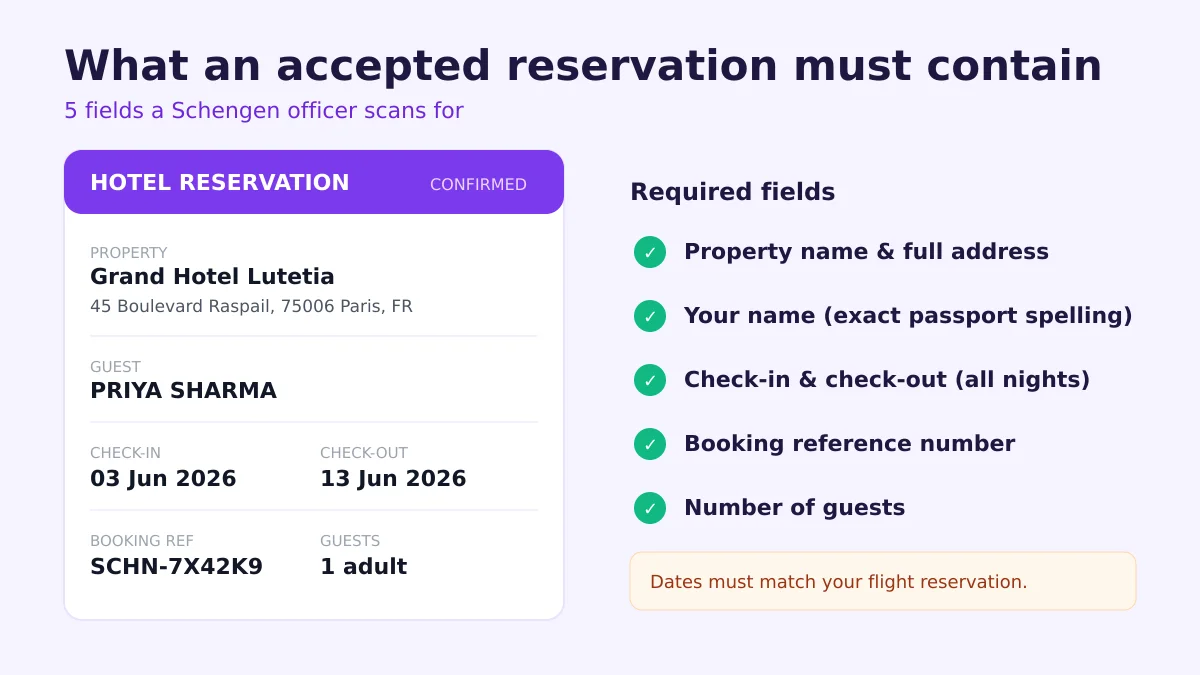
- Property name and full address — the consulate may cross-check it exists.
- Your full name, spelled exactly as in your passport, as the lead guest.
- Check-in and check-out dates that cover every night of your stay.
- A booking reference or confirmation number.
- The number of guests, matching the people on the application.
Format matters too. Submit a clean PDF or printout, not a blurry phone screenshot that crops half the page. A confirmation email forwarded as a PDF is fine as long as all five fields are visible on one document. If a consulate uploads documents through a portal such as VFS Global, a single-page PDF per booking is the safest format — see how to book your VFS appointment and what the portal expects.
"The single most common accommodation mistake we see is a one-night booking submitted for a ten-night trip. The officer counts the nights against your flight dates — any gap reads as an incomplete itinerary."
Your accommodation dates and your Schengen flight reservation must tell the same story. If your flight reservation shows arrival on 3 June and departure on 13 June, your accommodation must cover all ten nights.
Country-by-country: how strict is each Schengen state?
All 27 Schengen states share one rulebook, but consulates interpret accommodation evidence differently. The destination where you spend the most nights decides which consulate you apply to — and how strict the accommodation check is.
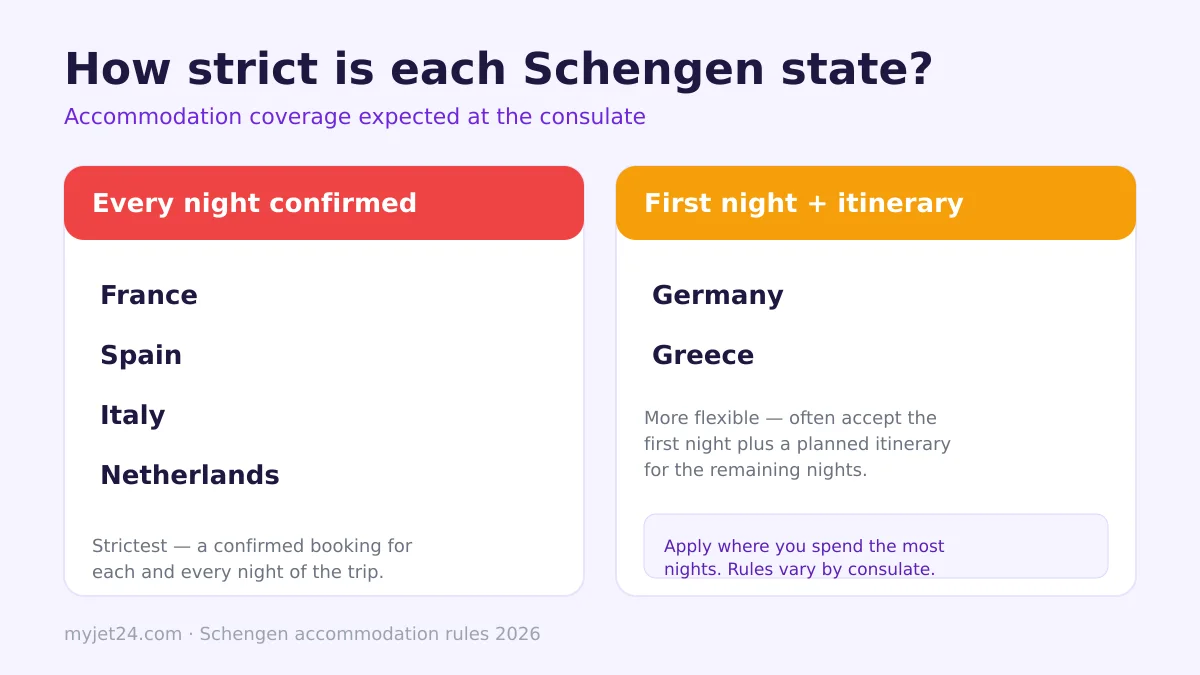
| Schengen state | Accommodation expected | Notes |
|---|---|---|
| France | Every night confirmed | Strict; gaps in coverage are flagged. |
| Spain | Every night confirmed | Wants names + addresses for each stay. |
| Italy | Every night confirmed | Full itinerary alignment expected. |
| Germany | First night + itinerary | Often accepts a plan for later nights. |
| Greece | First night + itinerary | More flexible for island-hopping trips. |
| Netherlands | Every night confirmed | Prefers hotel/booking confirmations over informal notes. |
Rules are interpreted at consulate level and can change. Confirm with your specific consulate; our Schengen visa checklist lists the full document set.
Do you have to pay for the hotel?
No. A reservation confirmation — not a paid invoice — is what consulates ask for. Most embassies explicitly accept reservations and do not require proof of payment, because they advise applicants not to commit money before approval. There are three safe ways to produce one:
- Free-cancellation bookings on platforms like Booking.com or Trip.com — reserve now, cancel free if refused.
- Pay-at-property reservations where nothing is charged until check-in.
- A generated flight + hotel reservation from a documentation tool, formatted the way embassies expect.
| Reservation type | Cost if refused | Embassy-ready? | Best for |
|---|---|---|---|
| Free-cancellation booking | $0 — cancel free | Yes | Single-city, flexible dates |
| Pay-at-property reservation | $0 — nothing charged yet | Yes | Travellers who want a held room |
| Generated hotel reservation | $0 | Yes — formatted for consulates | Multi-city trips, fast turnaround |
| Non-refundable prepaid | Full amount lost | Accepted, but risky | Avoid before approval |
Hotel vs Airbnb vs host invitation
All three can satisfy the requirement, but they are not equal in the eyes of every consulate.
- Hotel reservation — universally accepted, instantly verifiable, the safest default.
- Airbnb / Vrbo — generally accepted, but a few consulates (German missions are often cited) prefer traditional hotels. Print the confirmation with host name, address and dates.
- Host invitation — valid when staying with family or friends, but it adds paperwork: a signed letter, the host's ID copy and proof of address.
If you want zero friction, a hotel reservation is the path of least resistance — and you can replace it with your real booking after approval.
Multi-city and multi-country Schengen trips
This is where applications quietly fail. A multi-country Schengen trip still needs accommodation for every night, not just the first city.
- Which consulate? Apply at the consulate of the country where you spend the most nights. If nights are equal, apply where you enter first.
- Cover the gaps. A Paris–Amsterdam–Rome trip needs reservations in all three cities, with dates that chain together with no unexplained nights.
- Match the route. Your accommodation cities should align with your flight or train itinerary — read our day-by-day travel itinerary guide.
A worked example: a 10-night trip of Paris (4), Amsterdam (3) and Rome (3) means you apply at the French consulate (most nights), and you submit three reservations whose dates chain together — 3–7 June in Paris, 7–10 June in Amsterdam, 10–13 June in Rome. No night is left uncovered, and the cities follow your transport itinerary. That is the level of coverage a strict consulate expects.
How to get free proof of accommodation in 4 steps
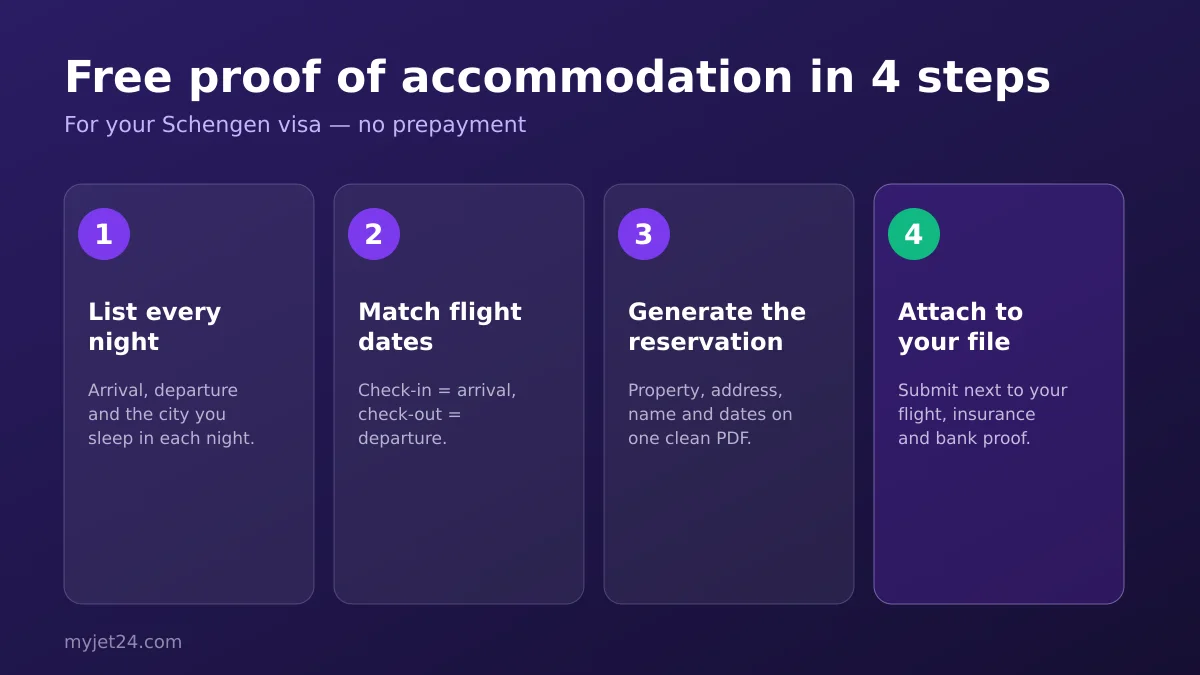
- List every night. Write down your arrival and departure dates and which city you sleep in each night.
- Match your flight reservation. Make sure check-in equals your arrival date and check-out equals your departure date.
- Generate the reservation. Use a free, embassy-formatted hotel reservation (with property name, address, your name and dates) instead of a screenshot that may not contain every field.
- Download the PDF and attach it to your application alongside your flight reservation, insurance and bank statement.
Property name, address, your name and dates — formatted the way consulates expect. No prepayment, ready in ~30 seconds.
Create my free reservation →When to book — and when to cancel
Timing is part of getting accommodation proof right. Book your reservation shortly before your appointment, not months early, so the dates still match a realistic itinerary. There is no need to hold a paid room while your file sits in processing.
- Before submission: have a confirmed reservation covering every night, dated to your flight reservation.
- During processing: keep a free-cancellation or generated reservation in place — do not switch to a prepaid booking yet.
- After approval: book and pay for your real accommodation, then cancel any placeholder reservation.
- On arrival: keep the confirmation on your phone in case the EES border asks about your stay.
Schengen processing averages around two weeks but can stretch longer in peak season, so timing matters — check real processing times by country and consulate before you lock in dates.
Legal reservation vs a fake hotel booking
A reservation is not a "fake" document — it is a genuine booking you are free to cancel. A fabricated PDF is different and risky. Officers can phone the property or check the reference, and an invented confirmation that does not exist in any system fails that check instantly.
"Use a real, cancellable reservation or a properly generated confirmation tied to a real property. Anything you typed yourself in a document editor is the fastest way to a refusal — and a refusal follows you onto future applications."
The safe options are the same ones consulates already accept: a free-cancellation booking or a generated reservation built from real property data. For the wider risk picture, see why fake tickets are risky and what to use instead.
EES 2026: how the new border system affects accommodation proof
The EU Entry/Exit System (EES) became fully operational on 10 April 2026. It replaces passport stamping with a biometric record of every entry and exit. According to the European Commission's EES information, border officers can still ask for the conditions of your stay — including where you are staying — at the biometric border, not just at the consulate.
Picture the new arrival flow: you land, scan your passport, and register fingerprints and a photo at the EES kiosk or desk. If an officer asks where you are staying, the answer should match the dates and city on the reservation you submitted with your visa. A traveller who declares a ten-night stay but can only show a two-night booking invites follow-up questions — exactly the friction the system is designed to surface.
The practical takeaway: keep your accommodation confirmation accessible on arrival, not just inside your visa file. A reservation that matches your declared dates supports a smooth EES registration. For the full picture, read how EES changes your travel documentation and real traveller reports from EES airports.
How much money do consulates expect — including accommodation?
Accommodation does not sit in a vacuum. Each Schengen state sets a minimum daily amount — its "means of subsistence" — that is meant to cover your stay, accommodation included. When your accommodation is already reserved, several states lower the cash figure they expect you to prove on a bank statement, because a booked room is one less thing you must fund on arrival.
| Country (example) | Published daily minimum | Note |
|---|---|---|
| Germany | ≈ €45 / day | One of the lowest reference amounts. |
| France | ≈ €120 / day, or ≈ €65 with prepaid accommodation | A booked room lowers the figure. |
| Spain | ≈ €113 / day (trip minimum also applies) | Tied to the national IPREM index. |
| Italy | ≈ €45 / day on a sliding scale | Lower per-day rate for longer trips. |
Reference amounts are set nationally and updated regularly — treat these as examples and confirm the current figure on your consulate's page or the official means-of-subsistence guidance.
The practical move is to pair the two documents. A confirmed reservation plus a bank statement that comfortably clears the daily minimum tells one consistent story. If your statement is thin, a booked (and therefore already-accounted-for) room helps the maths. Learn how to present finances cleanly in our guide to a bank statement embassies trust.
Special cases: cruises, road trips and transits
Not every itinerary is hotel-to-hotel. The "cover every night" rule still applies — it just changes shape:
- Cruises: the cruise booking is your accommodation for nights on board. Cover any pre- and post-cruise nights on land with a normal reservation, and make sure the embarkation and disembarkation dates line up with your flights.
- Road trips: book each overnight stop. A vague "we will drive and find rooms along the way" plan is a frequent rejection trigger, because the officer cannot verify where you sleep.
- Long multi-visit trips: for a multiple-entry plan, show accommodation for the first trip in full; you do not have to pre-book a year of stays. See multiple-entry flight and reservation rules.
- Airport transit: a same-day Schengen transit normally needs no accommodation, but an overnight layover that requires you to leave the airport does — read the airport transit visa guide.
Common mistakes that get accommodation proof rejected
- Nights that don't cover the trip — the top cause; book the full duration.
- Name mismatch — the lead guest must match your passport exactly.
- Dates that contradict your flight reservation — align both documents.
- Missing address — a property name alone is not enough.
- A non-refundable prepaid booking — financially risky if refused.
- A fabricated confirmation — fails verification and triggers a refusal.
If your application is refused for any reason, you can still recover — our Schengen rejection appeal guide has templates and success rates.
- Every night of the trip is covered by a confirmed reservation.
- Check-in and check-out match your flight reservation dates.
- The lead guest name matches your passport exactly.
- Each booking shows property name and full address.
- You used free-cancellation, pay-at-property, or a generated reservation — nothing non-refundable.
- For multi-country trips, every city is covered with no unexplained gaps.
Conclusion and next steps
Accommodation proof is one of the simplest Schengen documents to get right: confirm every night, match your flight dates, keep your name exact, and never prepay a non-refundable rate. Generate a free, embassy-formatted reservation, attach it next to your flight reservation, and keep a copy on your phone for the EES border. Get the accommodation right and you remove one of the most common reasons Schengen files are sent back — without spending a cent before your visa is approved.
Pair this with the rest of your file: the complete guide to proof of accommodation without prepaying, your Schengen flight reservation, and travel insurance that embassies accept. When you are ready, generate your free reservation in about 30 seconds.
Last updated: 30 May 2026.
