
Last updated: 21 July 2026 · Reading time: 15 min · Author: Joshua White, Travel Documentation Writer at MyJet24
TL;DR — Key Facts
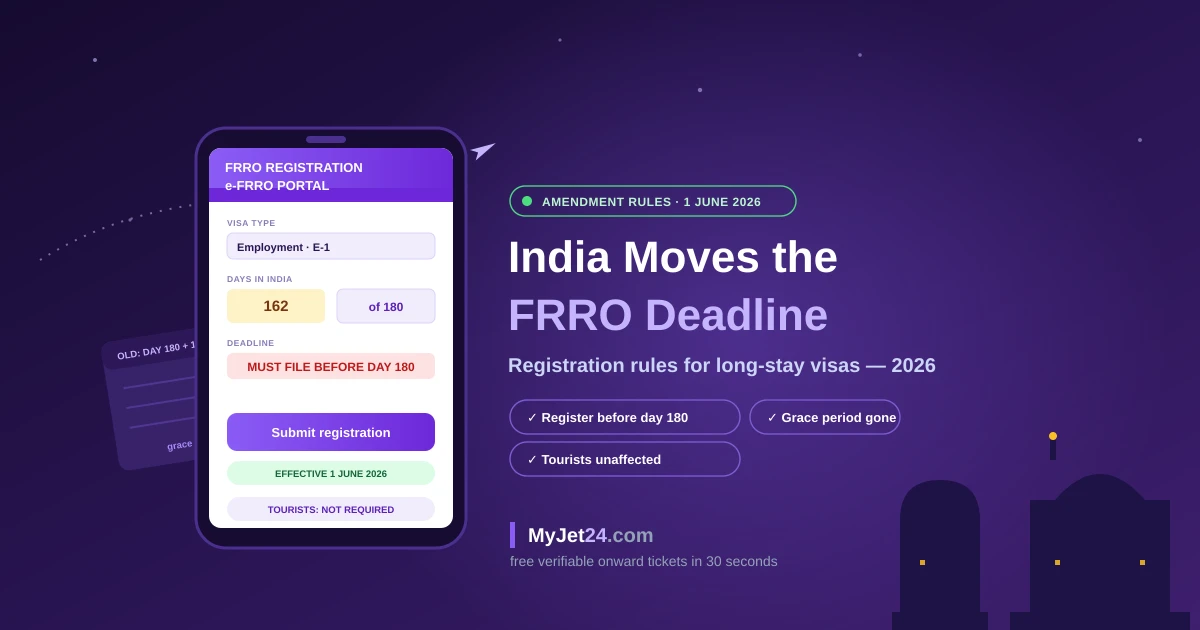
- India quietly flipped its FRRO registration deadline. The Ministry of Home Affairs notified the Immigration and Foreigners (Amendment) Rules, 2026 on 1 June 2026: foreign nationals staying beyond 180 days must now complete registration before day 180 — the old 14-day grace period after the 180-day mark is gone.
- Headlines called it both "easing" and "tightening" — both are true. The window to register is technically longer and clearer (no more waiting for day 180 to pass), but the safety net is gone: late registration is now permitted only under "emergent circumstances," a stricter standard than the old automatic 14-day grace.
- Who this affects: student, employment, project and business visa holders whose stay exceeds 180 days in a calendar year. Tourist e-visas and short visits under 180 days are not affected — if you're a tourist, this entire rule change doesn't touch you.
- Employment visa subcategories were also restructured, consolidating four categories (E-1 to E-4) into three (E-1, E-2, E-3), and a new digital appeals mechanism lets foreign nationals contest Bureau of Immigration decisions online, with a 60-day resolution target.
- The legal backdrop is bigger than one amendment. These rules sit under the Immigration and Foreigners Act, 2025 — which replaced four colonial-era laws dating to 1920 and introduced tougher penalties (2–7 years' imprisonment, fines up to ₹10 lakh) for document fraud.
India's Immigration and Foreigners (Amendment) Rules, 2026, notified on 1 June 2026, require foreign nationals staying beyond 180 days on student, employment, project or business visas to complete FRRO/FRO registration before their 180th day in India, replacing the previous rule that allowed registration up to 14 days after that deadline passed. Late registration is now permitted only under "emergent circumstances." The amendment also restructures employment visa subcategories from four (E-1 to E-4) to three (E-1 to E-3) and introduces an online appeals process before the Commissioner of the Bureau of Immigration, with a 60-day target for resolution. Tourist visa holders and short-term visitors under 180 days are entirely unaffected.
In this guide
- What actually changed on 1 June 2026
- Eases or tightens? Why both headlines are correct
- Who must register — and who never had to
- Old rule vs new rule, side by side
- Employment visas restructured: E-1 to E-4 becomes E-1 to E-3
- The new digital appeals mechanism
- The bigger picture: replacing four colonial-era laws
- How to register with FRRO before day 180
- Six mistakes to avoid
- Frequently asked questions
What actually changed on 1 June 2026
On 1 June 2026, India's Ministry of Home Affairs notified the Immigration and Foreigners (Amendment) Rules, 2026 — a set of changes issued under Section 30 of the Immigration and Foreigners Act, 2025, that came into force immediately. Buried in bureaucratic language is a change that affects every foreign student, employee, business traveler and project worker planning to stay in India past six months.
The core change is about when you must register with the FRRO (Foreigners Regional Registration Office) or FRO (Foreigners Registration Office):
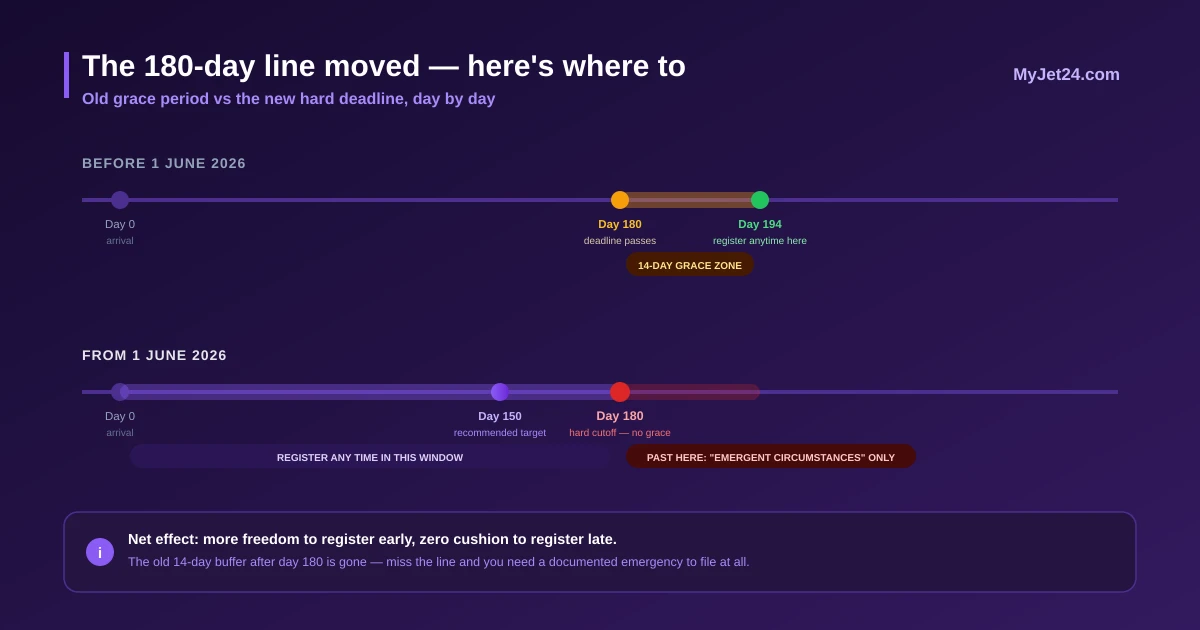
- Before: foreign nationals could register up to 14 days after their 180th day in India — a grace period that let the deadline pass before you had to act.
- Now: registration must be completed before the 180-day mark is reached. There's no window that opens after day 180 anymore.
Two more changes rode along in the same notification: employment visa subcategories were consolidated, and a new online appeals process was introduced for foreign nationals disputing Bureau of Immigration decisions. Each gets its own section below — but the registration-deadline flip is the one with the widest practical impact.
Eases or tightens? Why both headlines are correct
If you searched this topic, you likely saw contradictory framing: some outlets reported the MHA "relaxes" the registration timeline, others said it "tightens" enforcement. Neither is wrong — they're describing two different halves of the same change:
| Angle | Why it's true |
|---|---|
| "MHA eases the timeline" | You can now register any time before day 180 — the moment you know your stay will exceed six months, you're free to walk into the FRRO the next week rather than waiting for a specific trigger date. More flexibility in when within the window you act. |
| "MHA tightens enforcement" | The old 14-day buffer after day 180 — the forgiving margin that let genuinely busy or unaware travelers register a little late without drama — no longer exists by default. Miss day 180 now, and you need to demonstrate "emergent circumstances" to register late at all. |
In plain terms: the rule change removes a safety net and calls it flexibility. It is more flexible in letting you register early — but it is measurably less forgiving if you let the date slip. Foreign nationals who treated the old 14-day grace period as a soft buffer are the ones who need to recalibrate.
Who must register — and who never had to
| Traveler | FRRO registration? | Notes |
|---|---|---|
| Student visa holders | Required if stay > 180 days | Most academic programs run well past six months — register early in the term |
| Employment visa holders (incl. NGO staff) | Required if stay > 180 days | Now filed under the restructured E-1/E-2/E-3 categories |
| Business visa holders | Required if aggregate stay > 180 days/calendar year | Multiple short trips can add up — track your cumulative days |
| Project visa holders | Required if stay > 180 days | Common for infrastructure and energy-sector contractors |
| Tourist e-visa / short visits | Not required | This entire amendment doesn't apply — see our e-Arrival Card guide for what tourists actually need |
| OCI cardholders | Exempt | Regardless of stay duration |
| Children under 12 | Exempt | A parent's registration covers the household |
If you're planning a tourist trip to India, stop worrying about FRRO. It has never applied to e-visas or short tourist stays under 180 days, and this amendment changes nothing for you. What tourists do need is India's e-Arrival Card and, for one-way itineraries, proof of onward travel — covered in our India e-Arrival Card guide and India dummy ticket guide.
Old rule vs new rule, side by side
| Element | Before 1 June 2026 | From 1 June 2026 |
|---|---|---|
| Registration deadline | Within 14 days after the 180-day mark | Before the 180-day mark is reached |
| Late registration | Effectively built into the deadline (14-day buffer) | Only under "emergent circumstances" |
| Employment visa subcategories | Four: E-1, E-2, E-3, E-4 | Three: E-1, E-2, E-3 (consolidated) |
| Appeals process | Largely paper-based, no fixed resolution target | Online, before the Commissioner, 60-day resolution target |
| Child citizenship reporting | Electronic birth reporting required in mixed-nationality families | Waived where retaining Indian citizenship; new 30-day duty to report if child later takes foreign citizenship |
Employment visas restructured: E-1 to E-4 becomes E-1 to E-3
Alongside the registration deadline, the amendment consolidates India's employment visa subcategories. The old four-tier system (E-1 through E-4) is now three tiers:
- E-1 — all employment visas, including intracompany transferees, except cases specifically carved into E-2 or E-3;
- E-2 — employees of non-governmental organizations;
- E-3 — missionaries, religious workers and staff of approved religious organizations.
For employers and HR teams managing foreign staff in India, this means re-checking which bucket a given hire now falls into before filing — a transferred employee who was previously classified as E-2 or E-4 under the old scheme may now sit under the broader E-1 category. The practical registration process (FRRO filing, documentation) is unchanged; it's the classification logic that moved.
The new digital appeals mechanism
The amendment also formalizes how a foreign national contests a decision from India's immigration authorities. Under the new process:
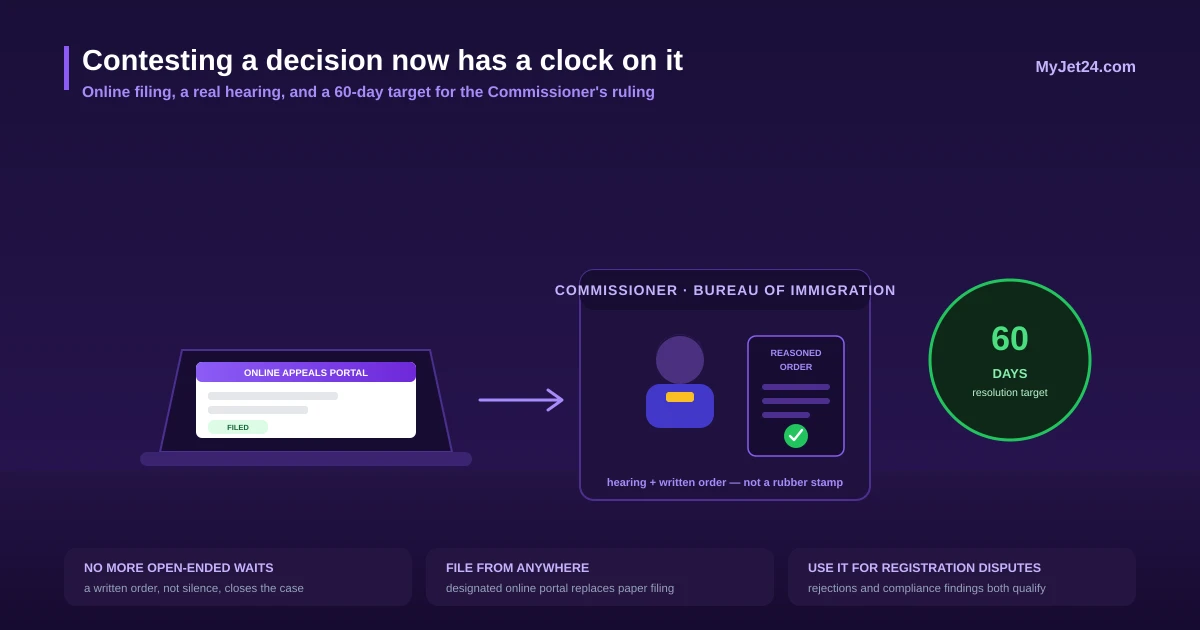
- Appeals go to the Commissioner of the Bureau of Immigration;
- The Commissioner must provide a hearing and issue a reasoned order — not a rubber-stamp rejection;
- The target is to complete proceedings within 60 days of the appeal being filed;
- Filing moves onto a designated online portal, replacing what was previously a slower, paper-heavy process.
This matters most to foreign nationals facing a registration rejection, a compliance dispute, or another adverse Bureau of Immigration decision — it gives a clearer, time-bound path to challenge it, rather than an open-ended wait.
The bigger picture: replacing four colonial-era laws
This June 2026 amendment doesn't stand alone — it implements powers created by the Immigration and Foreigners Act, 2025, which took effect on 1 September 2025 and consolidated four separate, decades-old statutes into a single modern framework:
- The Passport (Entry into India) Act, 1920;
- The Registration of Foreigners Act, 1939;
- The Foreigners Act, 1946;
- The Immigration (Carriers' Liability) Act, 2000.
The parent Act also raised the stakes for document fraud significantly: penalties for using or supplying altered travel documents now reach 2 to 7 years' imprisonment and fines of up to ₹10,00,000 (roughly US$12,000 at mid-2026 rates). It further imposed mandatory reporting duties on hotels, universities, hospitals and international carriers to share information on foreign nationals with immigration authorities — infrastructure that makes the stricter 180-day enforcement in this amendment practically enforceable, not just a rule on paper.
Seen in that light, the June 2026 registration change is one implementing regulation inside a much larger modernization — the same pattern we've tracked in the US ending "duration of status" for F-1/J-1 visa holders this July: broad legal reform first, specific enforcement mechanics arriving in the months after. It's also part of a wider 2026 trend toward stricter, better-documented stays that we've tracked across South Africa's mandatory customs declaration and the Philippines' eTravel enforcement — governments everywhere are pairing digital registration with sharper follow-through.
How to register with FRRO before day 180
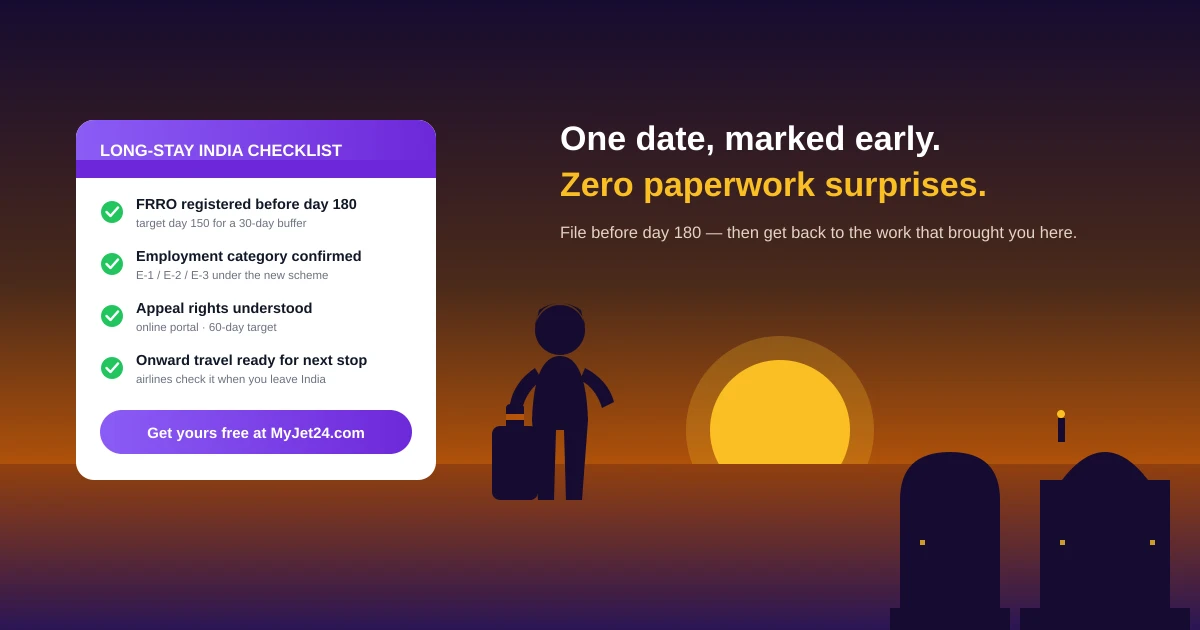
- Count from your date of arrival. The 180-day clock starts the day you land — mark day 150 in your calendar as your working deadline, giving yourself a 30-day buffer before the new hard cutoff.
- File through the e-FRRO portal. India's registration system is online — gather your passport, visa, photographs, proof of address in India (rental agreement, institutional letter) and your visa sponsor's documentation before starting.
- Confirm your visa's registration category. Employment visa holders should check whether their role now sits under E-1, E-2 or E-3 under the restructured system — this affects which supporting documents the FRRO expects.
- Keep proof of submission. Save your application reference number and any acknowledgment — if a processing delay pushes your actual registration past day 180 through no fault of your own, this is your evidence that you acted within the window.
- If you're going to be late, document why immediately. "Emergent circumstances" is not defined precisely in the amendment — hospitalization, natural disasters, and administrative portal outages are the kinds of situations likely to qualify. Gather evidence (medical records, official notices) as the situation happens, not after.
- Departing India after a long stay? FRRO registration and visa compliance are separate from what you'll need for your next destination — many onward countries still expect proof of return or onward travel at check-in, regardless of how long you stayed in India. Our India dummy ticket guide covers the arrival-side version of that same check.
Six mistakes to avoid
- Treating the old 14-day grace period as still active. It's gone. Plan to register before day 180, not after.
- Assuming this applies to your tourist trip. It doesn't. E-visas and stays under 180 days were never in scope, before or after this amendment.
- Ignoring cumulative business-visa days. Several short trips in one calendar year can add up past 180 days even if no single visit felt long — track the running total.
- Not rechecking your employment visa category. If your role was classified E-2 or E-4 under the old four-tier system, confirm where it now sits under E-1/E-2/E-3 before your next filing.
- Waiting to gather "emergent circumstances" evidence after the fact. If something genuinely prevents on-time registration, document it as it happens — after-the-fact explanations carry less weight.
- Confusing FRRO registration with your entry paperwork. FRRO is about your ongoing stay; it has nothing to do with the e-Arrival Card or onward-ticket checks you handled when you first arrived.
Frequently asked questions
What changed with India's FRRO registration rules in 2026?
The Immigration and Foreigners (Amendment) Rules, 2026, notified 1 June 2026, require foreign nationals staying beyond 180 days to complete FRRO/FRO registration before day 180, replacing the old rule that allowed registration up to 14 days after that point. Late registration is now permitted only under "emergent circumstances."
Does this rule apply to tourists visiting India?
No. FRRO registration has only ever applied to foreign nationals staying beyond 180 days — student, employment, project and business visa holders. Tourist e-visas and short visits are entirely unaffected by this amendment.
Is the new FRRO rule easier or stricter than before?
Both, depending on the angle. It's more flexible in when you can register — any time before day 180, rather than waiting for a specific post-deadline window. It's stricter because the old 14-day grace period after day 180 no longer exists by default; late registration now requires "emergent circumstances."
What counts as "emergent circumstances" for late registration?
The amendment doesn't define the term precisely. Based on how similar standards are applied elsewhere in Indian immigration practice, situations like hospitalization, natural disasters or documented portal/system outages are the kinds of cases likely to qualify — routine forgetfulness or poor planning would not.
Who is exempt from FRRO registration?
OCI (Overseas Citizen of India) cardholders are exempt regardless of how long they stay, as are children under 12. Registration requirements for a foreign parent's child are also waived where the family is retaining the child's Indian citizenship under the Citizenship Act, 1955.
What happened to India's E-1 to E-4 employment visa categories?
The 2026 amendment consolidated four employment visa subcategories into three: E-1 (general employment, including intracompany transferees), E-2 (non-governmental organization staff) and E-3 (missionaries, religious workers and approved religious organizations).
How does the new appeals process work?
Foreign nationals can now appeal Bureau of Immigration decisions through a designated online portal to the Commissioner of the Bureau of Immigration, who must hold a hearing and issue a reasoned order, with a target of completing proceedings within 60 days — replacing a slower, largely paper-based process.
What law gives the MHA authority to make this change?
The amendment was issued under Section 30 of the Immigration and Foreigners Act, 2025 — the law that took effect 1 September 2025 and replaced four older statutes: the Passport (Entry into India) Act 1920, the Registration of Foreigners Act 1939, the Foreigners Act 1946, and the Immigration (Carriers' Liability) Act 2000.
What are the penalties for immigration violations under the new law?
The Immigration and Foreigners Act, 2025 introduced significantly tougher penalties, including 2 to 7 years' imprisonment and fines of up to ₹10,00,000 (roughly US$12,000) for using or supplying altered travel documents — a marked increase from the older, fragmented legal framework.
Do business visa holders need to register even for short trips?
Only if their aggregate stay in India on a business visa exceeds 180 days within a calendar year. Multiple shorter trips count cumulatively, so frequent business travelers should track their running total rather than assuming each trip resets the clock.
Do hotels and universities have new reporting duties for foreign nationals?
Yes — under the broader Immigration and Foreigners Act, 2025, hotels, universities, hospitals and international carriers are required to report information on foreign nationals to immigration authorities, supporting stricter enforcement of registration and stay-compliance rules like this one.
Does FRRO registration replace India's e-Arrival Card for tourists?
No — they're unrelated. The e-Arrival Card is a short-stay entry declaration for all travelers; FRRO registration is an ongoing-stay requirement only for those exceeding 180 days on qualifying visa types. See our India e-Arrival Card guide for the tourist-facing rules.
Do children need to be reported if born to a foreign national parent in India?
The revised rules waive electronic birth-reporting where a parent is an Indian citizen and the family intends the child to retain Indian citizenship under the Citizenship Act, 1955. However, parents must notify the Registration Officer within 30 days if the child later acquires foreign citizenship.
Do I still need proof of onward travel if I'm on a long-stay Indian visa?
FRRO registration itself doesn't require an onward ticket, but many visa application processes and departure checks do expect evidence of your onward or return travel plans. When you eventually leave India for your next destination, a verifiable onward reservation with a live PNR — like MyJet24's Premium onward ticket ($7.90) — satisfies that check in about 30 seconds.
The bottom line
If you're a tourist, this entire story is noise — your India trip runs on the e-Arrival Card and, for one-way travelers, proof of onward travel, neither of which this amendment touches. But if you're a student, employee, business traveler or project worker looking at six-plus months in India, the safety net changed on 1 June 2026: the deadline to register with FRRO is now day 180, full stop — not day 194 with a grace period. Mark day 150 as your working target, confirm your employment visa's new E-1/E-2/E-3 classification if it applies, and keep evidence ready if anything threatens to delay you past the line.
And whenever your stay in India ends and the next leg of your trip begins, remember that onward-ticket checks don't disappear just because you handled FRRO correctly — a verifiable onward reservation from MyJet24 Premium ($7.90) covers that in about 30 seconds, wherever you're headed next.
Sources
- Free Press Journal — MHA Notifies Immigration And Foreigners (Amendment) Rules, 2026: https://www.freepressjournal.in/india/mha-notifies-immigration-and-foreigners-amendment-rules-2026-introduces-digital-appeals-and-revised-registration-norms
- The420.in — MHA Notifies Amended Immigration Rules: 180-Day Registration Window Relaxed: https://the420.in/govt-amends-immigration-rules-foreigner-registration-online-appeals/
- Fragomen — India: Visa Registration Rules and Employment Visa Categories Revised: https://www.fragomen.com/insights/india-visa-registration-rules-and-employment-visa-categories-revised.html
- Fragomen — India: New Law Simplifies Immigration Law and Creates Stricter Registration and Reporting Rules: https://www.fragomen.com/insights/india-new-law-simplifies-immigration-law-and-creates-stricter-registration-and-reporting-rules.html
- PRS India — The Immigration and Foreigners Bill, 2025: https://prsindia.org/billtrack/the-immigration-and-foreigners-bill-2025
- Bureau of Immigration, India — Registration Requirements: https://www.boi.gov.in/boi/contents/registration-authority/registration-of-foreign-nationals/registration-requirements
This guide reflects the Immigration and Foreigners (Amendment) Rules, 2026 as reported by legal and immigration industry sources as of 21 July 2026. Registration procedures and interpretations of "emergent circumstances" can evolve — verify your specific situation with your visa sponsor, employer or an immigration attorney, and check the Bureau of Immigration's official channels before relying on this summary. This article is informational and not legal advice.
