
TL;DR
- Whether you need a Japan visa depends on your nationality, not your UAE residence. Emiratis are visa-free (90 days); expat residents need a visa.
- Most eligible UAE residents can now apply for a Japan eVisa online via the official MOFA portal — no embassy visit since 2025.
- Typical cost from the UAE: from ~AED 400 (service included); processing 3–5 business days.
- You must show a detailed itinerary, hotel bookings and a round-trip/onward flight — Japan checks these closely.
- Your UAE residence visa should be valid 3+ months and your passport 6+ months beyond travel.
UAE residents can apply for a Japan tourist visa from inside the UAE — and since 2025 most do it online as a Japan eVisa. The single biggest point of confusion is eligibility: it is set by your passport nationality, not by your Emirates ID. Emiratis travel visa-free; expat residents apply for the eVisa. And the requirement that trips people at the airport is the same everywhere — proof of a confirmed onward or return flight.
Quick answer
A Japan visa from the UAE costs from about AED 400 and takes 3–5 business days. Emirati nationals enter visa-free for 90 days; expat residents (Indian, Filipino, Pakistani, etc.) apply for the Japan eVisa online with a passport valid 6+ months, residence valid 3+ months, a day-by-day itinerary, hotel bookings and a round-trip or onward flight.
Do UAE residents need a visa for Japan?
This is the question that causes the most confusion in the UAE, and the answer is simple once you know the rule: your eligibility is decided by your passport nationality, not by your UAE residence visa or Emirates ID. Living in Dubai or Abu Dhabi lets you apply from the UAE, but it does not change which document Japan requires of you. In practice there are two groups. UAE nationals (Emirati passport holders) enjoy visa-free entry for short stays. Expat residents — Indian, Filipino, Pakistani, Egyptian, Jordanian and most other nationalities living in the UAE — need a Japan visa before they fly, which the majority can now obtain as an eVisa.
Which route applies to you?
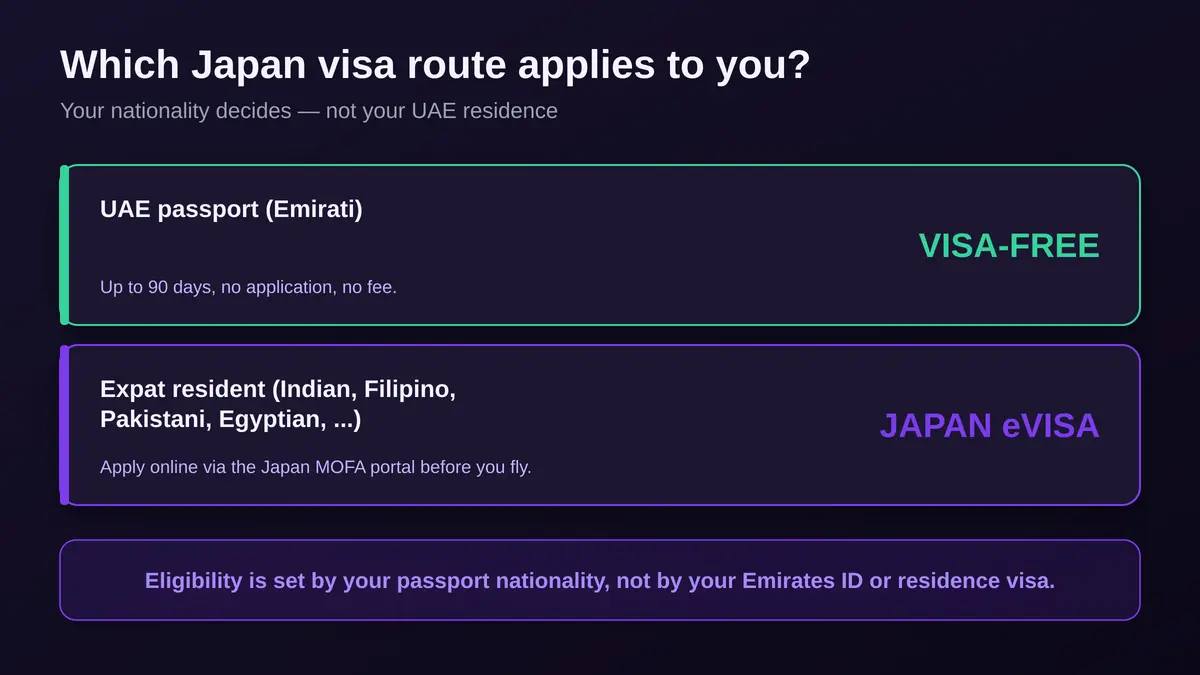
- UAE passport (Emirati): visa-free, up to 90 days, no application, no fee.
- Expat resident, eVisa-eligible nationality: apply online via the Japan MOFA eVisa portal before travel.
- Expat resident, not eVisa-eligible: apply through the Japanese embassy/consulate route in the UAE (often via an accredited agency).
"Your Emirates ID gets you to the application — your passport nationality decides which application you make."
If you want the general mechanics of how Japan's electronic visa works, see our Japan eVisa complete guide; this article focuses on applying specifically as a UAE resident.
How much does a Japan visa cost from the UAE?
The consular fee for a single-entry short-stay Japan visa is modest, and it is waived entirely for some nationalities. What you actually pay from the UAE usually reflects the service or agency handling the submission. A realistic picture:
| Item | Cost | Notes |
|---|---|---|
| Consular fee (single entry) | low / often waived | depends on nationality |
| eVisa / service (typical) | from ~AED 400 | end-to-end handling |
| Flight + hotel proof | from AED 0 | reservation, not prepaid |
| Emirati nationals | free | visa-free, 90 days |
Documents required for UAE residents
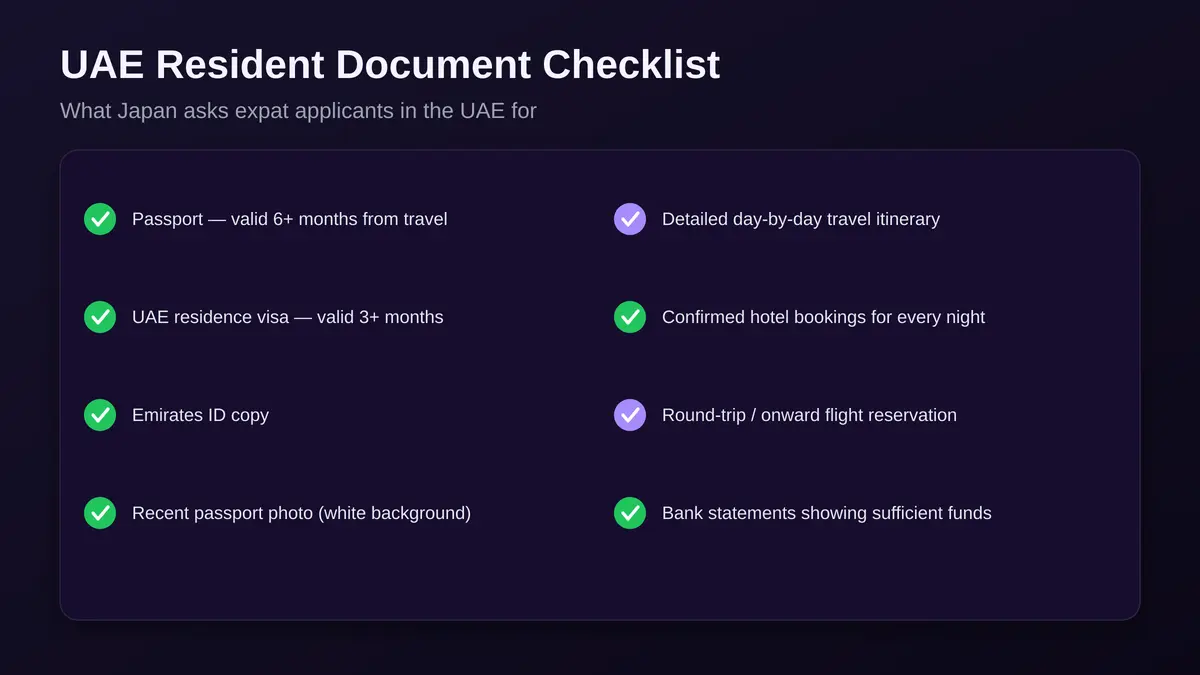
- Passport — valid at least 6 months from travel, with blank pages.
- UAE residence visa — valid at least 3 months beyond your trip.
- Emirates ID copy.
- Recent passport photo — white background, ICAO-style.
- Detailed day-by-day itinerary — where you go each day.
- Confirmed hotel bookings — covering every night.
- Round-trip or onward flight reservation.
- Bank statements — showing funds for the trip.
Onward travel, itinerary and hotels — the make-or-break
Japan is stricter than most short-stay destinations about the trip plan. The application expects a coherent day-by-day itinerary, hotel bookings for every night and a confirmed round-trip or onward flight that matches those dates. Even after the visa is granted, the airline re-checks your onward ticket at check-in, because it is liable for carrying improperly documented passengers — so you can be stopped at the gate for a country you are cleared to enter.
The trap is buying non-refundable flights and hotels to satisfy the file, then losing the money if the visa is delayed or refused. The fix is a confirmed flight reservation with a real PNR and cancellable hotel bookings: they satisfy the requirement without locking in fares. Build the day-by-day plan with our travel-itinerary guide, see the proof-of-onward-travel pillar, and generate the reservation itself via the CTA below.
"For Japan, a vague plan is a weak application. A dated itinerary plus a confirmed onward flight is what gets approved — and what gets you on the plane."
How to apply from the UAE step by step
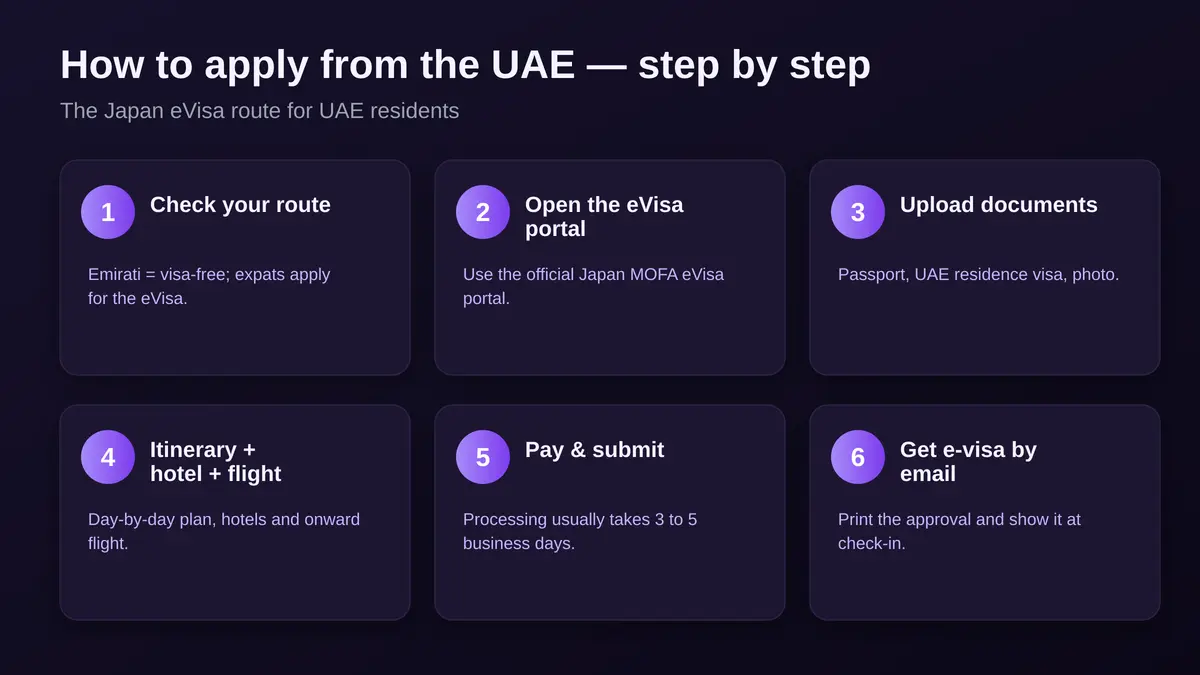
- Check your route — Emirati (visa-free) or expat (eVisa / embassy).
- Open the official Japan MOFA eVisa portal — avoid look-alike sites.
- Upload documents — passport, UAE residence visa, Emirates ID, photo.
- Add itinerary, hotels and onward flight — dates must line up.
- Pay and submit — processing usually 3–5 business days.
- Receive the e-visa by email — print it and keep it offline for check-in.
Processing time and when to apply
A complete eVisa application is typically decided in three to five business days, with the approval emailed to you. Demand spikes for cherry-blossom season (late March–April) and autumn foliage (October–November), so apply two to three weeks ahead in those windows. Never buy non-refundable flights assuming same-day approval, and double-check that your passport and UAE residence validity comfortably cover the trip before you submit.
The embassy and agency route
Not every nationality is covered by the eVisa, and some applicants — or certain visa types — are still processed through the Japanese embassy in Abu Dhabi or consulate in Dubai, often via an accredited travel agency rather than in person. The document set is essentially the same, with the itinerary, hotels, flights and financial proof still central. If the eVisa portal does not accept your nationality, use the embassy route and start earlier, since agency handling adds a little time.
Top reasons UAE applications get refused
- Vague or inconsistent itinerary — dates that do not match flights and hotels.
- Weak financial proof — a sudden large deposit instead of steady balances.
- Residence visa expiring too soon after the trip.
- Assuming the eVisa covers your nationality when it does not.
- No confirmed onward flight, stopping you at check-in.
Stay limits and the 90-day rule
A short-stay tourist visa or visa-free entry generally allows up to 90 days. A single-entry visa must usually be used within three months of issue and is voided once you leave Japan, so a side trip out of the country ends it. Japan does not offer a casual on-arrival extension of a temporary visitor stay the way some Southeast Asian countries do, so plan your departure within the permitted period and keep your onward ticket consistent with it.
Single-entry vs multiple-entry visas for UAE residents
Most first-time applicants from the UAE receive a single-entry short-stay visa, valid for one trip and voided the moment you leave Japan. For travellers who visit Japan regularly — for business, family or repeat holidays — Japan also issues multiple-entry visas valid for several years, letting you come and go within the permitted stay limits without reapplying each time. These are usually granted to applicants with a clean travel history and strong ties, and the document set is the same, with extra emphasis on your travel record and finances. If you expect to combine Japan with side trips to South Korea or Southeast Asia and return, the multiple-entry option is worth requesting, because a single-entry visa would otherwise be consumed by your first departure. Bear in mind that even a multiple-entry holder still needs a confirmed onward or return flight for each individual trip, since the airline check happens every time you fly, not just once.
First-time vs repeat applicants from the UAE
If this is your first Japan application, treat the file as a small case you are making: a clear purpose of travel, a realistic itinerary, accommodation that matches it, and finances that comfortably cover the trip. Officers are reassured by consistency far more than by big numbers — a tidy, coherent application from a salaried UAE resident with a stable bank history reads well. Repeat travellers who have used previous Japan visas correctly, and who have a record of returning home on time, generally have an easier path and are the most likely to be offered a multiple-entry visa. In both cases, the fastest way to weaken your application is an itinerary that does not line up with your flights and hotels, or a residence visa that is about to expire. Fix those before you submit, and the rest is routine.
Money and what “sufficient funds” means
Japan does not publish a fixed minimum balance, but the expectation is that you can clearly fund your trip without working illegally or relying on someone you have not declared. As a working rule, show three to six months of UAE bank statements with regular salary credits and an ending balance that comfortably covers flights, hotels and daily costs in Japan, which is not a cheap destination. A stable, steadily funded account is far more convincing than a single large deposit dropped in a few days before applying, which reads as borrowed money and is a classic reason for extra questions or refusal. If a sponsor — an employer or a relative in Japan — is covering part of the trip, declare it and add their supporting documents and your relationship, rather than leaving the funding unexplained.
Travelling with family or children from the UAE
Each traveller files their own application, including children, and minors usually need additional documents such as a birth certificate and copies of both parents' passports and UAE residence visas. If a child travels with one parent or alone, a parental consent letter is often expected, sometimes attested. The practical key for families is consistency: one shared itinerary, the same hotels and the same round-trip or onward flights across every family member's file, so the dates never contradict each other. Inconsistent dates between family members are a common cause of delay, and with several applications in play they multiply quickly. Prepare one master plan, then attach it to each person's submission.
After approval: entry and what to carry
An approved eVisa or visa is permission to travel to the border, not a guaranteed entry — the immigration officer in Japan makes the final decision and can still ask for your hotel bookings, return ticket and funds on arrival, so carry the same documents you submitted. On entry you will be fingerprinted and photographed, and you receive a short-stay landing permission stamped to your declared period. Keep your printed eVisa, itinerary and onward ticket reachable offline, because airport connectivity is unreliable and you may need to show them twice — once to the airline at check-in and once to immigration. Respect the stay limit precisely; overstaying in Japan is treated seriously and damages any future application.
Timing and agency tips
A few habits make the UAE-to-Japan process smooth. Apply two to three weeks ahead, more in cherry-blossom and autumn peaks when both visa demand and flight prices climb. Use the official portal for the eVisa and treat any “guaranteed approval” or “express visa” promise as a warning sign — no agency can override Japan's checks or shorten the consular decision. If you do use an agency, because your nationality needs the embassy route or you simply prefer it, choose an established one and confirm exactly what their fee covers versus the consular fee. Above all, lock your itinerary, hotels and onward flight into a consistent set before you submit; that single step prevents the majority of avoidable refusals from the UAE.
Applying in the UAE vs your home country
Many expats ask whether they should apply for the Japan visa from the UAE or from their home country on their next visit. For most, applying from the UAE is the stronger option, precisely because your UAE residence demonstrates stability: a steady job, a salary credited to a UAE bank, a tenancy and a valid residence visa all signal strong ties and a clear reason to return. That profile is often more convincing than applying as an unemployed visitor in your home country. The condition is that your UAE residence visa is valid well beyond your trip — generally at least three months — and that your bank history is in the UAE account you are submitting. If your residence is about to expire, or you have only just arrived and have little local financial history, applying from your home country with established documents there may be cleaner. As a rule of thumb: apply where your strongest, most consistent evidence lives. Whichever country you apply from, the core requirements do not change — a passport valid six months, a coherent day-by-day itinerary, hotels for every night, proof of funds and a confirmed onward or return flight. Get those four pillars right and the location of your application becomes a detail rather than a hurdle, and you avoid the most common reason Gulf-based applications stall: documents that point in two different directions at once.
Frequently asked questions
Do UAE residents need a visa for Japan?
It depends on nationality: Emiratis are visa-free (90 days); expat residents need a visa, usually the online eVisa.
Can I apply for the Japan eVisa from Dubai?
Yes — since 2025 eligible UAE residents apply online via the official Japan MOFA portal, no embassy visit.
Do I need an onward ticket and hotel bookings?
Yes. A day-by-day itinerary, hotels for every night and a confirmed onward/round-trip flight are required.
Need an onward flight + itinerary for your Japan file?
Generate a confirmed round-trip / onward reservation with a real PNR in under a minute — accepted at check-in worldwide, no non-refundable fare.
Create your onward ticket →Marc Hoffmann
Travel-documents specialist at MyJet24. Covers visas, proof of onward travel and entry requirements for travellers across the Gulf and beyond.
