
Last updated: 7 July 2026 · Reading time: 15 min · Author: Joshua White, Travel Documentation Writer at MyJet24
TL;DR — Key Facts
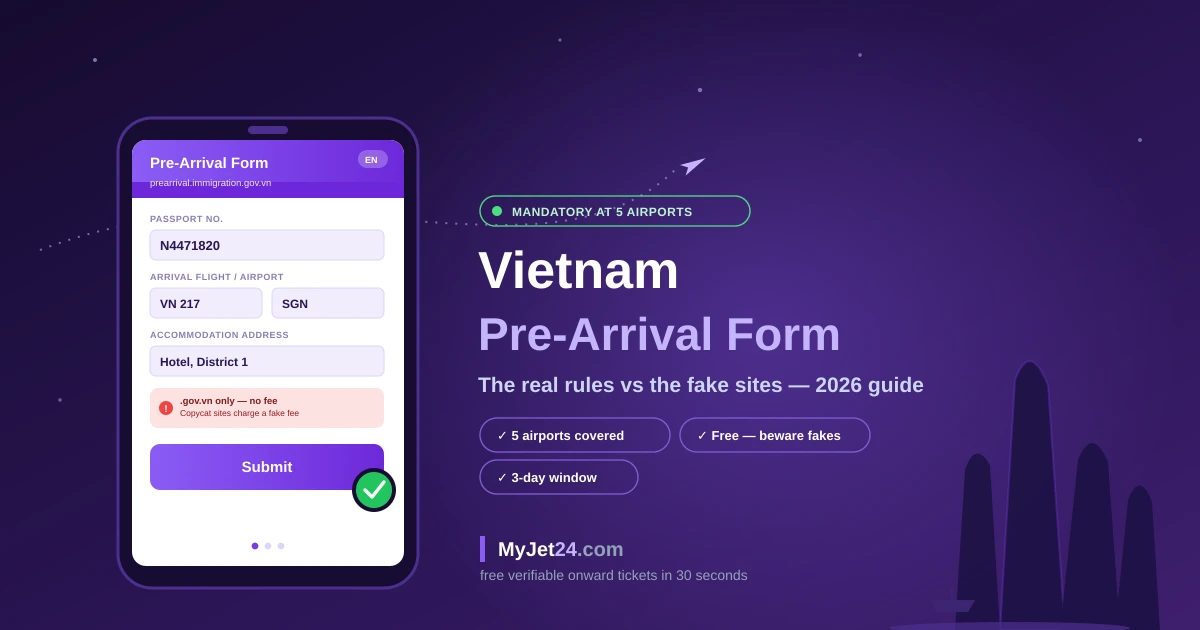
- Vietnam's Pre-Arrival Form is real, free and now mandatory at five airports. Rolled out airport by airport between 15 April and 15 June 2026 — Ho Chi Minh City, Phu Quoc, Hanoi, Da Nang and Nha Trang — every foreign passport holder flying into one of these must file it within 3 days of arrival at the official portal, prearrival.immigration.gov.vn.
- Fake copycat websites are actively stealing card details. Vietnam's Immigration Department has issued a direct warning about clone sites impersonating the Pre-Arrival system. The real form is free — if a site asks you to pay, it is not the official one.
- The "mandatory health declaration" headline you've seen is misleading. A new decree took effect 1 July 2026 that lets Vietnam activate a health declaration during a disease outbreak — but the Ministry of Health has confirmed it is not routinely required, and no official form or link exists for it right now.
- The Pre-Arrival Form does not replace your visa or e-visa. It is an entry declaration, not a travel authorization — visa-required nationalities still need a visa or e-visa exactly as before.
- Vietnam separately still enforces proof of onward or return travel for every entry type, including e-visas, most often checked at departure airport check-in. A free MyJet24 onward ticket covers this in about 30 seconds if you don't have a booked flight out yet.
Vietnam's Pre-Arrival Form is a free, mandatory online declaration for every foreign passport holder flying into Ho Chi Minh City, Phu Quoc, Hanoi, Da Nang or Nha Trang airport, phased in between April and June 2026. File it within 3 days of arrival at the official portal, prearrival.immigration.gov.vn, and bring the QR code it generates. Separately, a widely reported "mandatory health declaration" is not currently active — Vietnam's government has confirmed it only switches on during a declared disease outbreak. Neither form replaces the visa or e-visa requirement, and Vietnam continues to separately require proof of onward or return travel at entry.
If you've searched anything about entering Vietnam in the past few months, you've probably landed on three different, half-overlapping stories: a new digital arrival form that's suddenly mandatory at major airports, a "mandatory health declaration" starting July 2026 that half the headlines contradict each other about, and warnings about fake government websites. All three are real stories. Only one of them requires you to actually do anything before you fly, and figuring out which one is exactly the kind of confusion that costs travelers time at immigration or, worse, their card details to a scam site.
This guide separates the three cleanly: the Pre-Arrival Form that is genuinely mandatory and expanding airport by airport, the health declaration that technically exists in law but isn't switched on, and the copycat websites you should actively avoid. It closes with the one Vietnam entry requirement that predates all of this, rarely makes headlines, and still catches travelers at the departure gate: proof of onward or return travel. For the country-by-country version of that requirement, see our guide on proof of onward travel.
The Short Answer: What's Actually Required Right Now
| Requirement | Status in July 2026 |
|---|---|
| Pre-Arrival Form | Mandatory at 5 airports (SGN, PQC, HAN, DAD, CXR). File within 3 days of arrival. |
| Health declaration | Not active. Legal framework exists since 1 July 2026 but requires a specific Ministry of Health activation, which has not happened. |
| Visa / e-Visa | Unchanged — still required for non-exempt nationalities, independently of the Pre-Arrival Form. |
| Proof of onward/return travel | Unchanged — a long-standing entry condition, enforced primarily at departure check-in. |
Two of these four rows are old news dressed up as new by recycled headlines; two are genuinely new in 2026. The rest of this guide takes them one at a time.
The Pre-Arrival Form: What It Is and Which Airports Require It
The Pre-Arrival Form (officially the Pre-Arrival Information declaration) is an online entry form run by Vietnam's Immigration Department, under the Ministry of Public Security. It collects your passport details, flight information, visa or entry-document details, and your accommodation address in Vietnam before you land — the same purpose as Taiwan's TWAC or India's e-Arrival Card, though Vietnam's rollout is airport-by-airport rather than nationwide on a single date.
The phased rollout, confirmed across official and industry sources:
- Ho Chi Minh City (SGN) — mandatory from 15 April 2026, the first airport in the rollout.
- Phu Quoc (PQC) — added 1 June 2026.
- Hanoi / Noi Bai (HAN) — added 8 June 2026.
- Da Nang (DAD) — added 15 June 2026.
- Nha Trang / Cam Ranh (CXR) — also now covered.
It applies to every foreign passport holder, including overseas Vietnamese entering on a visa, arriving at any of these five airports. It is free, requires no document uploads, and takes most travelers under five minutes once their flight and accommodation details are at hand.
Step-by-Step: How to File in About 5 Minutes
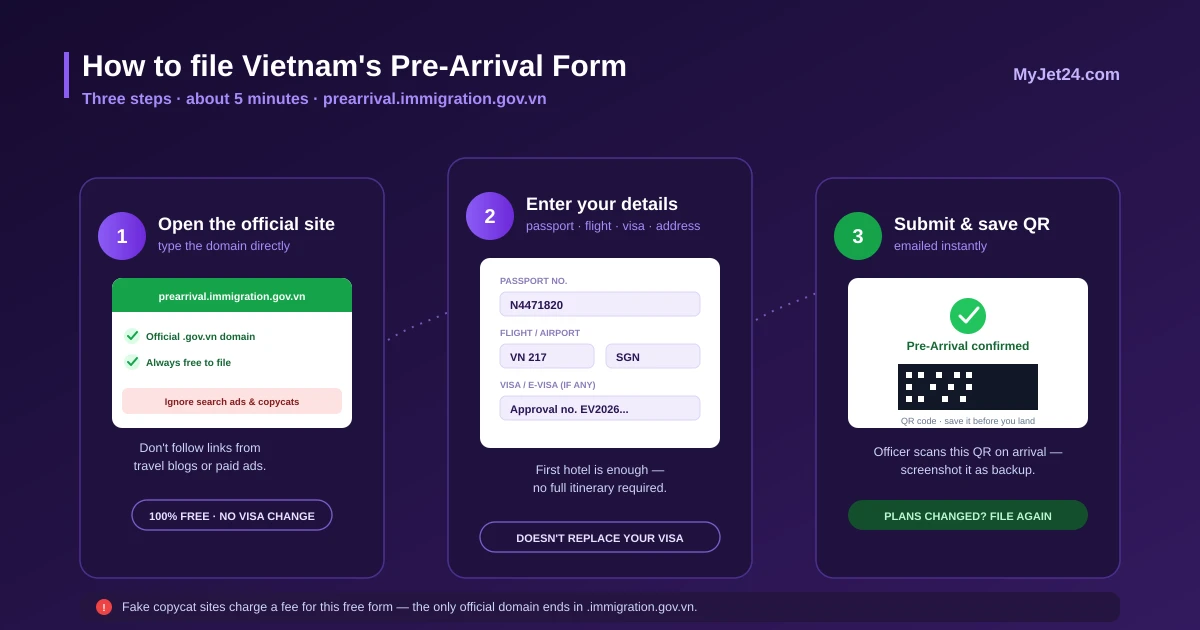
- Go to the official portal only: prearrival.immigration.gov.vn. Type it directly or bookmark it — do not follow search ads or links from unfamiliar travel blogs (more on why in the next section).
- File within 3 days before your flight lands in Vietnam, not earlier — the system is built around that rolling window, the same pattern used by Taiwan's TWAC and India's e-Arrival Card.
- Enter your passport, flight and visa details. If you already have an e-visa or visa, have the approval details on hand — the form asks for them separately from your passport data.
- Add your accommodation address in Vietnam. Your first hotel is sufficient; you do not need to list every stop of a multi-city trip.
- Submit, then save the QR code you receive by email. Download it or take a screenshot before you lose signal at the airport — immigration scans this QR code on arrival instead of stamping a paper form.
The Fake Websites Stealing Card Details
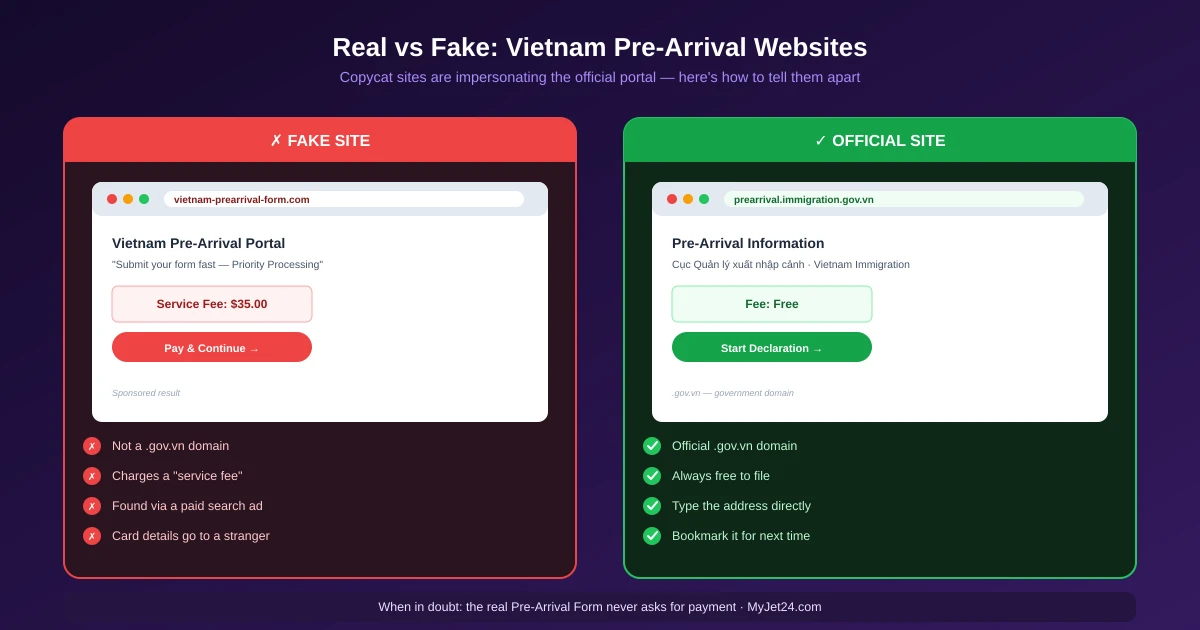
Official warning: Vietnam's Immigration Department has confirmed that fake websites impersonating the Pre-Arrival Information system exist, some of which can charge your card. The genuine service is free. If a site asks for payment to submit your Pre-Arrival Form, close it.
This is the pattern behind almost every new government e-form worldwide: within weeks of a real system launching, copycat sites appear in search results and paid ads, styled to look official, charging a "processing fee" for a form that costs nothing on the real portal. A few checks protect you every time:
- Check the domain, not the design. The only official Pre-Arrival Form is at prearrival.immigration.gov.vn — a government domain. A convincing layout on a different domain is not a substitute.
- The real form is free. Any site charging a fee to "process," "expedite" or "guarantee" your Pre-Arrival Form submission is not the official channel, whatever it claims.
- Ignore search ads for arrival forms. Paid search placement is exactly how copycat sites outrank the real government portal for exactly this kind of one-time, urgent, unfamiliar task.
- The same rule applies to the health declaration. Vietnam's Ministry of Health has separately warned that tokhaiyte.vn is not being used for the border health declaration — see the next section.
The Health Declaration "Requirement" That Isn't (Yet)
Here is the part almost every headline got wrong. Decree 165/2026/ND-CP, paired with a new Law on Disease Prevention, took effect on 1 July 2026 — and dozens of articles reported this as a new mandatory health declaration for every traveler entering, leaving or transiting Vietnam from that date. Vietnam's own Ministry of Health had to publicly correct the record.
What actually happened: the decree creates a legal framework that lets health authorities activate a border health declaration when needed — tied to a specific communicable disease, a specific outbreak risk, and a specific government decision to switch it on. It does not make a declaration a routine, permanent part of entering Vietnam. As of this guide's last update, the Ministry of Health has not activated it for general travel.
The practical takeaway: there is currently no general health declaration to complete before traveling to Vietnam. No official online form or link exists for it right now. If you see a website asking you to complete one — including at the domain tokhaiyte.vn, which the Ministry of Health has explicitly said is not being used for this purpose — it is not the official channel.
This could change: if Vietnam declares an outbreak-related activation, the declaration would need to be filed within seven days before entry, exit or transit, either electronically or on a paper form matching Appendix V of the decree, available from airlines and at border gates. Vietnam's government has said an official system is being developed for that scenario and will be announced if and when it is actually required. Until such an announcement appears on an official Vietnamese government channel, treat any "mandatory health declaration" claim for routine travel as outdated or incorrect.
Pre-Arrival Form vs e-Visa vs Visa Exemption: You May Need More Than One
The Pre-Arrival Form answers a different question than your visa does, and confusing the two is the second most common mistake after missing the fake-site warning:
| Visa / e-Visa | Pre-Arrival Form | |
|---|---|---|
| Question it answers | Are you allowed to enter Vietnam at all? | Who exactly is arriving, on what flight, staying where? |
| Who needs it | Nationalities without visa-exempt access to Vietnam | Every foreign passport holder arriving at SGN, PQC, HAN, DAD or CXR |
| Cost | Visa or e-visa fee applies | Free |
| Replaces the other? | No — completing your visa does not exempt you from the Pre-Arrival Form | No — filing it does not grant entry or replace a required visa |
If your nationality is visa-exempt for Vietnam (a growing list that already includes most of Western Europe, the UK, Japan, South Korea and several others under unilateral and reciprocal exemptions) you skip the visa step entirely — but you still file the Pre-Arrival Form if you're landing at one of the five listed airports. If your nationality requires an e-visa, apply for that separately at Vietnam's National Electronic Visa system in advance, then file the Pre-Arrival Form in the 3 days before you fly.
Worth noting because it trips people up every year: visa exemption is about the visa, not about anything else on this page. An exempt nationality still needs a passport valid well beyond the stay, still needs proof of onward or return travel at entry (covered later in this guide), and — since April 2026 — still needs the Pre-Arrival Form at the five listed airports. "Visa-free" has never meant "paperwork-free," and 2026 added one more line to that list rather than removing any.
Flying Into an Airport Not on the List?
Vietnam has other international airports — Cat Bi (Haiphong), Van Don, and several smaller gateways — that are not yet named in the Pre-Arrival Form rollout. Given the pace of the April-to-June expansion across five airports in nine weeks, treat any additional airport as a candidate for the next phase rather than a permanent exemption. Two sensible habits cover you either way: check the official portal for the current airport list a few days before you fly, and if your arrival airport isn't listed, you are not required to file — there is no version of the form for airports outside the published list.
Seven Mistakes That Cause Delays on Arrival
- Using a copycat website and paying a fee for a free form. Covered above — check the domain every time.
- Filing more than 3 days before arrival. The portal is built around that window; file the flight number and date you'll actually use.
- Assuming the Pre-Arrival Form replaces your visa. They are separate systems — visa-required nationalities need both.
- Losing the QR code before landing. Download it or screenshot it the moment you receive it; don't rely on finding the confirmation email with weak airport Wi-Fi.
- Completing a "health declaration" on a third-party site. As of this guide's last update, there is nothing to complete — see the section above.
- Mismatched details between the Pre-Arrival Form, visa and passport. Names, passport numbers and flight details should match exactly across all three.
- Forgetting the onward-ticket requirement entirely. Covered fully next — a different, older requirement that has nothing to do with any of the 2026 changes above.
The Onward Ticket Rule Vietnam Still Enforces
Separately from everything above — and predating all of it — Vietnamese immigration rules require foreign visitors to hold proof of onward or return travel at entry. This applies across visa-free arrivals, e-visa holders and traditional visa holders alike; having an approved e-visa does not remove this requirement, since the e-visa and the onward-ticket rule address different questions.
In practice, enforcement is concentrated at departure: airlines flying to Vietnam check onward or return documentation before boarding one-way passengers, most consistently at major hub airports. What satisfies the requirement is a confirmed ticket — one-way flight in, and a booked flight leaving Vietnam again, with a live PNR that returns a valid, matching record if the airline or an immigration officer checks it.
The mistake to avoid: treating a completed Pre-Arrival Form as proof that "the paperwork is done." It answers a completely different question than the onward-ticket rule, and a check-in agent asking for your ticket out of Vietnam will not accept a Pre-Arrival Form confirmation as the answer.
If you already have a booked return or onward flight, there is nothing further to do. If your plans are open-ended — a common situation for backpackers deciding their route through Southeast Asia as they go — the standard, low-cost fix is a verifiable flight reservation with a real, checkable booking reference:
- Open the MyJet24 onward ticket generator.
- Enter a departure from Vietnam to any reasonable next destination, dated after your planned stay.
- Enter your name exactly as it appears on your passport, and generate.
- Download the PDF — a reservation with a verifiable PNR, ready in about 30 seconds, free.
Keep it alongside your visa or e-visa and your Pre-Arrival Form confirmation, not instead of either — all three answer different questions, and any of them may be checked independently. For the difference between a verifiable reservation and a fabricated document, see our dummy ticket guide.

Frequently Asked Questions
What is Vietnam's Pre-Arrival Form?
It is a free, mandatory online declaration for foreign passport holders flying into Ho Chi Minh City, Phu Quoc, Hanoi, Da Nang or Nha Trang airport, phased in between 15 April and 15 June 2026. Filed within 3 days of arrival at prearrival.immigration.gov.vn, it collects passport, flight, visa and accommodation details and generates a QR code that immigration scans on arrival.
Is Vietnam's health declaration mandatory in 2026?
No, not routinely. A decree that took effect 1 July 2026 created a legal framework allowing authorities to activate a health declaration during a specific disease outbreak, but Vietnam's Ministry of Health has confirmed it has not been activated for general travel. There is currently no official form to complete.
Is prearrival.immigration.gov.vn the only official Pre-Arrival Form website?
Yes. Vietnam's Immigration Department has warned about fake websites impersonating this service, some of which charge a fee and can compromise card details. The genuine form is always free and only available at that government domain.
Does the Pre-Arrival Form replace my Vietnam visa or e-visa?
No. They are separate systems addressing separate questions — the visa or e-visa authorizes your entry; the Pre-Arrival Form declares who is arriving, on what flight, and where they're staying. Visa-required nationalities need to complete both for the same trip.
Which airports require the Pre-Arrival Form?
Five airports as of this guide's last update: Ho Chi Minh City (SGN), Phu Quoc (PQC), Hanoi/Noi Bai (HAN), Da Nang (DAD) and Nha Trang/Cam Ranh (CXR). Given the pace of the rollout, check the official portal for the current list if you're flying into a different Vietnamese airport.
What happens if I don't file the Pre-Arrival Form?
At the five airports where it's mandatory, arriving without a completed form means resolving your entry manually at the border rather than moving through with a scanned QR code, which can mean a longer wait. Filing in advance is the straightforward way to avoid this.
When should I file the Pre-Arrival Form?
Within 3 days before your flight lands in Vietnam — not earlier, since the portal is built around that rolling window. Most travelers file it the day before departure.
Is tokhaiyte.vn Vietnam's official health declaration website?
No. Vietnam's Ministry of Health has explicitly stated that tokhaiyte.vn is not being used for entry, exit or transit health declarations. No official link exists for this purpose at the time of writing, because the declaration itself has not been activated.
Do I still need proof of onward travel to enter Vietnam?
Yes, and this is unrelated to the 2026 changes. Vietnamese immigration rules require proof of onward or return travel across visa-free arrivals, e-visa holders and visa holders alike. Enforcement is concentrated at departure check-in for flights to Vietnam, and neither the Pre-Arrival Form nor an approved e-visa satisfies this separate requirement.
Can I file the Pre-Arrival Form if my flight changes afterward?
Yes — file an updated submission with your new flight details. There is no penalty for submitting more than once.
Do children need their own Pre-Arrival Form?
Yes, each traveler files on their own passport, with a parent or guardian completing the form on a child's behalf. There is no combined family submission covering multiple passports.
Is it legal to use a dummy or onward ticket to meet Vietnam's onward-travel requirement?
A verifiable flight reservation with a real, checkable PNR — what MyJet24 generates — is a legitimate document used to satisfy onward-travel requirements worldwide, the same kind of instrument travel agencies issue during visa processing. A fabricated document with an invented reference is different: it fails the moment anyone checks it and risks serious consequences for fraud. The difference is verifiability, not the label.
What documents do I need to file the Pre-Arrival Form?
Your passport, confirmed flight details for your arrival in Vietnam, your visa or e-visa approval details if applicable, and the address of your first accommodation in Vietnam. No documents are uploaded, and there is no fee.
Do I need the Pre-Arrival Form for a connecting flight through Vietnam?
Only if you clear Vietnamese immigration during your connection. If you stay airside and continue to an onward international flight without collecting bags or presenting your passport at an immigration desk, you are not arriving in Vietnam in the sense this form covers. If your connection requires clearing immigration — including to change airports within the same city, or on a long layover where you leave the terminal — file it like any other arriving traveler at one of the five listed airports.
Sources & further reading
- Vietnam Immigration Department — official Pre-Arrival Information portal
- Vietnam National Electronic Visa system
- VietnamPlus (official state news agency) — Ministry of Health clarification on health declarations
Entry rules and enforcement practice change quickly during a phased rollout; verify current airport coverage with the official portal before travel. This guide reflects conditions documented as of July 2026.
