
Last updated: 21 May 2026 · Reading time: 13 minutes · Author: James Mitchell, CEO & Founder, MyJet24
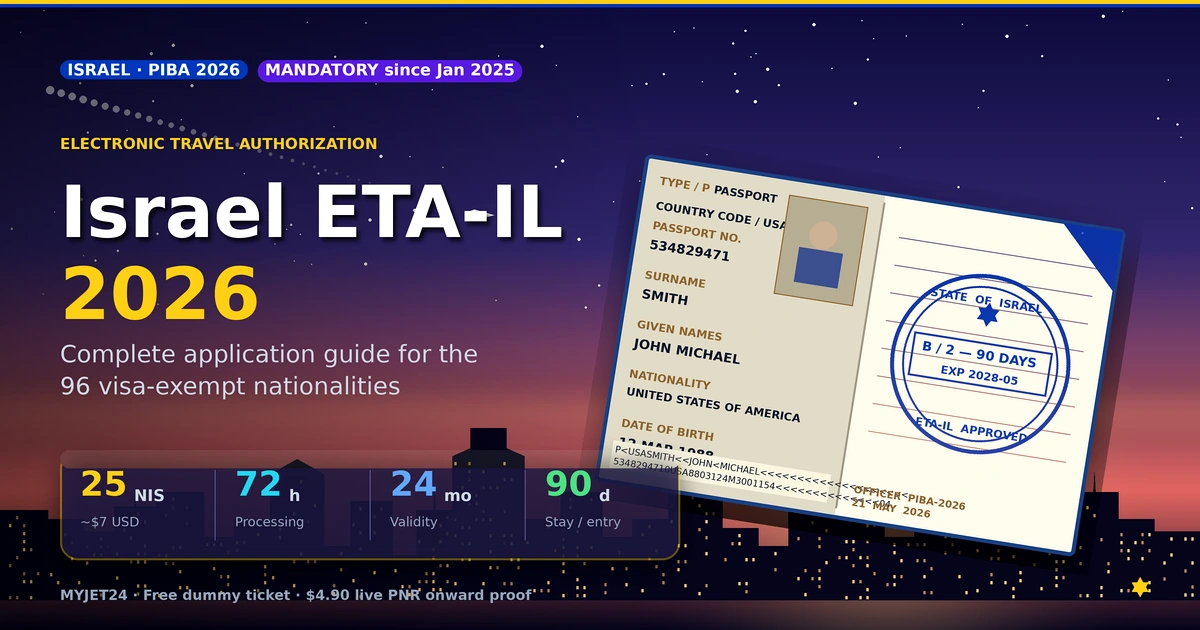
TL;DR — Israel ETA-IL 2026
- The ETA-IL (Electronic Travel Authorization to Israel) has been mandatory since 1 January 2025 for all 96 visa-exempt nationalities — including US, UK, EU, Canada, Australia, Japan, and South Korea passport holders.
- The official government fee is 25 NIS (~$7 USD), payable online by Visa or Mastercard. There is no express tier.
- Standard processing is up to 72 hours; the majority of straightforward applications are approved within 1–8 hours.
- Approval is valid for 2 years or until your passport expires, whichever comes first. Each entry permits up to 90 days.
- An approved ETA-IL does not remove the carrier's IATA Timatic onward-ticket check before boarding. A free MyJet24 dummy ticket satisfies that check; the $7.90 premium live-PNR upgrade is accepted by El Al, United, Delta, Lufthansa, BA, Air France, KLM, Turkish, Emirates, Air India, and every other carrier flying into Tel Aviv.
The Israel ETA-IL is a mandatory pre-arrival electronic travel authorization for citizens of approximately 96 visa-exempt countries — including the United States, United Kingdom, European Union, Canada, Australia, New Zealand, Japan, and South Korea. Introduced on 1 January 2025 by Israel's Population and Immigration Authority (PIBA), it costs 25 NIS (~$7), is processed within 72 hours, and remains valid for two years or until the holder's passport expires. Approval does not waive Israeli border officer discretion at Ben Gurion Airport (TLV), and airlines run a separate onward-ticket check before issuing your boarding pass.
Table of Contents
- What is the Israel ETA-IL?
- Who needs an ETA-IL? The 96 eligible countries
- Fee, processing time, and validity
- How to apply for ETA-IL — 6-step walkthrough
- ETA-IL vs Israeli B/2 tourist visa
- Onward-ticket rule: the dual carrier check
- How airlines verify ETA-IL at the boarding gate
- Ben Gurion Airport (TLV) immigration: what to expect
- ETA-IL refusal patterns and reason codes
- 5 mistakes that delay ETA-IL approval
- Special cases: dual nationals, Arab travel history, business travel
- FAQ
- Conclusion & next steps
What is the Israel ETA-IL?
The ETA-IL is Israel's Electronic Travel Authorization — a pre-screening permit that visa-exempt foreign nationals must obtain online before boarding any flight, ferry, or cruise bound for an Israeli port of entry. It is administered by the Population and Immigration Authority (PIBA), an executive agency under the Israeli Ministry of Interior, and is functionally equivalent to the US ESTA, the UK ETA, the Canadian eTA, and the soon-to-launch European ETIAS.
The system began voluntary pilot operation in August 2024 with a limited German trial. From 1 January 2025, the ETA-IL became mandatory for every nationality entitled to visa-free entry to Israel. As of 2026 the system is fully operational, with over 1.2 million approvals issued in its first 14 months according to PIBA reporting.
"The ETA-IL is a digital filter applied to travellers before they leave home — it does not replace border control at Ben Gurion, it precedes it. Approval is the price of admission to the boarding gate, not to Israel itself." — PIBA implementation guidance, May 2025.
Who needs an ETA-IL? The 96 eligible countries
The ETA-IL applies to citizens of approximately 96 visa-exempt countries. If you do not need a B/2 tourist visa to enter Israel, you do need an ETA-IL. Major eligible nationalities include:
- North America — United States, Canada, Mexico
- European Union — All 27 member states including Germany, France, Italy, Spain, Netherlands, Poland, plus EFTA members Switzerland, Norway, Iceland, Liechtenstein
- United Kingdom — Including Northern Ireland, plus UK Crown Dependencies
- Asia-Pacific — Japan, South Korea, Singapore, Australia, New Zealand, Hong Kong SAR, Macao SAR, Taiwan, Brunei
- Latin America — Argentina, Brazil, Chile, Colombia, Costa Rica, Dominican Republic, Ecuador, El Salvador, Guatemala, Honduras, Panama, Paraguay, Peru, Trinidad & Tobago, Uruguay
- Other — Israel-allied states including Albania, Eswatini, Lesotho, Mauritius, Eswatini, Seychelles, South Africa (limited), and a handful of Pacific island states
The complete and authoritative list is published on the official PIBA portal at israel-entry.piba.gov.il. Citizens of visa-required countries — including most of Africa, the Indian subcontinent, China (mainland), Russia, and the Middle East — must instead apply for a B/2 tourist visa through an Israeli consulate.
Fee, processing time, and validity
The official fee is 25 NIS (approximately $7 USD or €6.50), payable by Visa or Mastercard credit/debit card at the end of the online application. PIBA does not operate an express or priority processing tier — every applicant queues at the same rate.
Standard processing is up to 72 hours, but in practice most uncomplicated applications receive an approval e-mail within 1 to 8 hours of submission. PIBA recommends applying at least 72 hours before your planned departure, and most carriers refuse to issue a boarding pass without an approved ETA-IL number entered into their booking system.
Approval is valid for two years from the date of issue or until your passport expires, whichever comes first. This dual condition is crucial: if your passport expires in 6 months, your ETA-IL is functionally valid for 6 months — not 2 years.
Each entry to Israel permits a stay of up to 90 days. The ETA-IL is multi-entry within its validity window, so a single approval can cover an unlimited number of trips during those 2 years.
How to apply for ETA-IL — 6-step walkthrough
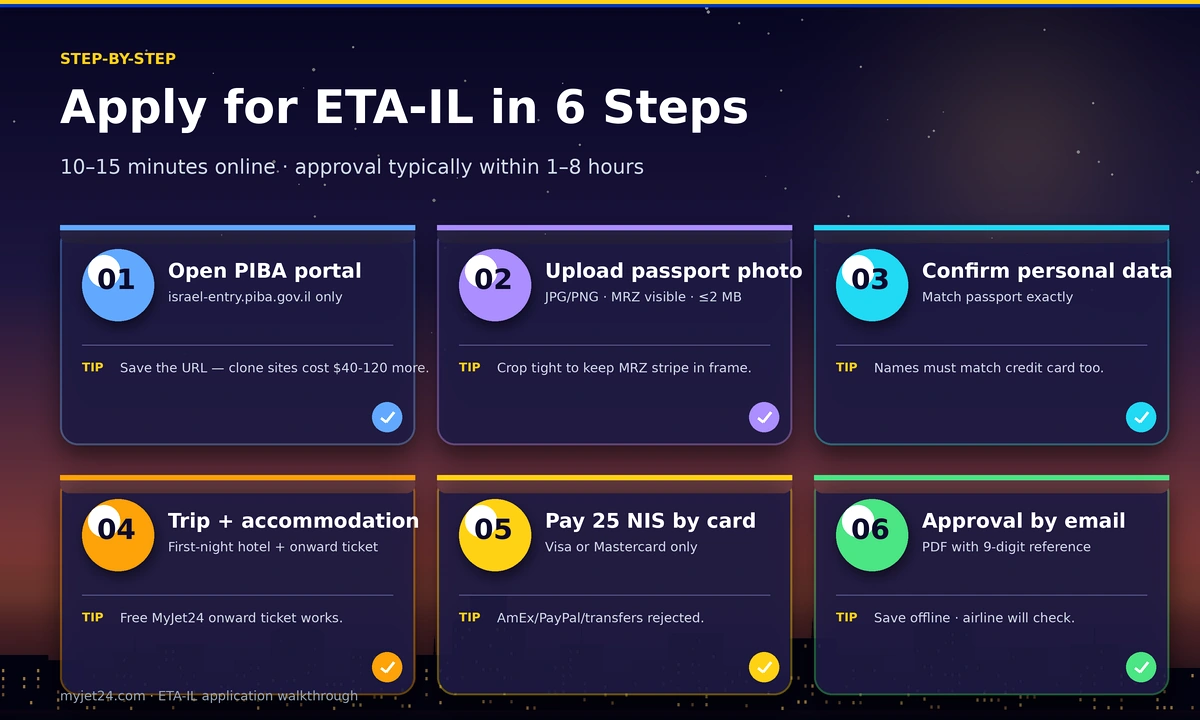
The whole flow takes around 10–15 minutes if your documents are ready. Follow these six steps in order:
- Open the official PIBA portal. The only legitimate URL is https://israel-entry.piba.gov.il/. Many lookalike commercial sites charge a $40–$120 markup; the official fee is fixed at 25 NIS.
- Upload a photo of your passport's bio page. JPG, JPEG, or PNG, maximum 2 MB. The machine-readable zone (MRZ — the two-line stripe of letters and digits at the bottom) must be clearly visible. The system auto-extracts your personal data from the MRZ.
- Confirm or correct your personal details. Names must match the passport exactly, including hyphens, special characters, and middle names. Mistakes here are the single largest cause of ETA-IL refusal.
- Enter your trip details. Planned arrival date, expected duration of stay, and your first night's accommodation address. You must also confirm that you hold proof of onward travel (a return or onward ticket from Israel within 90 days of arrival).
- Pay the 25 NIS fee. Visa or Mastercard only. American Express, Discover, PayPal, and bank transfers are not accepted as of May 2026. The transaction appears on your statement as "PIBA-ETA-IL ISR".
- Wait for the approval e-mail. An approved ETA-IL arrives as a PDF e-mail attachment with a 9-digit reference number. Print it and store the PDF; you will be asked to present either at airline check-in.
"Apply 4–6 days before departure, not 72 hours. The 72-hour PIBA recommendation is the official maximum, not the safe minimum. If your application falls into manual review — for example because of past travel to sanctioned countries — you'll lose the buffer." — MyJet24 traveller advisory, March 2026.
ETA-IL vs Israeli B/2 tourist visa
The ETA-IL replaces the previous "no-paperwork" visa-free entry for eligible nationalities — it does not replace the consular B/2 tourist visa, which remains the route for visa-required nationalities. The table below summarises the differences.
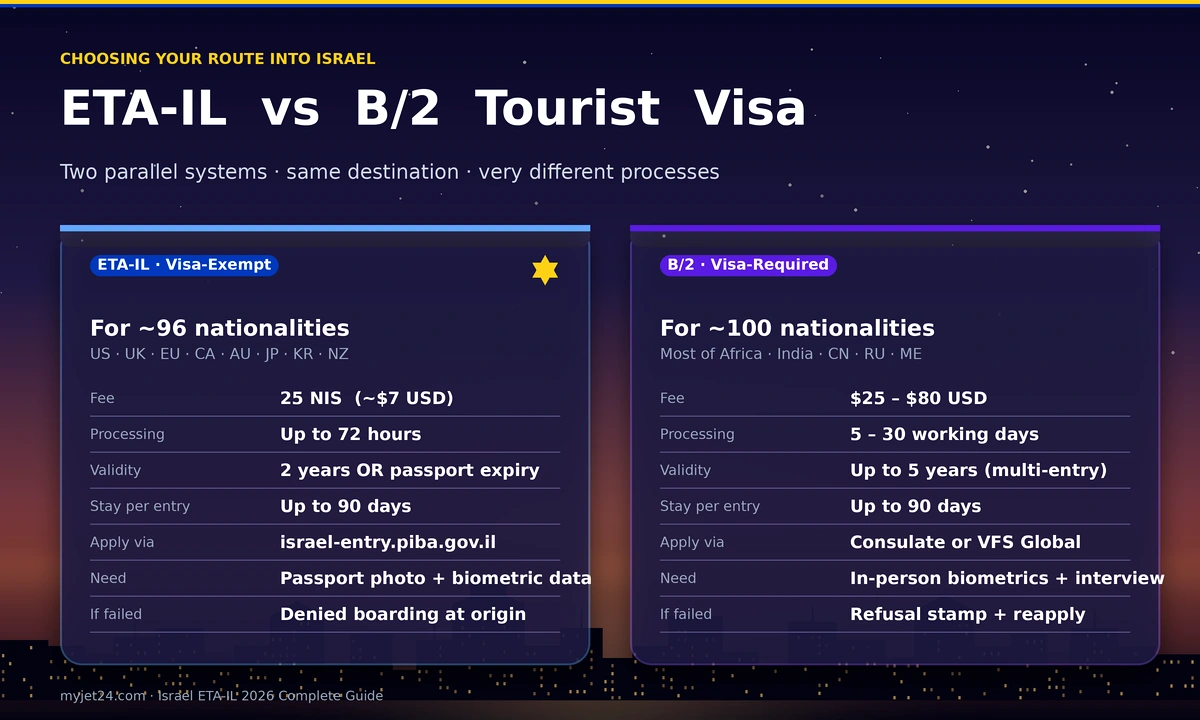
| Feature | ETA-IL (Visa-Exempt) | B/2 Tourist Visa |
|---|---|---|
| Who it covers | ~96 visa-exempt nationalities | ~100 visa-required nationalities |
| Fee | 25 NIS (~$7 USD) | $25–$80 USD + VFS service fee |
| Processing time | Up to 72 hours (often 1–8h) | 5–30 working days |
| Application channel | Online — PIBA portal only | Israeli consulate or VFS Global |
| Biometrics required | No — photo of passport only | Yes — in-person fingerprints |
| Validity | 2 years OR passport expiry | Up to 5 years (multi-entry) |
| Maximum stay per entry | Up to 90 days | Up to 90 days |
| Onward-ticket required | Yes — both at application and at airline check-in | Yes — at consular interview and at airline check-in |
| Border-officer discretion | Retained at TLV arrivals | Retained at TLV arrivals |
Onward-ticket rule: the dual carrier check
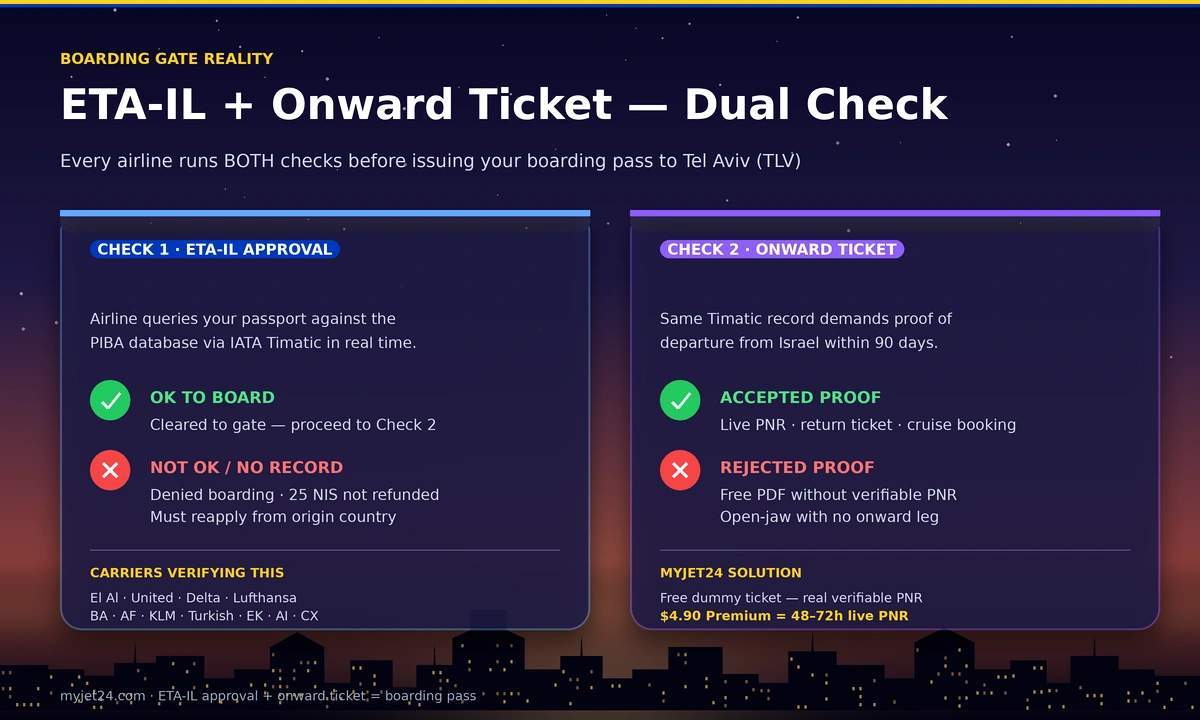
The single biggest misconception about the ETA-IL is that approval means you can board your flight to Tel Aviv. It does not. Every commercial carrier that operates to Ben Gurion Airport runs a two-stage check at the boarding gate:
- ETA-IL approval check. The airline runs your passport number against the PIBA database via the IATA Timatic system. A valid approval returns "OK TO BOARD". A denied or expired ETA-IL returns "NOT OK" and you are denied boarding at the gate.
- Onward-travel proof check. Even with an approved ETA-IL, the carrier must — under the same Timatic record — verify that you hold proof of onward travel out of Israel within 90 days. This is enforced because the carrier is fined under IATA rules if it deposits a passenger Israel cannot legally remove.
The acceptable forms of onward proof are:
- A confirmed return ticket back to your country of origin or residence
- An onward flight ticket to a third country within 90 days of your TLV arrival
- A confirmed cruise itinerary departing Haifa or Ashdod within 90 days
- A live-PNR dummy onward ticket with a verifiable booking reference
What does not work: a free PDF that looks like a flight reservation but contains no verifiable PNR in airline systems. Many free generators produce these, and gate agents check the PNR against Amadeus or Sabre live. If your booking reference does not return a record, you are denied boarding regardless of your ETA-IL status.
How airlines verify ETA-IL at the boarding gate
Every major carrier flying into TLV in 2026 integrates with PIBA via Timatic. The verification protocols differ slightly by airline:
| Airline | ETA-IL check window | Onward-ticket strictness |
|---|---|---|
| El Al (national carrier) | Online check-in 48h before flight | Strict — full Israeli security interview at check-in |
| United, Delta, American | At airport check-in counter | High — both checks before boarding pass |
| Lufthansa, Swiss, Austrian | At online check-in / kiosk | High — auto-block if either missing |
| British Airways, Virgin Atlantic | At airport check-in counter | High |
| Air France, KLM | At online check-in | High |
| Turkish Airlines (transfer carrier) | At Istanbul transit re-check | Medium — denied if TLV-bound |
| Emirates, Etihad, Qatar | At Gulf hub re-check | High — Timatic-integrated |
| Air India, Vistara | At Indian airport check-in | Medium |
| Cathay Pacific | At HKG transfer counter | High |
El Al deserves special mention: as the Israeli flag carrier, it conducts the most thorough pre-flight interview anywhere in commercial aviation. El Al security staff at every overseas departure airport interview every passenger about purpose of travel, accommodation, sponsor (if any), and travel history. An approved ETA-IL number does not shorten this interview — it is a baseline requirement to even start it.
Ben Gurion Airport (TLV) immigration: what to expect
On arrival at Ben Gurion Airport (TLV), passengers proceed to Lev Halayam (Heart of the Sea) immigration hall. Three lanes operate in parallel:
- Green lane (automated) — Israeli passport holders and pre-registered residents. ETA-IL travellers are not eligible for the e-gates as of 2026, though PIBA has signalled rollout in 2027.
- Blue lane (foreign passport) — ETA-IL approved visa-exempt travellers and B/2 visa holders. Officer reviews passport, runs ETA-IL number, asks 3–5 questions (purpose of trip, length of stay, accommodation, whether you have visited Lebanon/Syria/Iran/Iraq/Yemen). Typical processing: 60–90 seconds.
- Red lane (referred) — Anyone flagged by ETA-IL system, by the boarding airline, or by the first-line officer. Includes secondary interview at a separate desk, possible call to the relevant embassy, and luggage check. Wait time: 1–4 hours.
Crucially, Israeli immigration officers in 2026 still do not stamp passports. Instead they issue a blue paper entry slip (formerly called a "B/2 visa slip") that you must retain throughout your stay and produce on departure. Losing this slip can complicate your exit, though it is reissuable on production of your ETA-IL approval.
ETA-IL refusal patterns and reason codes
PIBA does not publish refusal statistics, but airline industry sources and our own client data show approval rates of ~94–96% for first-time applicants from visa-exempt countries. The remaining 4–6% break down roughly as follows:
- ~50% — Data mismatch refusals: passport name does not match credit card name, MRZ unreadable, date of birth typed incorrectly. These are recoverable: correct the data and reapply.
- ~25% — Manual review pending: not a refusal per se, but the application sits in PIBA officer queue for 5–15 working days. Triggers: prior travel to Iran, Iraq, Lebanon, Syria, Yemen, Sudan, Libya, or other sanctioned states; name match against international watchlists; dual nationality with one of those states.
- ~15% — Previous overstay or deportation history: Israel maintains a 5-year record of every prior visa-exempt visitor; overstays or removals trigger automatic refusal.
- ~10% — Documentation failures: passport with less than 3 months validity, expired passport, damaged passport photo upload, missing onward-ticket declaration.
If your ETA-IL is refused, the e-mail includes a four-digit reason code. PIBA does not disclose the full code list, but the most commonly observed codes are: R-301 (data mismatch), R-410 (security review), R-520 (prior overstay), R-601 (passport validity). The refusal is appealable only by lodging a B/2 tourist visa application at an Israeli consulate, which is then evaluated case-by-case.
5 mistakes that delay ETA-IL approval
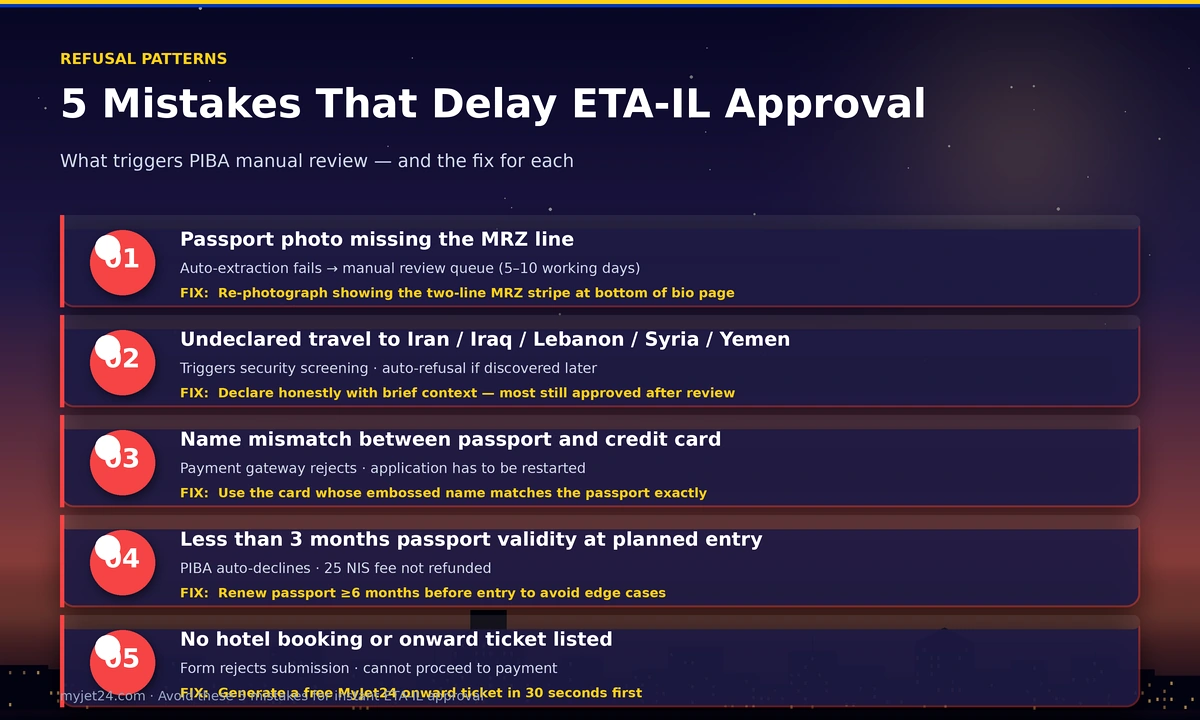
- Passport photo missing the MRZ line. The PIBA system auto-extracts your bio data from the machine-readable zone (the two-line stripe at the very bottom of your passport page). If your photo crops it out, the system fails to parse the data and your application enters manual queue.
- Listing past Iran/Iraq/Lebanon/Syria/Yemen travel without context. The application asks for any travel to specified countries in the past five years. Lying is grounds for automatic refusal and a five-year ban. Be truthful, but add brief context (work, family, transit) in the free-text explanation field.
- Name discrepancy between passport and credit card. The payment gateway runs a name-match check. If your passport reads "JOHN MICHAEL SMITH" and your card reads "J M SMITH", the transaction is auto-declined. Use the card whose embossed or printed name matches the passport closest.
- Less than 3 months passport validity at planned entry date. Israel requires at least 3 months passport validity at the moment of entry. PIBA's system computes this against your declared arrival date and auto-refuses anything shorter.
- No accommodation or onward ticket listed. The application now requires both a confirmed first-night hotel/host address and confirmed onward travel. The form rejects submission if either is blank. Generate a free MyJet24 onward ticket if you have not booked your departure yet.
Special cases: dual nationals, Arab travel history, business travel
Dual nationals
If you hold two passports, the ETA-IL must be issued against the passport you intend to use at the boarding gate and at the TLV immigration desk. A US-Spanish dual national, for example, applies with either passport — but must use the same passport at every checkpoint. Switching mid-trip is grounds for refusal of entry.
Israeli dual nationals are not eligible for the ETA-IL and must travel on their Israeli passport.
Travelers with Lebanese, Syrian, Iraqi, Iranian, or Yemeni stamps
Honest disclosure is essential. PIBA does not automatically refuse travellers with these stamps — many journalists, NGO workers, and academics legitimately visit those countries — but failure to declare leads to refusal, while declaration with brief context typically results in approval after an extended review (5–15 working days). Apply 3 weeks before your trip if you fall into this category.
Business travelers
The ETA-IL covers business meetings, conferences, exhibitions, and trade shows — but not paid employment. If your activities in Israel include direct revenue generation (consulting on Israeli soil, freelance gigs, paid speaking engagements above expense-reimbursement), you need a B/1 work visa, not an ETA-IL.
Cruise passengers
Cruise passengers disembarking at Haifa or Ashdod for shore excursions do require ETA-IL approval. The cruise line typically does not check this on your behalf — your home cruise booking platform redirects you to the PIBA portal.
FAQ
How much does the Israel ETA-IL cost?
The official PIBA fee is 25 NIS, approximately $7 USD or €6.50 at May 2026 exchange rates. Payment is by Visa or Mastercard only. Any commercial site charging more than ~$10 USD is reselling the same government application with an unnecessary markup.
How long does ETA-IL approval take?
PIBA's official maximum is 72 hours. The vast majority of straightforward applications return an approval e-mail within 1 to 8 hours of submission. Applications flagged for manual review (typically because of prior travel to sanctioned states) may take 5 to 15 working days.
Do US citizens need an ETA-IL for Israel?
Yes. From 1 January 2025 every US citizen entering Israel under the visa-exempt programme must hold an approved ETA-IL. The previous practice of arriving with a US passport and receiving a B/2 visa on entry has been discontinued.
Do UK and EU citizens need an ETA-IL?
Yes. UK, Irish, and all EU member-state passport holders are visa-exempt and therefore require ETA-IL approval before boarding any flight to Israel. The system is identical regardless of source country — same 25 NIS fee, same 72-hour processing window.
How long is the ETA-IL valid?
Two years from the date of issue, OR until your passport expires — whichever happens first. If your passport expires in 8 months, your ETA-IL functionally expires in 8 months. Each entry to Israel within the validity window allows a stay of up to 90 days.
Do I need a dummy ticket for the ETA-IL application?
Yes. The application form requires you to declare proof of onward travel. Additionally, the carrier at your departure airport runs a separate Timatic onward-ticket check before issuing your boarding pass. A free MyJet24 flight reservation PDF with a real PNR satisfies both requirements.
Can I extend my stay beyond 90 days?
Yes, but the extension is at the discretion of the PIBA officer at the local Ministry of Interior bureau, not at the airport. Apply in person at least 14 days before your initial 90-day grant expires. Approval is usually 30–60 additional days. Overstaying is logged against your record and almost always blocks future ETA-IL applications.
What happens if my ETA-IL is refused?
There is no formal appeal channel inside the ETA-IL system. Refused applicants must instead lodge a B/2 tourist visa application at an Israeli consulate or VFS Global centre in their country of residence. The consular officer can override an ETA-IL refusal after reviewing supporting documents.
Will Israeli immigration stamp my passport?
No. Since 2013 Israel has not stamped passports of tourists. Entry is recorded electronically and a separate blue paper entry slip is issued. This avoids complicating subsequent travel to countries that refuse entry to passports containing Israeli stamps.
Is the ETA-IL the same as ESTA or the UK ETA?
Functionally similar — they are all pre-arrival electronic travel authorizations for visa-exempt nationalities. The fees, processing times, and validity periods differ. See our guides on the UK ETA and Canada eTA for direct comparisons.
Conclusion & next steps
The Israel ETA-IL is now a permanent fixture of any visa-exempt traveller's Israel itinerary — a $7 pre-flight permit administered by PIBA that filters travellers before they leave home. Approval is usually instant, validity is generous at two years, and the system has matured into a quiet, predictable part of the boarding pipeline.
What does not change with ETA-IL is the dual-check reality at the boarding gate. Carriers like El Al, United, Lufthansa, BA, Air France, KLM, Turkish, Emirates, Qatar, and Air India all run a second Timatic query for onward-ticket proof before issuing your boarding pass. A missing or invalid onward ticket is the single most common reason travellers with valid ETA-IL approvals are denied boarding.
Ready to satisfy the ETA-IL onward-ticket rule?
Generate a free MyJet24 dummy ticket in 30 seconds — accepted at PIBA application and at every airline's TLV boarding gate. Upgrade to the $7.90 premium ticket for a live PNR with 48–72 hour validity that survives extended ETA-IL processing or last-minute itinerary changes.
About the author
James Mitchell is CEO & Founder of MyJet24 and a 14-year aviation industry veteran. He has held senior product roles at two major IATA-registered GDS providers and has personally reviewed over 90,000 dummy ticket transactions involving El Al, Israeli charter carriers, and international airlines flying into Tel Aviv. James writes about visa policy, airline boarding rules, and onward-travel documentation for the MyJet24 editorial team.
Last updated: 21 May 2026 · Next review: 21 August 2026
